


Welcome to Ballot Bulletin: Ballotpedia's Weekly Election Policy Digest. Every Tuesday, we deliver the latest updates on election policy around the country, including nationwide trends and recent legislative activity.
In this week’s edition, we cover 330 bills state legislatures acted on in the last week and look at oral arguments in a U.S. Supreme Court case on Mississippi's absentee ballot return law.
The state of election legislation in the U.S.
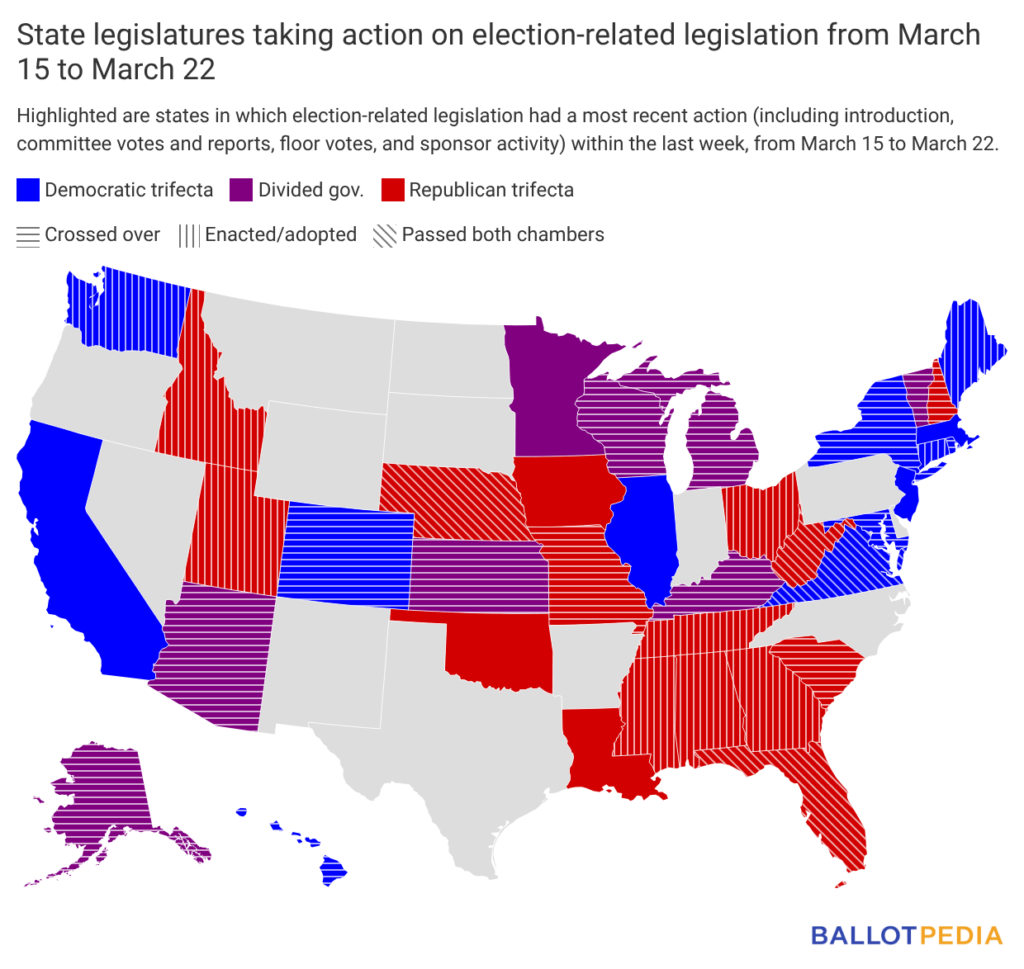
Lawmakers in 37 states acted on 330 election-related bills over the past week. Thirty-four state legislatures are in regular or special sessions. In the last week, 15 bills were enacted, 18 bills passed both chambers of a state legislature, and no bills were vetoed.
Of the bills acted on this week, 97 (29.4%) are in states with Democratic trifectas, 156 (47.3%) are in states with Republican trifectas, and 77 (23.3%) are in states with divided government. The most active bill categories this week were campaign finance (111), election types and stages (76), and ballot measures (68).
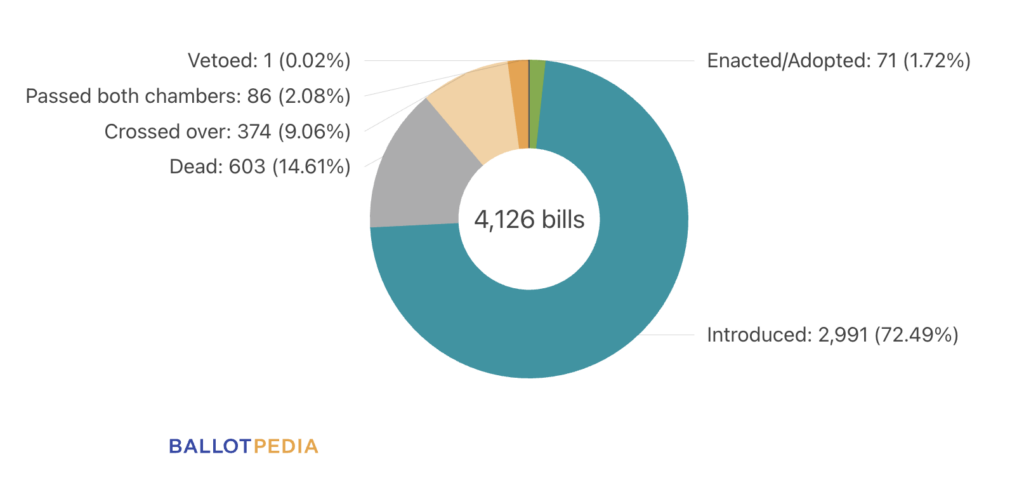
Ballotpedia is currently tracking 4,126 election-related bills across the country. We are actively processing bills filed since March 10 as legislative activity increases for 2026.
The chart below breaks down the status of those 4,126 bills by where they stand in the legislative process:
Note: In some states, legislators can file hundreds of bills per day. We are actively reviewing those bills to determine their relevance to election administration. As a result, during this period of heightened legislative activity, the newsletter may not yet account for all relevant bills introduced in 2026.
Enacted bills
On March 17, Alabama Gov. Kay Ivey (R) signed HB 214 into law. It prohibits foreign nationals from making direct or indirect campaign contributions, donations, or promises of contributions or donations to a state or local candidate, a group involved in a non-candidate election, a state or local political party, a political action committee, or an independent expenditure or electioneering communication. It defines foreign national as any individual who is not a citizen or lawful permanent resident of the United States, as well as any foreign government, political party, group, or business (including a U.S. entity wholly owned by a foreign national unless certain conditions are met).
On March 17, Ohio Gov. Mike DeWine (R) signed SB 63 into law. The bill prohibits elections from being conducted in the state using ranked-choice voting (RCV) or instant runoff voting. It also requires the state to withhold Local Government Fund distributions from municipalities that attempt to authorize the use of either of these voting methods. With the enactment of SB 63, Ohio is the 19th state to ban ranked-choice voting. Read more about Ohio’s RCV ban here.
On March 19, Mississippi Gov. Tate Reeves (R) signed HB 908 into law. If the U.S. Supreme Court overturns Mississippi’s mail-in ballot law, HB 908 would require mail-in ballots to be received the day before an election (rather than up to five days after an election if they were postmarked on or before the election). For the changes to take effect, the state attorney general would have to determine whether a U.S. Supreme Court decision meets the criteria stated in the bill. Read more about oral arguments in Watson v. Republican National Committee below in this week’s policy spotlight.
Twelve other bills were enacted this week. They are:
- Connecticut (Democratic trifecta)
- Georgia (Republican trifecta)
- Idaho (Republican trifecta)
- Maine (Democratic trifecta)
- Mississippi (Republican trifecta)
- Tennessee (Republican trifecta)
- Utah (Republican trifecta)
- Washington (Democratic trifecta)
Bills passing both chambers
Eighteen bills passed both chambers this week. They are:
- Florida (Republican trifecta)
- Maine (Democratic trifecta)
- Mississippi (Republican trifecta)
- Nebraska (Republican trifecta)
- Tennessee (Republican trifecta)
- Utah (Republican trifecta)
- Virginia (Democratic trifecta)
- West Virginia (Republican trifecta)
To see a full list of bills awaiting gubernatorial action, click here.
Vetoed bills
No election-related bills we are following were vetoed in the past week. For a list of all vetoed bills, click here.
All bills
The chart below shows all bills Ballotpedia is currently tracking, broken down by partisan sponsorship:
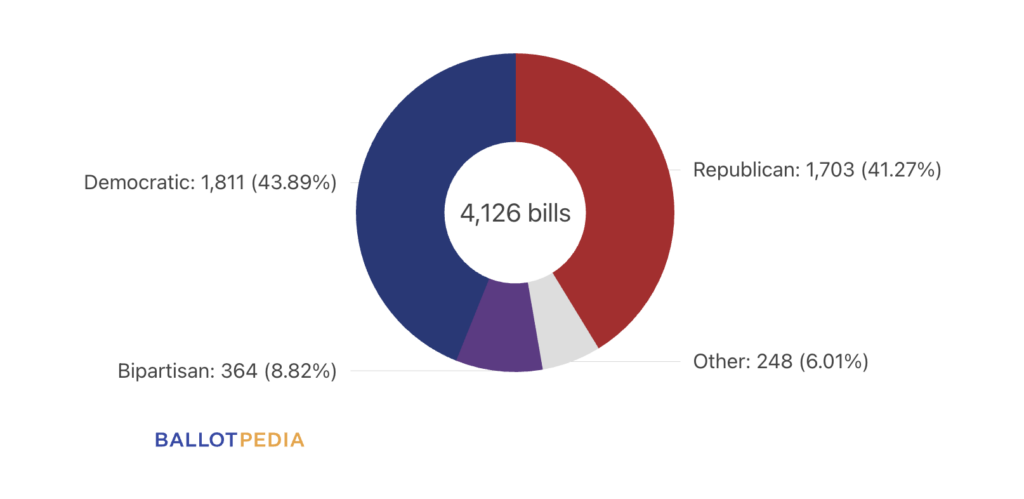
We are currently following 4,126 election-related bills, including bills carried over from the previous year.
- Trifecta status
- Democratic: 1,803 (43.7%)
- Republican: 1,503 (36.4%)
- Divided: 820 (19.9%)
- Partisan sponsorship
- Democratic: 1,811 (43.9%)
- Republican: 1,703 (41.3%)
- Bipartisan: 364 (8.8%)
- Other: 248 (6%)
In the news
On March 19, the Alabama House passed HB 541 — known as the Safeguard Alabama Voter Engagement (SAVE) Act — 63-35, sending it to the state Senate. The bill would move Alabama from an open primary system to a closed one. Specifically, it would require voters to register with a political party at least 60 days before that party’s primary in order to participate. It would also prohibit them from voting a different party’s ballot in a primary or runoff.
The bill’s supporters say that moving to a closed primary system will ensure that a party’s nominee for office more closely represents the general will of party members. They also say that because the bill allows voters to switch party registrations as long as they do so two months before the primary, voters would still be able to choose which primary to vote in.
Opponents of the bill say that because the state funds elections, moving to closed primaries would unfairly require the state to fund intraparty contests, which would exclude unaffiliated voters and voters registered with other parties. They also say that crossover voting is not a significant enough issue to justify changing the way Alabama conducts its partisan primaries.
Read more about different types of primary elections across the states here.
Here are other news stories from across the country:
- On March 20, Maricopa County Recorder Justin Heap (R) announced plans to report individuals suspected of being noncitizens flagged using a database from the Department of Homeland Security for prosecution and change their voter registration status. In a letter to Arizona Secretary of State Adrian Fontes (D), Heap said that the move was necessary to maintain the accuracy of voter rolls. Critics said that Heap is not following the correct procedure for removing noncitizens from voter rolls, which is outlined in existing state law.
- On March 17, Alaska Lt. Gov. Nancy Dahlstrom (R) announced that a ballot measure to specify that only U.S. citizens may vote in any election has collected enough valid signatures to make the ballot this year. If the Legislature adjourns by April 20, the measure will be put to voters in the Aug. 20 primary election. Otherwise, it will appear on the Nov. 3 general election ballot. Supporters say that the measure is necessary to clarify existing law, while opponents say that it incorrectly suggests that noncitizens are currently able to vote in Alaska elections.
- On March 23, organizers in Missouri announced that they have gathered enough signatures for a measure to place a veto referendum on Missouri’s newly adopted congressional districts to appear on the ballot in November. While laws in Missouri challenged in a referendum generally do not go into effect until after the vote, a Cole County judge was asked last month to consider whether this applies to redistricting laws.
Policy spotlight: U.S. Supreme Court hears oral arguments on legality of Mississippi's absentee ballot return law
The story below is adapted from a recent Ballotpedia News story by Andrew Bahl.
The U.S. Supreme Court heard oral arguments on March 23 in Watson v. Republican National Committee, a case challenging the legality of a Mississippi law that allows absentee ballots postmarked by Election Day to be counted if they are received up to five business days after the election.
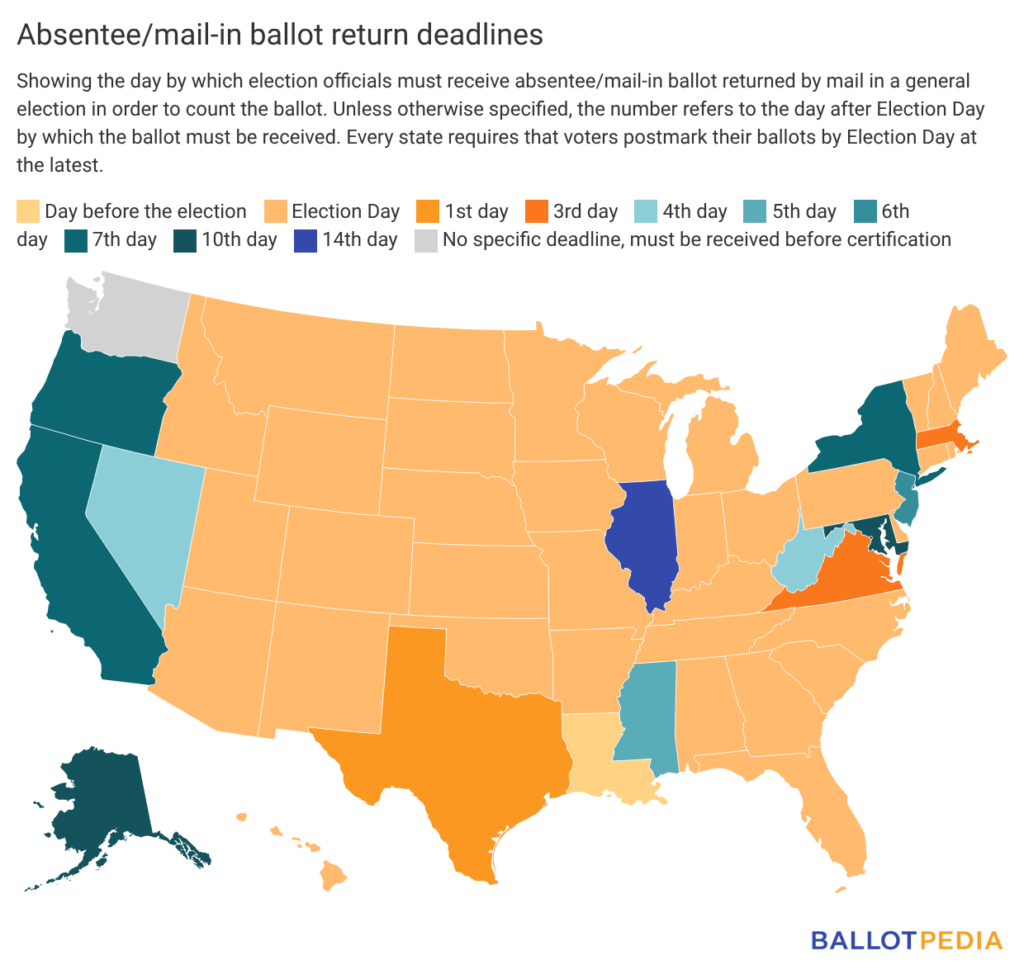
Mississippi is one of 14 states that allow absentee/mail-in ballots postmarked by Election Day to be counted if they arrive within a set period of time after the election. The state passed a law allowing for a five-day grace period in 2020. Most states, including Mississippi, also allow at least some absentee/mail-in ballots from military or overseas voters to be counted if they arrive after Election Day.
The Supreme Court agreed to hear Watson v. Republican National Committee in November, after a federal appeals court ruled that federal statutes preempts Mississippi’s law. The Republican National Committee, the Mississippi Republican Party, the Libertarian Party of Mississippi, George County Election Commissioner Matthew Lamb, and former Hinds County Republican Party Chair James Perry challenged the law in 2024.
The U.S. District Court for the Southern District of Mississippi ruled in favor of the state in July 2024. Plaintiffs appealed to the U.S. Court of Appeals for the Fifth Circuit, where a three-judge panel in October 2024 held that Mississippi's statute was unlawful and ordered the case be sent back to the district court. Mississippi then appealed to the U.S. Supreme Court.
In oral arguments on March 23 before the U.S. Supreme Court, what constitutes “Election Day” and what counts as voters making their final ballot decisions were at the heart of both parties’ arguments.
U.S. Solicitor General D. John Sauer said that “Mississippi’s theory of election is so general and permissive that it would authorize statutes that Congress could not possibly have approved in the 19th century.” He also argued that “official receipt is at the definitional heart of election,” meaning that a ballot that can be received after Election Day should not count as a vote being made on or by Election Day.
Mississippi Solicitor General Scott Stewart said that “states have broad power over elections” and that Congress has respected that power to extend to mail-in ballot receipt deadlines until now. Rather than using the receipt of ballots on Election Day as the standard for the acceptability of those votes, Stewart argued, “the expression by qualified electors of their choice of candidates” by Election Day should be the rule.
Opponents of the Mississippi law have asked the Supreme Court to uphold the appeals court ruling, and say that federal law establishes a uniform, national Election Day for congressional and presidential elections.
"The Fifth Circuit rightly held that the 'day for the election' has a fixed meaning," attorneys for the RNC and three other plaintiffs wrote in a brief. "It doesn’t mean whatever each State wants it to mean. It means the day by which ballots must be 'received by state officials.'"
Supporters of the law, including Mississippi Secretary of State Michael Watson (R), say Mississippi’s statutory requirement that ballots be postmarked by Election Day complies with federal law.
"[T]he federal election-day statutes require only that the voters cast their ballots by election day," Mississippi Attorney General Lynn Fitch’s (R) office wrote. "The election has then occurred, even if election officials do not receive all ballots by that day."
In 2025, four states — Kansas, North Dakota, Ohio, and Utah — passed laws requiring absentee/mail-in ballots to be received by the close of polls on Election Day.
Previously, Kansas required ballots to be received by the end of business on the third day following the election, Ohio counted ballots if they arrived within four days after the election, Utah required ballots to be received by noon on the day of the canvass, and North Dakota did not have a specific deadline in statute.
So far this year, lawmakers in 22 states have introduced or carried over from the 2025 session 58 bills related to absentee/mail-in voting deadlines. Legislators in five states — Alaska, Illinois, New Jersey, New York, and West Virginia — have introduced bills requiring absentee/mail-in ballots to be received by the close of polls on Election Day. Illinois, New Jersey, and New York have Democratic trifectas, West Virginia has a Republican trifecta, and Alaska has a divided government.
West Virginia HB 4600, which ends the state’s current four-day grace period for absentee ballots and requires ballots to be received by 8 p.m. on Election Day, passed the House of Delegates on a 79-17 vote on Feb. 10. Seventy-nine Republicans voted in support of the bill, while eight Democrats and nine Republicans voted in opposition. The bill died in the state Senate.