

Welcome to Hall Pass, a newsletter written to keep you plugged into the conversations driving school board governance, the politics surrounding it, and education policy.
In today’s edition, you’ll find:
- On the issues: The debate over verifying students’ immigration status
- School board filing deadlines, election results, and recall certifications
- U.S. House committee advances bipartisan science of reading bill
- Extracurricular: education news from around the web
- Candidate Connection survey
Reply to this email to share reactions or story ideas!
On the issues: The debate over verifying students’ immigration status
In this section, we curate reporting, analysis, and commentary on the issues school board members deliberate when they set out to offer the best education possible in their district. Missed an issue? Click here to see the previous education debates we’ve covered.
A bill before the Tennessee General Assembly would require K-12 public and charter schools to verify students’ citizenship or immigration status and share that data with the Tennessee Department of Education.
On March 16, 2026, the Tennessee House voted 70-25 to pass SB 836, with Republicans supporting and Democrats opposed. The Tennessee Senate passed SB 836 in 2025, but it will now need to take another vote because the House removed a provision that would have allowed schools to bar noncitizen students from enrolling in classes.
State Sen. Bo Watson (R), who sponsored SB 836, said, “Since the Plyler decision deprived the state of having this legislative debate, we have been mandated or forced to pay that additional cost without consideration.” House Majority Leader William Lamberth (R) said, “We should never be afraid of data, truth, facts, figures. I mean how many illegal immigrant children are in our schools?”
In 1982, the U.S. Supreme Court ruled 5-4 in Plyler v. Do that states cannot withhold funding from K-12 public schools that enroll children residing in the country without legal permission.
Tennessee has a Republican trifecta.
Below are two perspectives on whether public schools should be required to verify public school students’ immigration status.
Corey DeAngelis, a research fellow with the Heritage Foundation and author of The Parent Revolution: Rescuing Your Kids from the Radicals Ruining Our Schools, says schools should, at a minimum, collect data on noncitizen students. However, he says lawmakers should go farther and deny those students access to public education because states have an obligation to prioritize citizens. DeAngelis identifies Plyler as the source of the problem, saying the ruling has burdened public schools and encouraged unlawful immigration.
Alexza Barajas Clark, the executive director of EdTrust-Tennessee, defends Plyler and says laws requiring schools to verify students’ immigration status will create an atmosphere of fear among immigrant children and their parents. Clark says the requirement would burden citizen and noncitizen families alike with finding and presenting official documents, and that schools will need to redirect resources from teachers to administrators tasked with complying with the laws.
Overturning an outlandish Supreme Court ruling is the only way to fix education | Corey DeAngelis, Fox News
“Critics of these efforts often invoke compassion, arguing that denying education harms innocent children. Yet the real harm stems from policies that encourage illegal entry by promising free services, perpetuating a cycle of dependency and straining resources meant for legal residents.
“States like Tennessee invest billions in education to foster opportunity, but that promise erodes when funds are spread thinner to accommodate those who bypassed the system. Overturning Plyler would restore fairness, allowing states to focus on their own communities without apology.
“The fiscal implications demand attention. Nationwide, educating illegal immigrant students costs billions annually, with estimates varying by state but consistently revealing a disproportionate load on taxpayers.”
How two new TN bills threaten entire school communities | Alexza Barajas Clark, The Tennessean
“Collecting and reporting the immigration status of every student pulls schools away from their core mission: educating children. Staff will need dedicated time and professional development funds to understand the intricacies of more than 185 visa categories, each with varying durations.
“They will then have to learn how to collect, verify and report the documentation students present. Tennessee's more than 106,000 English learners may mean that some districts will also need to translate and communicate this system to families in their home languages, piling onto school staff who are already stretched thin serving nearly 1 million students across the state.
“Every dollar spent on compliance is a dollar not spent in the classroom. Every hour a school administrator spends on paperwork is an hour they are not supporting the students who need them most. Our teachers and school staff should be focused on educating students, not training to become immigration lawyers.”
School board update: filing deadlines, election results, and recall certifications
In 2026, Ballotpedia will cover elections for more than 30,000 school board seats. We’re expanding our coverage each year with our eye on covering the country’s more than 80,000 school board seats.
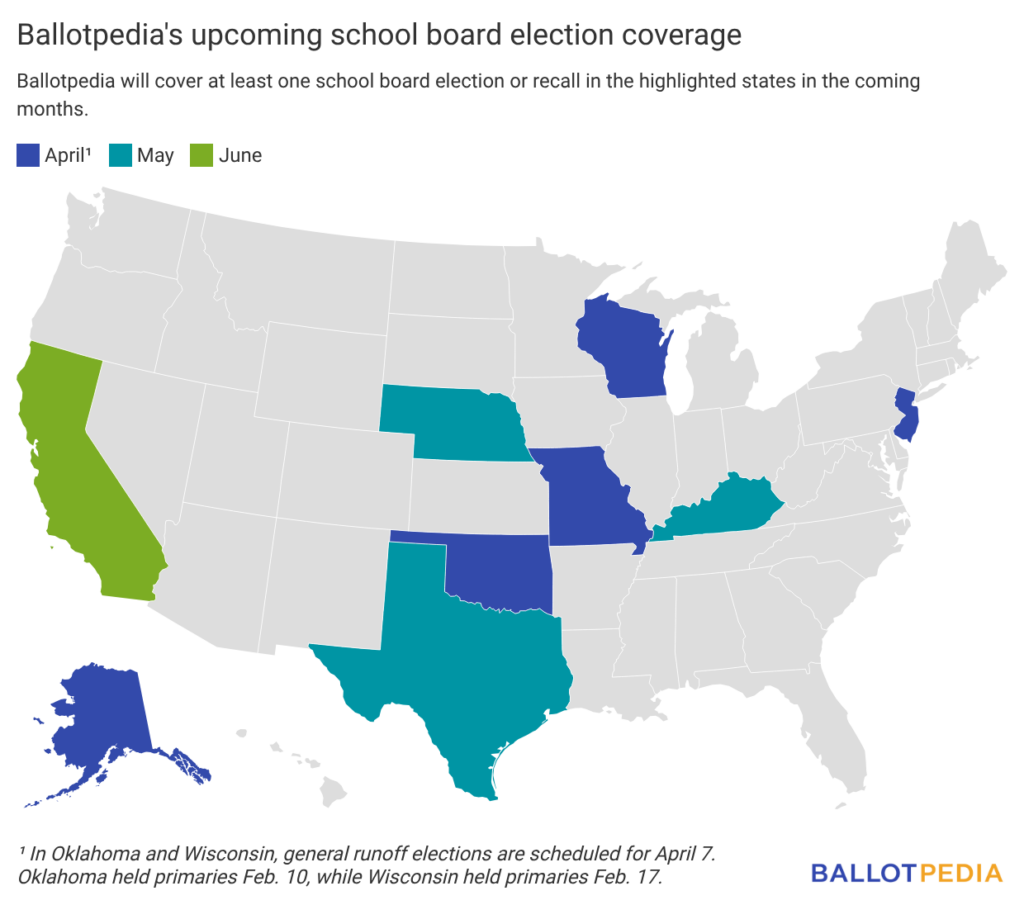
Click here to learn more about school board elections.
U.S. House committee advances bipartisan science of reading bill
When it comes to efforts to improve literacy instruction in K-12 public schools, states have been busy. Since 2013, nearly every state in the country has passed one or more laws intending to strengthen how public schools teach reading. Many of those laws reference the science of reading, a prominent, broadly phonics-based approach to literacy instruction.
Now, a bill is moving through Congress that would establish the science of reading in federal education law.
On March 17, the House Committee on Education and Workforce voted 33-0 to advance HR 7890, the “Science of Reading Act of 2026.” The bill would require an existing federal grant program to prioritize funding for literacy instruction aligned with the science of reading and prohibit federal education dollars from supporting three-cueing, an alternative approach to reading instruction.
What is the science of reading?
There’s no precise definition of the science of reading. Broadly speaking, the science of reading refers to instructional practices rooted in phonics and vocabulary development that advocates say reflect how the brain learns to read.
HR 7890 defines the science of reading as “an interdisciplinary body of evidence-based research about reading and issues related to reading and writing that (A) identifies instruction in phonemic awareness, phonics, vocabulary, fluency, comprehension, and writing as essential components to skilled reading; (B) demonstrates the importance of background knowledge, oral language, the connection between reading and writing, and strong writing instruction; (C) explains why some students have difficulty with reading and writing.”
The phonics-based approach to literacy instruction, in which children are taught to sound out and decode words, contrasts with approaches like whole language, which emphasizes the context in which readers encounter words. According to public school educator and former school board member Bob Peterson, who supports the whole language approach, “Linguists and child psychologists say infants learn language through using it, not by being drilled in its separate parts. Similarly, whole language proponents argue that children best develop their language skills – reading, writing, speaking and listening — through reading, writing, speaking and listening.” The whole language approach is closely associated with the three-cueing system, which encourages young readers to use meaning, sentence structure, and visual letter cues to identify unfamiliar words.
The dominant approach to literacy instruction in public schools — phonics-related, whole language, and balanced literacy, which sought to blend the two — has fluctuated throughout the 20th century and into the 21st in what some have styled “the reading wars.”
Here’s what the Science of Reading Act of 2026 would do
The Science of Reading Act of 2026 would amend the Elementary and Secondary Education Act of 1965 to restrict Comprehensive Literacy State Development grants to state literacy programs that align with the science of reading, and require states in their applications to explain to what extent their programs reflect that approach. The bill would also prohibit grants to programs that use the three-cueing system. At least eight states have enacted legislation prohibiting three-cueing in their reading curricula since 2021.
Committee on Education and Workforce member Erin Houchin (R) said, “The Science of Reading Act gets us back to the basics and ensures our classrooms are equipped with the proven, phonics-based methods to effectively teach all students to read.” U.S. Rep. Lucy McBath (D) said, “When implemented correctly, the science of reading has been proven to help children learn to read and to write more effectively.”
HR 7890 now goes before the full House for consideration.
Which states have passed science of reading laws?
According to Whiteboard Advisors, an education research and consulting firm, 44 states and D.C. have passed one or more laws to improve K-12 literacy instruction since 2010, when Arizona enacted its Move on When Reading law designed to support struggling K-3 readers. The release of the 2024 National Assessment of Educational Progress (NAEP) results, which showed that average third- and eighth-grade reading scores had been on a downward slide since before the COVID-19 pandemic, prompted state lawmakers to take a greater interest in the science of reading and literacy instruction.
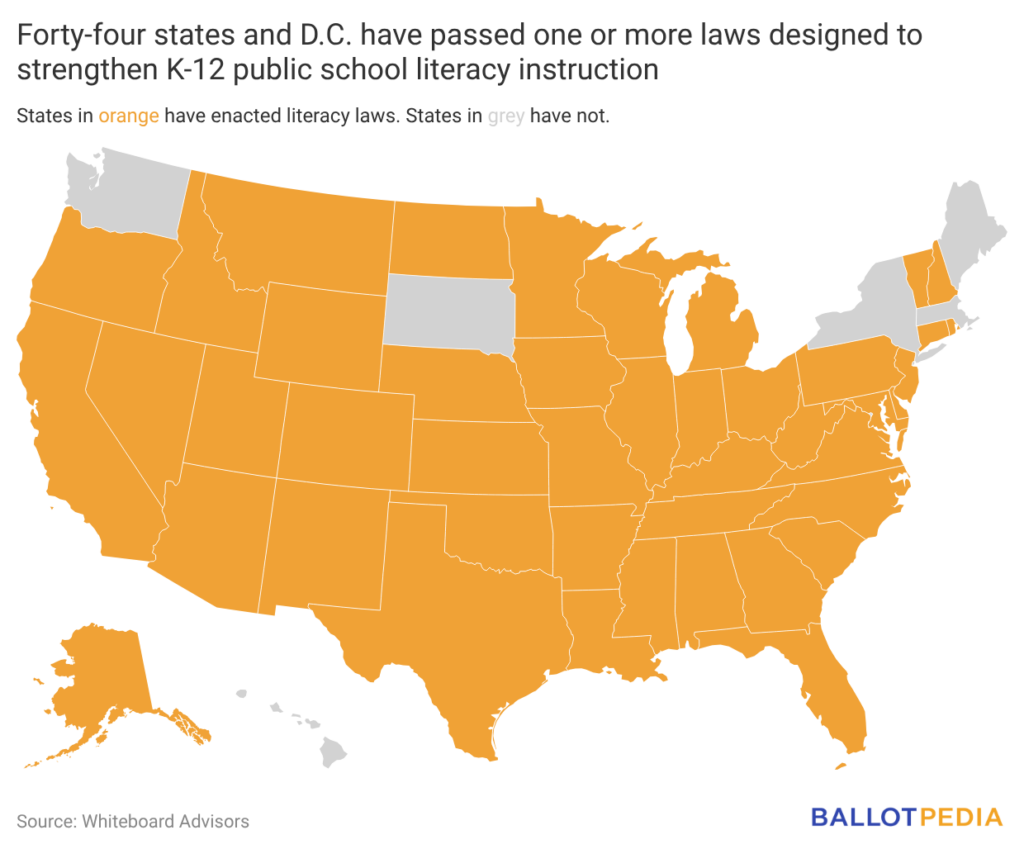
A few states have enacted laws on literacy instruction in 2026, as we noted in the March 18 edition of Hall Pass. New Mexico Gov. Michelle Lujan Grisham (D) signed SB 37, the “High Quality Literacy Act,” on March 9, requiring research-based literacy curriculum for K-3 graders and earmarking $14 million for low-performing schools to hire literacy coaches. Utah Gov. Spencer Cox (R) signed HB 241 on March 18, establishing, among other things, a goal of getting at least 80% of students to score proficient on the state’s year-end benchmark assessment by 2030.
In October 2025, California, which is home to more public school students than any other state in the country, enacted a comprehensive literacy law. AB 1454 directs the California State Board of Education to adopt reading curricula for K-8 students that includes “explicit and systematic instruction in print concepts, phonological awareness, phonics and word recognition, and fluency and attending to oral and written language development, vocabulary and background knowledge, and comprehension…”
What is the debate over the science of reading?
Proponents say that instructional approaches based in the science of reading have been shown to improve students’ reading scores. Kymyona Burk, a senior policy fellow at the Foundation for Excellence in Education and the former literacy director at the Mississippi Department of Education, says that “neuroscientists using functional MRI scans showed the section of the brain dealing with language was significantly more active in young students learning to read through a phonetic-based curriculum than in kids who were taught by three-cueing methods.”
Proponents often point to Mississippi and Louisiana, which have made significant reforms to their literacy programs over the last decade and a half. In 2013, when Mississippi was ranked 49th in the country in fourth-grade reading proficiency, Gov. Phil Bryant (R) signed a law requiring that teachers receive literacy training rooted in the science of reading and mandating that third-grade students who did not achieve a certain score or higher on the state’s reading exam repeat the grade. In 2024, Mississippi fourth-graders ranked ninth in reading proficiency.
Louisiana was the only state where average fourth-grade NAEP reading scores increased between 2019 and 2024.
The science of reading approach has its critics.
Furman University education professor Paul Thomas has attributed the political success of the science of reading to advocates’ willingness to present it as a panacea. Thomas writes that “[T]he current science of reading reform movement has not served reading policy decisions well because advocates and commercial vendors often exaggerate and oversimplify both the problems and solutions around reading achievement and instruction.” Thomas says the crisis of literacy is overstated, and that the real problem is poverty and an unequal distribution of resources. Freddie DeBoer, author of The Cult of Smart: How Our Broken Education System Perpetuates Social Injustice, says that while phonics can be an important component of literacy instruction, science of reading advocates place too much emphasis on it. DeBoer says that “when students fail to learn to read, people blame teachers or schools for improper implementation of phonics, rather than acknowledge that phonics can’t do everything, especially under resource constraints.”
Some science of reading critics have said they force teachers to adhere to a one-size-fits-all approach that might not work for all students. Julie Hines-Lyman, a reading specialist in Chicago Public Schools, told the National Education Association (NEA), the country’s largest teachers union, that “It was not about teaching the students any longer, it was about teaching the curriculum. It took away individualization and asked teachers to kind of teach all students the same thing, regardless of their ability to access what was being taught.”
In 2023, Hall Pass ran a four-part deep dive into the debate around the science of reading. Click to read parts one, two, three, and four.
Extracurricular: education news from around the web
This section contains links to recent education-related articles from around the internet. If you know of a story we should be reading, reply to this email to share it with us!
- This small West Philly school is mostly full and outperforms its peers. The Philadelphia School District is trying to close it — again. | The Philadelphia Inquirer
- Gov. Kevin Stitt orders review of Oklahoma public school spending | News On 6
- Gretchen Whitmer’s failed literacy test | The Washington Post
- SC charter schools take on high-risk debt, banking on growth. When things go wrong, students suffer. | The Post and Courier
- Ed tech is not the answer or the problem | Slow Boring
- In Deep-Red Idaho, a Republican Rift Over Schools and ‘Parental Choice’ | The New York Times
Take our Candidate Connection survey to reach voters in your district
Today, we’re looking at responses from candidates running in the June 23 primary for two seats on the Baltimore City Public Schools Board of Commissioners. The Baltimore City Public School System is the third largest district in Maryland, with roughly 76,000 students. The general election is Nov. 3.
Glenn Schatz’s career experience includes working as a vice president of community engagement, a chief revenue officer, and a program manager. Here’s how Schatz answered the question, “What are the main points you want voters to remember about your goals for your time in office?”

- “Safe buildings and reliable transportation aren't amenities – they're preconditions for learning. HVAC that works, dry roofs, safe water, buses that show up on time: these are basics that every child deserves and that a competent board can actually deliver. I'll bring the same operational discipline I use to run large-scale field programs to fixing the fundamentals City Schools has deferred for too long.
- Baltimore City Schools spends $2 billion a year serving 75,000 students. That demands transparency. Not just audits, but plain-language dashboards showing what's working, what isn't, and what's being done about it. I will push for public, school-by-school reporting on facilities, transportation, and after-school access. If something isn't working, the public should know first, not last.
- I'm a parent, not a politician. I'm not using this seat as a steppingstone to anything else. My sole focus is removing the friction that keeps teachers from teaching and students from learning – transportation barriers, crumbling buildings, inadequate after-school options. I respect teachers and will work in partnership with them. This campaign is about execution and accountability, not ideology or ambition.”
Click here to read the rest of Schatz’s responses.
Ashley Esposito’s career experience includes working as a database developer, painter, and photographer. Here’s how she answered the question, “What are the main points you want voters to remember about your goals for your time in office?”
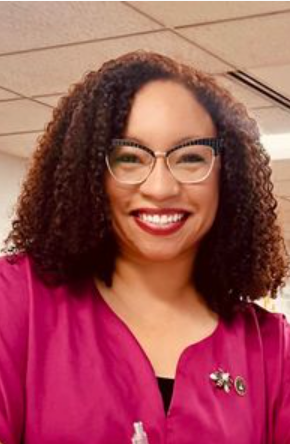
- “Our kids are the center of our community. Schools should show the strengths of our neighborhoods. That means safe and welcoming spaces where families feel included and kids have a voice. Trust comes from being open, listening to parents, and supporting teachers so they can do their best. Schools should also celebrate culture, art, and help keep buildings healthy and safe. As a City Schools parent, I know how important it is to feel heard. Strong schools mean strong neighborhoods, and that lifts all of Baltimore.
- Accessibility means every child and family can take part fully in school. It means giving early help to kids who need it, making sure special education works, and supporting families who speak different languages. It also means fixing buses so kids can get to school safely and on time. Every student should have the chance to take advanced classes, join arts, and get mental health support. Teachers need tools and training to meet student needs. I know from my own struggles that real support helps kids succeed.
- Educational equity means every child gets what they need to do well. It starts with reading, math, and early support for kids who fall behind. It also means fair access to good high schools, safe buildings, and strong arts programs. Kids need help with mental health, safe spaces, and healthy school environments. Families should be part of decisions and see how money is spent. Teachers need support to stay in our schools. When kids and families are part of the process, schools work better for everyone.”
Click here to read the rest of Esposito’s responses.
As a reminder, if you're a school board candidate or incumbent planning to run this year, click here to take the survey. If you complete the survey, your answers will appear in your Ballotpedia profile. Your responses will also appear in our sample ballot. If there is an election in your community, share the link with your candidates and urge them to take the survey!