


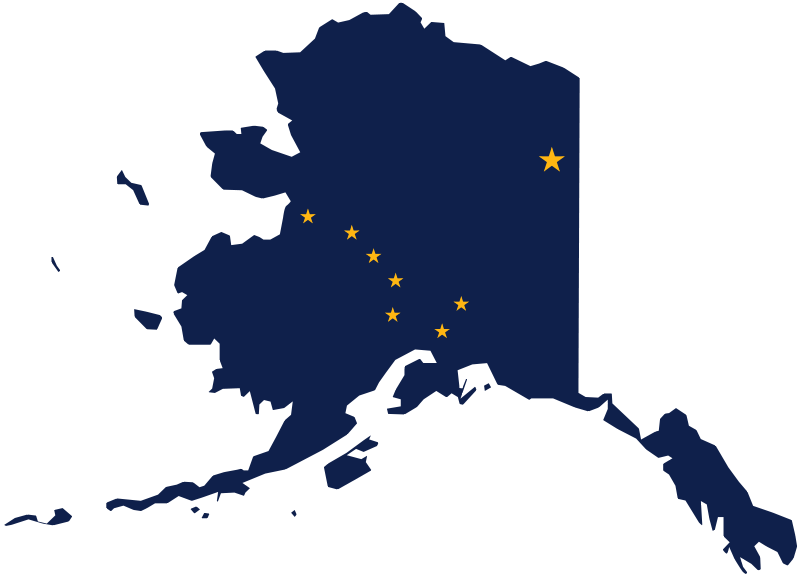
Voters in Alaska will decide on a ballot initiative designed to prohibit noncitizens from voting in 2026, unless the legislature approves substantially similar legislation during its upcoming session.
Lt. Gov. Nancy Dahlstrom announced that officials verified 34,944 qualified signatures across 40 house districts on March 17, 2026. This exceeds the required minimum of 34,098 qualified signatures across 30 house districts.
In Alaska, a ballot initiative appears on the ballot at the first statewide election held at least 120 days after the legislature adjourns its session. The legislature could approve legislation that is "substantially the same as the proposed law," rendering the initiative void. The legislative session is expected to begin Jan. 20 and adjourn May 20. If the legislature instead adjourned one month earlier, on April 20, the initiative would be eligible to appear on the August 18, 2026, primary ballot. Otherwise, it would appear on the November 3, 2026, general election ballot.
Currently, Alaska law reads: "A person may vote at any election who is a citizen of the United States." Under this initiative, the law would read, "Only a person who is a citizen of the United States … may vote at any election."
Alaskans for Citizen Voting, the campaign supporting the initiative, said, “Across America, a small but growing number of cities and jurisdictions have authorized noncitizen voting in local contests, spawning lawsuits and sowing public distrust. Alaskans don’t need to import chaos or invite activist reinterpretations of settled norms. With ranked choice voting and other reforms already testing public patience, a bright-line rule about who gets a ballot is a stabilizing safeguard."
Stan Jones, an Alaska journalist speaking out against the initiative, said, “Alaska already requires voters to be U.S. citizens. Election officials enforce that rule. There is no bill in Juneau proposing to change it, no court case challenging it, and no Alaska municipality contemplating noncitizen voting. Nothing in our election history or law suggests that the state’s citizenship requirement is under threat. Which raises the real question: if there’s no problem to solve, what is this measure actually for? The answer has everything to do with election politics."
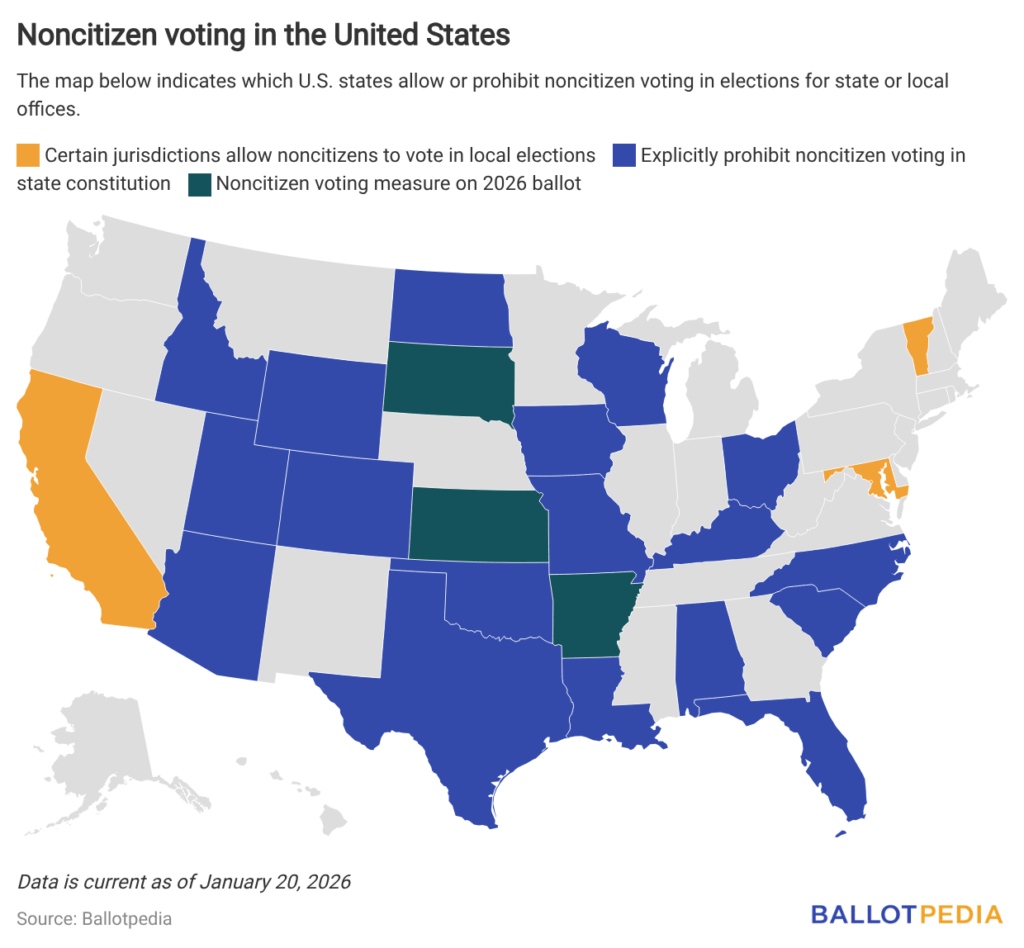
In 2026, four other states—Arkansas, Kansas, South Dakota, and West Virginia—will be deciding ballot measures to prohibit noncitizen voting, while potential measures could make the ballot in Arizona and Michigan. However, the Alaska initiative is the only initiated state statute of these, which amends state law, while the other 2026 measures are constitutional amendments.
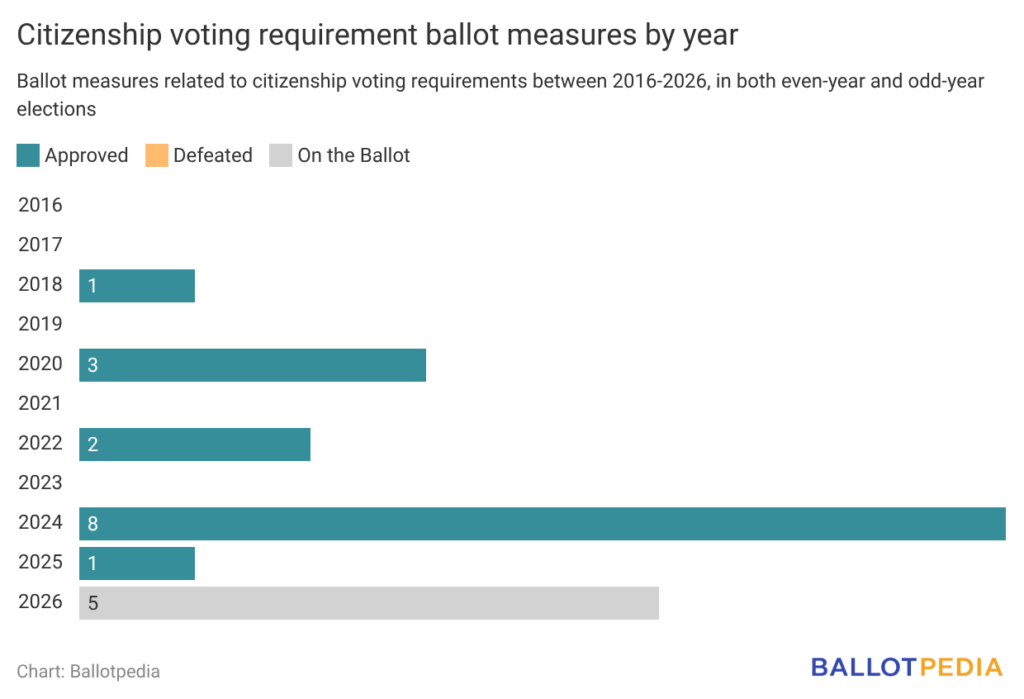
From 2018 to 2025, voters approved 15 ballot measures adding language about citizenship requirements for voting. In 2024, eight statewide measures to prohibit noncitizen voting were approved by voters—the greatest number of noncitizen-voting-related measures to appear on statewide ballots in any election year.
In 1996, the U.S. Congress passed a law prohibiting noncitizens from voting in federal elections, including those for the U.S. House, the U.S. Senate, and the presidency. This law does not apply to elections for state and local offices. Every state requires voters to attest that they are U.S. citizens when registering to vote.
While no state constitution explicitly allowed noncitizens to vote in the state or local elections, some states have jurisdictions that allow noncitizens to vote in some or all local elections. The District of Columbia and certain municipalities in California, Maryland, and Vermont allow noncitizens to vote in some or all local elections. Meanwhile, 18 states include language explicitly prohibiting noncitizen voting in their state constitutions.
This is the third citizen initiative to qualify for the ballot in Alaska. An initiative that would establish new campaign contribution limits for campaigns for state and local office has already been certified for the ballot. Another initiative that would repeal the top-four ranked-choice voting (RCV) system in the state has qualified for the ballot, and will be certified unless the legislature approves a comparable amendment.