


Welcome to Hall Pass, a newsletter written to keep you plugged into the conversations driving school board governance, the politics surrounding it, and education policy.
In today’s edition, you’ll find:
- On the issues: The debate over the role students should play on school boards
- School board filing deadlines, election results, and recall certifications
- The San Francisco Unified School District Board readopts policy allowing eighth graders to take Algebra 1
- Extracurricular: education news from around the web
- Candidate Connection survey
Reply to this email to share reactions or story ideas!
On the issues: The debate over the role students should play on school boards
In this section, we curate reporting, analysis, and commentary on the issues school board members deliberate when they set out to offer the best education possible in their district. Missed an issue? Click here to see the previous education debates we’ve covered.
According to a 2020 National School Boards Association study, at least 33 states allow students to serve on local school boards, with California and Massachusetts mandating that boards have student members under certain circumstances. The study found that among those states whose data was captured in the survey, 14% of school boards had student members who were either elected or appointed.
Student school board members typically serve in an advisory role. In some cases (in Maryland, for example), student board members may vote on either specific matters or all decisions that come before the board. In some states, students cast nonbinding votes that signal their views to the voting members of the board. Other states (such as Ohio) require schools to establish student advisory councils that make it easier for students to share recommendations for school policy with school board members.
Fourteen states require that, to be eligible for school board membership, one must be at least 18 years old and a registered voter.
Today, we look at contrasting opinions on whether students should be able to have a binding vote on district matters.
Gene Harrington, a contributing opinion writer for Maryland Matters, says students, especially those who are under 18 years of age, may lack the discernment to make decisions about school district finances, personnel, and other weighty matters. Harrington says allowing students to vote on school boards would be inconsistent with other policy changes, such as restrictions Maryland lawmakers put on 16- and 17-year-old drivers due to concern over poor judgment and susceptibility to peer pressure. He says conflict-of-interest laws that bar teachers and principals from serving on school boards should also apply to students, who might otherwise have a say on homework and testing policies.
Mark Phillips, a former teacher and journalist, says that allowing students to directly influence district policy will create better outcomes for both students and schools. Phillips also says that to teach students about complex decision-making, they must be able to practice it. He says students spend their school years learning about democracy, but almost none of them practice it. Phillips says student government associations do not teach students to practice democracy, and instead generally serve as social planning committees.
Is Increased Authority for Student Members of School Boards a Good Idea? | Gene Harrington, Maryland Matters
"Having 16- and 17-year-olds serve as public officials is the textbook example of putting the cart before the horse. Teenagers should have the life experience of casting a ballot in a state election before making the deciding vote on a budget or controversial issue like whether to keep school resource officers in schools. Indeed, it sure seems more logical to grant 16- and 17-year-olds the right to vote in state elections before electing them to public office.
…
“Maryland’s education code precludes teachers, principals and others subject to the authority of local boards of education from serving on such bodies. This law was enacted to avoid the obvious conflicts of interest that would arise if school employees served on the board of education. Only students are exempt from this restriction. Yet, voting student members in some counties have made motions to not have final exams or homework. The adult members on those boards didn’t even note that the student member taking such an action could have the appearance of a conflict of interest.
“Expanding the issues on which a student member’s vote will only increase the opportunities for conflicts of interest. Just imagine a student member voting on disciplining a student they know or go to school with or voting on curriculum or redistricting that could impact a sibling or friend."
Increasing Student Voice in Local Schools and Districts | Mark Phillips, Edutopia
"The most frequent cliché I hear regarding educational policy is, 'We're doing this for the good of the students.' We undoubtedly mean that, but the fact that students are not included in district-wide and school-wide decision making essentially excludes them from expressing what they perceive as 'for the good of the students.'
It should be conventional wisdom that including students directly and empowering them to help shape high school and district policy would be educationally beneficial for both schools and students.
"Student leadership involvement should take place in every high school district. The failure to do so excludes those most affected by decisions from having a voice in that process. It also deprives school boards of some potentially valuable insights.
"The arguments against this role for students are weak, frequently founded on an underestimation of student maturity and perception that too often becomes a self-fulfilling prophecy. But the leadership must come from administrators and teachers, in concert with student leaders."
School board update: filing deadlines, election results, and recall certifications
In 2026, Ballotpedia will cover elections for more than 30,000 school board seats. We’re expanding our coverage each year with our eye on covering the country’s more than 80,000 school board seats.
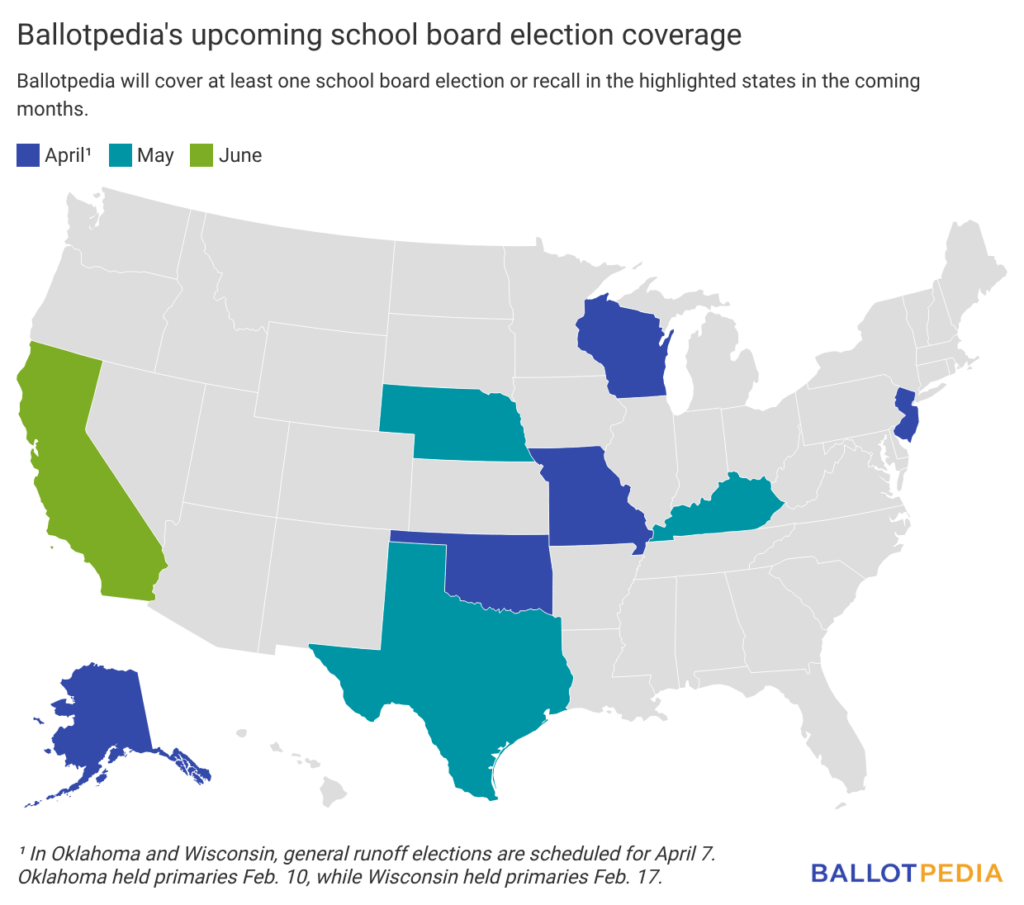
On April 7, Ballotpedia will cover school board elections in Alaska, Iowa, Oklahoma, and Wisconsin.
Alaska
Two of the seven seats on the Anchorage School District school board are up for election this year. Anchorage School District is the largest district in Alaska, with roughly 43,000 students.
- Rachel Blakeslee and Alexander Rosales are running for Seat C. Rosales completed Ballotpedia’s Candidate Connection survey.
- Dustin Darden, Sharon Gibbons, and Paul McDonogh are running for Seat D. McDonogh completed the Candidate Connection survey.
Iowa
Voters in the Mormon Trail Community School District will vote in a special general election for an at-large seat. Andrew Bexten and Matthew Cromer are running.
Mormon Trail Community School District, with roughly 240 students, ranks 25 out of 237 districts in the state. the 25th smallest district in Iowa. It is located south of Des Moines.
Oklahoma and Wisconsin
Voters in Oklahoma and Wisconsin will decide the general elections. Both states held primaries in February.
Oklahoma
A total of 224 candidates will appear on the ballot across 113 districts.
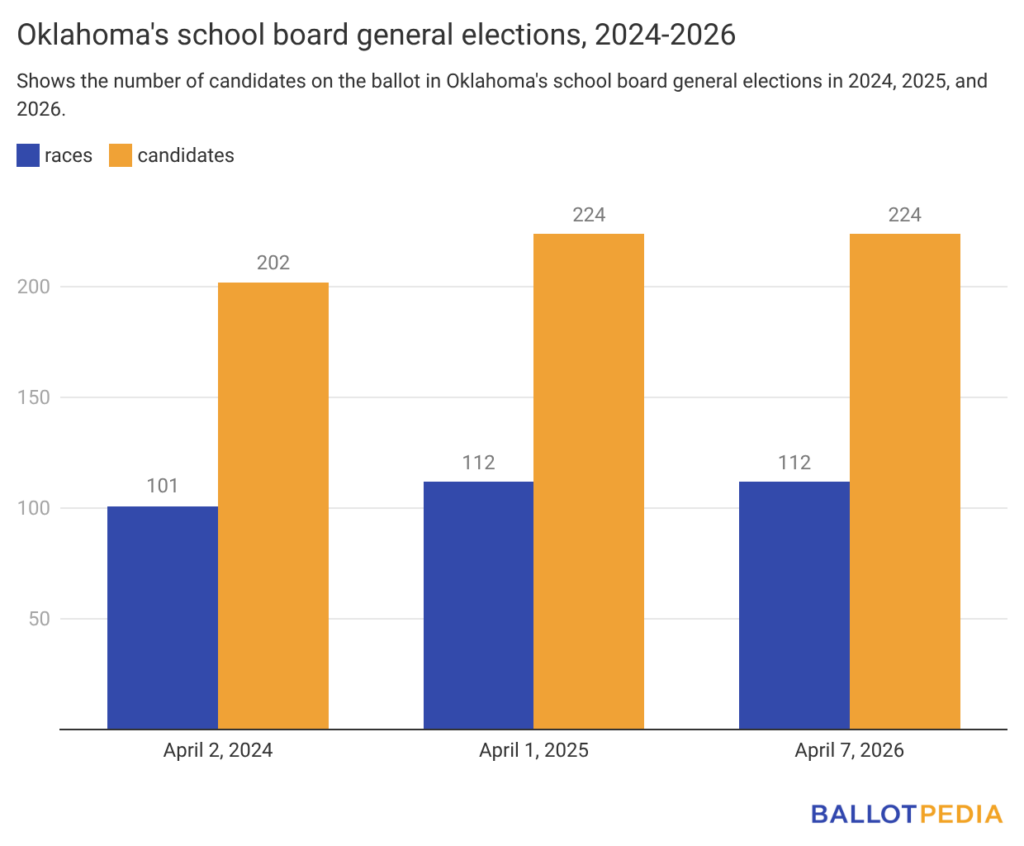
Oklahoma’s primaries were Feb. 10. School board candidates appeared on the ballot in only 15 districts — 2.9% of the state’s 509 districts. A total of 50 candidates ran across all 15 districts.
Districts hold primaries if more than two candidates run for a seat. If only one candidate runs, the candidate wins the seat outright. If two candidates run, then the district cancels the primary, and the candidates automatically advance to the general election.
Click here to read our deep dive into Oklahoma’s Feb. 10 primaries.
Wisconsin
A total of 580 candidates will appear on the ballot across 167 districts.
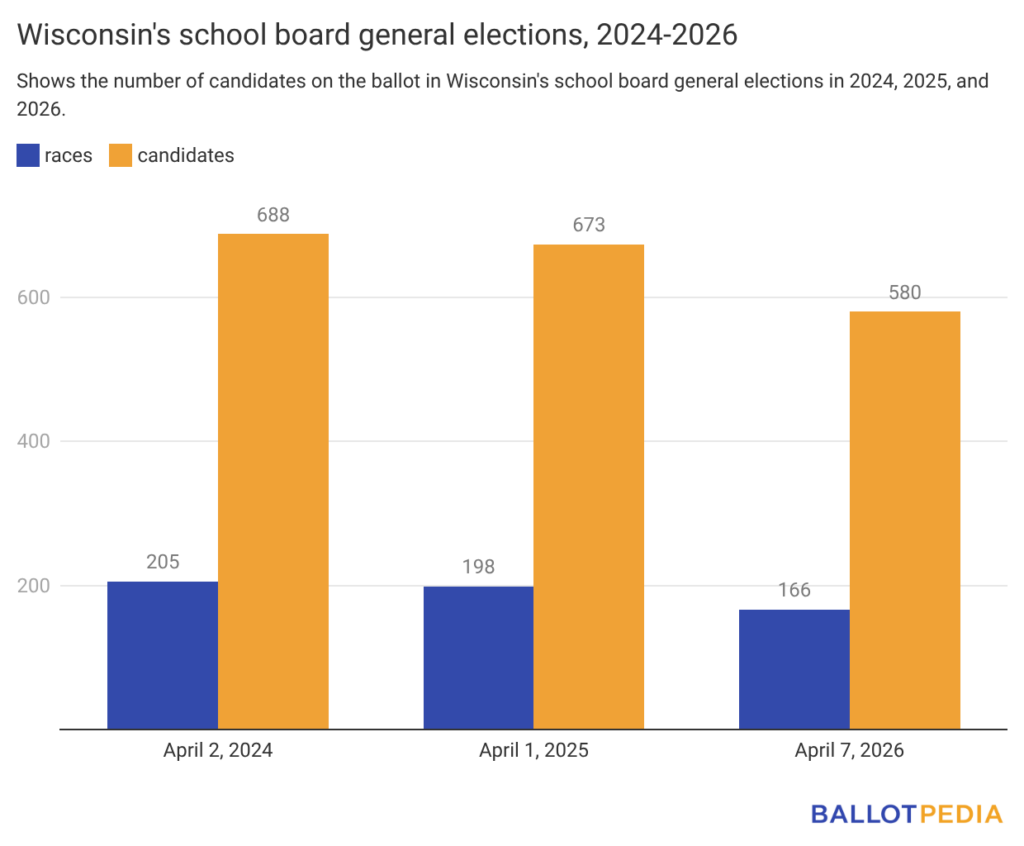
Wisconsin’s primaries were Feb. 17. Eighty-three candidates ran in 17 districts.
School board primaries are only held in Wisconsin if there are more than two candidates running for a single seat or if the number of candidates running in multi-seat races is more than twice the number of seats up for election.
Click here to read more about Ballopedia's 2026 school board election coverage.
The San Francisco Unified School District Board readopts policy allowing eighth graders to take Algebra 1
On March 24, the San Francisco Unified School District (SFUSD) Board voted to reinstate a policy allowing middle schools to offer Algebra 1 to eighth graders, 12 years after eliminating a similar policy. All eighth graders will be able to take Algebra 1 as an elective. Schools will automatically enroll students with qualifying test scores in both Math 8 and Algebra 1, though the students can opt out of Math 8.
The Board reinstated the policy after years of debate over the elimination of middle school Algebra 1, which Hall Pass has previously covered. The push from parents, community members, and some researchers to reinstate Algebra 1 in middle school culminated in a 2023 lawsuit, a 2024 ballot measure that urged the district to reinstate the course for eighth graders, and a 2025 settlement in which the district agreed to offer it.
Board President Phil Kim said, "Families want to see a public school system that offers rigorous coursework…This is absolutely an instructional strategy. But it’s also a retention tool to bring families to our district and demonstrate we will not only take care of your children, but we will teach them, too."
Removing Algebra 1 from SFUSD middle schools
During the 2014-2015 school year, SFUSD ended a policy that allowed advanced students to take Algebra 1 classes in eighth grade. Instead, the district required all students to take the same classes, regardless of ability, through 10th grade (at which point students could try to accelerate to an advanced math pathway by taking a course that combined Algebra II and Pre-Calculus or taking Geometry the summer after ninth grade). This policy was aligned with the California Common Core State Standards (CCSS). The district called the move an equity-based detracking initiative aimed at reducing racial achievement gaps.
Supporters of the change said that when students are accelerated through middle school math courses, they gain only a slim understanding of math concepts crucial for higher levels of math and that exposing all students to rigorous math courses at an earlier age was preferable. In a 2018 oped, math education professors Jo Boaler, Alan Schoenfeld, Phil Daro, Harold Asturias, Patrick Callahan, and David Foster wrote that, "[SFUSD] studied the research that shows the ineffectiveness of tracking and shallow curricula, and made bold decisions based on knowledge of the relevant research. … They decided to challenge students earlier with depth and rigor in middle school.”
Opponents of the policy shift said it made student excellence in math difficult because it compressed accelerated courses later into high school and had a disproportionate effect on socio-economically disadvantaged students who could not pursue instruction elsewhere. In a 2023 oped, Rex Ridgeway, a SFUSD grandparent, and David Margulies, a SFUSD parent, wrote: ”The benefits of eighth-grade algebra 1 are clearly explained in an open letter signed by nearly 1,800 science, technology, engineering and math professionals. This course initiates a five-year pathway to STEM readiness culminating in AP calculus in 12th grade. In practice, SFUSD’s delay of [A]lgebra 1 has created a nightmare of workarounds. Families with resources turn to fee-required online algebra 1 courses in eighth grade, outside the public school system, or enroll their kids in private schools."
Measuring success
Initially, the district reported in 2018 that the policy was successful. It cited an increase in students taking advanced math, a decrease in Algebra 1 repetition, and an increase in students taking Advanced Placement (AP) math courses, specifically Black and Hispanic students.
However, Families for San Francisco released a 2021 report saying they believed the statistics the district used to measure the policy's success were misleading and, in some cases, inaccurate. The report said, "[t]he grade distribution we received from SFUSD showed no improvement at all in Algebra 1 grades. The repeat rate did come down, but only because in 2015 SFUSD eliminated the requirement to pass the Algebra 1 California Standards Test (CST) exit exam as a condition of progressing."
In March 2023, the Annenberg Institute at Brown University released a study on student achievement in the district after SFUSD implemented the 2014 reform. It found that racial gaps remained largely unchanged and that AP math enrollment was down 15%.
Mounting pushback
In the same month, a group of parents sued the district, saying Algebra 1 should once again be offered to middle school students with the requisite mathematical knowledge. The parties settled on May 29, 2025, with the district agreeing to reinstate Algebra 1 for eighth graders and end a testing practice for students taking Algebra 1 outside the district.
On March 5, 2024, voters approved a local ballot measure 81.75% to 18.25% that urged SFUSD to offer Algebra 1 to students by the eighth grade. SFUSD announced on March 15, 2024, that it would launch a pilot program in select middle schools to provide access to Algebra 1.
SFUSD voted 4-3 to approve the March 2026 policy to offer Algebra 1 to eighth graders.
The bigger picture
The debate over offering Algebra 1 in eighth grade is not limited to SFUSD. Policy debates about tracking and course sequencing, as well as their relation to equity, have happened in Palo Alto, Detroit, and Cambridge, to name a few. In 2023, the California State Board of Education adopted guidance for all the state's districts based on SFUSD's removal of Algebra 1 in middle school. State Board President Linda Darling-Hammond said their policy aimed to address inequitable and ineffective math instruction.
NWEA, an education data and assessment company, released a report in 2025 that found that 58% of students across the United States have access to Algebra 1 in eighth grade. Below is a breakdown of eighth-grade access to Algebra 1 by school characteristics.
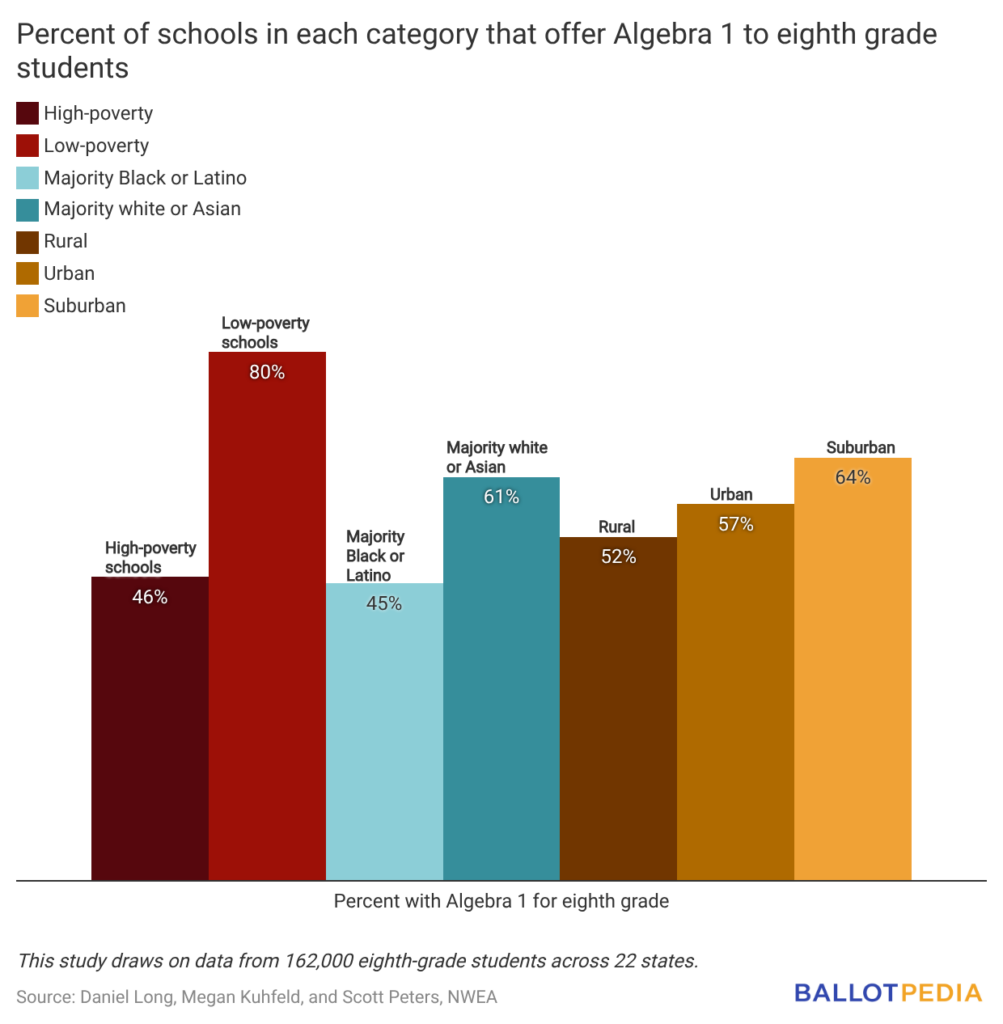
Minnesota is currently the only state that requires eighth graders to take Algebra 1, the debates on which Hall Pass has covered in an earlier edition. The Hechinger Report found that 6.4% of school districts in the United States report having policies mandating algebra in eighth grade, with most of them in Minnesota.
Extracurricular: education news from around the web
This section contains links to recent education-related articles from around the internet. If you know of a story we should be reading, reply to this email to share it with us!
- ESSER pandemic spending is over. What will its legacy be? | K-12 Dive
- Many Parents Value Grades Over Test Scores, Missing Signals to Intervene | The 74
- Evers vetoes bill to join federal tax credit program, citing concerns over expansion of school vouchers | Wisconsin Public Radio
- Following the lead of other Southern states, Georgia lawmakers adopt major school literacy initiative | Rough Draft Atlanta
- New digital hall passes track bathroom breaks, gather data in NYC schools | Gothamist
- Many Parents Value Grades Over Test Scores, Missing Signals to Intervene | The 74
Take our Candidate Connection survey to reach voters in your district
Today, we’re looking at survey responses from Arturo Sanchez and Gabriel Gonzales II, the two candidates running in the May 2 general election to represent District 3 on the Clear Creek Independent School District school board, in Texas.
Clear Creek is the 27th largest district in Texas, with roughly 40,000 students. It is located southeast of Houston.
Arturo Sanchez was first elected to the Clear Creek Independent School District school board in 2017. Sanchez’s professional experience includes working as the NASA Johnson Space Center’s director of external relations. Here’s how Sanchez answered the question, “What are the main points you want voters to remember about your goals for your time in office?”
- “My top priority is maintaining the fiscal discipline that allowed us to adopt the lowest tax rate in over 30 years for the 2024-2025 school year. In a time of stagnant state funding, we must continue to use data-driven strategies to maximize every taxpayer dollar, ensuring funds directly support student achievement and classroom innovation.
- I am committed to advancing CCISD’s Vision 2030 strategic plan, our commitment to transform educational experiences to better prepare students for future majors, careers, and military pathways through programs like the STREAM of Innovation. By integrating Space, Technology, Robotics, Engineering, Arts, and Medicine at the intermediate level into our curriculum, we ensure CCISD remains a 'District of Choice' for students, families, and teachers.
- Teachers have the greatest impact on student success. I will continue to prioritize competitive salaries and professional pathways, such as the Teacher Incentive Allotment, to attract and retain the high-quality staff our students deserve. A strong, supported workforce is the foundation of a stable district.”
Click here to read the rest of Sanchez’s responses.
Gabriel Gonzales II’s career experience includes working as a teacher. Here’s how Gonzales answered the question, “What are the main points you want voters to remember about your goals for your time in office?”
- “Putting Students First Through Academic Excellence: As a classroom teacher, I understand that student success must always be the top priority. That means focusing on strong academics, safe schools, and preparing students for college, careers, or military service. I believe we must maintain high standards while ensuring every student has the opportunity to succeed.
- Supporting and Respecting Teachers: Teacher retention and support directly impact student outcomes. We must ensure teachers have the resources, respect, and professional environment they need to do their jobs effectively. When we support educators, we support students.
- Responsible Leadership and Community Trust: Taxpayers deserve transparency and responsible financial decisions. I believe in common-sense leadership that listens to parents, respects the community, and focuses on results—not politics. My goal is to be a voice for students, families, and educators.”
Click here to read the rest of Gonzales’ responses.
As a reminder, if you're a school board candidate or incumbent planning to run this year, click here to take the survey. If you complete the survey, your answers will appear in your Ballotpedia profile. Your responses will also appear in our sample ballot. If there is an election in your community, share the link with your candidates and urge them to take the survey!