


On Feb. 26, 2026, the United States Department of Agriculture (USDA) sent guidance to state agencies reversing its November 2025 termination of 18 Supplemental Nutrition Assistance Program (SNAP) work requirement waivers. The reversal came as a result of ongoing litigation that challenged the early termination of these waivers.
All of the waivers that the USDA's guidance terminated were obtained under a legal provision that the One Big Beautiful Bill Act (OBBBA) — which President Trump (R) signed into law on July 4, 2025 — repealed. The repealed provision allowed states to apply for geographical work requirement waivers if they could prove an area had insufficient jobs. Now, states can only apply for these waivers for areas with unemployment rates above 10%, with exceptions for Alaska and Hawaii through 2028.
What are waivers and work requirements?
Work requirement waivers waive the time limit associated with the able-bodied adult without dependents (ABAWD) work requirements for SNAP. Under SNAP rules, ABAWDs can only receive benefits for three months during a 36-month period if they are non-compliant with work requirements. In areas covered by a waiver, ABAWDs who do not meet the ABAWD work requirement can continue receiving benefits for more than three months.
Work requirements are activities that certain recipients must complete in order to remain eligible for food assistance. SNAP has two types of work requirements:
- General work requirements, which apply to most adult recipients, including ABAWDs and those without dependents, and
- ABAWD work requirements, which prohibit ABAWDs from receiving more than three months of benefits in a 36-month period if they are not exempt or working 20 hours per week. After reaching this time limit, they lose eligibility for benefits unless they start meeting the work requirement.
When the USDA grants a waivers for the time limits associated with the ABAWD work requirements, a state may continue issuing benefits to non-compliant ABAWDs beyond 3 months in the covered area.
For general work requirements, individuals who do not comply lose benefits for a period of time. This period of time is determined by how many times the recipient has been non-compliant in the past. These policies vary by state and are not subject to federal waivers.
Waiver termination
After the OBBBA became law, the USDA began issuing guidance documents to states to assist in the implementation of the new provisions. On Oct. 3, 2025, they released guidance regarding the ABAWD work requirement waivers and announced that all waivers granted under the now-repealed insufficient jobs clause would be terminated by the agency on Nov. 2. At the time, eighteen states had some form of time limit waiver granted under the OBBBA-repealed criteria.
On Oct. 30, eight cities and several other groups filed a lawsuit against the USDA regarding certain actions the agency took during the Oct. 2025 government shutdown and after the enactment of the OBBBA. The lawsuit argues that, “USDA also prematurely terminated waivers of certain SNAP work requirements in states and areas with insufficient jobs, acting without any statutory authorization or consideration of the effects on people trying to keep up with those requirements.”
On Oct. 31, the U.S. District Court for the District of Rhode Island granted a temporary restraining order which, among other provisions, directed the USDA to temporarily stay the early termination of the ABAWD work requirement waivers that was scheduled to occur on Nov. 2.
Results
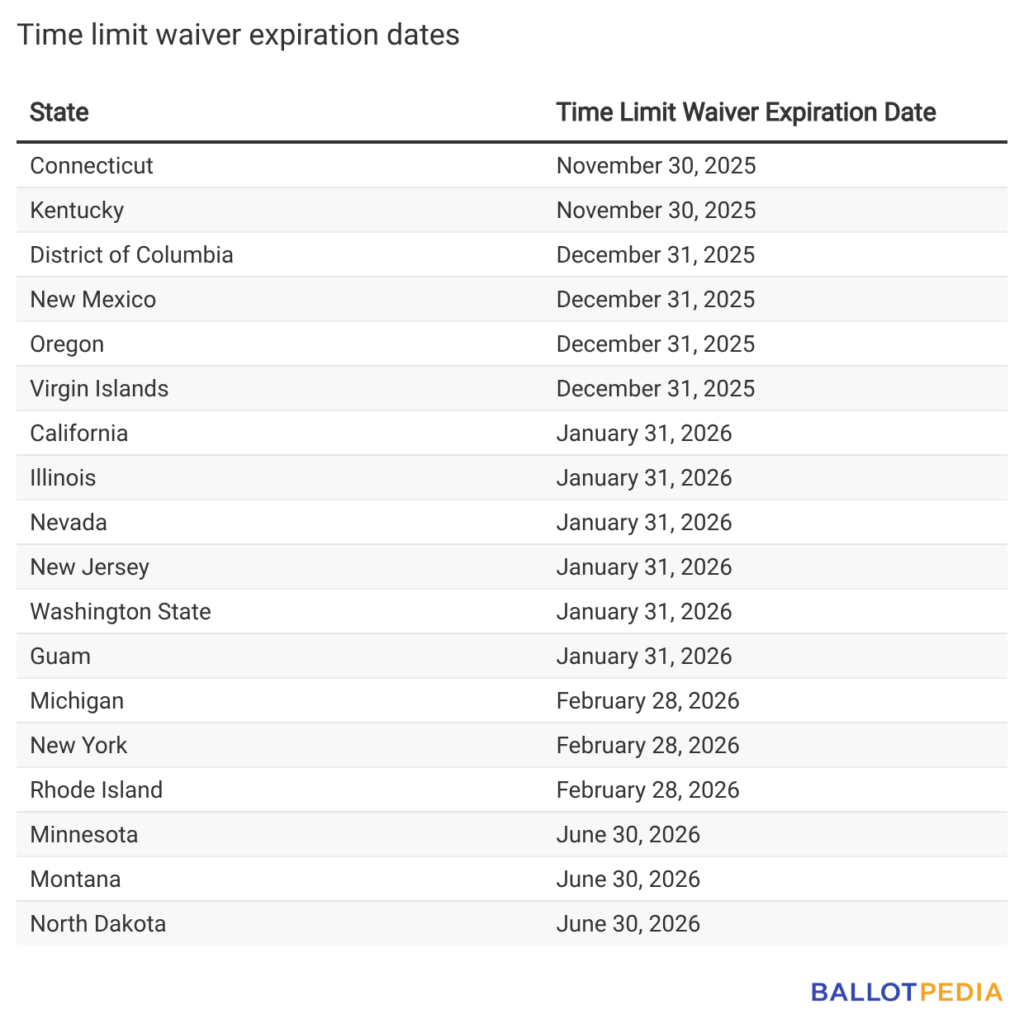
On Feb. 26, 2026, the USDA sent guidance to state agencies announcing the reinstatement of the terminated waivers. “Due to ongoing litigation and a order from the District Court of Rhode Island, the time limit waivers that were terminated will remain in effect through their original expiration date,” the guidance said. The original expiration dates for these 18 waivers can be found in the table below:
In some states, such as Nevada, the USDA guidance was received after some ABAWDs had already lost benefits. The Nevada Registry reported that approximately 43,000 ABAWDs lost benefits on March 1. On March 3, the state reinstated SNAP benefits for these individuals and began backpaying benefits that were not issued on March 1. The state will allow ABAWDs to continue receiving benefits through April 30 in response to the USDA’s Feb. 26 guidance.