


Welcome to the Monday, April 6, 2026, Brew.
By: Lara Bonatesta
Here’s what’s in store for you as you start your day:
- Trump signs absentee/mail-in voting executive order
- Open state legislative seats down and contested incumbents up in states with earliest filing deadlines
- Kentucky voters to decide on amendment limiting governor’s pardon power
Trump signs absentee/mail-in voting executive order
On March 31, President Donald Trump (R) issued an executive order that requires the U.S. Postal Service (USPS) to mail absentee/mail-in ballots only to an approved list of voters eligible to vote in federal elections.
The order, entitled Ensuring Citizenship Verification and Integrity in Federal Elections, requires the U.S. Department of Homeland Security to use federal data to create a list of U.S. citizens who are eligible to vote in each state and submit each state’s list to its respective chief election official. Those voters would still need to register to vote to cast a ballot.
The order also requires states to notify the USPS 90 days before a federal election whether they intend to allow absentee/mail-in voting. State officials would then submit a list to the USPS 60 days before the election of all eligible voters to whom they intend to send a ballot. The USPS would be prohibited from mailing an absentee/mail-in ballot to individuals “unless those individuals have been enrolled on a State-specific list.” The USPS would then also be required to provide states with a “State-specific Mail-In and Absentee Participation List,” which states would be able to modify ahead of the election.
The order also requires the postmaster general to initiate a proposed rule specifying that “all outbound ballot mail must be mailed in an envelope” that is “marked as Official Election Mail” and is “automation-compatible and bears a unique Intelligent Mail barcode.”
The order requires the U.S. attorney general to prioritize the investigation and prosecution of state and local officials "who issue Federal ballots to individuals not eligible to vote in a Federal election" and directs executive departments and agencies to withhold federal funds from non-compliant state or local governments.
“The Federal Government has an unavoidable duty under Article II of the Constitution of the United States to enforce Federal law, which includes preventing violations of Federal criminal law and maintaining public confidence in election outcomes,” the executive order states. “To enhance election integrity via the United States Mail, additional measures are necessary.”
The order requires the USPS to begin drafting rules to implement the order within 60 days. USPS representative Cathy Purcell said that the agency was reviewing the order.
On April 1, four Democratic Party groups, as well as Senate Minority Leader Chuck Schumer (D) and House Minority Leader Hakeem Jeffries (D), filed a federal lawsuit challenging the constitutionality of the executive order. In the complaint, lawyers for the plaintiffs wrote that the executive order “dramatically restricts the ability of Americans to vote by mail, impinging on traditional state authority … by directing the Postal Service to take actions unrelated to the agency’s statutory mandate.” The plaintiffs allege, “Because the Executive Order does not ‘stem either from an act of Congress or from the Constitution itself’—and further threatens to unjustifiably disenfranchise eligible voters across the country—it is an unlawful exercise of authority that must be declared invalid.”
In January 2025, Trump issued an executive order requiring documentary proof of citizenship for individuals registering with a federal voter registration form, and requiring absentee/mail-in ballots to be received by Election Day. Federal court rulings have blocked both of those provisions, though the U.S. Department of Justice has appealed the decisions.
Every state has a method allowing voters to cast ballots without visiting a physical polling place.
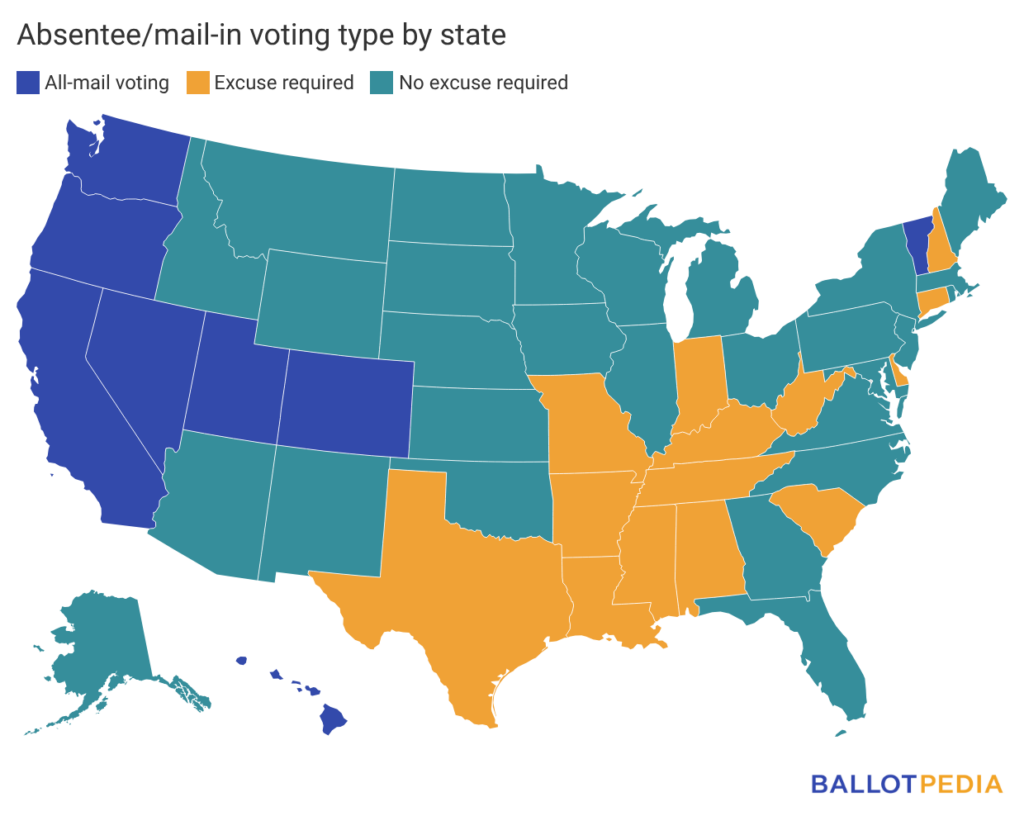
Fourteen states require voters to provide a valid excuse to vote by mail. Twenty-eight states allow any eligible voter to cast an absentee/mail-in ballot. Eight states have all-mail voting systems in which every eligible voter is automatically sent a mail ballot.
The executive order comes as Trump has also called on the U.S. Senate to enact the SAVE America Act, which would require individuals to provide proof of citizenship to register and voter ID to cast a ballot in federal elections. The voter ID requirement would also apply to absentee/mail-in voting.
In March, the U.S. Supreme Court heard a case challenging a Mississippi law allowing absentee ballots postmarked by Election Day to be received up to five days after the election, which could also affect absentee/mail-in voting nationally. Mississippi is one of 14 states to allow absentee/mail-in ballots postmarked by Election Day to be counted if they arrive within a set period of time after the election.
For more information on absentee/mail-in voting in the U.S., click here.
Number of open state legislative seats down and contested incumbents up in states with earliest filing deadlines
Each year, Ballotpedia analyzes how competitive the year's primary elections are using metrics including the number of incumbents who did not seek re-election, the total number of contested primaries, and the number of incumbents with primary challengers.
Forty-six states are holding state legislative elections this year. So far, Ballotpedia has processed post-filing deadline information for 13 states’ legislative elections: Alabama, Arkansas, California, Idaho, Illinois, Kentucky, Montana, Nevada, North Carolina, Ohio, Oregon, Texas, and West Virginia. We’ll add more states throughout the primary season.
Since 2010, these first 13 states have shown a downward trend in the number of open seats and an upward trend in the number of contested incumbents.
Open seats
Between 2010 and 2024, the 13 states had an average of 285 total open seats. In 2026, there are 232 open seats, the second-fewest, next to 227 in 2020.
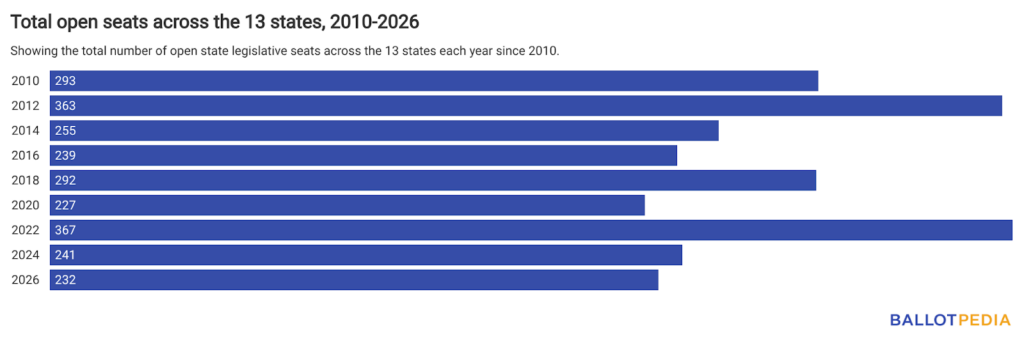
Three of the 13 states have a record-low number of open seats in 2026 — Alabama with 10, Nevada with nine, and North Carolina with 10. Three other states will have their second-lowest number of open state legislative seats since 2010 — California (21), Kentucky (10), and Montana (39).
Contested incumbents
Between 2010 and 2024, the 13 states had an average of 299 incumbents in contested primaries. In 2026, there are 339 incumbents in contested primaries, the second-highest since 2010.
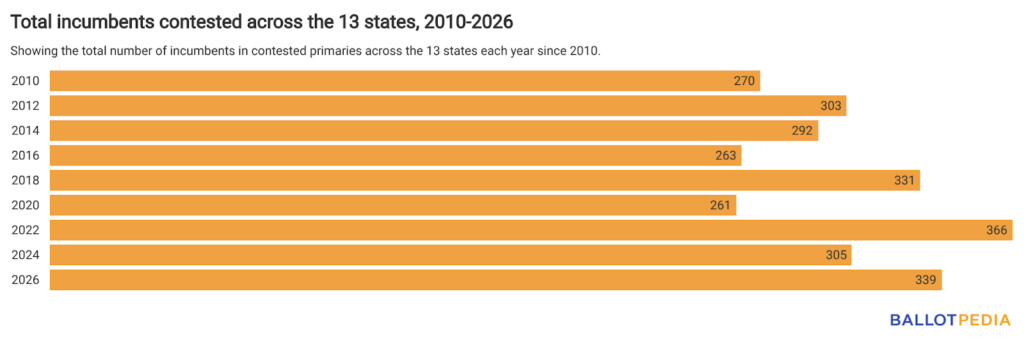
Two of the 13 states have a record-high number of contested incumbents in the 2026 primaries—North Carolina (39) and Oregon (15). Three other states will have their second-highest number of incumbents in contested primaries—Montana with 23, Nevada with 15, and West Virginia with 48.
Click here to see our analysis of primary election competitiveness in state and federal government this year.
Kentucky voters to decide on amendment limiting governor’s pardon power
On April 1, the Kentucky General Assembly voted to put a constitutional amendment to limit the governor’s pardoning power on the Nov. 3 ballot. The amendment would prohibit the governor from issuing a pardon or commuting a sentence 60 days before the gubernatorial election and up to the fifth Tuesday succeeding the election. The Kentucky Constitution sets the swearing-in of a newly elected governor on the fifth Tuesday succeeding the election. Traditionally, Kentucky governors are sworn in shortly after midnight on that date.
The amendment would also change the section's language to gender-neutral terms. Currently, the state constitution says the governor has the power “to remit fines and forfeitures, commute sentences, grant reprieves and pardons, except in case of impeachment.”
In Kentucky, a 60% vote is required during one legislative session to place a constitutional amendment on the ballot. The amendment was introduced as Senate Bill 10 (SB 10) on Jan. 8. It passed in the state Senate 36-0 on Jan. 20. The state House passed an amended version 82-12 on April 1. The state Senate concurred on the same day by a vote of 36-1.
According to the National Governors Association, every state authorizes a governor or a board of pardons to grant clemency in some form. Authority and procedures vary by state.
Texas was the last state to decide on a measure related to the pardon power. In 2011, voters approved Texas Proposition 9 57.3%-42.7%. It allows the governor to grant pardons, reprieves, and commutations to persons who complete deferred adjudication. At the time, the governor could only pardon convicted felons.
This is the first statewide ballot measure to be certified in Kentucky for 2026. Between 1985 and 2024, Kentucky voters approved 18 constitutional amendments and rejected 10.
Click here to learn more about the amendment in Kentucky.