


Welcome to the Friday, April 10, 2026, Brew.
By: Lara Bonatesta
Here’s what’s in store for you as you start your day:
- Alabama enacts bill ending state judicial deference, Georgia General Assembly passes similar bill
- Idaho voters to decide official state gun ballot measure in November
- Three statewide candidate filing deadlines in the next two weeks
Alabama enacts bill ending state judicial deference, Georgia General Assembly passes similar bill
On March 31, Alabama Gov. Kay Ivey (R) signed SB 167, ending judicial deference in state courts. Judicial deference is a practice in which courts adopt an agency’s reading of an ambiguous statute, regulation, or other document in cases involving that agency.
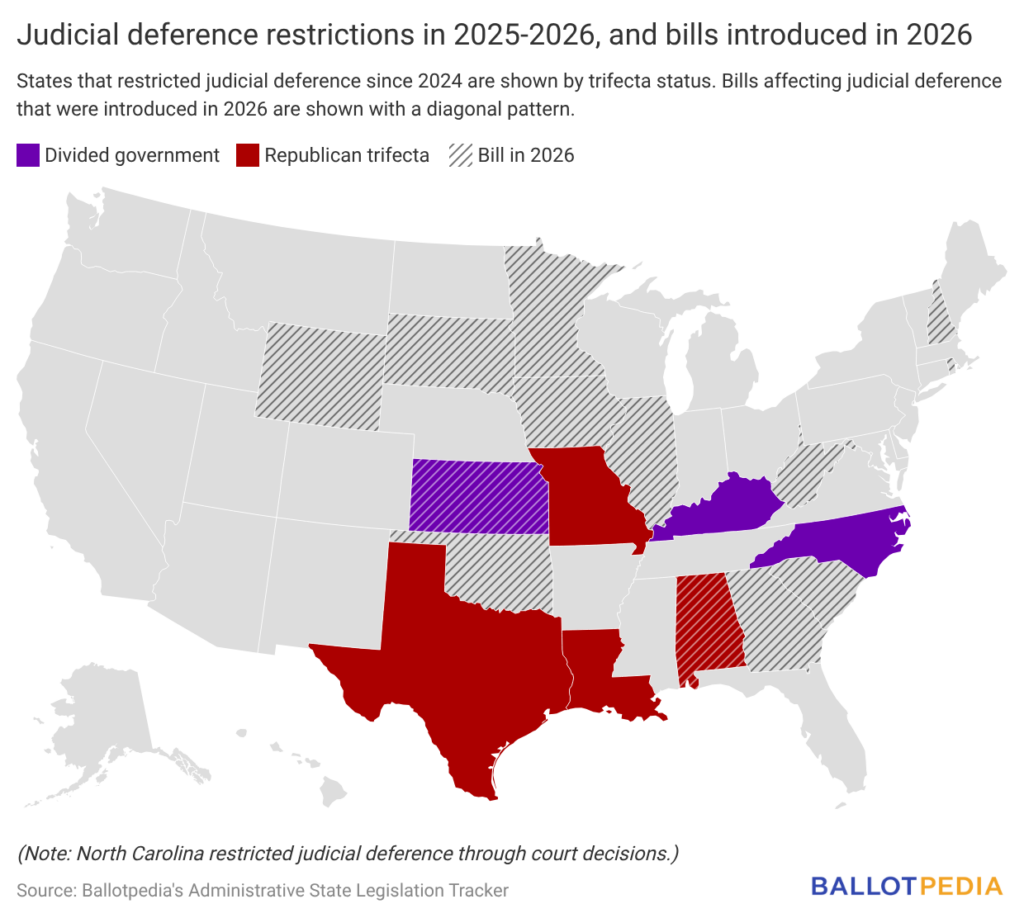
Alabama is the second state to comprehensively end judicial deference so far this year. Kansas passed a similar bill on Feb. 6.
SB 167 removes language in the state Administrative Procedure Act instructing courts that "the agency order shall be taken as prima facie just and reasonable and the court shall not substitute its judgment for that of the agency as to the weight of the evidence on questions of fact.” The new law says that courts “may consider, but shall not defer to” state agencies’ interpretations of state statutes or regulations. “After applying all customary tools of interpretation,” the new text continues, “the court shall exercise any remaining doubt in favor of a reasonable interpretation.”
The Alabama Senate passed the bill 34-0 (seven Democrats and 27 Republicans voting yes) on Feb. 5. The Alabama House of Representatives passed it 105-0 (29 Democrats and 76 Republicans voting yes) on March 17.
The Georgia General Assembly passes HB 1247
The Georgia General Assembly passed a similar bill, HB 1247, on April 3. It would prohibit state courts from deferring to agency interpretations “when interpreting this state's Constitution, statutes, or published rules.”
The Georgia House of Representatives passed it 98-63 (63 Democrats voted no, and one Democrat and 97 Republicans voted yes) on March 4. The Georgia Senate amended the bill to include provisions of another bill, which would require legislative review of proposed agency rules. The state Senate passed this amended version 48-2 (two Democrats voted no, 18 Democrats and 30 Republicans voted yes) on March 25.
The state House added its own amendments (on public disclosure of legislative records and state outreach services) on April 2, and passed it 98-70 (70 Democrats voted no, and two Democrats and 96 Republicans voted yes). The state Senate then passed the state House-amended bill on April 3, 34-18 (17 Democrats and one Republican voted no, and three Democrats and 31 Republicans voted yes). The bill now goes to Gov. Brian Kemp (R).
Judicial deference in context
At the federal level, the U.S. Supreme Court transformed deference jurisprudence with the 2024 Loper Bright Enterprises v. Raimondo case. In a 6-2 ruling (Justice Ketanji Brown Jackson recused herself), the Court struck down the Chevron doctrine of judicial deference to federal agencies’ interpretations of statute. While this case restricted some judicial deference practices at the federal level, it did not affect practices like Auer deference, under which federal courts defer to agencies’ interpretations of their own regulations.
Because the Loper Bright case was a federal case, it also did not affect judicial deference practices at the state level. However, at least eight states, including Alabama, have restricted judicial deference in state courts since the Loper decision. Seven states have done so through legislation since 2025 (Kentucky, Texas, Oklahoma, Louisiana, Missouri, Kansas, and Alabama). In North Carolina, the state Supreme Court struck down state-level judicial deference practice in the 2025 cases of Thurman Crofton Savage v. N.C. Department of Transportation and Alvin Mitchell v. University of North Carolina Board of Governors.
Ballotpedia has identified 23 bills in 13 states related to judicial deference in 2026, including the Alabama and Georgia bills.
Click here to learn more about state responses to judicial deference.
Idaho voters to decide official state gun ballot measure in November
The Idaho Legislature approved House Bill 932, putting an advisory question on the November ballot to determine the official state gun.
The ballot question will be as follows:
“Which of the following guns should be designated as the state gun of Idaho? Please choose only one answer.
(a) Winchester Model 1894 (.30-30);
(b) Winchester Model 1873 "Gun that Won the West" (.44-40);
(c) 1873 Colt Single Action Army Revolver "Peacemaker" (.45 Colt);
(d) M1 Garand rifle (.30-06);
(e) Colt M1911 .45 automatic Colt pistol (.45 ACP); or
(f) Remington Model 700 bolt-action rifle (.30-06).”
The list of gun choices could increase before the 2026 election. House Bill 932 (HB 932) grants the Idaho Legislative Council, which provides the Secretary of State with the official ballot language before election preparations, the ability to add options to the list of potential state guns.
State Rep. Jason Monks (R-22B) introduced the measure to the Idaho House of Representatives. On March 20, the state House approved it 68-0 with two members not voting. On March 31, the Idaho Senate approved it 32-0 with three members not voting. Governor Brad Little (R) signed HB 932 into law on April 2, officially placing the measure on the November 2026 ballot.
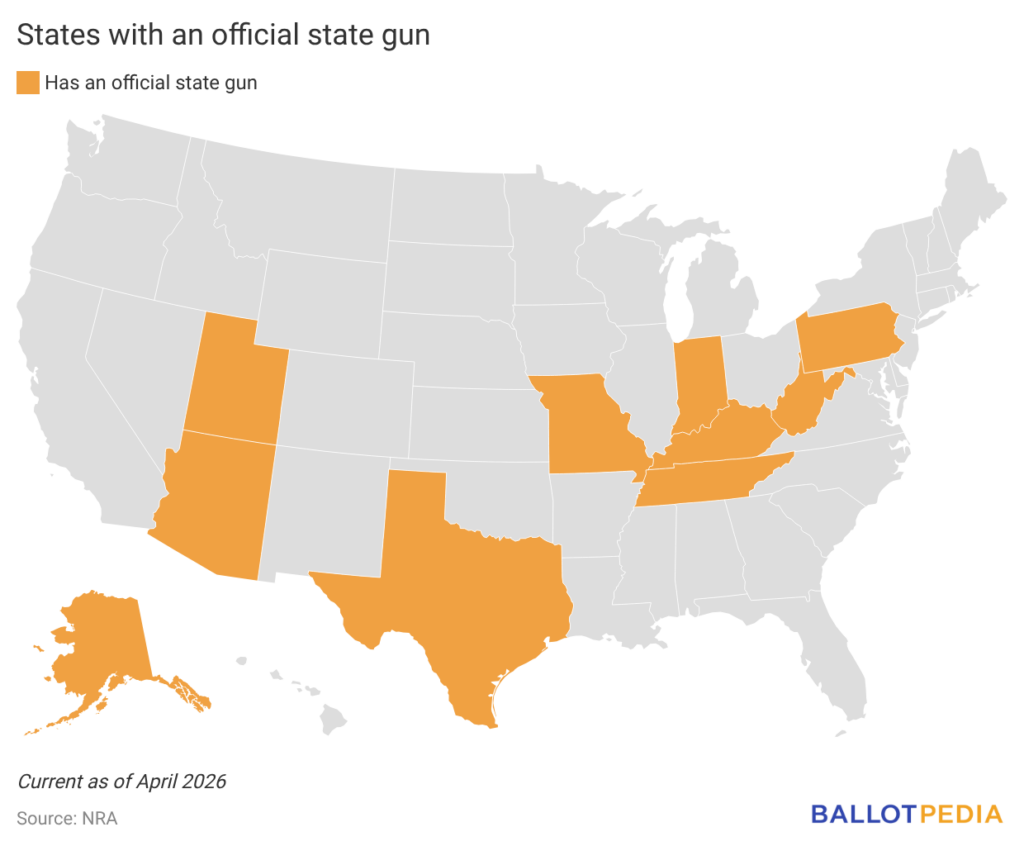
Ten states have an official state gun.
The text of HB 932 stated the advisory question would observe the 250th anniversary of the signing of the Declaration of Independence of the United States and “commemorate the role played by firearms in America's and Idaho's histories.”
In addition to the advisory question, Idaho voters will decide on two constitutional amendments in November.
HJR 4 is a proposed constitutional amendment that states "only the [Idaho Legislature] shall have power and authority" to legalize "marijuana, narcotics, or other psychoactive substances.” This would effectively stop the initiative process from being used to create or alter legislation surrounding psychoactive substances, including marijuana. HJR 6 is a proposed constitutional amendment that would establish English as the state’s official language. English is already the state's official language, but that provision is in state statute, not the constitution.
Click here to learn more about Idaho’s 2026 ballot measures.
Three statewide candidate filing deadlines in the next two weeks
Three states have statewide candidate filing deadlines in the next two weeks. The map and bulleted list below show which states have candidate filing deadlines scheduled between April 11 and April 25.
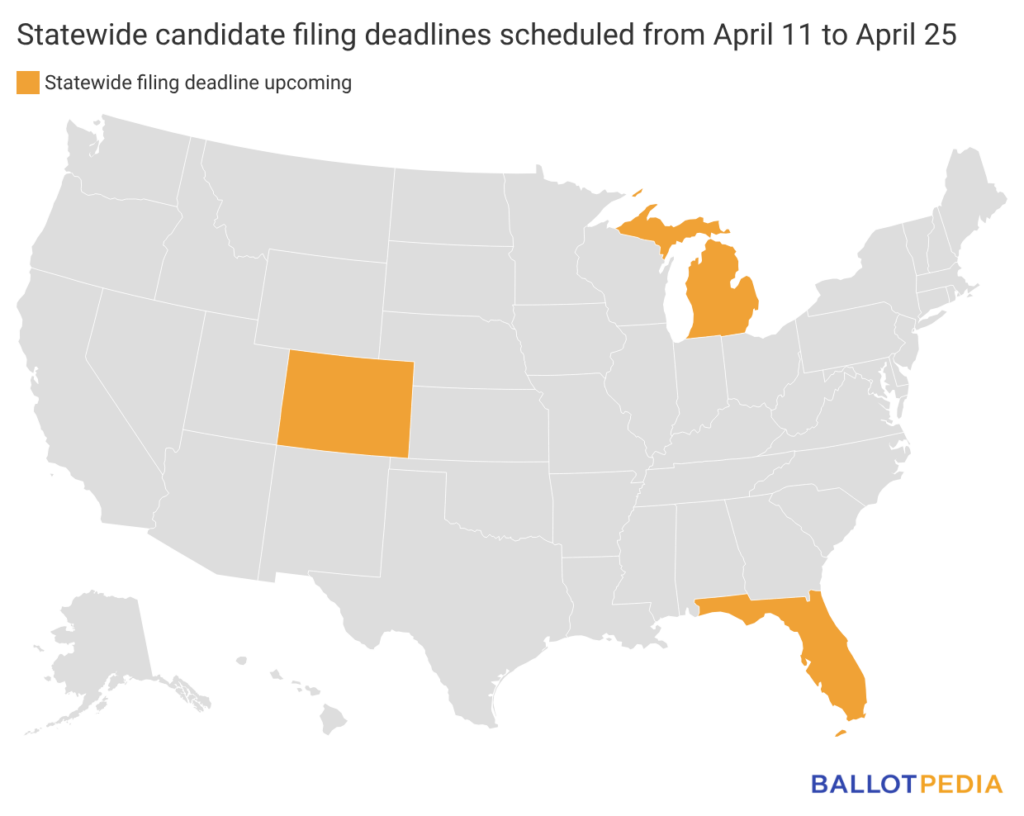
- Colorado: April 24 (statewide primary write-in candidate filing deadline)
- Florida: April 24 (statewide candidate filing deadline for U.S. Senate and state supreme court)
- Michigan: April 21 (statewide primary candidate filing deadline)
Looking back
Nine states had a candidate filing deadline in the past two weeks:
- Maine: March 31 (statewide primary write-in candidate filing deadline)
- Missouri: March 31 (statewide primary candidate filing deadline)
- New York: April 6 (statewide primary candidate filing deadline)
- North Dakota: April 6 (statewide primary candidate filing deadline)
- Oklahoma: April 3 (statewide candidate filing deadline)
- South Carolina: March 30 (statewide primary candidate filing deadline)
- South Dakota: March 31 (statewide primary candidate filing deadline)
- Virginia: April 2 (statewide U.S. Senate primary candidate filing deadline)
- Wisconsin (Spring election): April 3 (statewide general write-in candidate filing deadline)
Candidates must meet various state-specific filing requirements and deadlines to appear on primary and general election ballots. These regulations, known as ballot access laws, determine whether and how candidates can make it onto the ballot. These laws are set at the state level and apply to candidates running for state and federal offices.
Voting in upcoming elections
Looking ahead, there is one remaining statewide election taking place in April:
Virginia (redistricting ballot measure special election)
- Voter registration deadline: April 14 by mail or online (April 21 in person)
- Early voting start date: March 6
- Special election date: April 21
Two states have early voting periods that start in the next two weeks:
- Nebraska: Early voting for the May 12 primary begins on April 13.
- South Dakota: Early voting for the June 2 primary begins on April 17.
Four states have voter registration deadlines in the next two weeks:
- Georgia: Last day to register to vote in the May 19 primary is April 20.
- Kentucky: Last day to register to vote in the May 19 primary is April 20.
- Louisiana: Last day to register to vote in the May 16 primary is April 15 (in person and by mail) or April 25 (online).
- West Virginia: Last day to register to vote in the May 12 primary is April 21.
One state has an absentee/mail-in ballot request deadline in the next two weeks:
- Indiana: Last day to request an absentee ballot for the May 5 primary is April 23.
Click here to see our list of upcoming election dates and filing deadlines.