


Welcome to the Tuesday, April 14, 2026, Brew.
By: Lara Bonatesta
Here’s what’s in store for you as you start your day:
- Ballotpedia's 2026 trifecta exposure ratings: Nine exposed trifectas nationwide
- Fifteen Democrats are running to succeed Eleanor Holmes Norton as Washington D.C.’s delegate in Congress
- Wisconsin and Kansas Governors veto bills opting into federal school choice tax credit program
Ballotpedia's 2026 trifecta exposure ratings: Nine exposed trifectas nationwide
Ballotpedia assessed potential changes to the landscape of state government trifectas in this year's elections, analyzing the exposure of existing state government trifectas to breaking and the potential for new trifectas to form in the 2026 elections.
We rated nine existing state government trifectas as the most exposed to breaking this year – four Democratic and five Republican.
A trifecta is considered exposed when one or more of its three components — the governorship and both chambers of the state legislature — meets the following criteria. The gubernatorial election is rated a Toss-up, Lean, or Tilt. A state legislative chamber's partisan majority is small enough that a shift in seats could change partisan control. Ballotpedia evaluates each component individually, looking at three factors:
- The ratings for the gubernatorial election.
- The percentage of seats up for election required to change control of the upper chamber.
- The percentage of seats up for election required to change control of the lower chamber.
One important caveat: our exposure ratings reflect the size of legislative majorities, not the electoral landscape. A trifecta can be rated exposed even when the political environment makes an actual change unlikely. Click here to read more about our methodology.
Here are some highlights from our analysis.
In three states, fewer than five seats in at least one state legislative chamber would need to change party control for the state's trifecta status to change.
Maine has had a Democratic trifecta since 2019. Democrats have a 20-14-1 majority in the Senate and a 75-72-3 majority with one vacancy in the House. To break the Democratic trifecta, Republicans would need to gain four seats to win a majority in the Senate, three seats to win a majority in the House, or win the governorship.
Oregon has had a Democratic trifecta since 2007, except for 2011 and 2012, when the House was split. Democrats have an 18-12 majority in the Senate and a 37-23 majority in the House. To break the Democratic trifecta, Republicans would need to gain four seats to win a majority in the Senate, eight seats to win a majority in the House, or win the governorship. The gubernatorial election is rated Safe Democratic.
Texas has had a Republican trifecta since 2003. Republicans have an 18-12 majority with one vacancy in the Senate and an 88-62 majority in the House. To break the Republican trifecta, Democrats would need to gain four seats to win a majority in the Senate, 14 seats to win a majority in the House, or win the governorship. The gubernatorial election is rated Safe Republican.
In six states, between five and ten state legislative seats in at least one chamber would need to change party control.
Democratic trifectas in New Mexico and Washington were rated somewhat exposed. To break the trifecta in Washington, Republicans would need to gain six seats to win a majority in the Senate or 11 seats to win a majority in the House.To break the trifecta in New Mexico, Republicans would need to gain ten seats to win a majority in the House or win the governorship. The gubernatorial election is rated Likely Democratic.
Republican trifectas in Iowa, Montana, and New Hampshire were rated somewhat exposed. To break the trifecta in Iowa, Democrats would need to gain nine seats in the Senate, 18 in the House, or win the governorship. The gubernatorial election is rated Lean Republican. In Montana, Democrats would need to gain eight seats in the Senate or nine in the House. In New Hampshire, In New Hampshire, Democrats would need to gain five seats in the Senate, 22 seats in the House, or win the governorship. The gubernatorial race is rated Likely Republican.
The Republican trifecta in Georgia was rated moderately exposed. To break the Republican trifecta, Democrats would need to gain six seats in the Senate, nine seats in the House, or win the governorship.. The governor’s race is rated Leans Republican.
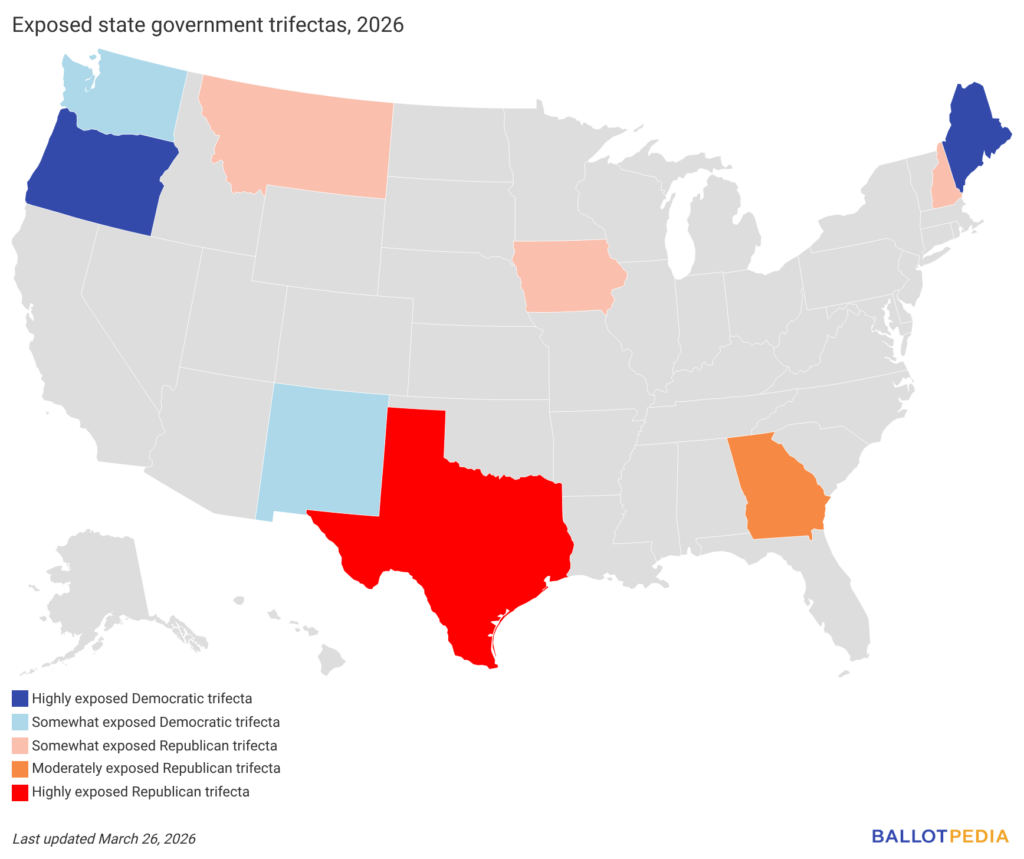
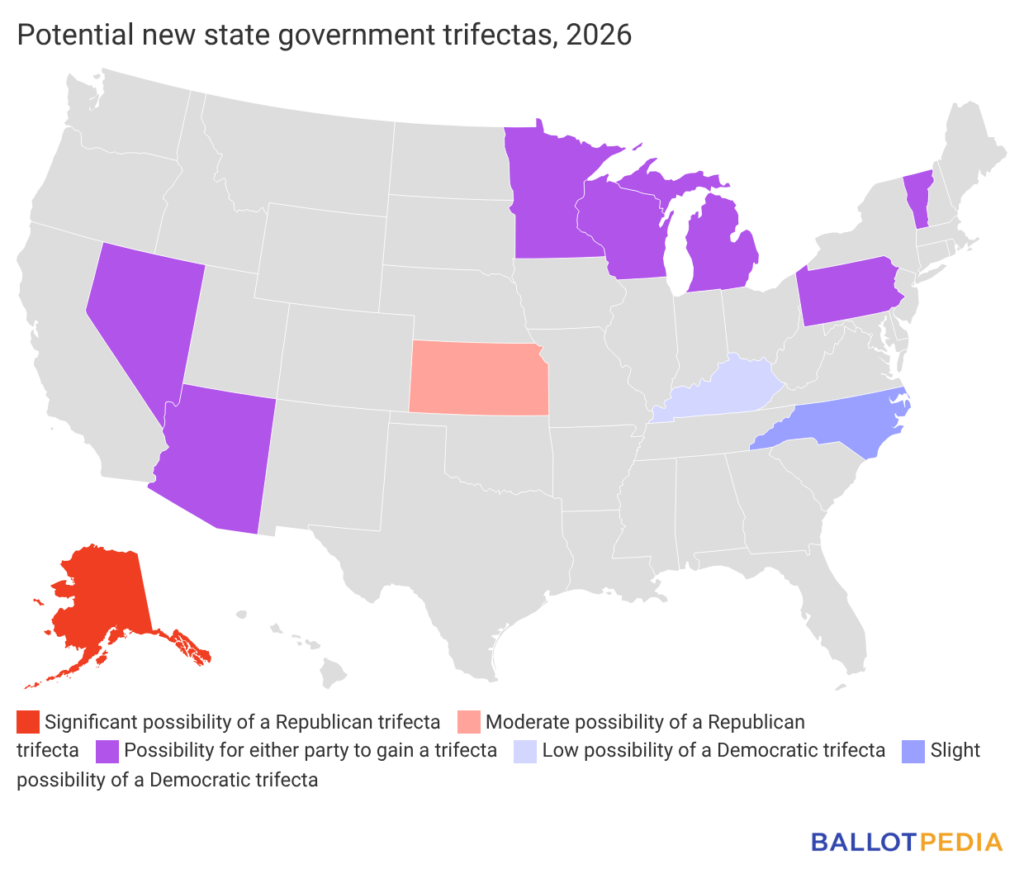
Democrats and Republicans each have trifecta pickup opportunities in two states. Seven states are pickup opportunities for both parties.
Ballotpedia assessed the chances of new trifectas forming in states that currently have divided governments. Possible Democratic trifecta pickups are Kentucky and North Carolina, while possible Republican pickups are Alaska and Kansas. In Arizona, Michigan, Minnesota, Nevada, Pennsylvania, Vermont, and Wisconsin, either party could establish a state government trifecta.
Additional information
A state government trifecta occurs when one party holds the governorship and majorities in both chambers of the state legislature. There are currently 39 state government trifectas: 23 Republican trifectas and 16 Democratic trifectas. The remaining 11 states have divided governments.
Thirty-six states are holding gubernatorial elections in 2026, and members of 88 of the country's 99 state legislative chambers are up for election. This means that while the states mentioned above have particularly close legislative majorities or competitive gubernatorial races, trifecta status could change in up to 46 states holding elections for at least one trifecta office. Four states are not holding elections for any trifecta offices. Elections for one or more trifecta offices are taking place in:
- 21 of the 23 states with Republican trifectas,
- 14 of the 16 states with Democratic trifectas
- All 11 states with divided governments.
Heading into the 2026 elections, Virginia is the most recent state to become a trifecta, when Democrats won the governorship in 2025. Democrats lost trifectas in Michigan and Minnesota in the 2024 elections. Republicans did not gain or lose any trifectas in 2024. Between 1992 and 2025, 118 state government trifectas were broken or created.
Click here to learn more about the trifecta outlook in the 2026 elections.
Fifteen Democrats are running to succeed Eleanor Holmes Norton as Washington, D.C.’s delegate in Congress
Fifteen candidates are running in the June 16 Democratic primary to succeed incumbent Eleanor Holmes Norton (D) as the District of Columbia’s non-voting delegate in the U.S. House of Representatives. Brooke Pinto, Robert White, and Kinney Zalesne lead in polling, fundraising, and media attention.
On Jan. 26, Norton announced she would not seek re-election this year. Norton was first elected in 1991.
The Associated Press' Matt Brown wrote, "Her retirement opens up a likely competitive primary to succeed her in an overwhelmingly Democratic city," and NOTUS' Taylor Giorno wrote that the race "is shaping up to be one of the most expensive in the district’s history." While the non-voting delegate cannot cast final votes on bills, they can introduce legislation, serve on and vote in committees, offer amendments, and speak on the House floor.
Pinto represents Ward 2 on the D.C. city council. Previously, Pinto was an assistant attorney general in D.C.. Former D.C. city council member Mary Cheh, D.C. Firefighters Association president Dave Hoagland, and Shaw Main Streets board chair Gretchen Wharton have endorsed Pinto. Pinto is running on her record, specifically as chair of the council’s judiciary and public safety committee. In an interview with WAMU, she said that crime and public safety were her areas of expertise and that she could “educate many members of Congress on how our system works, and where the federal government can be helpful when it comes to public safety, like in filling judicial vacancies, and where it would not be helpful, like undermining our ability to change our own criminal laws.”
White is an at-large member of the D.C. city council. White's experience includes working as legislative counsel to Norton, director of community outreach for the D.C. attorney general, and adjunct professor at Georgetown University law school. Several labor unions, the Working Families Party, and City Council member Janeese Lewis George (D) have endorsed White. Koma is running on his experience working for Norton and as a city councilor. White’s campaign website said that his top priority is “fighting for D.C. statehood and ensuring that Washingtonians finally have the same voice as every American across the country.”
Zalesne worked as an attorney, strategist, and manager at Microsoft, as well as president of the non-profit College Summit, and deputy national finance chair of the Democratic National Committee. U.S. Rep. Teresa Leger Fernandez (D-N.M.), U.S. Rep. Suhas Subramanyam (D-Va.), and U.S. Rep. Josh Gottheimer (D-N.J.) endorsed Zalesne. Zalesne is running on her experience working for the DNC. In an interview with WAMU, she said that D.C’s non-voting delegate “has never been a job merely for someone who has been on the council. It’s a national job, and it needs someone with national relationships and national networks. And that’s what I bring to the race.”
D.C.’s non-voting delegate is one of six non-voting members of Congress. The others are from American Samoa, Guam, Northern Mariana Islands, Puerto Rico, and the U.S. Virgin Islands.
Deirdre Brown, Gordon Chaffin, Samuel Greenfield, Trent Holbrook, Greg Jaczko, Robert Matthews, Greg Maye, Jerry McClairn Jr., Angel Rios, Michael Smith, Sandi Stevens, and Kelly Mikel Williams are also running.
Click here to learn more about the Democratic primary in D.C.
Wisconsin and Kansas governors veto bills that would opt their states into the federal school choice tax credit program
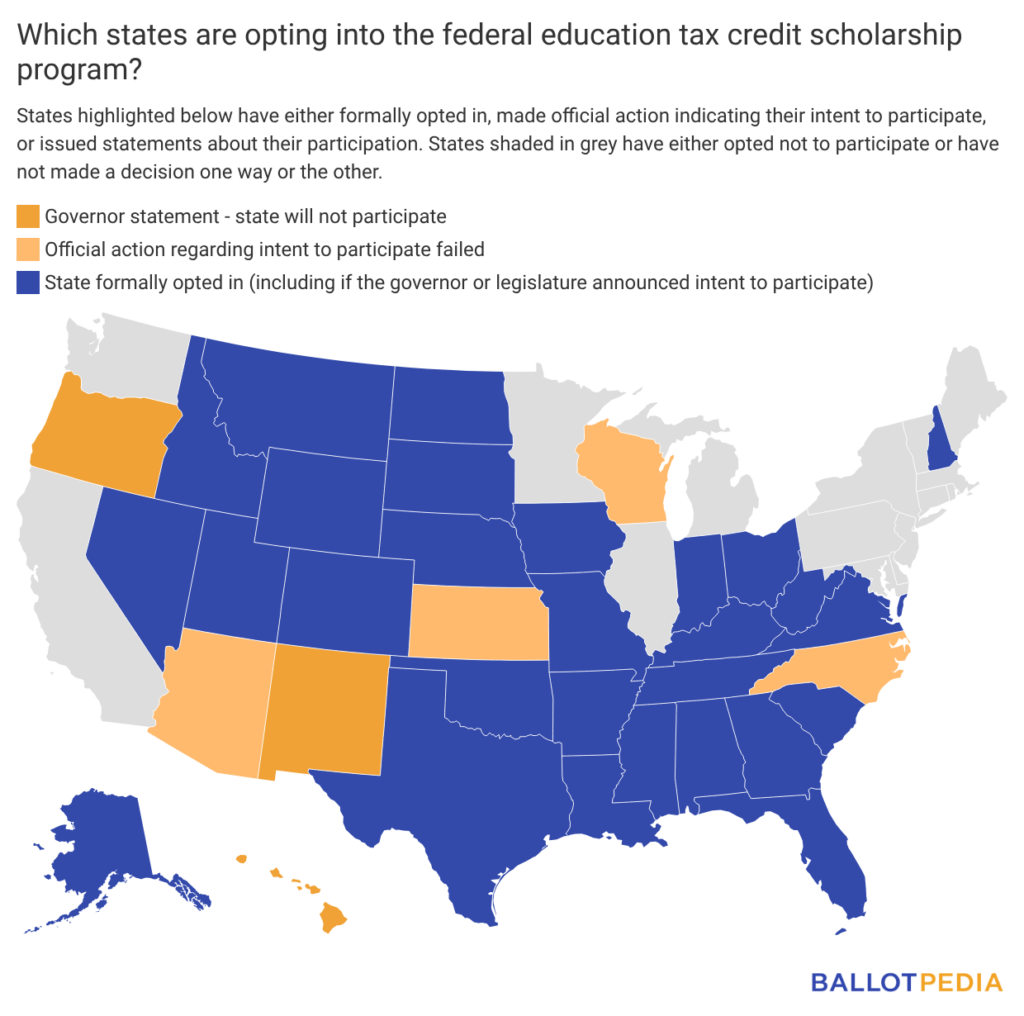
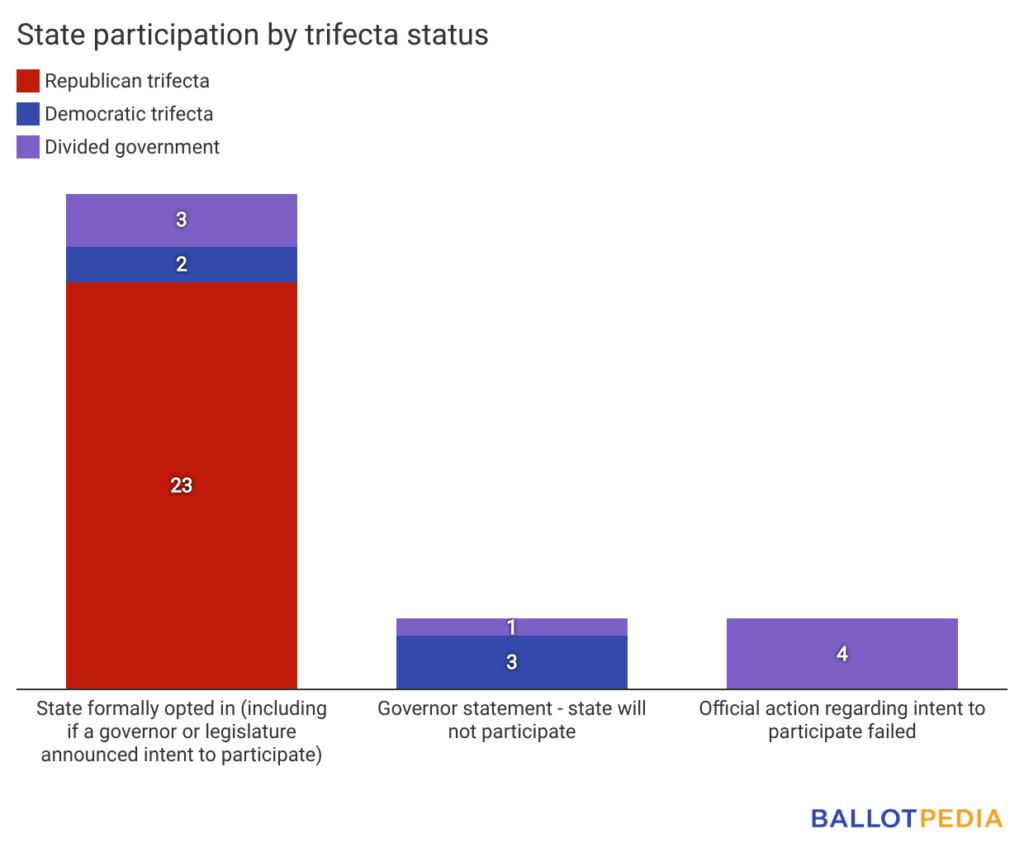
The Democratic governors of Kansas and Wisconsin both vetoed bills that would have opted their states into the federal school choice tax credit scholarship program. They became the fourth and fifth Democratic governors to veto bills to opt into the program. At least 27 states have officially opted in, 23 of which have Republican trifectas.
Democratic vetoes
On April 6, Kansas Gov. Laura Kelly (D) vetoed House Bill (HB) 2468, which would have permanently opted the state into the program. Kansas has a divided government, but Republicans in the Legislature have a veto-proof majority. Kansas’ legislative session ended on April 10. There was no motion to reconsider the vetoed bill.
On March 30, Wisconsin Gov. Tony Evers (D) vetoed Assembly Bill (AB) 602, which would have required the state to opt into the program annually. Wisconsin has a divided government, with a Republican-controlled Legislature and a Democratic governor. Republicans in the Legislature do not have a veto-proof majority, meaning they cannot override Evers' veto without Democratic help. Wisconsin requires two-thirds of members present in both chambers to vote to override a veto. Currently, Republicans have an 18-15 majority in the Senate and a 54-45 majority in the Assembly. As of this writing, there was no motion to reconsider the vetoed bill.
State legislators in both Wisconsin and Kansas voted mainly along party lines, with Republicans generally supporting and Democrats generally opposing. No Democrats in either state supported the bill. Some Republicans in both Kansas chambers also voted against opting into the tax credit.
Three other Democratic governors have vetoed similar bills. Kentucky Gov. Andy Beshear (D) vetoed HB 1 on March 16, but the Kentucky General Assembly overrode the veto on March 17. The new law requires the Secretary of State to opt into the program each year.
Arizona Gov. Katie Hobbs (D) vetoed SB 1106 on Jan. 16, but has not yet signed or vetoed a similar bill that the Legislature sent to her on April 8. North Carolina Gov. Josh Stein (D) was the first governor to veto a similar bill, doing so in August 2025. In his veto message, Stein said, “Once the federal government issues sound guidance, I intend to opt North Carolina in so we can invest in the public school students most in need of after school programs, tutoring, and other resources.” The North Carolina General Assembly is scheduled to vote on whether to override the veto on April 21.
Thirty-five states have taken action indicating whether they will participate in the program.
Here’s a look at the breakdown of state participation by trifecta status:
Click here to learn more about state participation in the federal K-12 education tax credit scholarship program. To learn more about how the program works, visitthis page. Plus, to see our previous Daily Brew and Hall Pass coverage of this program, clickhere, here, and here.
Editor’s note: This post has been updated to clarify the number of seats each party would need to gain to change control of state legislative chambers or break existing trifectas in Maine, Washington, New Mexico, New Hampshire, and Georgia.