


Welcome to Ballot Bulletin: Ballotpedia's Weekly Election Policy Digest. Every Tuesday, we deliver the latest updates on election policy around the country, including nationwide trends and recent legislative activity.
In this week’s edition, we cover 289 bills state legislatures acted on last week and look at the alignment of municipal and school board elections with regular statewide election dates.
The state of election legislation in the U.S.
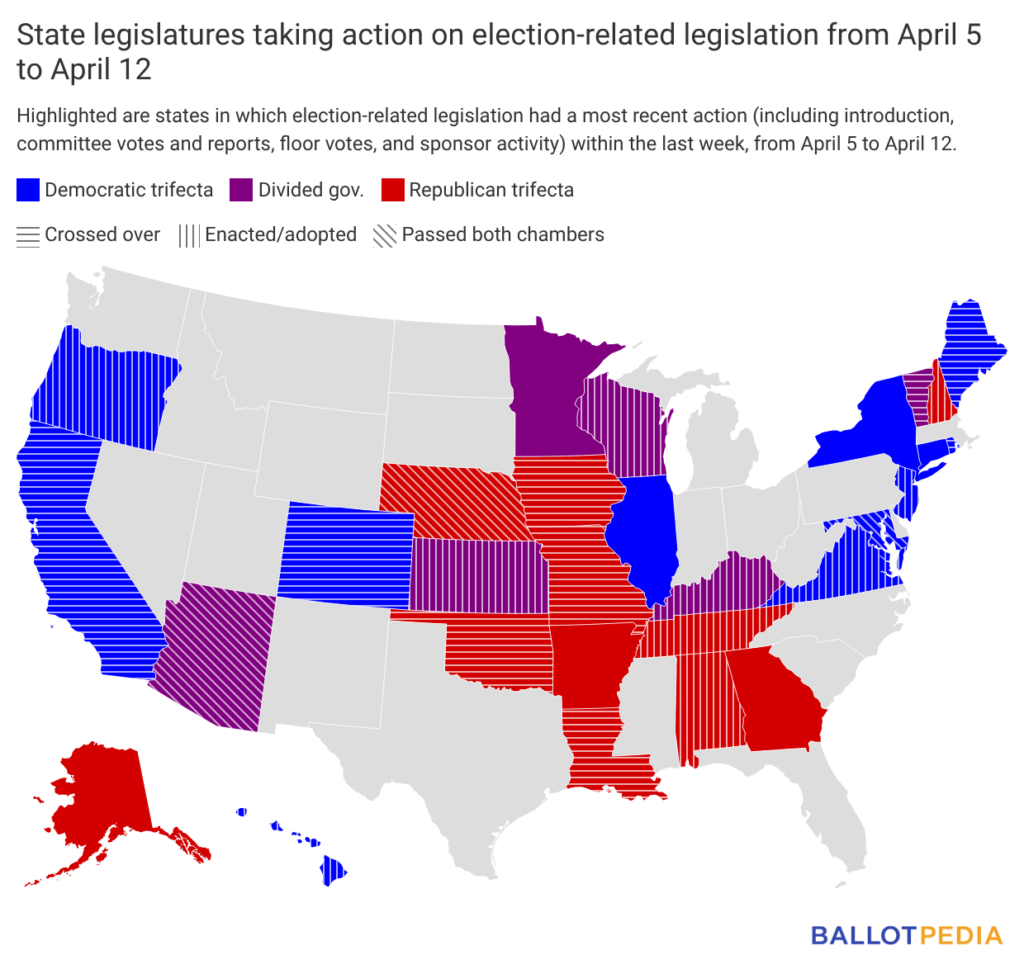
Lawmakers in 29 states acted on 289 election-related bills last week. Thirty state legislatures are in regular or special sessions. Last week, 26 bills were enacted, 29 bills passed both chambers of a state legislature, and six bills were vetoed.
Of the bills acted on last week, 144 (49.8%) are in states with Democratic trifectas, 115 (39.8%) are in states with Republican trifectas, and 30 (10.4%) are in states with divided government. The most active bill categories last week were campaign finance (116), election types and stages (87), and ballot measures (63).
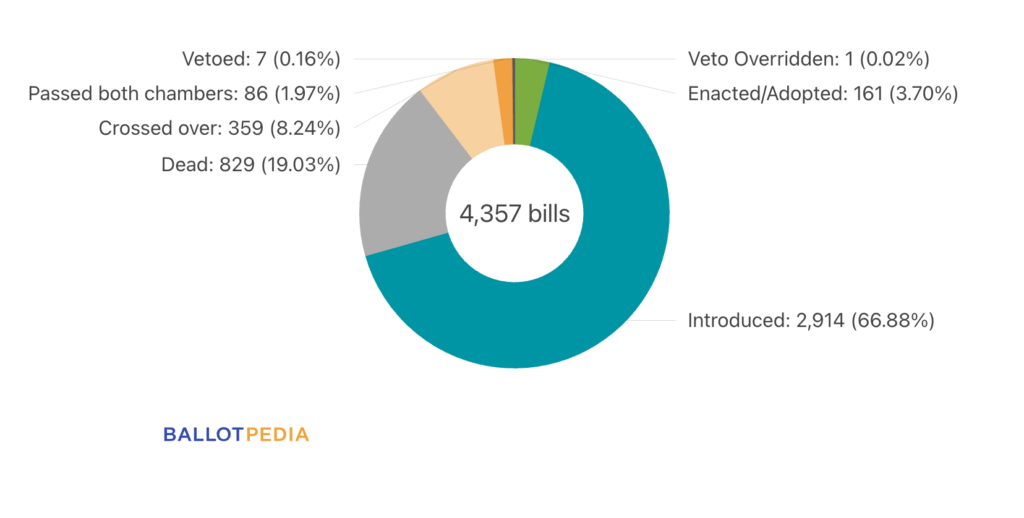
Ballotpedia is currently tracking 4,357 election-related bills across the country. We are actively processing bills filed since April 4.
The chart below breaks down the status of those 4,357 bills by where they stand in the legislative process:
Enacted bills
On April 9, the Kansas House and Senate overturned Gov. Laura Kelly’s (D) veto of HB 2437 84-39 and 28-11, respectively. Kelly vetoed the bill on April 9. HB 2437, titled the SAVE Kansas Act, requires scheduled checks of the state voter list against the federal Systematic Alien Verification for Entitlements (SAVE) database maintained by the Department of Homeland Security. It also requires county election officers to remove voters with driver’s licenses issued by another jurisdiction from the rolls if no confirmation of Kansas residency is received within 45 days of receiving a confirmation notice.
On April 9, Wisconsin Gov. Tony Evers (D) signed AB 374 into law. It aligns the state’s vote canvassing and certification deadlines with the Electoral Count Reform and Presidential Transition Improvement Act of 2022.
New Hampshire Gov. Kelly Ayotte (R) signed HB 323 into law on April 3, and the action was recorded on April 6. The bill removes student IDs from being considered acceptable forms of voter ID.
Twenty-three other bills were enacted or adopted last week:
- Alabama (Republican trifecta)
- Hawaii (Democratic trifecta)
- SR 99 (Senate resolution adopted)
- Kansas (Divided government)
- Kentucky (Divided government)
- New Jersey (Democratic trifecta)
- Oregon (Democratic trifecta)
- Tennessee (Republican trifecta)
- Virginia (Democratic trifecta)
Bills passing both chambers
On April 10, the Nebraska Legislature passed LB 1075, sending the bill to Gov. Jim Pillen (R). Among other provisions related to election workers, candidate filing forms, and recounts, the bill would define “foreign national” and prohibit such persons from contributing to ballot question committees or making expenditures to support or oppose ballot questions.
Twenty-eight other bills passed both chambers last week:
- Alabama (Republican trifecta)
- Arizona (Divided government)
- Maryland (Democratic trifecta)
- Nebraska (Republican trifecta)
- Tennessee (Republican trifecta)
To see a full list of bills awaiting gubernatorial action, click here.
Vetoed bills
Six election-related bills were vetoed last week:
- Kansas (Divided government)
- Kentucky (Divided government)
- Wisconsin (Divided government)
All bills
The chart below shows all bills Ballotpedia is currently tracking, broken down by partisan sponsorship:
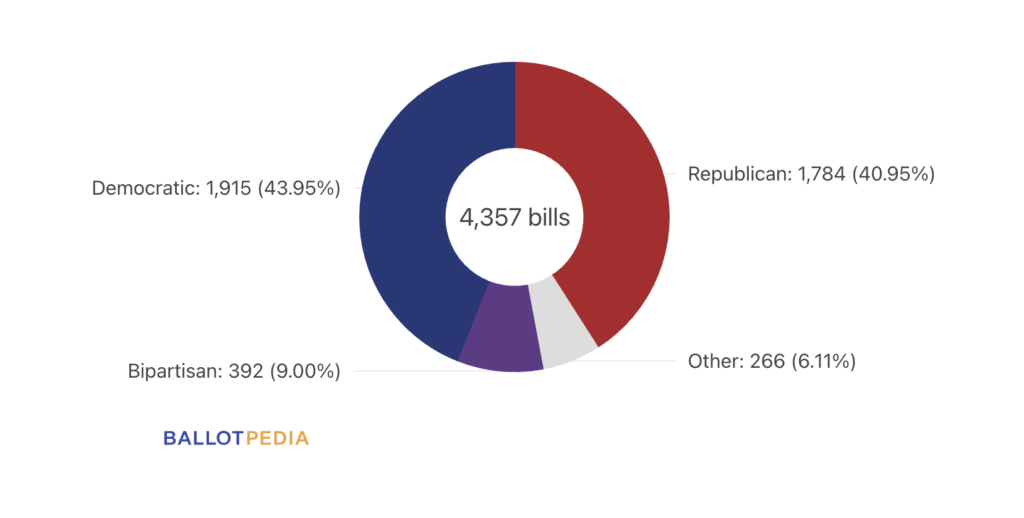
We are currently following 4,357 election-related bills, including bills carried over from the previous year.
- Trifecta status
- Democratic: 1,875 (43%)
- Republican: 1,600 (36.7%)
- Divided: 882 (20.2%)
- Partisan sponsorship
- Democratic: 1,915 (44%)
- Republican: 1,784 (40.9%)
- Bipartisan: 392 (9%)
- Other: 266 (6.1%)
In the news
On April 9, the U.S. District Court for the District of Massachusetts dismissed a complaint from the U.S. Attorney General requiring the Massachusetts Secretary of State to provide unredacted voter lists to the Department of Justice. Federal courts rejected similar DOJ lawsuits to compel states to share voter lists in California, Michigan, and Oregon.
In its lawsuit, the federal government said that Massachusetts had violated the Civil Rights Act of 1960 by refusing to provide its electronic statewide voter registration list upon request. Massachusetts Secretary of State William Galvin said that the federal government’s request was invalid since it did not demonstrate a basis or plausible purpose for providing the statewide voter list 22 months before a federal election.
In its ruling dismissing the federal government’s complaint, the court held that the U.S. Attorney General’s demand for Massachusetts’ unredacted voter list did not meet the preconditions for obtaining documents under the Civil Rights Act.
Here are other news stories from across the country:
- On April 8, Virginia Gov. Abigail Spanberger (D) signed several noteworthy election-related bills into law, including HB 1014 and SB 34. Both bills specify conditions under which individuals may be deemed lacking mental capacity to vote by a court and establish a petition process for such individuals. April 13 was the deadline for the governor to sign or veto legislation.
- On April 6, the Republican National Committee filed a lawsuit in the Circuit Court for the City of Richmond challenging the constitutionality of a Virginia law allowing Americans born and residing outside the country to vote in the state under certain conditions. In the complaint filed with the court, the RNC said that the Virginia Constitution “limits the franchise to persons who are residents of the Commonwealth and of the precinct in which they vote.”
- On April 7, the Republican National Committee and North Carolina State Board of Elections agreed to settle a lawsuit regarding the removal of individuals self-identifying as noncitizens in jury duty forms from voter rolls. If the Wake County Superior Court approves the settlement, it would create a timeline for the state board to use jury questionnaire responses to remove noncitizens from the rolls.
Policy spotlight: Four states have consolidated municipal or school board elections statewide since 2022
The story below is adapted from a recent Ballotpedia News story by Andrew Bahl.
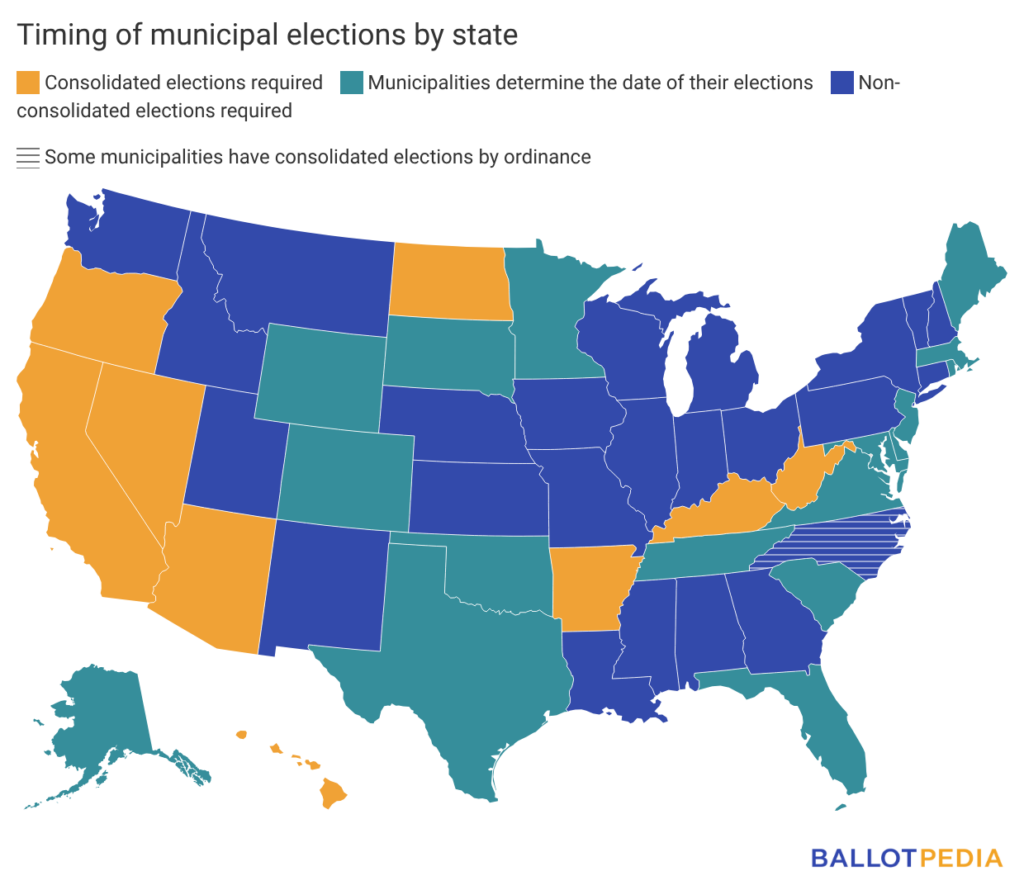
Each state has different rules dictating when general elections for municipal offices and school boards are held. Certain states have moved to require these local elections to take place at the same time as statewide elections.
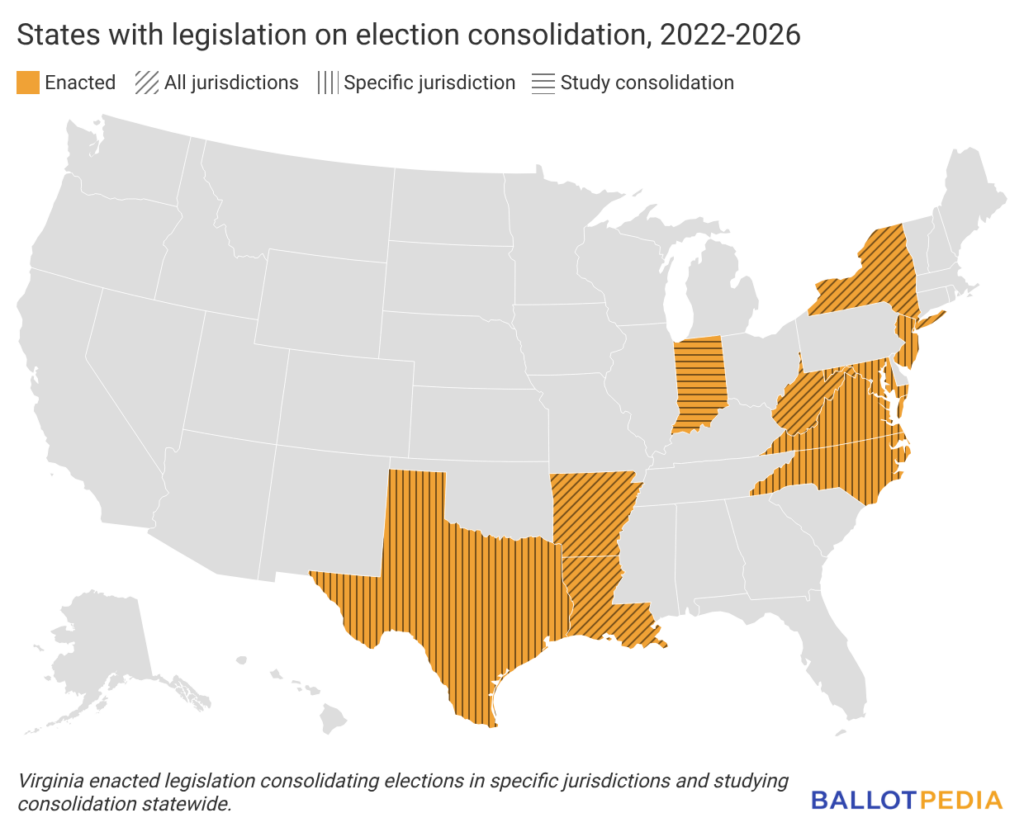
Since 2022, four states — Arkansas, Louisiana, New York, and West Virginia — have enacted laws mandating the consolidation of elections statewide. Arkansas (school board elections) and West Virginia (municipal elections) are the most recent states to do so, enacting their consolidation laws in 2025.
Nine states mandate consolidated elections for municipal offices, which means they require municipal elections to take place alongside a statewide primary or general election. Twenty-four states require municipal elections to be held at times other than statewide elections, and 17 states allow municipalities to choose their election date.
Thirteen states require consolidated elections for school board races, while 21 states require school board elections to be held on a different election date. In 15 states, school board election timing is determined at the local level or varies by type of school district.
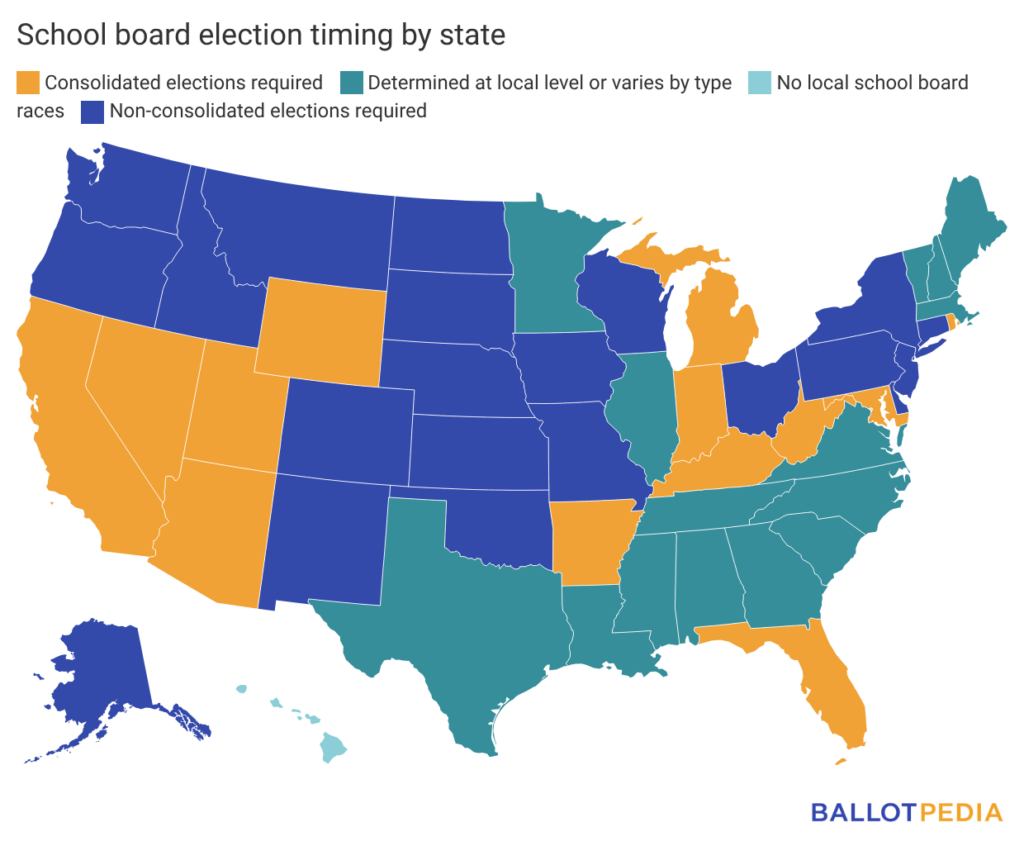
Five states — Maryland, New Jersey, North Carolina, Texas, and Virginia — have passed laws mandating election consolidation in some jurisdictions. Indiana and Virginia have passed laws requiring that statewide consolidation be studied.
Proponents say that consolidating elections saves taxpayer money, improves voter turnout, and ensures that those voting in local elections represent the broader electorate. Opponents say that consolidating elections makes it harder for local races to get attention, makes ballots longer, and makes it harder for candidates affiliated with minority parties to win.
In 2026, 31 states have introduced 74 bills related to election alignment. Legislators in Arizona have advanced a constitutional amendment that would require election consolidation. Currently, state statute mandates that municipal and school board elections must be held alongside statewide elections, but the Arizona Supreme Court has ruled that municipalities with other dates in their charters are exempt.
Four states have adopted legislation dealing with election alignment in 2026. On Feb. 23, South Dakota Gov. Larry Rhoden (R) signed a bill giving municipalities the option of holding municipal elections only in even years, rather than annually. New Mexico legislators passed a constitutional amendment that would repeal a requirement that school district elections be held on different days than partisan elections. It will appear before voters in November 2026.
In 2025, seven states enacted 10 bills dealing with election alignment. In 2024, four states enacted four such bills, and in 2023, 15 states enacted 30 bills.
For more information on the timing of municipal and school board elections, click here.