


Welcome to Hall Pass, a newsletter written to keep you plugged into the conversations driving school board governance, the politics surrounding it, and education policy.
In today’s edition, you’ll find:
- On the issues: The debate over teachers' use of AI
- School board filing deadlines, election results, and recall certifications
- Democratic governors veto bills to participate in federal school choice tax credit scholarship
- Extracurricular: education news from around the web
- Candidate Connection survey
Reply to this email to share reactions or story ideas!
On the issues: The debate over teachers' use of AI
In this section, we curate reporting, analysis, and commentary on the issues school board members deliberate when they set out to offer the best education possible in their district. Missed an issue? Click here to see the previous education debates we’ve covered.
Previous editions of Hall Pass have delved into debates around artificial intelligence (AI) and K-12 education policy, including the role it should play in student learning, whether it should be included in K-12 curricula, and whether the federal Congress or the states should primarily regulate it.
This week, we are going to look at the debates around teachers' use of AI. Thirty-four states have issued guidance on K-12 AI use, with many offering guidelines for how teachers can use the technology.
Teacher AI usage generally includes creating lesson plans or assessments, completing administrative tasks, or establishing grading rubrics, among other uses.
Dr. Peter Zhang, a pharmacist and technology professional, and Dr. Nidhi Sachdeva, a curriculum and instructional creator, say that AI can prepare lesson materials in line with well-regarded instructional practices that would otherwise have a high time cost for educators. They say it can develop lesson plans, individualized explanations for concepts students may struggle to grasp, and low-pressure quizzes to give teachers more time to spend on instructional time with students.
Educator Marcus Luther says he's concerned about the lack of transparency around teacher AI use and how teachers’ use of AI exemplifies the learning process for students. Luther says that though he believes teachers are "under-resourced when it comes to the time [they] need to fully do [their] jobs," he is concerned that using AI for grading or feedback could lessen a teacher's understanding of what each student needs or where they are academically.
Why (and How) Teachers Should Use Generative AI in the Classroom | Dr. Peter Zhang and Dr. Nidhi Sachdeva, Faculty Focus
"Building an effective and engaging lesson plan takes time and effort. For each lesson plan, teachers have to determine how to best deliver content while tailoring the quantity and complexity of materials to students’ pre-existing knowledge. … In this respect, generative AI tools can do much of the heavy lifting. When carefully prompted, it can present thorough lesson plan recommendations to educators.
…
"Much like lesson planning, providing explanations for students is ESSENTIAL. Explanations are needed so that students can make sense of new knowledge and process it deeply to connect it with their pre-existing knowledge. … Generative AI tools can tailor its outputs to its audience. By asking generative AI tools to translate complex ideas in simple terms, students are more likely to understand concepts. Instructors can also directly inform the generative AI tool the level of their students’ prior knowledge and the machine can respond accordingly.
…
"Regular creation of retrieval practice devices such as low-stakes quizzes, multiple choice questions, and polls is an exhausting process. The act of creating quizzes requires creativity, expertise, and a whole lot of time. Educators generating these devices from scratch often require a large amount of time and effort. Time and effort that overworked teachers often do not have. … The automation of this process with generative AI creates the efficiency necessary to implement retrieval practice on a regular basis."
What Worries Me About Teachers’ Use of AI | Marcus Luther, Eduptopia
"I’m typically quite open-minded as a teacher about people using different approaches in different contexts, but there are some values that should be universal—and one of those is a commitment to transparency around our practices.
…
"Beyond student perception, I believe part of our work as teachers is to be academic role models for students, and there is a ton of value in walking the walk as much as possible alongside them. For example, if I expect students to be able to craft an essay with zero support from AI, there is a ton of value in me going through the same process in crafting exemplar essays beforehand.
…
"First of all, time spent on something as a teacher sends a signal to students about how much we value it—and lack of time spent similarly sends the opposite signal. This is one of the reasons I am so against the use of AI-generated feedback for student writing: How can I ask them to care about their own writing if I do not invest my time in reading and responding to it?
"There is also real value in the time we spend doing our work. It takes considerable time as an English teacher to thoughtfully read essays and craft meaningful feedback, yes, but the end result is that I have a deep, authentic understanding of what my students need individually and collectively as writers—the foundation, I believe, of what can be truly transformational work in the classroom."
School board update: filing deadlines, election results, and recall certifications
In 2026, Ballotpedia will cover elections for more than 30,000 school board seats. We’re expanding our coverage each year with our eye on covering the country’s more than 80,000 school board seats.
Election results from the past week
April 7
Ballotpedia covered the April 7 school board general elections in Iowa, Missouri, Oklahoma, and Wisconsin. To view the results, click the links for each state. For a deep dive on the Oklahoma and Wisconsin school board elections, see this earlier edition of Hall Pass.
April 14
Ballotpedia covered the April 14 general election in South Carolina's Marion 10 School District, in which seats for districts 1, 3, 4, and 5 were up for election. We also covered an April 14 special election for Minnesota's Columbia Heights Public Schools' at-large board seat. To view the results, click the links for each district.
Upcoming school board elections
Ballotpedia’s staff is covering school board elections for 461 seats in 274 districts in the next 30 days.
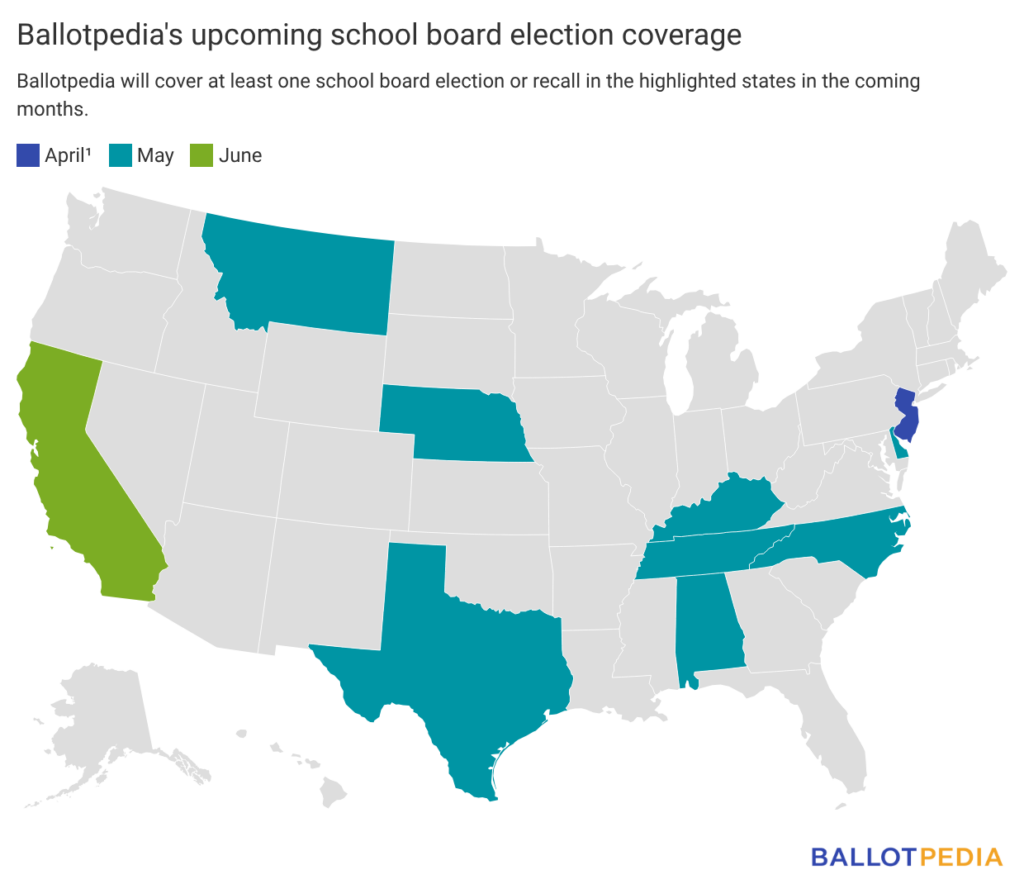
New Jersey
Ballotpedia will cover elections on April 21 for the Newark Public Schools Board of Education.
Watch future editions of Hall Pass for the May primary and general election results in Alabama, Delaware, Kentucky, Montana, North Carolina, Tennessee, and Texas.
Democratic governors veto bills to participate in federal school choice tax credit scholarship
In the last month, Democratic governors of Kentucky, Wisconsin, and Kansas vetoed bills opting their states into the federal school choice tax credit scholarship program. They became the third, fourth, and fifth Democratic governors to veto bills opting into the program, after Arizona Gov. Katie Hobbs and North Carolina Gov. Josh Stein. All five of these states have divided governments where Republicans control both chambers of the legislature. In two of them — Kansas and Kentucky — the legislature overrode the governor's veto within days.
On April 6, 2026, Kansas Gov. Laura Kelly (D) vetoed House Bill (HB) 2468, which would have required the state to opt into the program annually. The Legislature overrode the veto on April 10.
On March 30, Wisconsin Gov. Tony Evers (D) vetoed Assembly Bill (AB) 602, which would have required the state to opt into the program annually.
On March 13, Kentucky Gov. Andy Beshear (D) vetoed House Bill 1 which requires the secretary of state to annually opt the state into the program. The General Assembly overrode the veto on March 17.
One Democratic governor, Colorado's Jared Polis, opted into the program. Some, including Pennsylvania Gov. Josh Shapiro, New Mexico Gov. Michelle Lujan Grisham, and Oregon Gov. Tina Kotek, said they are waiting to see what federal regulations the U.S. Treasury issues to implement the program before deciding what to do. In his veto message, Stein said he would opt into the program when the federal government issued what he called sound guidance. The regulations were pending as of April 14.
At least 29 states have officially opted into the program, 23 of which have a Republican trifecta. Four states with divided governments — Alaska, Kansas, Kentucky, and Nevada — have opted in, and two states with Democratic trifectas — Colorado and Virginia — opted in. Former Virginia Gov. Glenn Youngkin (R) opted into the program in Jan. 2026, shortly before Gov. Abigail Spanberger (D) took office. Visit Ballotpedia's page on state participation to learn more about which states have taken action on the program.
About the program
The U.S. school choice tax credit scholarship is a nonrefundable tax credit, allowing individuals to receive federal tax credits for donations up to $1,700 to authorized scholarship-granting organizations (SGOs). It is a dollar-for-dollar nonrefundable tax credit, meaning individuals can lower their federal tax liability by $1 for every $1 donated to accredited SGOs. If a taxpayer donates more than $1,700, they will not receive a tax refund for the amount over $1,700. The total amount of credits the program can offer is not capped.
SGOs distribute the donated scholarship funds to eligible families, which can be used on a variety of private or public educational expenses, including private school tuition, tutoring services, textbooks, and more. In order to qualify for scholarships, students had to live in households earning no more than 300% of the area's median gross income and be eligible to enroll in K-12 schools. The program will take effect January 1, 2027.
States that elect to participate must submit a list of SGOs that taxpayers can donate to in order to receive the federal tax credit. Students in states that do not opt in cannot receive scholarships funded under the program, but donors in those states can still receive a federal tax credit by donating to SGOs in participating states. As enacted, the program will not affect state budgets.
Democratic responses to the program
Support and opposition to the program do not lie along party lines. While Democrats tend to oppose the program, some in the party support the opportunity for public or private school students to receive funds under the program. Conversely, while Republicans have largely supported the program, some have historically opposed school choice, particularly those who represent rural school districts (see Ballotpedia's research on legislative vote history for past school choice proposals). In Kansas, some Republican legislators broke with their party to oppose HB 2468.
Democratic debates about the federal school tax credit scholarship generally concern the program's nature, whether states should participate, and how the U.S. Treasury should craft regulations implementing it.
Opponents of the program, including Public Funds for Public Schools, say that the program is poorly designed, it could take money away from public schools, and that opting in would be irresponsible. Some Democrats want to add nondiscrimination requirements for schools receiving funds under the program. Others, including Stein, want to use it to prioritize public school funding.
Democratic supporters of the program say that, though it benefits private school students, donations accrued under the program can augment public education as well. CEO of Democrats for Education Reform Jorge Elorza said, "For too long, the political Left has allowed the debate over school choice to be defined and dominated by conservatives. In doing so, we’ve neglected the most dynamic lever for equity and innovation in American education while alienating the Black, Latino, and working-class families we claim to represent. It’s time for progressives to come to the school choice table—not to dismantle public education, but to reinvent it for a new era."
Democratic opponents of the program say that while many people believe the program is free for states, they believe it could harm other programs that depend on federal tax revenue that the federal school choice program would surrender. Kevin Welner with the National Coalition for Public Education said, "[F]or every dollar contributed to an SGO, the federal budget loses a dollar that would otherwise be paid in taxes. … Currently, the two biggest federal programs are Title I Grants to local school districts (about $18.4 billion) and IDEA Special Education State Grants (approximately $15 billion). This voucher program could dwarf those. … The loss of federal funds under Title I and other programs, with funding instead diverted to this tax credit program, will place very real pressures on state budgets."
Read Ballotpedia's full taxonomy of arguments and policy proposals for the program here.
What's next
The U.S. Treasury Department must establish regulations for the program. While no final guidance establishing the program had been issued as of April 14, the U.S. Treasury issued a notice in November 2025 requesting comments on policies it was considering. The notice indicated the IRS's intention to set certain policies for the program, including the following:
- Requiring states to list all organizations located in the state that have requested to be designated as an SGO and that meet OBBBA's requirements for SGOs.
- There are questions over whether states should be able to tailor the program by authorizing specific SGOs that support specific educational sectors. SGOs may have specific focuses, like providing students with disabilities scholarships for educational expenses. SGOs already exist in many states. Some SGOs provide services in multiple states. This guidance indicates that states may not have the authority to reject an SGO's participation in the program so long as it meets OBBBA's requirements.
There have been more than 2,400 responses to the Treasury notice since November 2025.
Ballotpedia is closely following the Treasury's guidance and state responses to the federal K-12 education tax credit. Click here to see the latest news, a timeline of state actions, and a taxonomy of arguments for and against the program. To learn more about how the program works, visit this page.
Extracurricular: education news from around the web
This section contains links to recent education-related articles from around the internet. If you know of a story we should be reading, reply to this email to share it with us!
- CCS spent millions on fixes for schools set for demolition | The Columbus Dispatch
- Is Colorado’s 4-day school week trend impacting student learning? A panel of education experts weighs in. | The Colorado Sun
- ‘Success Sequence’ Urges Marriage, Then Parenthood. These States Want Schools to Teach It | EducationWeek
- Cellphones will be banned in Maine schools this fall | Bangor Daily News
- High-Need Connecticut School District Doing ‘Things People Don’t Believe Are Possible’ | The74
- Tennessee House agrees to increase school choice scholarships | The Center Square, Tennessee
Take our Candidate Connection survey to reach voters in your district
Today, we’re looking at responses from the two candidates running in the May 2 general election for the Clear Creek Independent School District 3 seat in Texas.
The Clear Creek Independent School District operates 48 schools. The district served 40,132 students during the 2023-2024 school year.
Incumbent Arturo Sanchez's professional experience includes serving as the Director of External Relations at NASA Johnson Space Center. Here’s how he answered the question, “What are the main points you want voters to remember about your goals for your time in office?”
- "My top priority is maintaining the fiscal discipline that allowed us to adopt the lowest tax rate in over 30 years for the 2024-2025 school year. In a time of stagnant state funding, we must continue to use data-driven strategies to maximize every taxpayer dollar, ensuring funds directly support student achievement and classroom innovation.
- I am committed to advancing CCISD’s Vision 2030 strategic plan, our commitment to transform educational experiences to better prepare students for future majors, careers, and military pathways through programs like the STREAM of Innovation. By integrating Space, Technology, Robotics, Engineering, Arts, and Medicine at the intermediate level into our curriculum, we ensure CCISD remains a 'District of Choice' for students, families, and teachers.
- Teachers have the greatest impact on student success. I will continue to prioritize competitive salaries and professional pathways, such as the Teacher Incentive Allotment, to attract and retain the high-quality staff our students deserve. A strong, supported workforce is the foundation of a stable district."
Click here to read the rest of Sanchez's responses.
Gabriel Gonzales II earned a bachelor's degree from the University of Phoenix in 2022 and attended Southern New Hampshire University. Gonzales' career experience includes working as a teacher. Here’s how he answered the question, “What are the main points you want voters to remember about your goals for your time in office?”
- "Putting Students First Through Academic Excellence: As a classroom teacher, I understand that student success must always be the top priority. That means focusing on strong academics, safe schools, and preparing students for college, careers, or military service. I believe we must maintain high standards while ensuring every student has the opportunity to succeed.
- Supporting and Respecting Teachers: Teacher retention and support directly impact student outcomes. We must ensure teachers have the resources, respect, and professional environment they need to do their jobs effectively. When we support educators, we support students.
- Responsible Leadership and Community Trust: Taxpayers deserve transparency and responsible financial decisions. I believe in common-sense leadership that listens to parents, respects the community, and focuses on results—not politics. My goal is to be a voice for students, families, and educators."
Click here to read the rest of Gonzales' responses.