


In this week’s edition of Economy and Society:
- Labor Department promotes ESG critic to policy director
- Switzerland aligns climate rules with EU standards
- Canada forms sustainable finance council
- Oklahoma Supreme Court strikes down fossil fuel divestment law
- ESG legislation update
- Corporate climate targets rise despite political pressure
In Washington, D.C.
Labor Department promotes ESG critic to policy director
What's the story?
Justin Danhof, a critic of environmental, social, and governance (ESG) investing, was promoted to policy director at the Department of Labor's Employee Benefits Security Administration (EBSA), according to Pensions & Investments. Danhof announced the promotion in an April 9 LinkedIn post. He joined EBSA in April 2025 as a senior policy adviser. The agency oversees the nation's private retirement system and regulates fiduciary standards for retirement plans.
Before joining the Labor Department, Danhof served as head of corporate governance at Strive Asset Management. Former Republican presidential candidate and current Ohio gubernatorial candidate Vivek Ramaswamy founded Strive, which opposes ESG investing practices.
In a September 2025 speech before the Organization for Economic Co-operation and Development, Danhof compared ESG to Marxism and said that "ESG, at its core, looks a lot like a Marxist march through corporate culture."
Why does it matter?
Danhof's promotion places a vocal ESG opponent in a position that influences guidance for retirement plan fiduciaries — the entities legally required to manage employee retirement assets. EBSA said in its September 2025 regulatory agenda that it plans to issue a new rule addressing the extent to which retirement plan fiduciaries may consider ESG factors when selecting investments. The agency indicated it might propose the new rule as early as May 2026, though the timeline is not legally binding.
Stephen Soukup, author of "The Dictatorship of Woke Capital," described Danhof as "essentially the founder of the capital markets pushback against ESG." Danhof has publicly criticized large asset managers, particularly BlackRock and its CEO Larry Fink, for using client funds to advance what Danhof says are political agendas.
What's the background?
Danhof previously worked for the National Center for Public Policy Research, a conservative think tank, where he led the Free Enterprise Project (FEP). The organization described FEP as "the original and premier opponent of the woke takeover of American corporate life and defender of true capitalism." During his tenure there, Danhof filed shareholder resolutions opposing ESG initiatives, engaged with corporate executives and board members, and organized campaigns pushing corporations to avoid what the project characterized as political and social engineering.
The Trump administration has made multiple ESG-related policies since taking office in January 2025. Danhof's appointment and subsequent promotion align with that broader policy direction.
Around the world
Switzerland aligns climate rules with EU standards
What's the story?
Switzerland’s Federal Council announced a proposal on April 7, 2026, that would expand corporate climate reporting and due diligence requirements through a new Federal Act on Sustainable Corporate Governance, aligning the country’s rules more closely with European Union standards.
The proposal would require covered companies to:
- adopt a strategy and code of conduct,
- integrate those standards into risk management,
- identify and rank risks,
- prevent possible harms,
- address harms that have already occurred,
- create complaint and reporting systems, and
- monitor whether those steps work.
The Swiss Federal Council said the reporting rules would apply to about 100 companies, down from about 200 companies under current sustainability and climate reporting requirements. The due diligence rules would apply to about 30 companies.
What's the background?
The European Commission proposed amendments to the Corporate Sustainability Reporting Directive (CSRD) and Corporate Sustainability Due Diligence Directive (CSDDD) in February 2025 as part of a broader effort to simplify regulations and improve the European Union’s economic competitiveness. Officials said the changes would reduce regulatory burden and streamline compliance requirements across member states.
Lawmakers delayed implementation timelines while negotiating the revisions. In December 2025, the European Parliament approved a package that narrowed the number of companies covered and scaled back reporting and due diligence requirements, setting up the European Council’s final adoption of the updated rules.
Canada forms sustainable finance council
What's the story?
Canadian investor group Business Future Pathways (BFP) announced on Apr. 10, 2026, that it appointed a new Taxonomy and Transition Planning Council to develop a national system classifying sustainable investments.
The council will oversee the creation of a sustainable finance taxonomy, a framework that defines which investments qualify as green (environmentally beneficial) or transition (helping reduce emissions over time). It will also guide standards for corporate climate transition plans, which outline how companies would address climate-related risks and reduce emissions.
The 17-member council includes former Chief Investment Officer Marlene Puffer as chair and former Canadian banking regulator Jamey Hubbs as vice chair. It will set criteria for six priority sectors, with the first three expected in 2026, and oversee guidance to help companies integrate climate considerations into business strategy and financial planning.
Puffer said, “To stay competitive and attract investment, Canada needs to send clear signals of our climate-readiness to capital markets. Canada needs credible, internationally-aligned tools—including a sustainable investment taxonomy and transition plan guidance—to mobilize private capital for our companies, communities, and national priorities.”
What's the background?
In December 2025, the Canadian government announced it would create a national sustainable finance taxonomy by the end of 2026. Officials tasked the Canadian Climate Institute with leading technical development and assigned Business Future Pathways to convene a council of financial sector representatives, academics, and other stakeholders to approve the framework.
The taxonomy aims to standardize how investors and companies identify climate-related investments and align Canadian financial markets with international sustainability frameworks.
In the states
Oklahoma Supreme Court strikes down fossil fuel divestment law
What's the story?
The Oklahoma Supreme Court ruled April 8, 2026, that the Oklahoma Energy Discrimination Elimination Act of 2022 is unconstitutional when applied to the Oklahoma Public Employees Retirement System (OPERS). The court also issued a permanent injunction preventing state Treasurer Todd Russ (R) from enforcing the law against OPERS. The court upheld a 2024 Oklahoma County District Court ruling that temporarily blocked enforcement of the law.
The 2022 law required the state treasurer to compile a list of financial companies that boycott energy companies and directed state entities to divest from those firms. Writing for the majority, Justice James Edmondson said the law violated constitutional provisions requiring the OPERS Board of Trustees to fulfill its duties "solely in the interest of the participants and beneficiaries." Four justices concurred with Edmondson's opinion, three dissented, and one recused.
Why does it matter?
The ruling removes legal restrictions that would have forced Oklahoma's public pension system to divest from major financial firms based on their energy sector policies. OPERS had determined that complying with the law would cost millions of dollars. Companies on the treasurer's blacklist controlled 64% of the system's assets, according to the Supreme Court opinion.
The case originated when Oklahoma Public Employees Association President Don Keenan filed suit in 2023, alleging the law forced pension systems to drop fund managers at a cost to retirees. Keenan has since died. The district court found in 2024 that the law's stated purpose of countering a political agenda contradicted the retirement system's constitutional duty to act solely for members' benefit.
What's the background?
The Oklahoma Supreme Court is nonpartisan, but all nine current justices joined the court through gubernatorial appointment. As of 2026, six were appointed by Republican governors and three by Democratic governors.
The Oklahoma law was part of a broader push by Republican-controlled states to counter ESG investing practices. The State Financial Officers Foundation, a Kansas nonprofit promoting anti-ESG legislation, supported the Oklahoma measure. According to Ballotpedia, 22 of the 23 Republican trifecta states enacted legislation opposing ESG between 2020 and 2025, along with three of the 12 states with divided governments.
In February 2026, a U.S. district court invalidated a similar Texas law, the Energy Discrimination Elimination Act, ruling it violated First and Fourteenth Amendment protections. Analysts said the Texas ruling provided a legal roadmap for challenging comparable state laws.
ESG legislation update
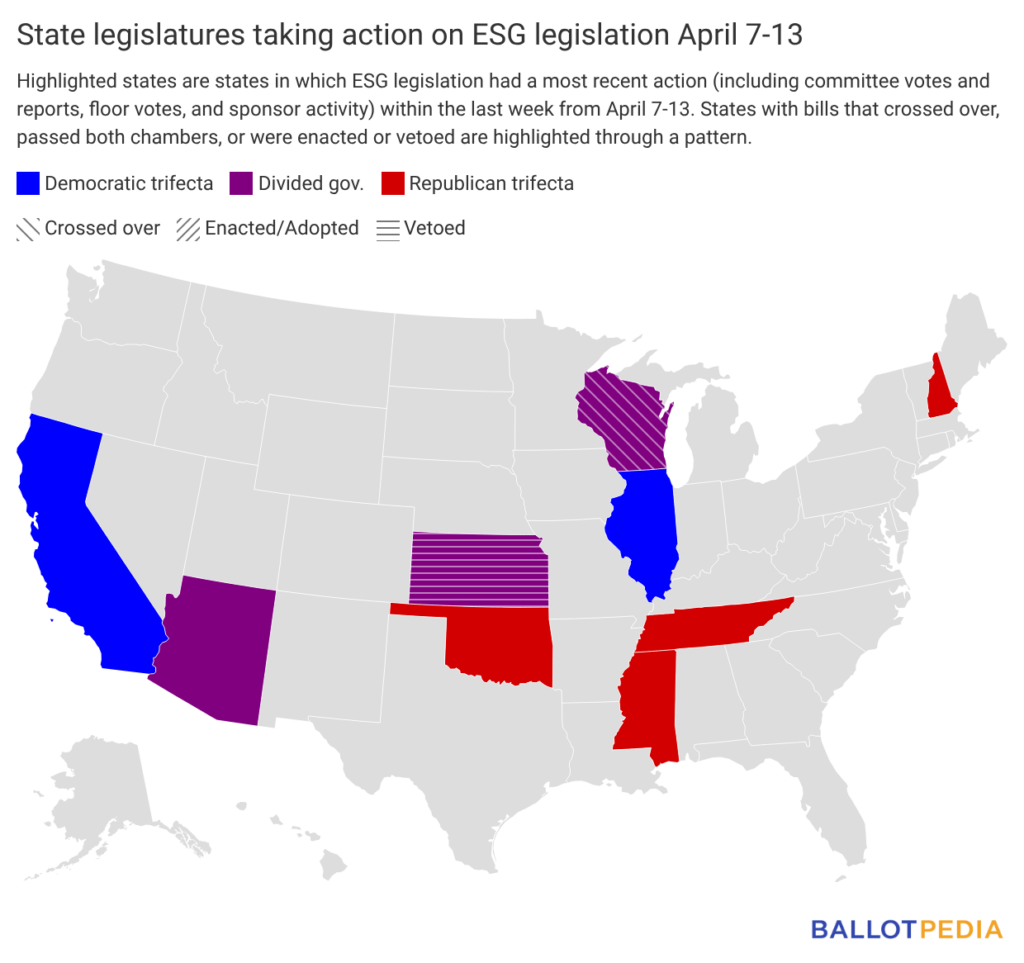
Nine states took action on 14 ESG-related bills last week (since April 7).
States with legislative activity on ESG last week are highlighted in the map below. Click here to see the details of each bill in the legislation tracker.
On Wall Street and in the private sector
Corporate climate targets rise despite political pressure
What's the story?
The Science Based Targets initiative (SBTi) reported on Apr. 9, 2026, that the number of companies worldwide with both near-term climate targets and net-zero goals increased 61% in 2025. SBTi describes itself as "a corporate climate action organization that enables companies and financial institutions worldwide to play their part in combating the climate crisis."
SBTi said more than 12,000 companies had either validated climate targets or commitments to set them by the end of 2025, with validated targets rising 40% year over year. Near-term targets refer to emissions reduction goals set over the next several years, while net-zero targets aim to balance greenhouse gas emissions with removals over a longer timeframe.
Asia had the fastest increase, led by China and Japan, while Africa and Latin America also recorded strong gains. Europe continues to have the highest total number of companies with SBTi-aligned targets.
SBTi CEO David Kennedy said that “The data in this report shows that despite political headwinds, increasing numbers of companies in every region are setting science-based targets. In doing so they are part of a market transformation that is good for business while contributing to achieving global climate objectives.”
What's the background?
State Republican officials have questioned SBTi’s role in corporate climate commitments. On July 28, 2025, Florida Attorney General James Uthmeier (R) announced an investigation into SBTi and the Climate Disclosure Project (CDP), alleging deceptive trade practices and potential antitrust violations related to how companies set and report climate targets. Uthmeier said SBTi validates corporate climate goals and directs companies to CDP to disclose progress.
In August 2025, 23 Republican attorneys general, led by Iowa Attorney General Brenna Bird (R), sent a letter to the organization requesting information about its standards and warning that companies adopting them could risk violating antitrust and consumer protection laws.