Highlights from this edition of Checks and Balances include a U.S. district court order that the Department of Veterans’ Affairs restore collective bargaining contracts, and a Kansas Supreme Court ruling that the Court calls “narrow” in a dispute between the Governor and Attorney General
In Washington
U.S. District court orders Department of Veterans’ Affairs to restore collective bargaining contracts for second time in a month
On March 27, 2026, U.S. District Court for the District of Rhode Island Judge Melissa DuBose issued an order that the Department of Veterans’ Affairs (VA) restore collective bargaining contracts with six worker unions. This comes after a March 2025 executive order that led the VA to terminate these contracts, and weeks after DuBose issued a preliminary injunction to restore them.
On March 27, 2025, President Trump (R) issued an executive order that excluded more than 40 federal agencies with national security-connected missions (including the VA) from federal laws that recognize a right to collective bargaining for federal workers. On Aug. 28, Trump issued another executive order that expanded this exemption to more agencies. In the wake of these executive orders, affected agencies began to terminate their collective bargaining contracts with worker unions. Litigation over the lawfulness of these orders is ongoing in the Ninth and DC Circuit Courts of Appeals.
On Aug. 6, 2025, the VA announced that it was terminating its collective bargaining contracts with five unions. In November, the American Federation of Government Employees’ National Veterans Affairs Council (AFGE/NVAC), the largest of the affected unions, and AFGE Local 2305, which represents VA employees in Rhode Island, filed a suit against the action in the Rhode Island U.S. District Court.
On March 13, 2026, Judge DuBose ruled against the VA and issued an injunction ordering that the Department should reinstate the collective bargaining contracts with these unions. Judge DuBose wrote that VA Secretary Doug Collins had “favored some unions over others” by terminating the specific collective bargaining contracts while leaving others in place. The termination of these specific contracts “seems likely substantially motivated by the plaintiffs’ history and frequency of vocally opposing changes to labor policies,” the injunction continued. President Joe Biden (D) appointed DuBose to her judgeship in 2024.
The VA formally restored the collective bargaining contracts a few days after the March 13 order. According to a March 20 court filing by the plaintiffs, the Department did not implement specific provisions of the contracts. Justice Department attorneys representing the VA told the court that “plaintiffs conflate the court’s order reinstating the master CBA (including its panoply of remedies available for breach thereof) with an order mandating adherence to each and every one of its terms.” AFGE President Everett Kelley said in a statement that the Department “has failed to reinstate a single one of our members’ rights,” and that “Secretary Collins cannot tell a federal judge one thing and then pretend he doesn’t understand what the ruling means.”
On March 26, Secretary Collins wrote a memo to AFGE re-terminating its collective bargaining contract. On March 27, Judge DuBose granted a AFGE motion to enforce her earlier injunction, issued a preliminary injunction ordering the VA to restore the contracts of several other unions, and threatened to hold the Department in contempt of court for what she called “blatant disrespect for not just this court’s order, but for the rule of law.” On April 2, the AFGE announced to its members that the VA was complying with DuBose’s order. Litigation in this case is ongoing, with the VA informing DuBose that it was appealing to the First Circuit Court of Appeals on March 27.
Existing federal worker unions like the AFGE and new organizations like the Federal Unionists Network (which was founded in 2022) have clashed with the second Trump administration as well as with Congress. On Oct. 27, almost a month into the 2025 shutdown of the federal government, AFGE President Kelley issued a statement calling on Congress to end the shutdown in light of its effects on federal workers. The 2025 shutdown was the longest full federal shutdown in history, beginning on Oct. 1 and ending Nov. 12.
Want to learn more?
- Executive Order: Exclusions From Federal Labor-Management Relations Programs (Donald Trump, 2025)
- Department of Veterans’ Affairs
- United States District Court for the District of Rhode Island
In the states
Kansas Supreme Court issues ruling that it calls “narrow” in dispute between Governor, Attorney General
On March 27, the Kansas Supreme Court issued a ruling in the case of Kelly v. Kobach, a dispute between the state’s Governor Laura Kelly (D) and Attorney General Kris Kobach (R) over who has the power to sue on behalf of the state. The Supreme Court dismissed the case in its ruling, calling the decision a “narrow,” one that “ploughed no new legal ground.” Both Kelly and Kobach declared victory after the ruling.
Gov. Kelly sued Attorney General Kobach over whether her office could join lawsuits on behalf of the state of Kansas on Oct. 31, 2025, after Kobach asserted in an earlier lawsuit that only his office had that power. Two justices joined in a decision that “neither attempts to resolve nor draws any conclusion about which official or officials in Kansas have the constitutional authority to speak for the State of Kansas in court,” citing statements made by both sides’ lawyers during oral arguments. They were joined by two justices in a concurring opinion. Two justices dissented, writing that they would rule for Kelly.
What was the case about?
The case started in September 2025, when Attorney General Kobach sued Gov. Kelly for her administration’s refusal to turn over personal information about recipients participating in Supplemental Nutrition Assistance Program (SNAP) to the U.S. Department of Agriculture (USDA). The USDA requested this information from states in May 2025, with at least 27 states complying with this request by October. In July, 21 states filed a suit challenging the request. Kansas was not a part of this suit, though Gov. Kelly did (on the state’s behalf) join a different multi-state lawsuit over federal spending cuts on July 31. On Aug. 14, Kobach filed an amicus brief with the federal trial court in that suit, asking it to remove Kelly as a plaintiff from the suit.
On Aug. 10 the USDA informed Kelly administration officials that it would deny Kansas $10.4 million per quarter in federal SNAP funding if they did not turn over the requested data. While the federal government and states share the administrative costs of SNAP, the federal government pays for the benefits that recipients receive. The 2025 One Big Beautiful Bill Act recently modified the SNAP funding structure, including the creation of a state cost-share program, which would require a state to pay a share of SNAP benefit costs if the program’s error rate in that state exceeds a 6% threshold.
On Sept. 8, Kobach sued Kelly to force her administration to comply with the USDA, arguing that Kansas law required this cooperation with federal officials. State district court Judge Teresa Watson dismissed Kobach’s suit on Sept. 29.
On Oct. 31, Kelly sued Kobach in turn, challenging claims he had made in his suit that the Attorney General had the sole right to officially represent the state of Kansas in court and asserting her right as governor to join suits on the state’s behalf. Attorney general is an elected position in Kansas, and Kobach, a Republican and former gubernatorial candidate, was elected to the position during the same 2022 election in which Kelly, a Democrat, was reelected governor.
The Supreme Court of Kansas heard oral arguments in Kelly’s suit on Jan. 16, 2026, in a special session. The Supreme Court held original discretionary jurisdiction over this case (meaning it could choose to be the first court to hear it) because it was a “quo warranto” (or “by what right”) dispute involving public officials.
What did the court rule?
The Court issued its ruling in the case on March 27, with four of the seven justices voting to dismiss the case and two joining a dissent that would find for Kelly (then-Justice Marla Luckert had recused herself from the case and retired from the Court the next day). In this ruling, the court dismissed Kelly’s suit, but explicitly noted that the ruling as a “narrow” one that “neither attempts to resolve nor draws any conclusion about which official or officials in Kansas have the constitutional authority to speak for the State of Kansas in court.”
Writing for the Court, Justice Caleb Stegall found that in the oral arguments, both Kobach and Kelly’s attorneys had made significant concessions to the other side’s position. He wrote that these concessions were enough for the court to dismiss the case without deciding in favor of the position that either side had going into it. The opinion also noted that “the SNAP Data Dispute could also be characterized as moot” (Gov. Kelly had reached an agreement to share the SNAP data with federal officials at the beginning of March). “Given all this,” Stegall continued, “there is nothing left for us to decide and, apart from political posturing by both parties, the issues presented no longer implicate a matter of significant public importance and instead consist of a political, legal or semantic dispute we will not referee.” Gov. Sam Brownback (R) appointed Stegall to the bench in 2014, and Kelly appointed Justice K. J. Wall in 2020.
Justice Larkin Walsh wrote a concurring opinion (which Chief Justice Eric Rosen joined), in which they noted their agreement with Stegall’s reasoning and their disagreement with the dissenting opinion’s interpretation of the oral arguments. Kelly appointed Walsh to the bench in 2025, and Gov. Kathleen Sebelius (D) appointed Rosen in 2005
Justice Melissa Standridge wrote the dissenting opinion (which Justice Daniel Biles joined), which said that the two sides had not agreed on the major issues in the oral arguments, and that the case, decided less narrowly on its merits, should have been decided in favor of the governor. Kelly appointed Standridge in 2020, and Gov. Sebelius (D) appointed Biles in 2009.
What were the reactions?
Both Kelly and Kobach claimed victory in the wake of the decision. Kelly issued a statement that said that the “Court’s majority opinion recognizes that the Office of the Governor indeed does have an independent voice in litigation regarding matters that impact the executive branch and state agencies overseen by the governor.” Kobach said that “the Kansas Supreme Court dismissed the Governor’s lawsuit because she conceded what we already knew – only the Attorney General can represent the interests of the state of Kansas in court as the state’s chief legal officer.”
Want to learn more?
Featured commentary
How has agency rule drafting changed after Loper Bright? In a draft report to the Administrative Conference of the United States, University of Michigan law professor Daniel Deacon discusses the results of interviews he conducted with agency officials in the wake of the 2024 Loper Bright v. Raimondo case. Deacon argues that the Loper Bright decision changed but did not fundamentally transform rule-drafting practices. Click here to read the full article.
Regulatory highlight
In this section, we highlight one of several regulations reviewed by the Office of Information and Regulatory Affairs (OIRA) each month and discuss an aspect of the federal regulatory landscape. In this edition, we focus on a partisan breakdown of how the Congressional Review Act has been used during the 119th Congress.
Notable regulations
- The Office of Information and Regulatory Affairs (OIRA) completed its review of an National Marine Fisheries Service interim final rule that approved the 2026 and 2027 Atlantic Sea Scallop Fishery Management Plan. It established days-at-sea limits for permit holders, limited access general category allocations, and modified area designations to optimize yield and protect young scallops.
Congressional Review Act
The Congressional Review Act (CRA) allows Congress to repeal executive agency rules with joint resolutions of disapproval. Under the CRA, Congress has 60 working days after a rule has been submitted to Congress to introduce a joint resolution of disapproval.
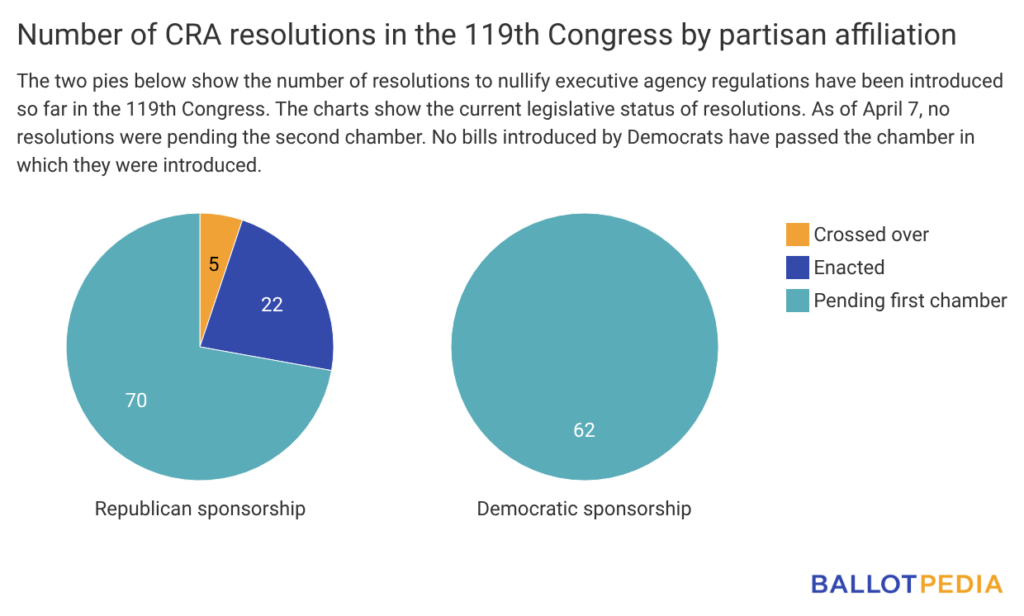
In the last edition of Checks and Balances, we talked about how the CRA has been most often used to repeal regulations from prior administrations using a lookback provision that allows Congress to review regulations issued within the last 60 days of the preceding legislative session. This explains why, even though the federal government has both a Republican president and a Republican-controlled Congress, Congress has enacted 22 resolutions to nullify executive actions during this session; all of the resolutions nullified Biden-era regulations.
Of the 159 resolutions introduced under the CRA this session, Republicans have issued 97 (around 61%). However, Democrats have turned to the CRA in recent weeks, and, since the beginning of March, have introduced 40 of the 62 total resolutions introduced by Democrats this session. These resolutions are unlikely to be enacted, as they face two Republican-controlled chambers and need President Donald Trump's (R) approval. As of April 7, the U.S. Senate had rejected motions to proceed to the consideration of seven resolutions introduced by Democrats.
Here's a breakdown of resolutions and their advancement by party.
- Want to learn more?
Pick of the news
Federal
OMB issues guidance downplaying GAO oversight. The Office of Management and Budget issued an update to Circular A-123, which provides general financial management guidance for executive agencies. This update deemphasizes the role of the Government Accountability Office (which is part of the legislative branch) in financial oversight. Fedweek
Trump admin seeks to downsize CFPB after court losses. Trump administration officials petitioned the U.S. Court of Appeals for the District of Columbia Circuit to allow major staff cuts to the Consumer Financial Protection Bureau (CFPB). This petition comes after administration plans to cut more than 90% of staff, effectively closing the agency, faced several losses in court. New York Times
OMB web portal seeks to recruit early-career employees. The Office of Personnel Management launched an “early-career talent network” web portal aimed at recruiting more early-career job seekers to the federal workforce. Federal News Network
Former Trump admin official to lead inspectors general group. Veterans Affairs Inspector General Cheryl Mason was elected as the chair of the Council of the Inspectors General on Integrity and Efficiency, an organization of federal Inspectors General. Mason, who was confirmed to her VA post last summer, had previously served as a senior advisor to VA Secretary Doug Collins. Government Executive
Federal judge blocks subpoenas of Fed chair. A U.S. district court judge blocked Justice Department subpoenas of Federal Reserve chair Jerome Powell, citing “essentially zero evidence” presented by prosecutors. The Justice Department opened an investigation of Powell in January for alleged false statements to Congress. Powell has denied the allegations. NBC News
Department of Education will transfer student loan portfolio to Treasury. The Department of Education announced it will transfer its portfolio of student loans, worth about $1.7 trillion, to the Treasury Department. President Trump (R) issued an executive order that the Department of Education be closed in March 2025. The Hill
‘God Squad’ meets, waives Endangered Species Act for Gulf of America oil extraction. The so-called ‘God Squad,’ a panel with the power to override environmental laws, met March 31. A 1978 amendment to the Endangered Species Act created the group, which is formally called the Endangered Species Committee. It last convened in 1992. In the March 31 meeting, it waived Endangered Species Act requirements for oil and gas extraction in the Gulf of America (formerly known as the Gulf of Mexico), citing national security considerations. BBC
State
Wyoming Legislature overrides veto of its power over executive branch hiring numbers. On March 6, the Wyoming Legislature voted to override a number of Gov. Mark Gordon’s (R) line-item vetoes, including a veto on statutory language that allows the Legislature to set the number of executive-branch employees. Wyoming Tribune Eagle
New Mexico creates new state division focused on immigrant workers. On March 9, New Mexico Gov. Michelle Lujan Grisham (D) signed a bill into law which elevates the existing Office of New Americans within the Workforce Solutions Department into a permanent state division. The new division will retain its focus on assisting immigrant workers in the state. News from the States
Florida Legislature passes bill which would make it harder to certify public-sector unions. On March 11, the Florida House passed SB 1296. The Florida Senate passed the bill on March 6. If Gov. Ron DeSantis (R) signs the bill into law, it would require that a public-sector union must receive support from more than 50% of employees in a bargaining unit before it can be certified. Florida Phoenix
Legislative Tracking Update
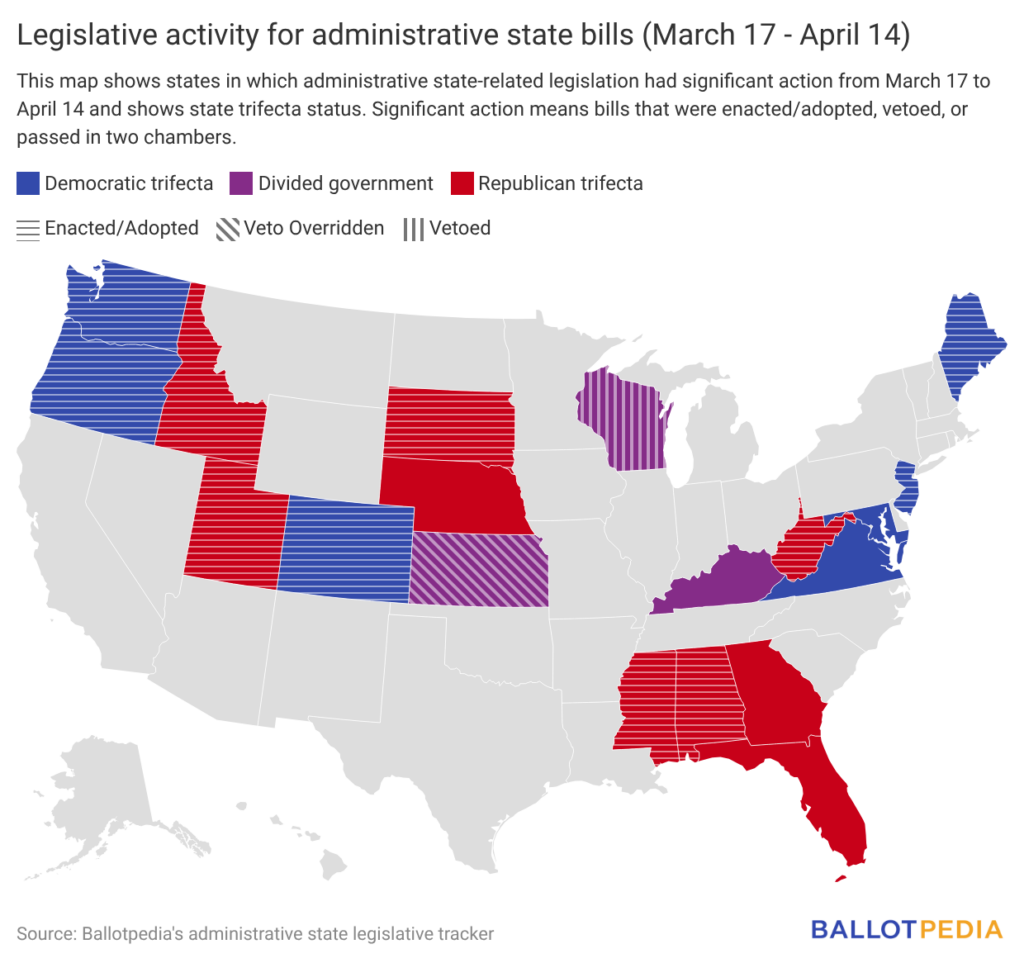
Since our last newsletter edition, Ballotpedia tracked significant legislative action (enactments, vetoes, and passage through both chambers) in 19 states on 109 bills related to the administrative state, as of April 14.
Alabama Gov. Kay Ivey (R), Colorado Gov. Jared Polis (D), Mississippi Gov. Tate Reeves (R), New Jersey Gov. Mikie Sherrill (D), and South Dakota Gov. Larry Rhoden (R) each signed one bill. Florida Gov. Ron DeSantis (R) signed four bills, Idaho Gov. Brad Little (R) signed six bills, Kentucky Gov. Andy Beshear (D) signed two bills, Maine Gov. Janet T. Mills (D) signed two bills, Oregon Gov. Tina Kotek (D) signed two bills, Utah Gov. Spencer Cox (R) signed 14 bills, Virginia Gov. Abigail Spanberger (D) signed five bills, Washington Gov. Bob Ferguson (D) signed four bills, and West Virginia Gov. Patrick Morrisey (R) signed 14 bills.
Kansas Gov. Laura Kelly (D) signed two bills, and the Kansas Legislature overrode her veto to enact three bills into law. Wisconsin Gov. Tony Evers (D) vetoed four bills. The Colorado legislature passed three bills, the Florida legislature passed two bills, the Georgia legislature passed two bills, the Kentucky legislature passed nine bills, the Maryland legislature passed six bills, the Maine legislature passed three bills, the Mississippi legislature passed one bill, the Nebraska legislature passed three bills, and the Virginia legislature passed four bills.
Ballotpedia tracked a total of 1,849 bills related to the administrative state in 2026, as of April 14.