


On April 15, Nebraska Gov. Jim Pillen (R) signed LB 1075, a bill expanding the state’s ban on foreign contributions to ballot measure committees.
In 2022, Nebraska enacted a law banning direct and indirect contributions to ballot measure committees, which Nebraska calls ballot question committees, from foreign citizens, governments, businesses, and political parties.
LB 1075 requires ballot question committees to certify that they have not received contributions from foreign nationals. Donors must also state that they have not accepted more than $100,000 in funds from foreign nationals in the previous four years.
The bill also bans foreign nationals from making independent expenditures on ballot measures and increases fines for violating the prohibition to $100,000 or the amount of the prohibited contribution, whichever is greater.
The legislation, which also included other changes to Nebraska’s election laws, passed the Nebraska Senate — the state’s unicameral legislature — unanimously on April 10.
The bill’s enactment comes after Nebraska Attorney General Mike Hilgers (R) sued Swiss national Hansjörg Wyss and six other groups in November 2025 for allegedly violating the state’s prohibition on foreign national contributions to ballot measure campaigns.
“We’re taking what I’m calling a bold and a really, really needed step forward to ensuring Nebraska’s elections remain the gold standard for security and transparency,” Pillen said after signing the bill.
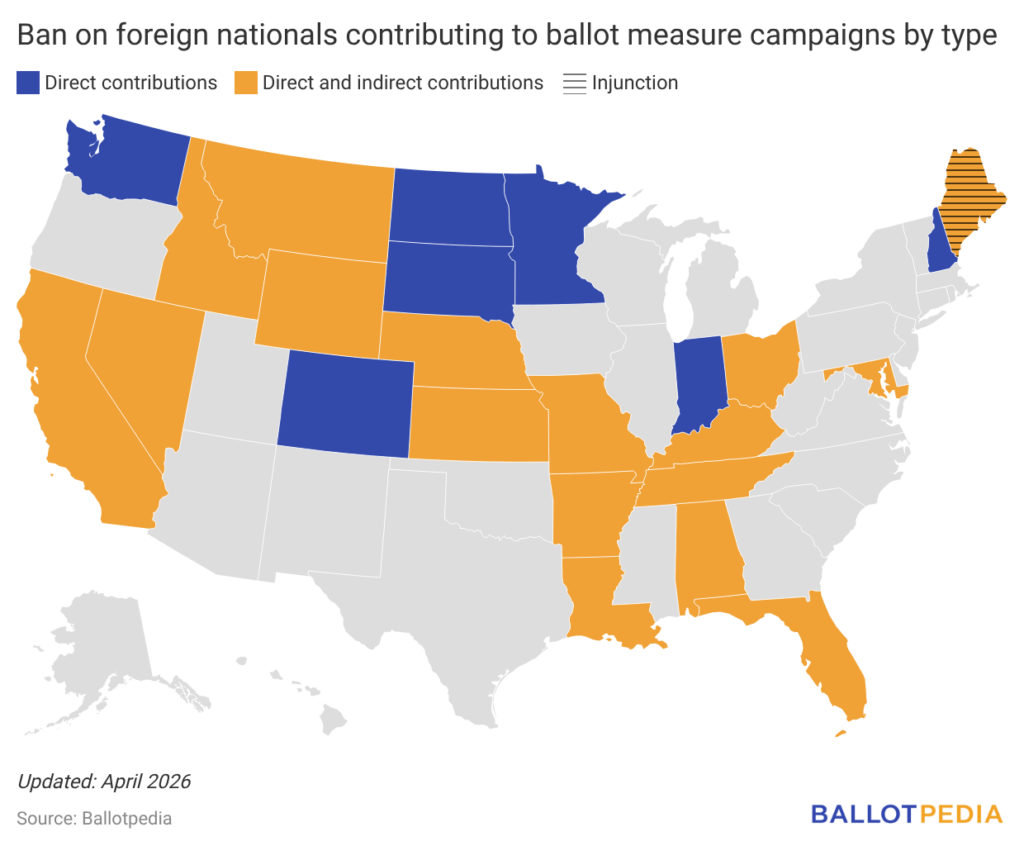
Nebraska is one of 24 states that have enacted laws banning foreign nationals or governments from contributing to ballot measure campaigns.
Seven states have enacted bans on direct contributions, while 17 states have banned direct and indirect contributions from foreign individuals or entities.
Nebraska became the second state in 2026 to enact legislation related to prohibiting foreign contributions to ballot measure campaigns. Alabama enacted legislation in March banning foreign national donations to both ballot measure and candidate campaigns.
Nationally, legislators in 29 states have introduced or carried over 90 bills related to foreign funding of elections in 2026.
Campaign finance rules for ballot measures differ from those for candidate elections. In 1978, the U.S. Supreme Court ruled in First National Bank of Boston v. Bellotti that spending on ballot measure campaigns is similar to issue advocacy in the lawmaking process.
In 2011, the U.S. Supreme Court upheld the U.S. District Court for the District of Columbia's ruling in Bluman v. FEC holding that the Federal Election Campaign Act (FECA) prohibits foreign contributions to political candidates and that this prohibition is constitutional. The district court found, "It is fundamental to the definition of our national political community that foreign citizens do not have a constitutional right to participate in, and thus may be excluded from, activities of democratic self-government." However, it also ruled that FECA "does not bar foreign nationals from issue advocacy,” which includes ballot measure campaigns.
The Federal Election Commission, following the court's orders, ruled in 2018 that ballot measure campaigns are not regulated under FECA. According to the FEC, since ballot measure campaigns are similar to issue advocacy, foreign individuals, corporations, and governments can contribute to them.