


Welcome to the Monday, April 20, 2026, Brew.
By: Lara Bonatesta
Here’s what’s in store for you as you start your day:
- Federal judge blocks Indiana law banning student ID for voting
- Three candidates seek Republican nomination for Indiana Secretary of State
- Signatures submitted for amendment to require schools to provide free meals in North Dakota
Federal judge blocks Indiana law banning student ID for voting
On April 14, a U.S. district court judge temporarily blocked the enforcement of a 2025 Indiana law that removed student IDs from the list of eligible voter identification. Indiana was the only state to prohibit student IDs for voting in 2025. Also in 2025, Montana passed a law allowing student IDs for voting. So far this year, Florida and New Hampshire have prohibited the use of student IDs for voting.
The ruling, from U.S. District Court Judge Richard Young, allows student IDs to be used as voter identification in the state’s May 5 primary election.
Governor Mike Braun (R) signed Senate Bill (SB 10) into law last year. The legislation was passed along party lines in both the state House and state Senate.
On May 5, 2025, an Indiana University student, Count US IN, and Women4Change Indiana challenged the law in U.S. district court, saying it would disenfranchise student voters and that it improperly targeted student IDs. The lawsuit sought both a temporary pause on enforcement of the student ID ban and a more permanent ruling blocking the law.
In issuing the preliminary injunction, Young wrote that plaintiffs were likely to prevail in their arguments that the policy violated the First and Fourteenth amendments to the U.S. Constitution.
"As discussed earlier, the law does not discriminate against students or young voters on its face," Young wrote. "But by eliminating student IDs as an acceptable form of identification, Defendants selectively excluded a form of identification that otherwise complies with the neutral criteria established by Indiana's voter ID law and that has been accepted as a form of voter identification for nearly two decades."
Indiana Attorney General Todd Rokita's (R) office said that it planned to appeal the ruling. Rokita's office wrote in a legal filing supporting the law: "Public university students face similar travel times and distances to Indiana BMVs as all other voters, including voters in their same age bracket who attend private universities or do not attend university at all. ... And Plaintiffs do not allege that the cost of obtaining an ID is uniquely burdensome for students … Plaintiffs' arguments also ignore the numerous avenues open to voters to obtain an ID and vote with or without one."
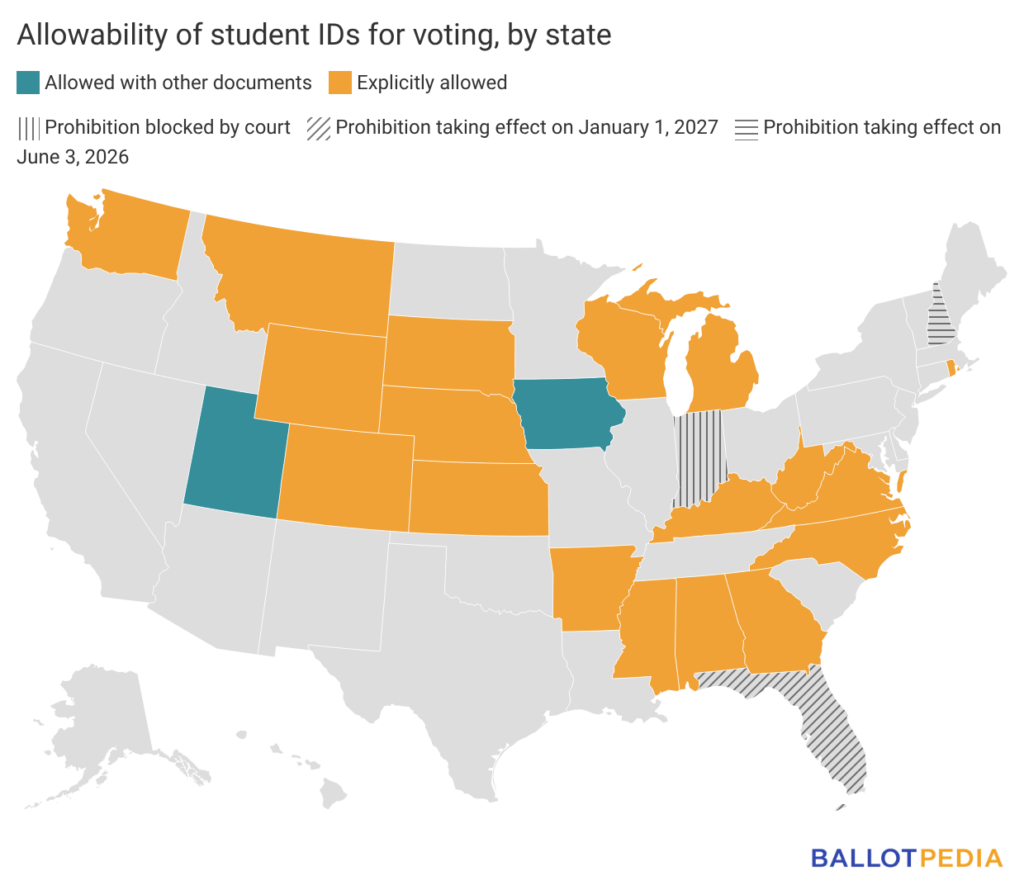
Eighteen states explicitly allow student IDs to be used for voting, while Iowa and Utah allow them to be used if presented with another form of identification. In states that do not explicitly allow student IDs to be used for voter identification, some student IDs may meet the state's voter identification criteria.
So far this year, Florida and New Hampshire have passed legislation prohibiting the use of student IDs for voting. Florida Gov. Ron DeSantis (R) signed HB 991, which included the student ID provision, on April 1. The policy takes effect on Jan. 1, 2027.
New Hampshire Gov. Kelly Ayotte (R) signed HB 323 on April 3. The policy takes effect on June 2, meaning it will be in effect for the state’s Sept. 8 primary election.
Currently, 36 states require voters to present identification to vote at the polls on Election Day, though many states provide exceptions to these rules. Six of those states have Democratic trifectas, 23 states have Republican trifectas, and seven states have divided governments.
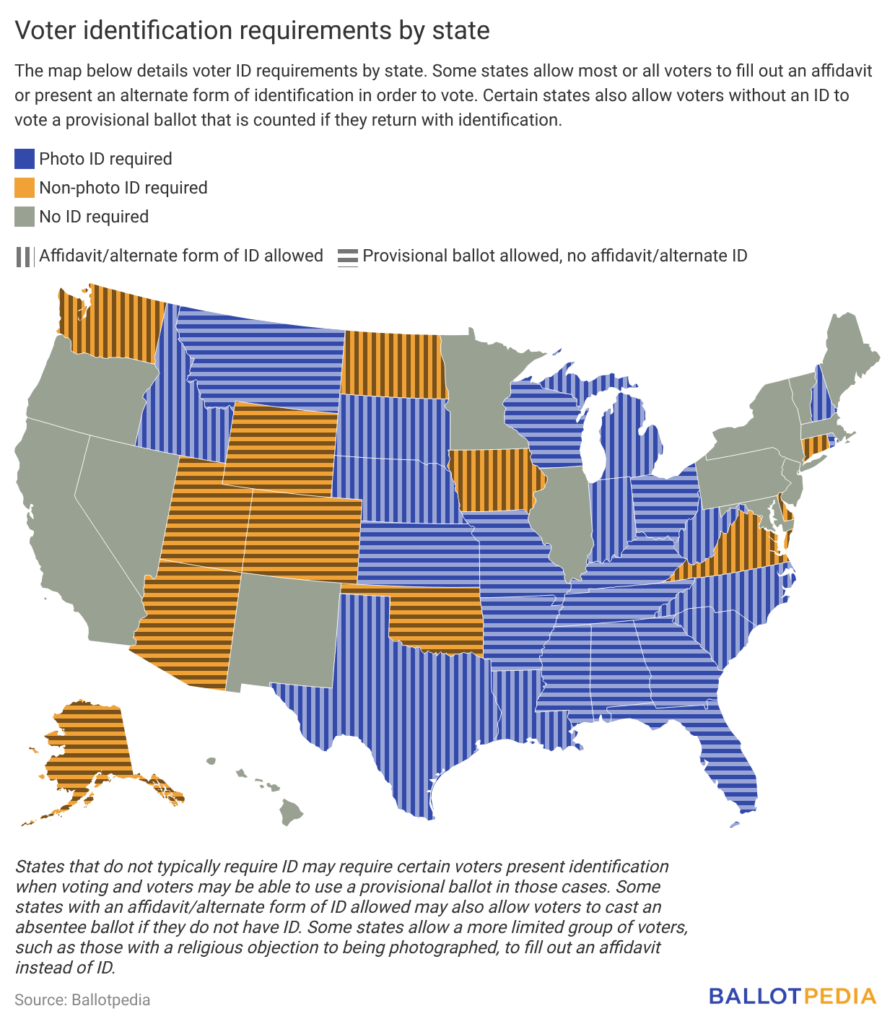
Of the states that require voter ID, 24 require ID that includes a photograph, with certain exceptions.
The remaining 14 states do not generally require voters to present identification to vote at the polls on Election Day, aside from what is required in federal law. Of the states without voter ID laws, 10 have Democratic trifectas, and four have divided governments.
Read more about the Indiana lawsuit here.
Three candidates seek Republican nomination for Indiana Secretary of State
Incumbent Diego Morales, Jamie Reitenour, and David Shelton are seeking the Republican Party nomination for Indiana Secretary of State. The Republican Party convention in Fort Wayne, Indiana, will choose the nominee on June 20. Party delegates elected in the May 5 primary will vote at the convention to determine which candidate will be the party's nominee in the general election on Nov. 3.
Nationally, the Indiana Secretary of State is one of 29 state executive offices for which political parties will choose nominees by convention this year. (Note: This includes eight offices in Utah, where candidates can collect signatures to appear on the ballot, meaning it is possible that those offices will still have a primary.)
Reitenour and Shelton oppose Morales’ international travel in office. According to the Indiana Capital Chronicle’s Whitney Downard and Niki Kelly, Morales spent the most on travel of any statewide Indiana official in the 2025 fiscal year. That is based on reports stemming from a state law passed last year that requires state officials to report their travel expenses and funding to the budget committee, a joint legislative body.
Morales previously told the budget committee, “I want people to talk about Indiana. I want them to know Indiana is open for business. … The media should be saying, ‘Thank you for your hard work. Thank you for promoting our state out there.’”
Reitenour's campaign website says, "Indiana does not need a world traveler serving as Secretary of State; it needs an administrative leader committed to the actual job description of the office.” Shelton said, "I just want the personal satisfaction of doing the job to the best of my abilities. I will not be a taxpayer-funded tourist on a statewide search for photo ops. That is not me.”
Morales won the Republican nomination at the 2022 convention over incumbent Holli Sullivan (R). He defeated Destiny Scott Wells (D) 54%-40% in the general election. He served in the U.S. Army and Indiana National Guard and worked in business as an executive, consultant, and entrepreneur.
Morales' campaign website lists accomplishments and future plans along four issues: protecting elections, increasing training and standards for Indiana car dealers, protecting Hoosier investments, and streamlining business services.
Reitenour’s career experience includes working as a mortgage broker, compliance manager, and ministry leader. Reitenour ran for governor in 2024, finishing fifth among six candidates in the Republican primary with 5% of the vote.
Reitenour supports using paper ballots instead of the voting machines the state currently uses for its elections: "No more expensive machines with third parties holding the source code in escrow. We want paper ballots with watermarks, precinct voting, and precinct-level hand counting."
Shelton was elected Knox County Clerk in 2018 and also serves as the Knox County Republican Party Chair at the time of the 2026 election. Shelton’s career experience includes working as a private investigator and the owner of an upholstery shop. Shelton also ran for secretary of state in 2022.
Shelton's campaign website says he is running on professionalism in office, election security, preparing for the 2030 redistricting cycle, strengthening election administration, leadership, and improving the office's non-election functions.
As we mentioned in our Feb. 26 edition of the Daily Brew, Indiana will also use conventions to nominate candidates for lieutenant governor, state treasurer, state auditor, and attorney general this year. The state’s Democratic convention will be on June 6, in Indianapolis.
Indiana is one of three states – the others being Michigan and South Dakota – with laws that require parties to nominate candidates for certain statewide offices at a state party convention. Parties in Utah also use conventions to select nominees for statewide office, but candidates can also gather petition signatures to qualify for the ballot. Click here to see a list of this year’s convention dates and locations, and here to learn more about political party pre-primary nominations and endorsements.
Click here to learn more about the June 20 Republican convention for Indiana Secretary of State.
Signatures submitted for amendment to require schools to provide free meals in North Dakota
Signatures were submitted for a North Dakota constitutional amendment that would require public schools to provide one free breakfast and one free lunch to students each school day. The secretary of state’s office is currently reviewing the signatures. If there are enough valid signatures, the measure will go on the Nov. 3 ballot.
The amendment says schools that provide these meals would be eligible for reimbursement if they first maximize federal reimbursement. If the Legislative Assembly is unable to identify a source of funds for reimbursement, the funds will be appropriated from the state's Legacy Earnings fund.
The group Together for School Meals reported submitting 57,229 signatures to the Secretary of State’s office. The initiative will need at least 31,164 valid signatures to qualify for the ballot. This equals 4% of the state's population reported in the last decennial census. The secretary of state’s office has until May 14 to verify signatures.
According to the North Dakota Department of Public Instruction, an estimated 47,000 (39.2%) children in the state receive free or reduced-cost meals. There are 120,000 K-12 students in the state. Currently, students are eligible for free lunch and breakfast programs if their household income is below 225% of the federal poverty guideline (estimated to be $74,250 for a family of four). The North Dakota Department of Public Instruction estimated the cost of the new program to be $134 million for two years.
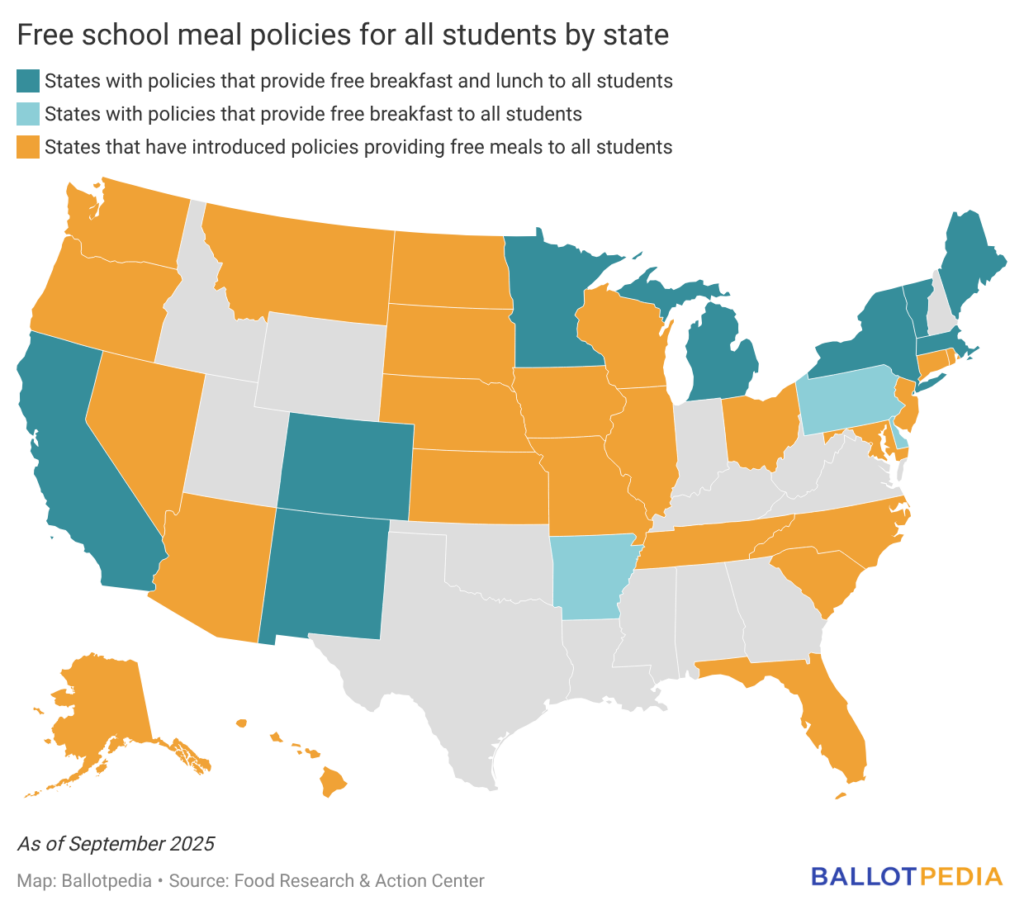
As of September 2025, nine states provide both a free breakfast and lunch to all students, while three states provide free breakfast to all students. California became the first state to implement a free meal policy (which took effect for the 2022-2023 school year). New York is the most recent state to implement a free meal policy, doing so for the 2025-2026 school year. Twenty-five other states and Washington, D.C., have introduced but not yet passed legislation that would provide free meals to all students.
No other state has a universal school meal policy in its constitution. This would be the first. Colorado is the only other state to put such a policy on the ballot. In 2022, voters approved Proposition FF, 56.8% to 43.3%, creating a school meals program, but this was a state statute, not a constitutional amendment.
There are currently two constitutional amendments on North Dakota’s November ballot. One amendment would change legislative term limits, and another would require a 60% supermajority to approve new constitutional amendments. On June 9, North Dakota voters will also decide on an amendment that would create a single-subject requirement for new amendments.
Click here to read more about the proposed amendment in North Dakota.