


Welcome to the Tuesday, April 21, 2026, Brew.
By: Briana Ryan
Here’s what’s in store for you as you start your day:
- Virginia voters to decide a constitutional amendment to determine congressional maps for the midterm elections
- Nebraska becomes the second state to enact or expand a foreign funding ban for ballot measures this year
- Thirteen candidates are running in the June 2 Democratic primary for New Jersey’s 12th Congressional District
Virginia voters to decide a constitutional amendment to determine congressional maps for the midterm elections
Today, April 21, Virginia voters will decide on a constitutional amendment in a special election to determine if the state will use the Virginia General Assembly’s newly drawn congressional maps ahead of this year’s midterm elections.
The amendment would allow the General Assembly to conduct congressional redistricting between Jan. 1, 2025, and Oct. 31, 2030, if another state first participates in congressional redistricting.
Since California, Missouri, North Carolina, and Texas voluntarily enacted new congressional maps in 2025, the amendment would allow the General Assembly to conduct congressional redistricting before the next scheduled redistricting in 2031.
The General Assembly approved House Bill 29 on Feb. 10, which contains a new congressional map that would take effect if voters approve the amendment. Virginia has a Democratic trifecta.
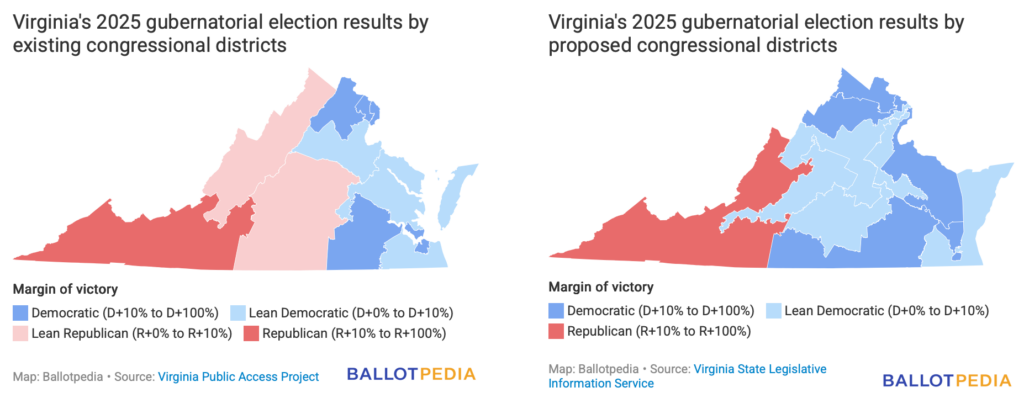
Based on the 2025 Virginia gubernatorial election results, the proposed map shifts four Republican-held congressional districts to be more Democratic. Virginia’s current U.S. House delegation has six Democrats and five Republicans. Under the proposed map, the delegation could include 10 Democrats and one Republican.
Campaign finance
As of the April 15 state campaign finance filing deadline, campaigns supporting and opposing the amendment have raised a combined $89 million. That's more than the amount raised the last time Virginia voters decided on an amendment regarding redistricting. Campaigns supporting and opposing that amendment raised a combined $2.7 million. Voters passed it 65.7% to 34.3%.
Compared to all redistricting-related ballot measures, it's the second-most expensive, after California Proposition 50. Campaigns supporting and opposing that amendment raised a combined $172.7 million. Voters passed it 64.4% to 35.6%.
Support campaigns in Virginia have raised more than $66 million. Opposition campaigns have raised more than $22 million.
Virginians for Fair Elections, the National Democratic Redistricting Committee - VA, and Commonwealth Voters for Fairness registered as a political action committee (PAC) in support of the amendment. Virginians for Fair Elections reported raising $64 million in cash and $1.75 million in in-kind contributions.
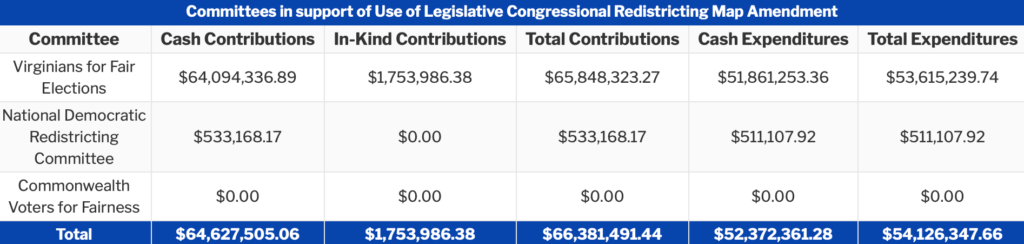
The largest contributor to the support campaign is the House Majority Forward, a nonprofit organization that says it aims to promote “economic growth and opportunity, social justice, environmental stewardship, and democracy.” The organization has donated $38 million to the Virginians for Fair Elections committee — more than the combined reported total of contributions to all opposition committees.

Virginians for Fair Maps, Justice for Democracy, and No Gerrymandering Virginia registered to oppose the amendment. Virginians for Fair Maps reported raising $19.8 million in cash.
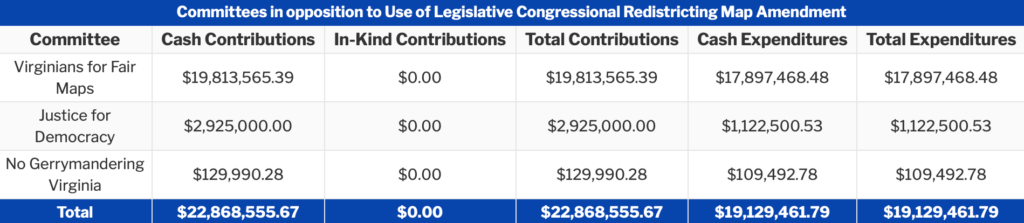
The largest contributor to the opposition campaign is Virginians for Fair Maps, a 501(c)(4) nonprofit organization. The organization has donated $19 million to oppose the amendment.
Litigation
Even if voters approve the amendment, there is ongoing litigation before the Virginia Supreme Court regarding the amendment. On Oct. 28, 2025, a group of Republican state senators filed a complaint with the Virginia Circuit Court seeking to block the amendment from appearing on the statewide ballot. The complaint stated that the Speaker of the House lacked the authority to convene or expand the scope of the special legislative session in 2025 when the amendment was introduced.
After a series of lower-court rulings and appeals, the Virginia Supreme Court denied a motion to pause the administration of the referendum, stating that it could be put on the ballot for the April 21 special election. The Court said it would hear arguments concerning the validity of the amendment after the election. Final briefs in the case are due on April 23.
Nationwide redistricting efforts
California, Missouri, North Carolina, Ohio, and Texas have passed a new congressional map between the 2024 and 2026 elections, and litigation led to a new map in Utah:
- California’s new map could result in five more Democratic members of their U.S. House delegation, and Texas’ could result in five more Republican members of their delegation.
- The new congressional maps in Missouri and North Carolina could result in one more Republican member of their respective delegations.
- Ohio’s new congressional map could result in two more Republican members of its delegation.
- Utah’s new congressional map could result in one Democratic member of its delegation.
Considering all the redistricting that has already occurred, Republicans could net a total of three seats based on the 2024 presidential election results. That figure does not include the redistricting that could occur due to the amendment in Virginia.
Redistricting by ballot measure in other states
After California, Virginia is the second state to decide on a ballot measure that would implement a new congressional district map between 2024 and 2026.
Two other states could implement new congressional district maps this year via ballot measures.
Missouri voters may decide on a veto referendum that would repeal or uphold the new congressional district map that the Legislature created. Gov. Mike Kehoe (R) signed the new map into law on Sept. 28, 2025. Missouri’s current U.S. House delegation includes six Republicans and two Democrats. According to Inside Elections’ Nathaniel Rakich, the new map, “features seven districts with a Baseline of R+10 or redder and leaves just one seat that is D+10 or bluer."
Colorado voters may decide on an initiated measure that would create a new congressional district map for the 2028 and 2030 elections. The measure would also move the state's congressional redistricting commission from the state constitution to state statute and reinstate the non-politician redistricting commission after the 2030 decennial census.
Click here to read more information, including polling, on the Virginia Use of Legislative Congressional Redistricting Map Amendment.
Nebraska becomes the second state to enact or expand a foreign funding ban for ballot measures this year
On April 15, Nebraska Gov. Jim Pillen (R) signed LB 1075, a bill expanding the state's ban on foreign contributions to ballot measure committees.
In 2022, Nebraska enacted a law banning direct and indirect contributions to ballot measure committees — which Nebraska calls ballot question committees — from foreign citizens, governments, businesses, and political parties.
LB 1075 requires ballot question committees to certify that they have not received contributions from foreign nationals. Donors must also state that they have not accepted more than $100,000 in funds from foreign nationals in the previous four years.
The bill also bans foreign nationals from making independent expenditures on ballot measures. It also increases fines for violating the prohibition to $100,000 or the amount of the prohibited contribution, whichever is greater.
The Nebraska Senate — the state's nonpartisan unicameral legislature — unanimously passed the bill, which also included other changes to Nebraska's election laws, on April 10.
The bill's enactment comes after Nebraska Attorney General Mike Hilgers (R) sued Swiss national Hansjörg Wyss and six other groups in November 2025 for allegedly violating the state's prohibition on foreign national contributions to ballot measure campaigns. On April 10, a Madison County judge allowed the case to proceed.
Nebraska is one of 24 states that have enacted laws banning foreign nationals or governments from contributing to ballot measure campaigns.
Seven states have enacted bans on direct contributions. Seventeen states have banned direct and indirect contributions from foreign individuals or entities.
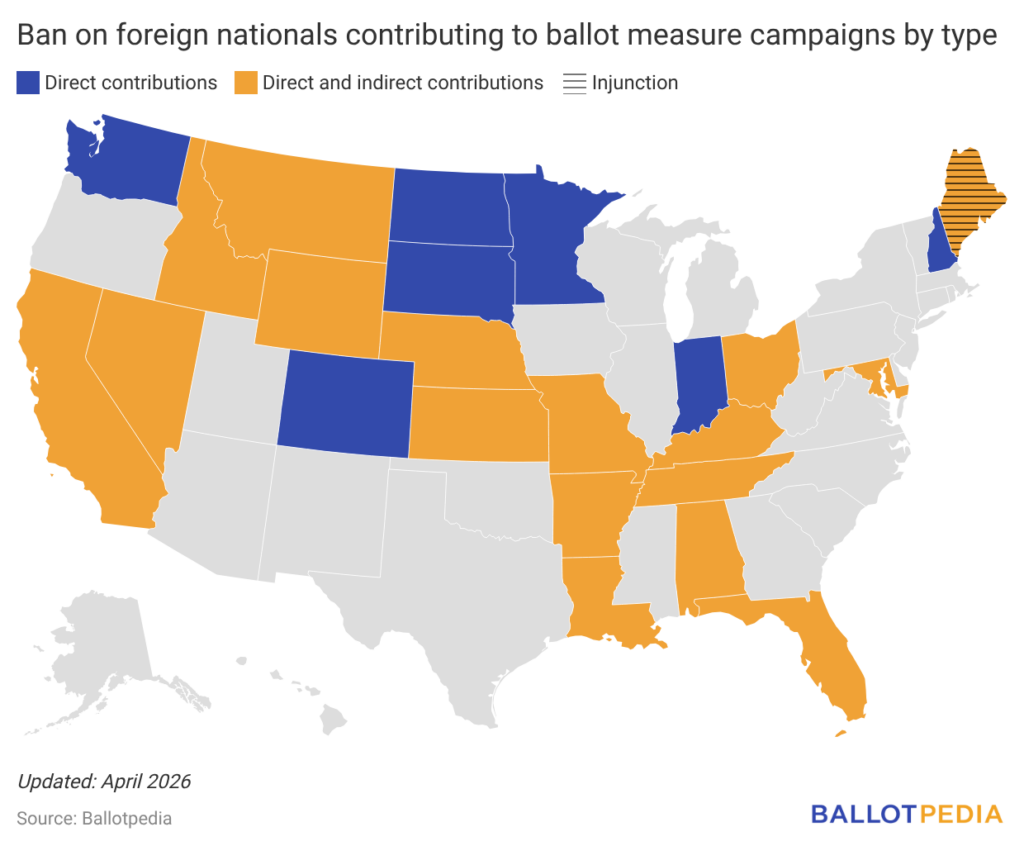
Nebraska became the second state this year to enact legislation related to prohibiting foreign contributions to ballot measure campaigns. Alabama enacted legislation in March banning foreign national donations to both ballot measure and candidate campaigns.
Nationally, legislators in 29 states have introduced or carried over 90 bills related to foreign funding of elections this year.
Campaign finance rules for ballot measures differ from those for candidate elections. In 1978, the U.S. Supreme Court ruled in First National Bank of Boston v. Bellotti that spending on ballot measure campaigns is similar to issue advocacy in the lawmaking process.
In 2011, the U.S. Supreme Court upheld the U.S. District Court for the District of Columbia's ruling in Bluman v. FEC, holding that the Federal Election Campaign Act (FECA) prohibits foreign contributions to political candidates and that this prohibition is constitutional. The district court found, "It is fundamental to the definition of our national political community that foreign citizens do not have a constitutional right to participate in, and thus may be excluded from, activities of democratic self-government." However, it also ruled that FECA "does not bar foreign nationals from issue advocacy," which includes ballot measure campaigns.
The Federal Election Commission (FEC), following the court's orders, ruled in 2018 that ballot measure campaigns are not regulated under FECA. According to the FEC, since ballot measure campaigns are similar to issue advocacy, foreign individuals, corporations, and governments can contribute to them.
Click here to read more about foreign funding in elections.
Thirteen candidates are running in the June 2 Democratic primary for New Jersey’s 12th Congressional District
Thirteen candidates are running in the June 2 Democratic primary for New Jersey's 12th Congressional District.
Incumbent Rep. Bonnie Watson Coleman (D) is not running for re-election. As of April 14, The Cook Political Report with Amy Walter and Inside Elections with Nathan L. Gonzales rated the general election as Solid Democratic. Larry J. Sabato's Crystal Ball rated it as Safe Democratic.
Rider University's Micah Rasmussen said "It's a Democratic district, a Democratic year, and you also have an open seat. When you don't have to take on incumbency, which gives a significant advantage, that is when we typically see a lot of people want to take on those open-seat opportunities, which don't happen very often."
The New Jersey Globe’s Joey Fox wrote that “Reynolds-Jackson, Cohen, Robinson, and Mapp all have support in their home turf, but other candidates like Altman, Hamawy, and Vaingankar have viable paths to the nomination that don’t rely on party endorsements. In other words, it’s anyone’s game for now.” The Democratic Committees in the four counties the district covers have endorsed different candidates. According to the New Jersey Globe's Zach Blackburn, the split in committee endorsements means that "[n]o candidate has dominant establishment support."
Below is a background on each noteworthy candidate who leads in endorsements and media attention:
- Susan Altman (D) ran unsuccessfully for New Jersey's 7th Congressional District in the 2024 general election. She previously worked as the executive director of the New Jersey Working Families Party and as state director for U.S. Sen. Andrew Kim (D-N.J.). The College Democrats of New Jersey endorsed Altman.
- Brad Cohen (D) is a physician and surgeon who was first elected mayor of East Brunswick in 2016. He previously served on the East Brunswick Board of Education from 2010 to 2016. The Middlesex County Democratic Committee endorsed Cohen.
- Adam Hamawy (D) is a surgeon and business owner who served in the U.S. Army from 2003 to 2011. U.S. Sen. Tammy Duckworth (D-Ill.) endorsed Hamawy.
- Adrian Mapp (D) is an accountant who was first elected mayor of Plainfield in 2013. He previously served on the Union County Board of Freeholders from 2005 to 2007, and on the Plainfield City Council from 1999 to 2006 and from 2009 to 2013. The Union County Democratic Committee endorsed Mapp.
- Verlina Reynolds-Jackson (D) was appointed to the New Jersey General Assembly in 2018. She previously served on the Trenton City Council from 2010 to 2018 and worked as a social worker. The Mercer County Democratic Committee endorsed Reynolds-Jackson.
- Shanel Robinson (D) was first elected to the Somerset County Board of Commissioners in 2018. She previously served on the Franklin City Council from 2015 to 2018 and worked as a borough administrator. Robinson also served in the U.S. Air Force from 1989 to 1998. The Somerset County Democratic Committee endorsed Robinson.
- Jay Vaingankar (D) is a community organizer who worked as a special advisor in the Secretary’s Office of Policy for the U.S. Department of Energy under President Joe Biden (D). Former U.S. Secretary of Energy Jennifer Granholm (D) endorsed Vaingankar.
Matt Adams (D), Elijah Dixon (D), Kyle Little (D), Squire Servance (D), Sujit Singh (D), and Samuel Wang (D) are also running in the primary.
Click here to read more about the Democratic primary for New Jersey’s 12th Congressional District. Also, if you're a New Jersey voter, check out our Sample Ballot Lookup here to prepare for Election Day.