


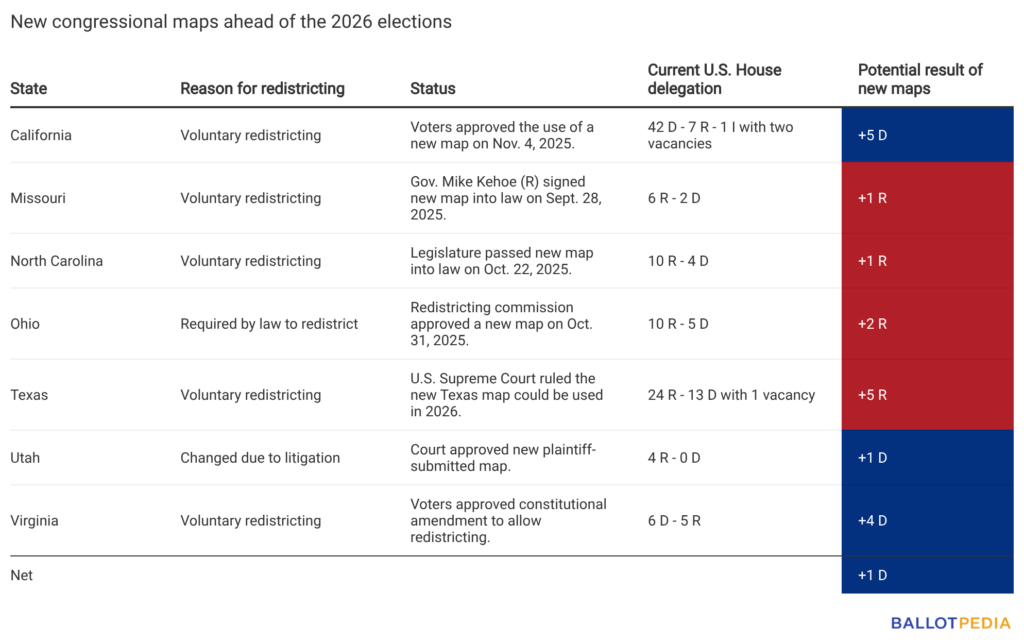
Virginia became the seventh state with new U.S. House district boundaries ahead of the 2026 elections when voters approved a constitutional amendment permitting mid-decade redistricting on April 21. Four other states—California, Missouri, North Carolina, and Texas—also adopted new maps voluntarily. Ohio was required by law to adopt a new map, and litigation led to a new map in Utah.
The new Virginia map could bring the net effect of mid-decade redistricting nationwide so far to one seat for Democrats.
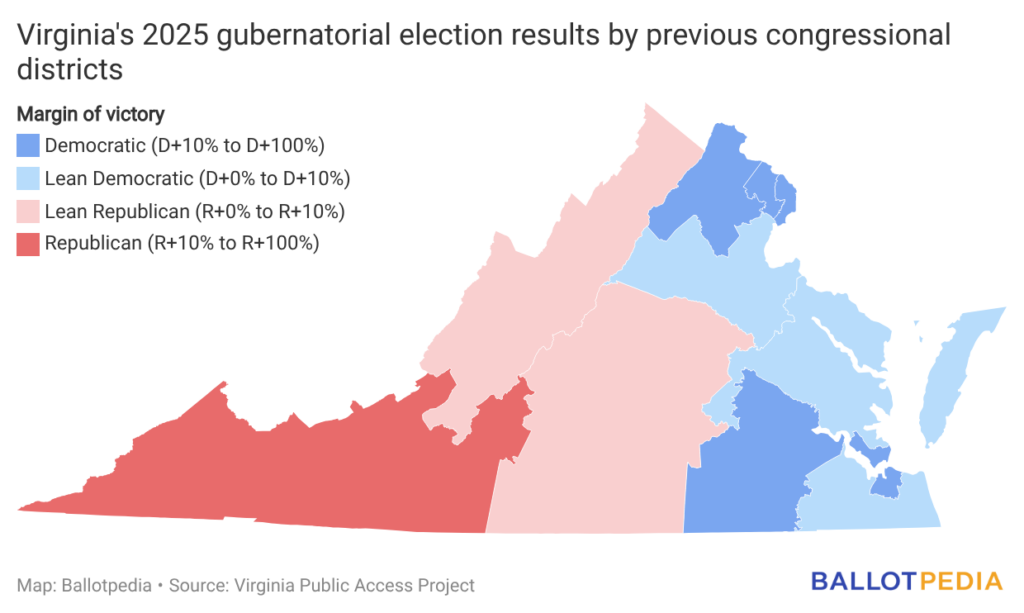
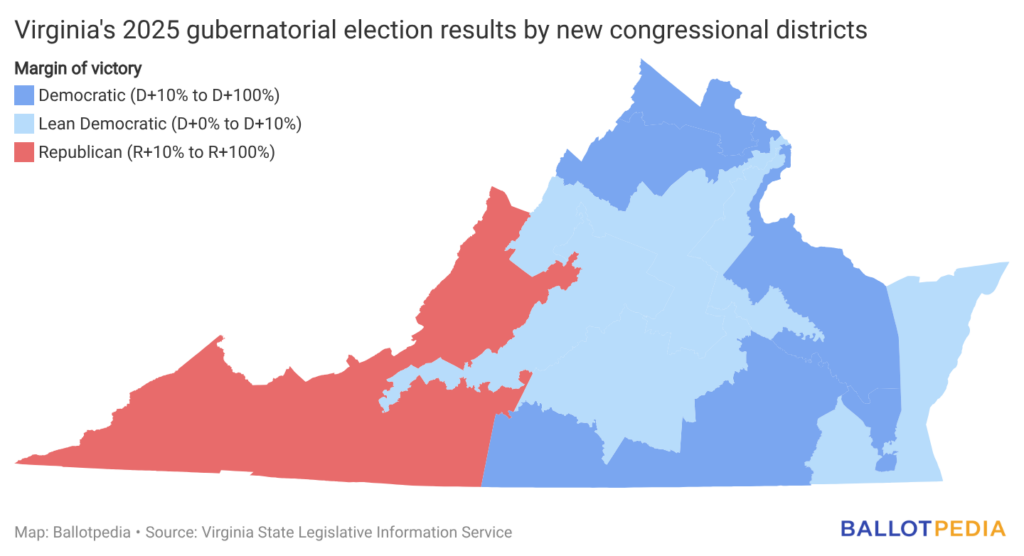
Virginia’s redrawn map shifts four districts with Republican representatives toward Democrats according to 2025 gubernatorial election results.
Eight of the state’s 11 existing districts voted Democratic in the 2025 gubernatorial election, including two with Republican representatives:
Under the new map, 10 of the districts would have voted Democratic in the 2025 gubernatorial election:
Mid-decade redistricting in Virginia
Redistricting in Virginia required a constitutional amendment to allow the General Assembly to temporarily amend the boundaries drawn by the state’s 16-member redistricting commission.
On October 27, 2025, the Virginia General Assembly adopted a resolution that would allow the legislature to consider a constitutional amendment for mid-decade redistricting. Two days later, the state House voted 51-42 along party lines to approve a constitutional amendment that would allow the state to redraw its congressional lines. The state Senate followed with a 21-16 party-line vote on October 31, 2025.
In Virginia, constitutional amendments must pass the legislature in two consecutive sessions before being placed on the ballot for voters. The General Assembly approved the amendment again in January 2026. The House voted 62-33 to approve the amendment on January 14, 2026, and the Senate voted 21-18 to approve the amendment on January 16, 2026. On January 27, 2026, a state judge blocked the amendment, ruling it had violated the special session's procedural rules when introduced in October 2025. According to the session's procedural resolution, "no bill, joint bills, joint resolutions, or resolutions affecting the rules of procedure or schedule of business of the General Assembly" could be added to the agenda except with unanimous approval. As Republicans had voted against it, the judge granted preliminary and permanent injunctions, blocking the amendment from the ballot. Democrats appealed the ruling, and the state court of appeals passed the case on to the state supreme court, which ruled that the referendum could continue.
Voters approved the amendment on April 21, 2026, with 51.5% voting in favor.
National context
Taken together with the other states with new district boundaries ahead of the 2026 elections, the Virginia map could shift the nationwide gains from redistricting to Democrats for the first time since Texas became the first state to pass a new map in August 2025.
Florida may still redraw its congressional district boundaries, which could reportedly move up to five more districts toward Republicans. A special session for redistricting was scheduled to begin on April 20, 2026, but was delayed. Axios’ Jeff Weiner wrote, “The timing change is, in part, to wait out a U.S. Supreme Court ruling that could invalidate minority-access districts, allowing GOP lawmakers to target Democrat-held seats in South Florida.” The case, Louisiana v. Callais, involves a challenge to Louisiana’s congressional map.