


Welcome to the Friday, April 24, 2026, Brew.
By: Lara Bonatesta
Here’s what’s in store for you as you start your day:
- California Secretary of State certifies first initiatives for the November 2026 ballot
- A special invitation to you to share a Mother’s Day story of civic engagement
- Five statewide candidate filing deadlines in the next two weeks
California Secretary of State certifies first initiatives for the November 2026 ballot
The California Secretary of State announced on April 21 that two ballot initiatives had qualified for the November ballot — the first initiatives to qualify this election cycle in California.
Two-Thirds Vote Requirement Initiative
The Two-Thirds Vote Requirement for Special Taxes and Charter City Real Estate Transfer Tax Prohibition Initiative is an initiated constitutional amendment that would increase the vote requirement to pass citizen-initiated local special taxes from a simple majority (50%+1) to a two-thirds (66.67%) vote. The requirement would apply to both the creation of new taxes and measures to raise existing taxes.
The amendment would also prohibit charter cities from imposing their own real estate transfer taxes, whether for general or specific purposes, above the existing statutory rate of $0.275 per $500 of value. Currently, 26 charter cities have enacted their own transfer taxes above the state rate.
Previous citizen-initiated local special taxes that voters approved with less than a two-thirds vote, and real estate transfer taxes in charter cities, would be invalidated.
Also on the ballot this year is the Vote Requirements for Initiatives Requiring Supermajority Votes Amendment, also known as Assembly Constitutional Amendment 13 (ACA 13). ACA 13 would require citizen-initiated constitutional amendments that propose a higher vote threshold for future state or local ballot measures to meet the same higher threshold to pass. ACA 13 would apply to any initiatives on the same ballot. This means if the ACA 13 passes, the two-thirds vote requirement initiative would need to win two-thirds of the vote.
The Howard Jarvis Taxpayers Association is sponsoring the two-thirds vote requirement initiative. The majority of funding has come from the California Business Roundtable Issues PAC ($3.65 million). In 2024, the groups qualified a similar initiative, but before ballots were finalized, the California Supreme Court unanimously ruled that it amounted to a revision of the state constitution and was unconstitutional.
To qualify an initiated constitutional amendment in California, proponents must submit 874,641 valid signatures, equal to 8% of the votes cast in the previous gubernatorial election.
The campaign submitted more than 1.3 million signatures for verification. The random count is not complete, but with an average county verification rate of 78.1%, the Secretary of State determined the petition contained enough signatures to qualify for the ballot.
Homebuyer program
The Second Mortgage Homebuyer Program and Revenue Bond Initiative is an initiated state statute that would establish a second-mortgage homebuyer program for qualified buyers on certain homes.
The program would authorize the California Housing Finance Agency (CalHFA) to offer up to $25 billion in bonds to eligible buyers for up to to 17% of a home’s sales price. Because the program is limited to second-mortgage loans, buyers would have to secure a first mortgage to cover any remaining costs of the qualified home. The initiative would require CalHFA to set interest and terms on the loans to account for the interest on the bonds and the administrative costs of the program.
To qualify, homebuyers must:
- Be a California resident for at least a year before applying
- Agree to occupy the home as a primary residence within 60 days of closing
- Have an income at or below 200% of the area median income for a similar-sized family in the county or city where the qualified new home is located
- Make a down payment of no less than 3% of the purchase price of the qualified home
To qualify an initiated state statute in California, proponents need to submit 546,651 valid signatures, which is equal to 5% of the votes cast in the previous gubernatorial election.
The campaign submitted more than 918,000 signatures for verification. The random count is not complete, but with an average county verification rate of 78.7%, the Secretary of State determined the petition contained enough signatures to qualify for the ballot.
So far this year, there are a total of five measures on the November ballot in California. In addition to the two citizen initiatives and the supermajority requirement mentioned above, California voters will also decide on two other legislative referrals:
- A proposed statute allowing state and local governments to create public campaign finance programs
- An amendment to eliminate the successor election when a state officer is recalled.
In California, proponents of citizen initiatives can withdraw a qualified measure by 5 p.m. 131 days before the next general election. The 2026 deadline is June 25.
In even years between 2010 and 2024, California voters decided an average of approximately 10 ballot measures each November. Of these, an average of eight per year were citizen initiatives, and an average of two were legislative referrals.
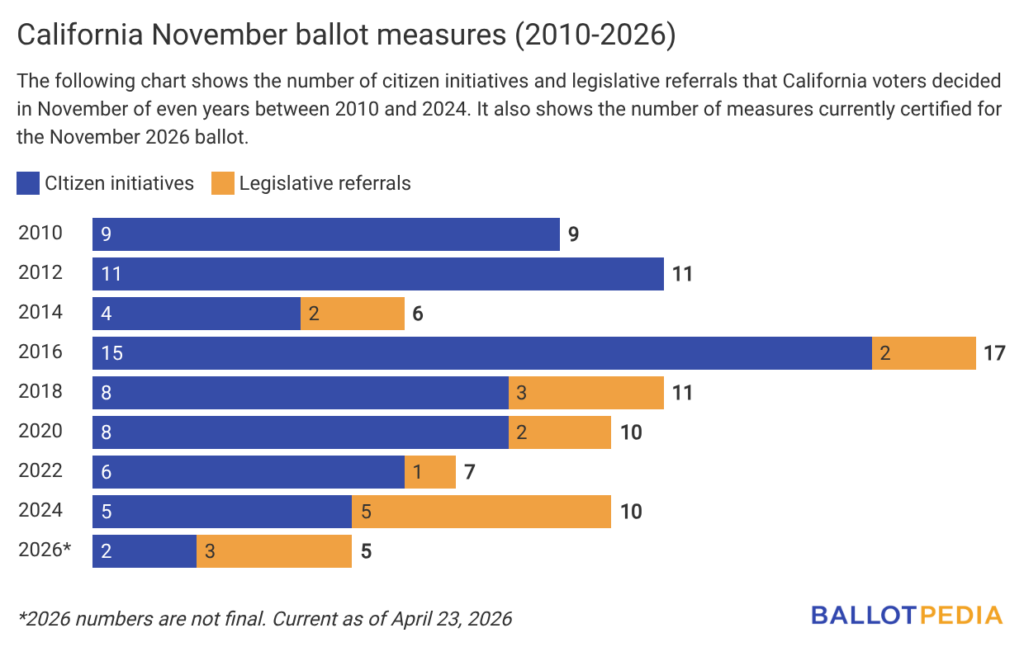
Click here to read more about California’s 2026 ballot measures. For more information on supermajority requirements for ballot measures, click here.
A special invitation to you to share a Mother’s Day story of civic engagement
While not an official holiday, Mother’s Day has become one of the most celebrated days on the calendar. As is the case with so many special days, there’s far more to Mother’s Day than the gifts, visits, and remembrances we offer to our moms. In the case of Mother’s Day, its roots are in the great American tradition of civic activism and public engagement.
As the Smithsonian’s Women’s History Museum notes:
Julia Ward Howe, best known as the author of the “Battle Hymn of the Republic,” was an abolitionist, a women’s rights advocate, and a peace activist. In 1870, horrified by the death and destruction she had witnessed during the Civil War and concerned by the Franco-Prussian war unfolding abroad, Howe issued what has come to be known as her “Mother’s Day Proclamation,” originally called an “Appeal to womanhood throughout the world.” In it, Howe urged the creation of an international body of women who could find ways to avoid war and bloodshed…
The Mother’s Day we know today began with Howe’s daughter, Anna, who “chose white carnations as an emblem and urged people to write heartfelt letters of gratitude to their mothers…”
This Mother’s Day, Ballotpedia wants to offer you a special way to honor your mother, or grandmother, or any woman in your life who has inspired you to get involved in our nation’s civic life.
Did your mom take you with her to the polls when she voted on Election Day? Did she talk about the news and issues of the day with you, or encourage you to get involved in a civic organization or even a political campaign? Maybe she was a candidate for office, and you got to see a campaign firsthand?
Whatever your story may be, we hope you will share it with us. To do so, simply reply to this email, or send a note to editor@ballotpedia.org. With permission, we will share excerpts of the Mother’s Day stories we receive with our readers.
Let’s inspire a new generation of voters, volunteers, community leaders, and candidates. Send your story today.
Five statewide candidate filing deadlines in the next two weeks
As the 2026 primaries get into swing, midterm races are continuing to take shape.
Five states and Guam have statewide candidate filing deadlines in the next two weeks. The map and bulleted list below show which states have candidate filing deadlines scheduled between April 25 and May 8.
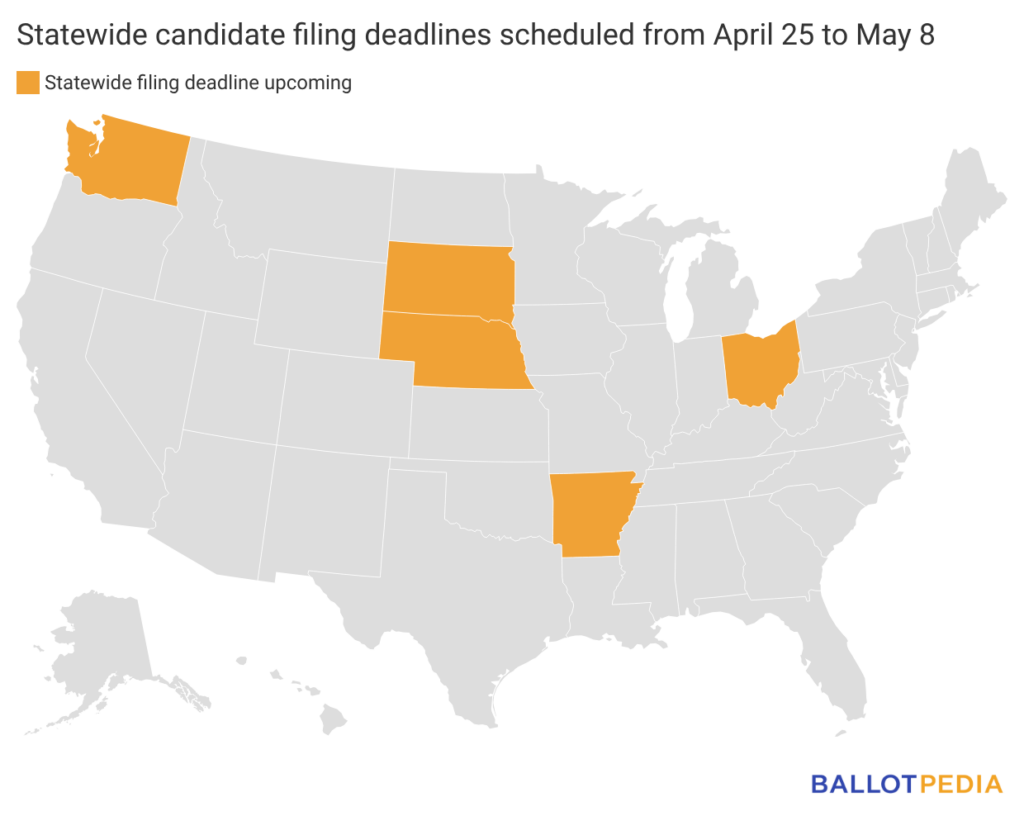
- Arkansas: May 1 (statewide unaffiliated candidate filing deadline)
- Guam: May 1 (territorywide candidate filing deadline for governor, lieutenant governor, senator, and delegate)
- Nebraska: May 1 (statewide primary write-in candidate filing deadline)
- Ohio: May 4 (statewide unaffiliated candidate filing deadline)
- South Dakota: April 28 (statewide unaffiliated candidate filing deadline)
- Washington: May 8 (statewide candidate filing deadline)
Looking back
Three states had a candidate filing deadline in the past two weeks:
- Colorado: April 24 (statewide primary write-in candidate filing deadline)
- Florida: April 24 (statewide candidate filing deadline for U.S. Senate and state supreme court)
- Michigan: April 21 (statewide primary candidate filing deadline)
Candidates must meet various state-specific filing requirements and deadlines to appear on primary and general election ballots. These regulations, known as ballot access laws, determine whether and how candidates can make it onto the ballot. These laws are set at the state level and apply to candidates running for state and federal offices.
Voting in upcoming elections
There are two statewide elections taking place in the next two weeks:
Seven states have early voting periods that start in the next two weeks:
- California: Early voting begins May 4 for the June 2 primary.
- Georgia: Early voting begins April 27 for the May 19 primary.
- Idaho: Early voting begins April 27 for the May 19 primary.
- Louisiana: Early voting begins May 2 for the May 16 primary.
- Montana: Early voting begins May 4 for the June 2 primary.
- New Mexico: Early voting begins May 5 for the June 2 primary.
- West Virginia: Early voting begins April 29 for the May 12 primary.
Nine states have voter registration deadlines in the next two weeks:
- Alabama: May 4 is the last day to register to vote in the May 19 primary.
- Idaho: May 8 is the last day to register online or by mail to vote in the May 19 primary.
- Louisiana: April 25 is the last day to register to vote online in the May 16 primary.
- Montana: May 4 is the last day to register by mail to vote in the June 2 primary.
- Nebraska: April 27 is the last day to register online or by mail to vote in the May 12 primary. In-person voter registration is available through May 1.
- New Mexico: May 5 is the last day to register online or by mail to vote in the June 2 primary.
- Oregon: April 28 is the last day to register to vote in the May 19 primary.
- Pennsylvania: May 4 is the last day to register to vote in the May 19 primary.
- South Carolina: May 8 is the last day to register in person to vote in the June 9 primary.
Six states have absentee/mail-in ballot request deadlines in the next two weeks:
- Georgia: May 8 is the last day to request an absentee/mail-in ballot for the May 19 primary.
- Idaho: May 8 is the last day to request an absentee/mail-in ballot for the May 19 primary.
- Kentucky: May 5 is the last day to request an absentee/mail-in ballot for the May 19 primary.
- Ohio: April 28 is the last day to request an absentee/mail-in ballot for the May 5 primary.
- Nebraska: May 1 is the last day to request an absentee/mail-in ballot for the May 12 primary.
- West Virginia: May 6 is the last day to request a ballot for the May 12 primary.
Click here to see our list of upcoming election dates and filing deadlines.