


Welcome to the April 27 edition of Robe & Gavel, Ballotpedia’s newsletter about the Supreme Court of the United States (SCOTUS) and other judicial happenings around the U.S.
Parks and ponds are good by day;
I do not delight
In black acres of the night,
Nor my unseasoned step disturbs
The sleeps of trees or dreams of herbs.
-Ralph Waldo Emerson
Parks and ponds
We’re back with a new batch of updates for you, dear readers. SCOTUS dropped two new opinions, and we’re excited to review them with you. Let’s gavel in!
Follow Ballotpedia on X and Bluesky or subscribe to the Daily Brew for the latest news and analysis.
We #SCOTUS and you can, too!
Grants
SCOTUS has accepted one new case to its merits docket since our April 20 issue. To date, the Court has agreed to hear 59 cases for argument for the 2025-2026 term and nine cases for the 2026-2027 term.
Click the link below to learn more about this case:
Arguments
The Supreme Court will hear five arguments this week. Click here to read more about SCOTUS' current term.
Click the links below to learn more about these cases:
April 27
- Chatrie v. United Statesconcerns the Fourth Amendment.
- The question presented: “Whether the execution of the geofence warrant violated the Fourth Amendment.”
- Monsanto Company v. Durnellconcerns the Federal Insecticide, Fungicide, and Rodenticide Act.
- The question presented: “Whether the Federal Insecticide, Fungicide, and Rodenticide Act preempts a label-based failure-to-warn claim where EPA has not required the warning.”
April 28
- Cisco Systems, Inc. v. Doe Iconcerns the Alien Tort Statute and the Torture Victim Protection Act.
- The questions presented: “1. Whether the Alien Tort Statute (‘ATS’), 28 U.S.C. § 1350, allows a judicially-implied private right of action for aiding and abetting.” “3. Whether the Torture Victim Protection Act, 28 U.S.C. § 1350 note, allows a judicially-implied private right of action for aiding and abetting.”
April 29
- Trump v. Miot (consolidated with Mullin v. Doe) concerns Temporary Protected Status (TPS) for Haitian and Syrian nationals.
- The question presented: Whether the Supreme Court should stay an order from the United States District Court for the District of Columbia that prevents the Trump administration from ending Temporary Protected Status (TPS) for Haitian nationals.
- Hikma Pharmaceuticals USA Inc. v. Amarin Pharma, Inc.concerns patent infringement of drugs.
- The questions presented: “1. When a generic drug label fully carves out a patented use, are allegations that the generic drugmaker calls its product a ‘generic version’ and cites public information about the branded drug (e.g., sales) enough to plead induced infringement of the patented use?
“2. Does a complaint state a claim for induced infringement of a patented method if it does not allege any instruction or other statement by the defendant that encourages, or even mentions, the patented use?”
In its October 2024 term, SCOTUS heard arguments in 65 cases. Click here to read more about SCOTUS's previous term.
Opinions
SCOTUS has ruled on two cases since our April 20 edition. The court has issued rulings in 28 cases so far this term. At this point in the 2024-2025 term, SCOTUS had issued rulings in 27 cases.
Click the links below to read more about the specific cases SCOTUS ruled on since April 20:
April 22
Enbridge Energy, LP v. Nesselwas argued before the court on Feb. 24.
The case concerns whether a U.S. district court can extend the 30-day deadline in 28 U.S.C. § 1446(b)(1).
The outcome: In a 9-0 opinion, SCOTUS affirmed the judgment of the U.S. Court of Appeals for the Sixth Circuit, holding that 28 U.S.C. § 1446(b)(1) conflicts with equitable tolling and, since it occurred outside the statute's 30-day deadline, Enbridge's removal of the case from Michigan state court to federal court was untimely.
- When a court applies the equitable tolling doctrine, the failure to meet a deadline is excused and the court grants the plaintiff an extension.
Hencely v. Fluor Corporation was argued before the court on Nov. 3, 2025.
The case concerns whether federal law preempts state tort law.
- According to the Cornell Legal Information Institute, "A tort is an act or omission that gives rise to injury or harm to another and amounts to a civil wrong for which courts impose liability. In the context of torts, ‘injury’ describes the invasion of any legal right, whereas ‘harm’ describes a loss or detriment in fact that an individual suffers."
The outcome: Fluor Corporation argued that the Constitution’s structure, which grants war powers to the federal government, implicitly preempts any suits against a military contractor working in a combat zone. In a 6-3 decision, SCOTUS vacated and remanded the decision of the U.S. Court of Appeals for the Fourth Circuit. The Court held that the Fourth Circuit erred in finding Hencely’s state-law tort claims preempted where the federal government neither ordered nor authorized Fluor’s challenged conduct.
Federal court action
Nominations
President Donald Trump (R) has not announced any new Article III nominees since our April 20 edition.
Committee action
The Senate Judiciary Committee has not reported any new nominees out of committee since our April 20 edition.
Confirmations
The Senate has confirmed one nominee since our April 20 issue.
Vacancies
The federal judiciary currently has 34 vacancies, 33 of which are for lifetime Article III judgeships. As of publication, there were 12 pending nominations.
According to the Administrative Office of U.S. Courts, there were 10 upcoming vacancies in the federal judiciary, where judges have announced their intention to leave active judicial status.
For more information on judicial vacancies during President Trump’s term, click here.
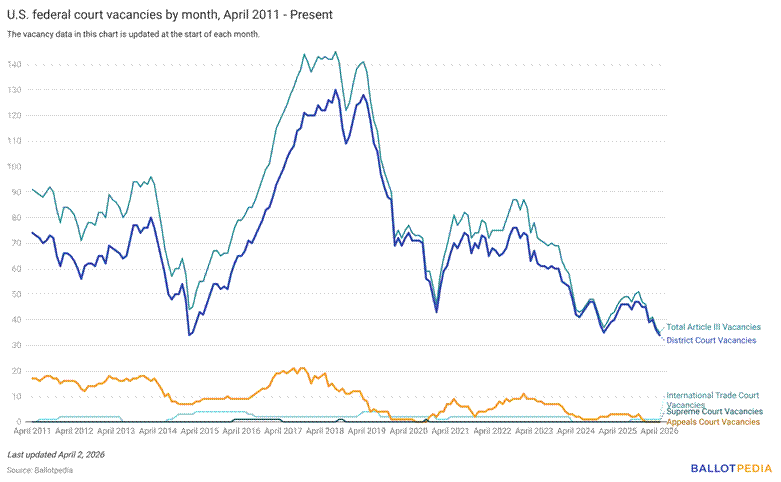
Do you love judicial nomination, confirmation, and vacancy information? We figured you might. Our monthly Federal Vacancy Count monitors all the faces and places moving in, moving out, and moving on in the federal judiciary. Click here for our most current count.
Need a daily fix of judicial nomination, confirmation, and vacancy information? Click here for continuing updates on the status of all federal judicial nominees.
Or, keep an eye on our list for updates on federal judicial nominations.
Looking ahead
We’ll be back on May 11 with a new edition of Robe & Gavel. Until then, gaveling out!
Contributions
Myj Saintyl compiled and edited this newsletter, with contributions from Sam Post, Ellie Mikus, and Spencer Richardson.