


Welcome to the Tuesday, April 28, 2026, Brew.
By: Lara Bonatesta
Here’s what’s in store for you as you start your day:
- 49 state financial officers and four insurance commissioners are up for election this year
- Oklahoma will be one of four states with a voter ID amendment on the ballot this year
- Kentucky legislators override four vetoes on election-related bills
49 state financial officers and four insurance commissioners are up for election this year
Forty-nine state financial offices (SFOs) are up for election this year, as are four state insurance commissioners.
State financial offices
State financial officers include three positions: state treasurers, state auditors, and state comptrollers/controllers. Broadly, these officials are responsible for things like auditing other government offices, managing payroll, and overseeing pensions. In some states, certain SFOs are also responsible for investing state retirement and trust funds.
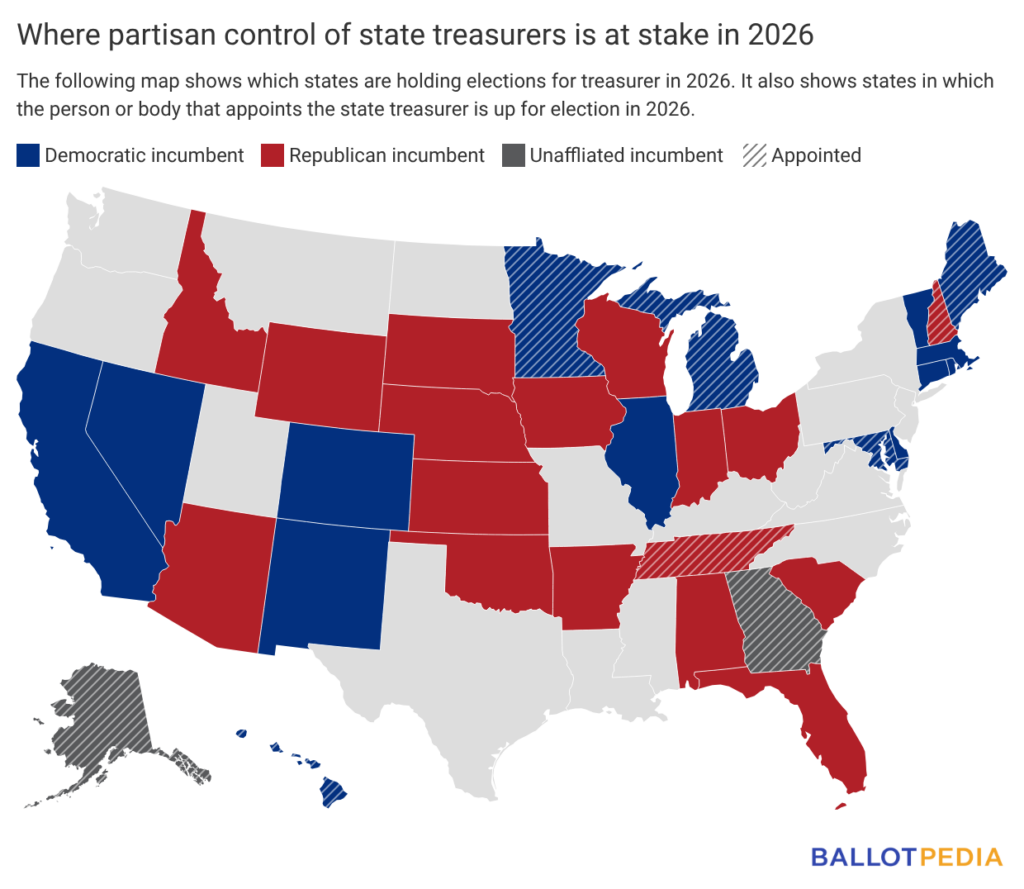
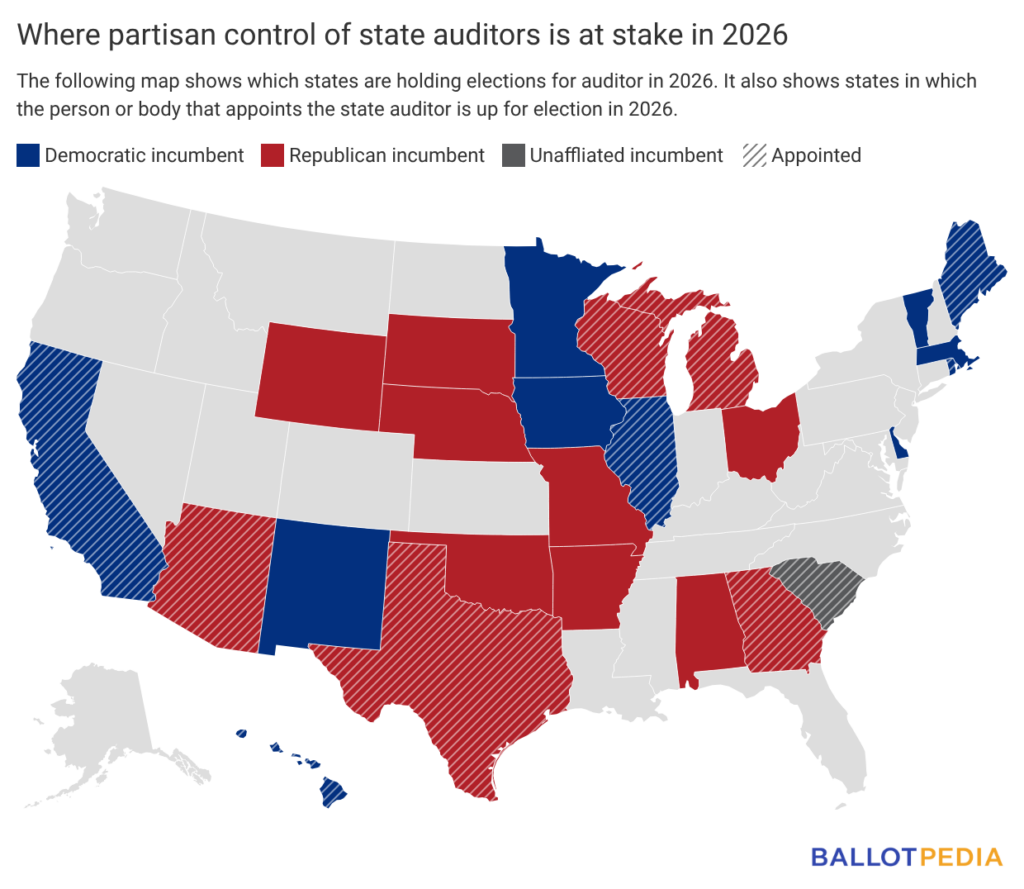
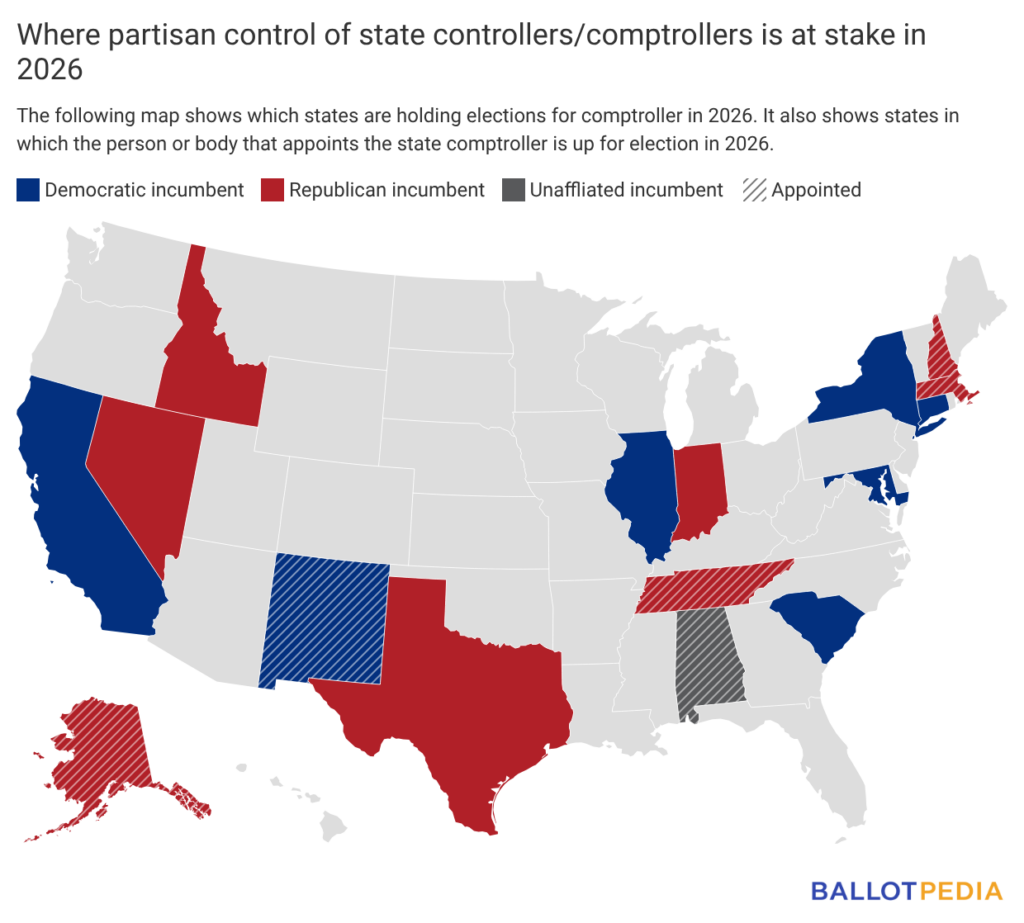
There are 25 treasurers, 14 auditors, and 10 comptrollers on the ballot this year. The partisan breakdown of those offices is as follows:
- Ten Democratic treasurers and 15 Republican treasurers
- Six Democratic auditors and eight Republican auditors
- Six Democratic comptrollers and four Republican comptrollers
Among these elections, Ballotpedia identified two races as battlegrounds:
- Illinois Comptroller (Democratic primary): Held on March 17, four Democrats ran to succeed retiring incumbent Susana Mendoza (D). Margaret Croke (D) won the nomination, defeating second-place finisher Karina Villa (D) 35% to 32%. Croke will face Bryan Drew (R) in the Nov. 3 general election.
- Ohio Treasurer (Republican primary): Jay Edwards (R) and Kristina Daley Roegner (R) are running in the Republican primary on May 5. Politico's Jacob Wendler wrote, "The otherwise sleepy battle … is one of many divides bubbling up in the Republican Party that is tentatively charting a post-Trump future, with both Ramaswamy and Vance jockeying to put their stamp on the GOP." Vice President J.D. Vance (R) endorsed Edwards, while gubernatorial candidate Vivek Ramaswamy (R) endorsed Roegner.
In many states, the governor or state legislature chooses the state financial officers, meaning this year’s gubernatorial and state legislative elections will affect who is appointed. An additional 26 state financial offices are at stake this year (meaning either the appointing person or all or part of the appointing body is up for election). Of those state executive offices, there are:
- Five Democratic treasurers, two Republican treasurers, and two unaffiliated treasurers
- Five Democratic auditors, five Republican auditors, and one unaffiliated auditor
- One Democratic comptroller, four Republican comptrollers, one unaffiliated comptrollers
Among elections for appointing officers, Ballotpedia identified the following battlegrounds:
- California governor (general election): Appoints California auditor
- Michigan governor (general election): Appoints Michigan treasurer
- Minnesota governor (general election): Appoints Minnesota treasurer
- Arizona House of Representatives: The Joint Legislative Audit Committee appoints the Arizona Auditor General
- Both chambers of the Georgia General Assembly: Appoints Georgia Auditor
- Both chambers of the Michigan Legislature: Appoints Michigan Auditor General
- Both chambers of the New Hampshire Legislature: Appoints New Hampshire Treasurer
- Both chambers of the Wisconsin Legislature: The Joint Committee on Legislative Organization appoints the Wisconsin Auditor
Heading into the 2026 elections, the partisan breakdown of all state financial officers was as follows:
- Nineteen Democratic treasurers, 27 Republican treasurers, and two unaffiliated treasurers
- Fourteen Democratic auditors, 23 Republican auditors, and one unaffiliated auditor
- Nine Democratic comptrollers, eight Republican comptrollers, and three unaffiliated comptrollers
Insurance Commissioners
Four insurance commissioners are also up for election in California, Georgia, Kansas, and Oklahoma. Currently, California has a Democratic commissioner, while Georgia, Kansas, and Oklahoma have Republican commissioners.
All 50 states have an insurance commissioner who serves as the state's chief regulator of insurance markets in the state. The duties of the position vary by state, but their general role is as a consumer protection advocate and insurance regulator. The position is elected in 11 states and appointed in 39. Of the commissioners whose partisan affiliations are known, nine are Republicans, and four are Democrats.
Ballotpedia identified one insurance commissioner election as noteworthy:
- California Insurance Commissioner (top-two primary): Eleven candidates are running in the June 2 primary. Leading candidates include Ben Allen (D), Steven Bradford (D), Jane Kim (D), Stacy Korsgaden (R), and Patrick Wolff (D). The race has centered on three issues: (1) wildfires, which have affected the state and increased premiums, (2) how to keep insurers in the state, and (3) how to lower premiums.
In 37 states, the governor appoints the insurance commissioner. Thirty-two of those states are holding gubernatorial elections this year. Some of the most competitive gubernatorial elections this year include contests in Arizona, Michigan, and Wisconsin.
To read more about state financial officers in 2026, click here. To read more about state insurance commissioner elections in 2026, click here.
Oklahoma will be one of four states with a voter ID amendment on the ballot this year
In an Aug. 25 special election, Oklahoma voters will decide on a constitutional amendment that would require voters to provide identification for all methods of voting.
While Oklahoma law already requires a voter ID, the amendment would add this requirement to the state constitution.
The amendment would also authorize the Oklahoma Legislature to define what qualifies as acceptable identification. Current law says that government-issued photo IDs and county election board voter identification cards are valid forms of ID for voting purposes.
The Legislature voted to put the amendment, Senate Joint Resolution 47 (SJR 47), on the ballot. On March 26, the state Senate approved the measure 39-8, with all 39 Republicans voting in favor and all eight Democrats voting against. On April 15, the state House approved the amendment 80-13, with 76 Republicans and four Democrats voting in favor and 13 Democrats voting against.
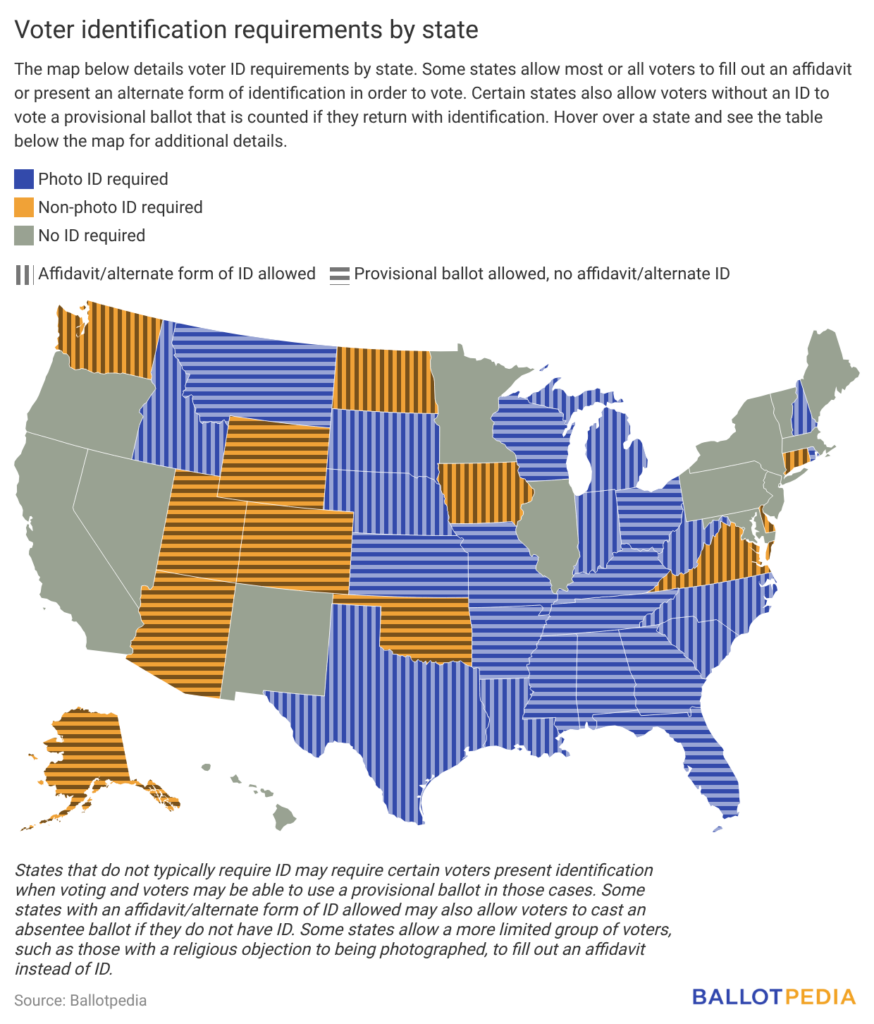
Currently, 36 states require voters to present identification in order to vote. Of these states, 24 require voters to present photo ID, with certain exceptions, and 12 states do not explicitly require photo ID. The remaining 14 states generally do not require voters to present identification to vote at the polls on Election Day.
Between 2004 and 2025, voters in 11 states decided on 12 ballot measures related to voter identification requirements. Voters approved nine of these measures and rejected three. The most recent state to approve a voter identification-related ballot measure was Wisconsin, when voters approved Question 1 in 2025. In 2025, Maine voters rejected Question 1, which would have required photo ID for in-person voting and made changes to absentee voting and ballot drop box rules.
California, Nevada, and North Carolina are also deciding ballot measures that would require voter ID this year. Voter ID measures may also be on the ballot in Arizona and Washington.
Click here to learn more about the amendment in Oklahoma.
Kentucky legislators override four vetoes on election-related bills
The Kentucky General Assembly adjourned on April 15 after overriding four of Gov. Andy Beshear’s (D) vetoes on election-related bills. Beshear signed four other pieces of election legislation.
Kentucky is one of two states, along with Kansas, where one party has a veto-proof majority in the legislature, and the other party holds the governor's office. It is one of 11 states with a divided government. The Kansas Legislature overrode Gov. Laura Kelly’s (D) veto of one election administration bill this year.
One of the bills enacted via veto override was HB 139, an omnibus bill making numerous changes to Kentucky election laws.
Under current law, Kentucky voters who cannot obtain a photo ID may present certain types of ID and sign an affidavit to vote. The bill removes food stamp cards, Social Security cards, and Supplemental Nutrition Assistance Program cards from the list of IDs that can be used if a person can’t obtain photo identification. It also removes the option for election workers to affirm the identity of individuals they personally know.
The legislation also authorizes the State Board of Elections to enter into data-sharing agreements with the federal government to identify noncitizens on the voter rolls and prohibits the use of voting equipment that uses nonhuman-readable codes, such as barcodes.
The Republican-controlled state Senate and state House both approved HB 139 along party lines. Beshear vetoed the bill on April 10. The state House voted 80-20 to override the veto on April 14, with the state Senate following suit later that day in a 32-6 vote.
Other bills enacted via veto override were:
- HB 607, which establishes redistricting criteria for consolidated local governments.
- HB 757, which makes changes to the process for filing a petition to challenge a tax levy.
- SB 59, which prohibits school districts from using local, state, and federal tax dollars and resources to advocate on public questions that appear on the ballot.
Among the bills Beshear signed were:
- HB 136, which allows a candidate or officeholder to use campaign funds to purchase security measures for themselves, their family members, and their employees.
- SB 195, which requires that the two voters witnessing a candidate’s declaration and signing their petition for office cannot be participants in the Safe at Home Program.
Kentucky enacted three election-related bills in 2025, nine in 2024, and three in 2023. There were no veto overrides on election bills in Kentucky in 2025, 2024, and 2023. Legislators introduced 57 bills in 2026 and 23 bills in 2025.
Aside from the veto legislators overrode in Kansas and the four in Kentucky, there have not been any other veto overrides on election administration bills this year. There were two in 2025, both in Kansas.