



A campaign sponsored by the California Teachers Association (CTA) submitted more than 1.6 million signatures on April 28 for a citizen-initiated constitutional amendment that would make permanent the additional income tax enacted with the approval of Proposition 30 in 2012, which funds education and early childhood programs. The additional income tax is set to expire in 2031.
The required number of signatures in California for an initiated constitutional amendment is 874,641, which equals 8% of the vote cast in the prior gubernatorial election. The petition will now undergo a random-sample check to verify that it contains enough valid signatures.
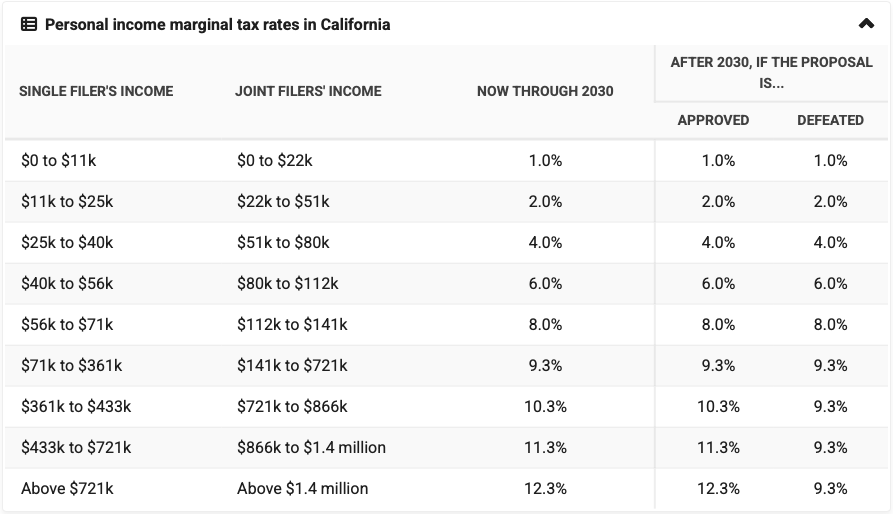
The initiative would continue the higher marginal income tax rates on income above $361,000 for single filers and $721,000 for joint filers. The additional tax rate was adopted in 2012 for incomes above $250,000 for single filers and $500,000 for joint filers, and was extended by voters in 2016 with the approval of Proposition 55. Propositions 30 and 55 did not contain mechanisms to adjust the bracket threshold in response to inflation increases. The proposed initiative increases the threshold and ties it to inflation. Proposition 30 (2012) was approved with 63% of the vote, and Proposition 55 (2016) was approved with 55% of the vote.
In California, the income tax bracket applies to a filer's portion of income within that bracket. The chart below shows the current rates through 2030 and the tax rates if it is approved or rejected.
The initiative would maintain that the revenue generated from the increased marginal tax would be divided with 89% to K-12 schools and 11% to state community colleges and deposited into the Education Protection Account (EPA). This division of revenue and account were adopted in 2012 with the approval of the tax. If there are funds in excess of the Proposition 98 education-funding requirement and education workload budget in the EPA, then 50% of the excess (not to exceed $2 billion per fiscal year) is required to be allocated to the state Department of Health Care Services. These funds must be used for critical, emergency, acute, and preventive health care for children and their families, primarily through Medi-Cal programs.
CTA President David Goldberg said the revenue from the income tax is critical to education funding. He said, “Make no mistake: This is a critical fight for our public schools — the impact of Prop. 55 expiring would be devastating. That’s why it’s so important for all of us to get involved now and be prepared to carry a permanent extension to the finish line in November. Our students and communities are counting on us!”
Wayne Winegarden, senior fellow at the Pacific Research Institute, opposes the extension. He said, “Extending these income tax rates, it’s hitting that same pressure points and it’s causing the same incentives to leave. And if you look at the latest IRS migration data, you can see it. People with greater means are leaving the state.”
Signatures were submitted for a separate ballot initiative on April 27 that would levy a one-time 5% wealth tax on billionaires in the state to fund state health care programs, food assistance, and public education. The initiative is sponsored by SEIU-UHW.
Signatures are also pending for four other California ballot initiatives that would:
- Make changes to the California Environmental Quality Act (CEQA) and Permit Streamlining Act (PSA);
- Establish a compensation limit for CEOs, executives, administrators, and managers of healthcare corporations;
- Require rideshare companies to conduct background checks and investigations when the company receives sexual assault or misconduct allegations against a driver; and
- Prohibit healthcare clinics, specifically federally-qualified health centers and related organizations, from spending less than 90% of their annual revenue on mission-related purposes.
Three initiatives have qualified for the 2026 ballot in California. Voters will decide on:
- An amendment to require a two-thirds vote by the electorate to enact special local taxes and to prohibit charter city real estate transfer taxes;
- An amendment to require voters to present government-issued identification when casting ballots and require election officials to use government data to confirm voter citizenship and report verification rates; and
- A law to establish a second mortgage homebuyer program for qualified homebuyers on qualifying homes and to issue $25 billion in bonds to fund the program.
California voters will also be deciding on three legislative referrals — an amendment related to initiative supermajority requirements, a law to allow the state and local governments to create public campaign finance programs, and an amendment to eliminate the successor election when a state officer is recalled.
Additional reading: