


In this week’s edition of Economy and Society:
- Sustainability standards board declines mandatory nature reporting requirement
- European Commission unveils $711 billion clean energy investment plan
- 23 attorneys general challenge ratings agencies on ESG
- ESG legislation update
- BP shareholders reject proposal to reduce climate disclosures
- Companies reframe net zero communication amid political skepticism
Around the world
Sustainability standards board declines mandatory nature reporting requirement
What’s the story?
The International Sustainability Standards Board (ISSB) announced on April 22, 2026, that it will develop a voluntary practice statement for companies to provide nature-related disclosures rather than issue a separate mandatory statement.
Practice statements provide guidance for applying IFRS standards but are voluntary, though individual jurisdictions can choose to make them mandatory. Nature-related disclosures refer to company reporting on how natural systems—such as forests, water, and biodiversity — affect financial performance and business risk.
The ISSB said it chose this approach to minimize disruption for companies currently implementing its existing sustainability and climate reporting standards, which were released in June 2023. The board left open the possibility of creating a mandatory standard later. It said an upcoming consultation with stakeholders will ask whether they agree that a practice statement is the appropriate approach for nature-related disclosures.
An International Financial Reporting Standards (IFRS) practice statement is a standalone document designed for application with IFRS standards. While not constituting a separate standard, it shares similarities with standards, including being subject to full due process and public consultation.
ISSB Chair Emmanuel Faber said "providing material nature-related disclosures is not optional; IFRS S1 already requires that." He added that "a Practice Statement will guide companies on how to provide such disclosures." The ISSB said it aims to publish an exposure draft of the proposed practice statement for public comment in October 2026.
What’s the background?
Several prominent sustainability groups published an open letter April 20, 2026, urging the ISSB to introduce a mandatory standard instead. The signatories — including CEOs from Conservation International, The Nature Conservancy, WWF International, and Ceres — wrote that "a critical opportunity would be missed if ISSB were to ignore the latest science, private sector momentum and global policy commitments by choosing not to introduce a standard on nature."
The IFRS Foundation launched the ISSB in November 2021 to develop sustainability disclosure standards for investors. The ISSB released its general sustainability standard (IFRS S1) and climate reporting standard (IFRS S2) in June 2023.
In late 2025, the ISSB announced it would begin work on nature-related disclosure requirements. Then the Taskforce on Nature-related Financial Disclosures (TNFD) announced that it would end its technical work program in light of the ISSB initiative. The TNFD framework currently has 750 early adopters.
European Commission unveils $711 billion clean energy investment plan
What’s the story?
The European Commission released AccelerateEU on April 21, 2026, a policy package designed to accelerate the European Union's shift to clean energy while providing relief to households and industry facing volatile fossil fuel markets. The Commission estimates the plan requires €660 billion ($711 billion) in annual investment through 2030 to meet energy transition goals.
Commission President Ursula von der Leyen said "the choices we make today will shape our ability to face the challenges of today and the crises of tomorrow." She added that "we must accelerate the shift to homegrown, clean energies. This will give us energy independence and security, and mean we are better able to weather geopolitical storms."
The package includes both short-term crisis response measures and structural reforms. The Commission will introduce an Electrification Action Plan by summer, setting targets for industry, transport, and buildings. The strategy prioritizes replacing oil and gas with renewable energy and accelerates deployment of sustainable aviation fuels. Short-term measures include targeted income support, energy vouchers, social leasing schemes (where governments or nonprofits lease private housing and rent it at lower rates), and temporary cuts to electricity taxes for vulnerable households. A revised State Aid Temporary Framework would give governments more flexibility to support energy-intensive industries facing high costs, including sectors that rely heavily on fuels such as aviation.
Why does it matter?
The policy responds to conflicts in the Middle East that have pushed energy prices higher. Europe spent €24 billion ($26 billion) in additional energy costs without receiving more supply. The plan treats energy security not as a standalone issue but as a convergence of finance, industrial policy, and climate strategy. The Commission launched a Clean Energy Investment Strategy in March 2026 and plans a dedicated investment summit to accelerate private capital deployment.
The Commission will coordinate national actions on gas storage refilling, oil stock releases, and emergency supply measures across member states. A new Fuel Observatory will track production, imports, exports, and stock levels of transport fuels. Grid infrastructure remains a critical bottleneck, with the Commission urging rapid implementation of existing legislation and swift agreement on the European Grids Package. A forthcoming legislative proposal will adjust network charges and taxation to favor electricity over fossil fuels.
In the states
23 attorneys general challenge ratings agencies on ESG
What’s the story?
A coalition of 23 Republican state attorneys general sent a letter on April 22, 2026, to Fitch Ratings, Moody’s Investors Service, and S&P Global Ratings accusing the firms of improperly downgrading fossil fuel companies and energy-producing states based on environmental, social, and governance (ESG) assumptions.
The attorneys general accused the three agencies of using "flawed methodologies to downgrade, or to threaten to downgrade, states and municipalities with fossil-fuel production revenues," and alleged the agencies "largely have not reversed the downgrades after highly speculative ESG predictions proved to be wrong."
The attorneys general cited the agencies' commitments to Principles for Responsible Investment, a United Nations-backed group, to incorporate ESG into credit ratings and analysis, and noted that Moody's and S&P pledged to help achieve net zero emissions. The attorneys general requested five corrective actions, including explaining ESG-driven downgrades, withdrawing from or disclosing ESG commitments, revising sector-specific methodologies, eliminating or disclosing ESG consulting conflicts, and certifying internal controls reviews.
An S&P representative said that the company "take[s] these matters very seriously and do[es] not have further comments at this time."
Why does it matter?
Credit ratings affect borrowing costs of companies and government entities and influence decisions about where to allocate capital. Lower credit ratings increase the cost of issuing bonds and can reduce investments. The attorneys general argued that the agencies' downgrades increase borrowing costs for fossil fuel-producing states, reduce economic activity and tax revenues, and lower the value of state pension holdings in energy companies.
The attorneys general said they will consider enforcement options if the firms do not take corrective actions. These options include actions under state unfair and deceptive acts and practices laws, antitrust investigations, referrals to the Securities and Exchange Commission's Office of Credit Ratings, or coordination with the U.S. Department of Justice.
What’s the background?
The attorneys general pointed to past enforcement actions involving the U.S. Department of Justice and multiple states against major credit rating firms:
- S&P Global Ratings (2015): Agreed to a $1.375 billion settlement after federal and state officials alleged the firm misrepresented its ratings as objective while allowing business pressures to influence its analysis of mortgage-backed securities.
- Moody’s (2017): Agreed to an $864 million settlement over similar claims that it failed to maintain independence and transparency in rating mortgage-related financial products.
They noted that the same firms are among those now facing scrutiny, though the earlier cases involved mortgage securities, not ESG or energy-related ratings.
ESG legislation update
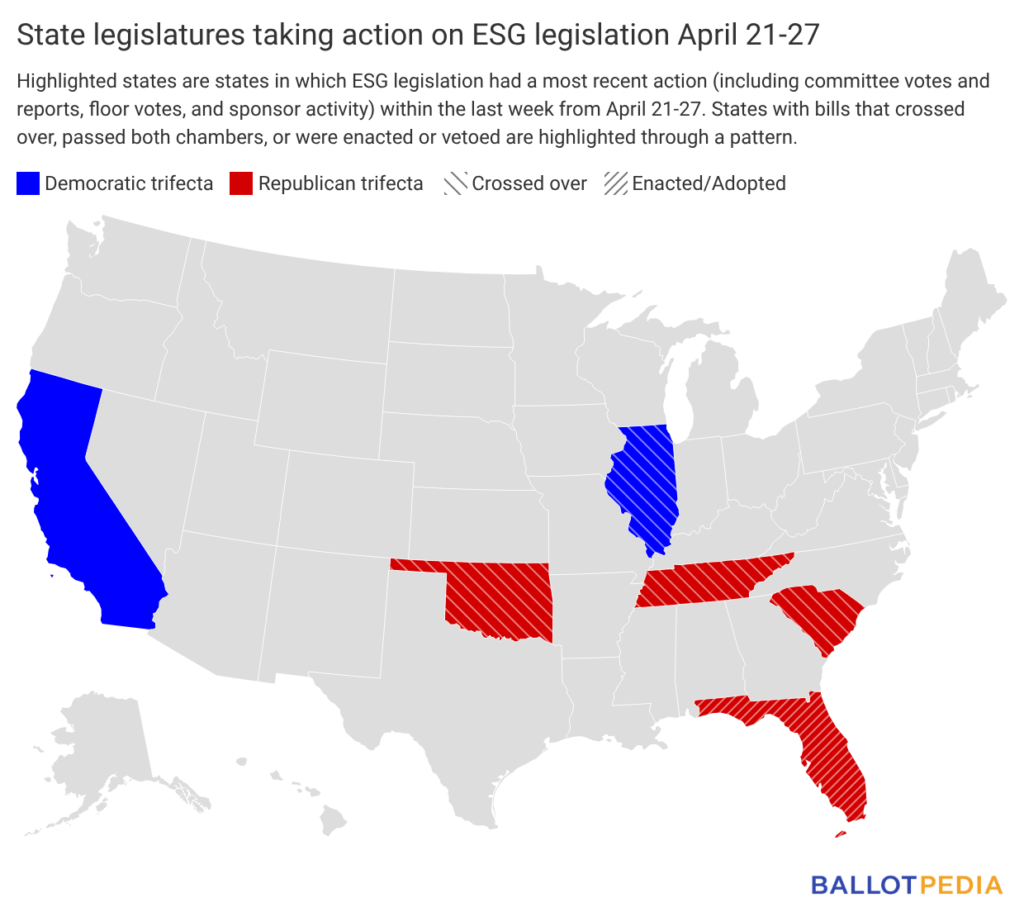
Six states took action on nine ESG-related bills last week (since April 21, 2026).
Florida Gov. Ron DeSantis (R) signed SB 1134, which prohibits counties and municipalities from funding or supporting diversity, equity, and inclusion offices or initiatives. It also voids existing DEI-related policies, imposes penalties for violations, and requires contractors and grantees to certify that they do not use local funds for DEI-related training or materials.
States with legislative activity on ESG last week are highlighted in the map below. Click here to see the details of each bill in the legislation tracker.
On Wall Street and in the private sector
BP shareholders reject proposal to reduce climate disclosures
What’s the story?
Shareholders rejected two resolutions proposed by BP at its annual general meeting (AGM) on April 23, 2026. The resolutions would have allowed the company to eliminate some climate-related disclosures and to hold virtual AGMs going forward. Both resolutions received around 47% support from shareholders, far short of the 75% required to pass.
One defeated resolution would have revoked earlier resolutions requiring BP to provide certain climate disclosures. This includes a 2015 resolution mandating reporting on the company's operational emissions management, portfolio resilience to climate transition scenarios, low-carbon research and development and investment strategies, key performance indicators and incentives, and public policy positions. It also would have eliminated a 2019 resolution requiring the company to describe its strategy to be consistent with the goals of the Paris Agreement.
Albert Manifold was re-elected as chair with 18.2% of shareholders voting against him. Board members typically receive near-unanimous support, indicating an unusually high level of investor opposition.
The vote followed the board's decision to block a proposal from Dutch activist group Follow This that would have required the company to share plans on creating value for shareholders under future scenarios of falling oil and gas demand.
Manifold said "while we appear to have overwhelming support for the direction of travel for the company, it seems very clear that the two special resolutions – one relating to our articles and one relating to historic resolutions – have not reached a simple majority."
Mark van Baal, CEO of Follow This, said "today, shareholders reminded BP's board who it works for. Not for itself, but for them". He added that "many shareholders agreed with us: BP's governance is broken."
What’s the background?
The shareholder action follows BP's strategic shift announced in February 2025. The company unveiled a new strategy reallocating capital to increase oil and gas investment while reducing low carbon energy to less than 5% of the company's capital expenditure allocation. BP initially set a net zero goal in 2020, with plans to reduce oil and gas production over time while increasing investments in low carbon energy sources.
Two influential proxy advisors, Glass Lewis and ISS, and one of Europe's biggest asset managers, Legal & General Investment Management, had recommended shareholders vote against BP's wishes on the climate disclosure resolution. Top investors, including Norway's Norges Bank Investment Management, supported BP's management along with several other board proposals. Nearly 26% of BP shareholders also backed a resolution from climate group ACCR calling on BP to justify its capital discipline on oil and gas investments.
Companies reframe net zero communication amid political skepticism
What’s the story?
BSI, a professional services and standards company, published a survey on April 21, 2026, finding that most businesses are reframing how they communicate about net zero while still maintaining their climate commitments. The survey, titled "G7 Net Zero Temperature Check," polled more than 7,000 business leaders across the United Kingdom, United States, France, Germany, Italy, Canada, and Japan.
The survey found that 83% of respondents reported being committed to achieving net zero by their national target, with 78% saying they will continue to pursue net zero regardless of political uncertainty because it is good for business. Additionally, 69% of respondents reported that their businesses increased net zero activity over the past 12 months, compared with only 4% reporting a decrease.
However, 61% of respondents said their businesses had changed the way they communicate their net zero initiatives in response to climate skepticism in media and politics. They shifted away from environmental messaging and toward a focus on resilience, risk mitigation, and long-term preparedness. The survey also found that 32% of respondents reported they have revised their net zero plans and 33% said they have reevaluated their targets, including 13% that had dropped their targets.
Chief executive at BSI, Susan Taylor Martin, said "recent geopolitical events have brought into stark focus the need for energy security and the important role played by renewable and low carbon energy." She added that "what's clear is that many business leaders are already thinking this way, and have recognised that the cost of not investing in net zero could threaten their operations in the long term."
Why does it matter?
The survey found that 74% of respondents reported they view the risks of not transitioning to net zero as greater than the risks of transitioning, and 75% agreed that net zero is important for their future business resilience. Additionally, 79% of respondents agreed that net zero will be a political priority again in the next decade, leading them to continue working toward it. Nearly three quarters (73%) of respondents said that if their competitors scaled back action, their business's continued net zero efforts would give them a competitive advantage.
Despite broad continued commitment to climate action, the survey indicated that the political environment was affecting many businesses. Policy uncertainty around net zero makes it difficult to invest, according to 76% of respondents. Respondents reported that the top obstacles included cost (26%), lack of available financing to invest in green technology (25%), and lack of internal skills and knowledge (23%). Political uncertainty ranked fourth at 20%.