


On April 29, the U.S. Supreme Court handed down a 6-3 decision in Louisiana v. Callais, ruling that Louisiana’s congressional map that added a second majority-Black district was an unconstitutional racial gerrymander.
In 2024, the Louisiana Legislature added the second majority-Black district in response to a previous lawsuit that argued the 2022 map diluted minority votes because it included only one majority-Black district, violating Section 2 of the Voting Rights Act.
The Callais decision will affect how Section 2, which prohibits voting practices and procedures that discriminate on the basis of race, is applied in future disputes over district boundaries.
Justice Samuel Alito wrote in the majority opinion that Section 2 “requires evidence giving rise to a strong inference of intentional discrimination. If race and politics are not disentangled and a Section 2 claim is cynically used as a tool for advancing a partisan end, the VRA’s noble goal will be perverted.” Alito wrote that in the case against the original map, “Much of the cited evidence—such as the low number of black Louisianans who have been elected to Congress in recent decades—failed to disentangle race from politics.”
As a result, Alito concluded that “because the Voting Rights Act did not require Louisiana to create an additional majority-minority district, no compelling interest justified the State’s use of race in creating SB8 [the map with the second majority-Black district]. That map is an unconstitutional gerrymander, and its use would violate the plaintiffs’ constitutional rights.”
Justice Elena Kagan wrote, dissenting, “The consequences are likely to be far-reaching and grave. Today’s decision renders Section 2 all but a dead letter. In the States where that law continues to matter—the States still marked by residential segregation and racially polarized voting—minority voters can now be cracked out of the electoral process.”
Effect on the 2026 U.S. House midterms
On April 30, Louisiana Gov. Jeff Landry (R) and Attorney General Liz Murrill wrote in a joint statement, “The State is currently enjoined from carrying out congressional elections under the current map. We are working together with the Legislature and the Secretary of State’s office to develop a path forward.” The state’s primaries were scheduled for May 16 and the filing deadline was Feb. 13.
Landry posted on X about the Supreme Court decision: “The Supreme Court has affirmed what we have said for years: drawing districts for political reasons is the States’ prerogative, not a federal civil-rights violation.” Louisiana’s six congressional districts are currently represented by four Republicans and two Democrats. They were represented by five Republicans and one Democrat under the 2022 map.
In Florida, where a special session for congressional redistricting was already underway when the Callais decision came down, the Florida Legislature approved a new map that same day. On April 29, the Florida House of Representatives approved the map 83-28, which would shift four seats to Republicans according to the 2024 presidential election results. One Republican joined all Democrats in voting against the map. After reviewing the Callais decision, the Florida Senate voted 21-17 to approve the map. Four Republicans and one independent joined all Democrats in voting against it.
So far, six states will have new congressional district boundaries in the 2026 midterms. Virginia could be another. The Virginia Supreme Court is weighing the constitutionality of the voter-approved redistricting amendment. On April 28, the Court upheld a lower court order blocking certification of the amendment.
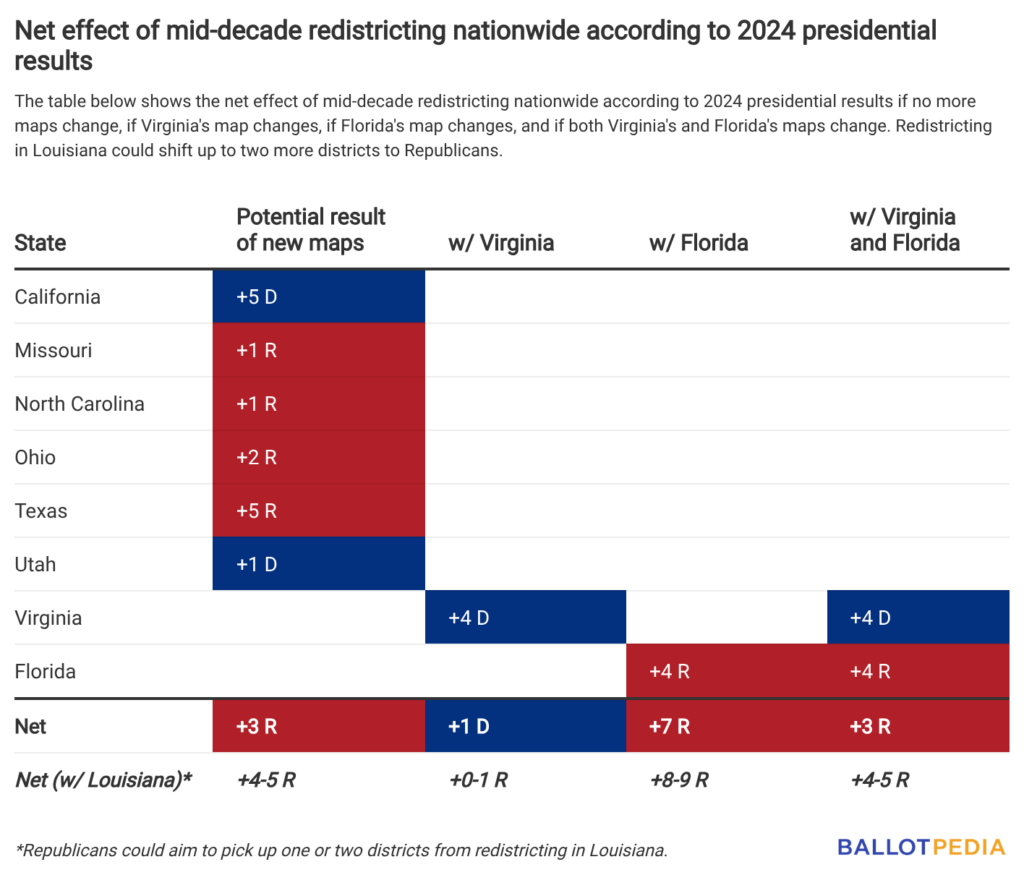
The table below shows the net effect of mid-decade redistricting nationwide should either, both, or neither of Florida and Virginia’s maps take effect. The figures below were calculated using 2024 presidential election results. The table also shows how these numbers could change should Louisiana pass a new map that moves one or both of its Democratic districts toward Republicans.
Effect on redistricting moving forward
Other states may pursue redistricting ahead of the 2028 elections. The Downballot identified 12 districts across eight southern states where Republicans could aim to redraw their congressional districts following the Callais decision.
Alabama Gov. Kay Ivey (R) said that she will not immediately call for a special session: "While I am encouraged by this decision, it does not yet resolve our ongoing redistricting fight over Alabama's congressional map. Alabama is currently under a court order prohibiting the use of new congressional districts until after the 2030 census. While we are not in position to have a special session at this time, I hope in light of this new decision, the court is favorable to Alabama."
Mississippi Gov. Tate Reeves (R) announced on April 24, that he was calling a special session for congressional redistricting to begin 21 days after the decision. That date would be May 20. Although Reeves did not say what election cycle Mississippi could start using the potential boundaries, Clarion Ledger’s Bea Anhuci wrote that it “would almost definitely not be in effect for the upcoming midterm elections later this year.”
Republicans currently have a 217-212-1 majority in the U.S. House of Representatives, with five vacancies. The general election is Nov. 3.
Additional reading:
Editor's note: This post was updated to include detailed analysis of how the U.S. Supreme Court decision in Louisiana v. Callais will affect the House midterm elections and future redistricting efforts.