On May 1, Nebraska became the first state to implement Medicaid work requirements after Congress passed the One Big Beautiful Bill Act (OBBBA). The OBBBA directs states to adopt policies requiring able-bodied Medicaid recipients in the Affordable Care Act (ACA) expansion group to work 80 hours per month beginning January 1, 2027. Nebraska became the third state ever to enforce a work requirement for the program.
Beginning May 1, Medicaid expansion members in Nebraska need to work, attend school or an apprenticeship, participate in a work program, or volunteer for 80 hours per month unless they have an exemption.
The Nebraska Department of Health and Human Services (DHHS) website defines Medicaid expansion members as recipients who:
- Are between age 19 and 64
- Are not pregnant
- Do not have a disability
- Are not enrolled in Medicare
- Meet income limits (earn up to 138% of the federal poverty level or about $22,025 per year for one person or $45,540 for a family of four)
- Are U.S. citizens or meet immigration rules
Exemptions in Nebraska include, but are not limited to:
- Being parent or caretaker of a child age 13 or younger,
- Caring for a person with a disability,
- Being a veteran with a total disability rating,
- Having a medical condition that prevents you from working,
- Living in a household that is compliant with Supplemental Nutrition Assistance Program (SNAP) or Temporary Assistance for Needy Families (TANF) work requirements,
- Participating in a qualified drug or alcohol treatment program,
- Being held in jail or having been released from jail within 90 days, and
- Being pregnant or are up to 12 months postpartum.
For a full list of exemptions, see the Nebraska DHHS website.
Governor Jim Pillen (R) announced the state's intention to speed up implementation of work requirements in a press release from December 2025. In it, he stated:
“These requirements will help Nebraskans achieve greater self-sufficiency through employment and other meaningful activities. ... Nebraska will be ready to move forward with these requirements prior to the federally mandated start of Jan. 1, 2027.”
Drew Gonshorowski, the state's Medicaid director, said that Nebraska was well positioned to move up the implementation timeline, in part because the state "own(s) our state enrollment and eligibility system. ... We're just in a situation where we can be more nimble in terms of how verification actually works."
Opponents of the work requirements have expressed concerns about the fast implementation timeline from the passage of the OBBBA, and the possibility of eligible people losing coverage due to an inability to prove exemption or navigate the various requirements and exemptions. Anthony Wright, executive director of healthcare advocacy group Families USA, was critical of Nebraska's decision to fast track implementation, saying: “Eighteen months to implement such a massive undertaking of all these new eligibility and requirements is bad enough, but it’s even worse that for no reason at all, Nebraska has decided to start this process eight months early.”
Allie Gardner, senior policy analyst at the Center on Budget and Policy Priorities, a nonpartisan research group said, “It’s not super straightforward. If you’re an enrollee, you’re trying to parse together all these 295 pages of code to figure out if you have a condition that would qualify for an exemption.”
Background
The 2025 budget reconciliation bill, the One Big Beautiful Bill Act, established mandatory work requirements for certain able-bodied Medicaid recipients beginning in 2027. By creating a federal mandate, the OBBBA significantly changed the national landscape of Medicaid work requirements and states must respond by designing and implementing systems to comply, or risk losing federal funding.
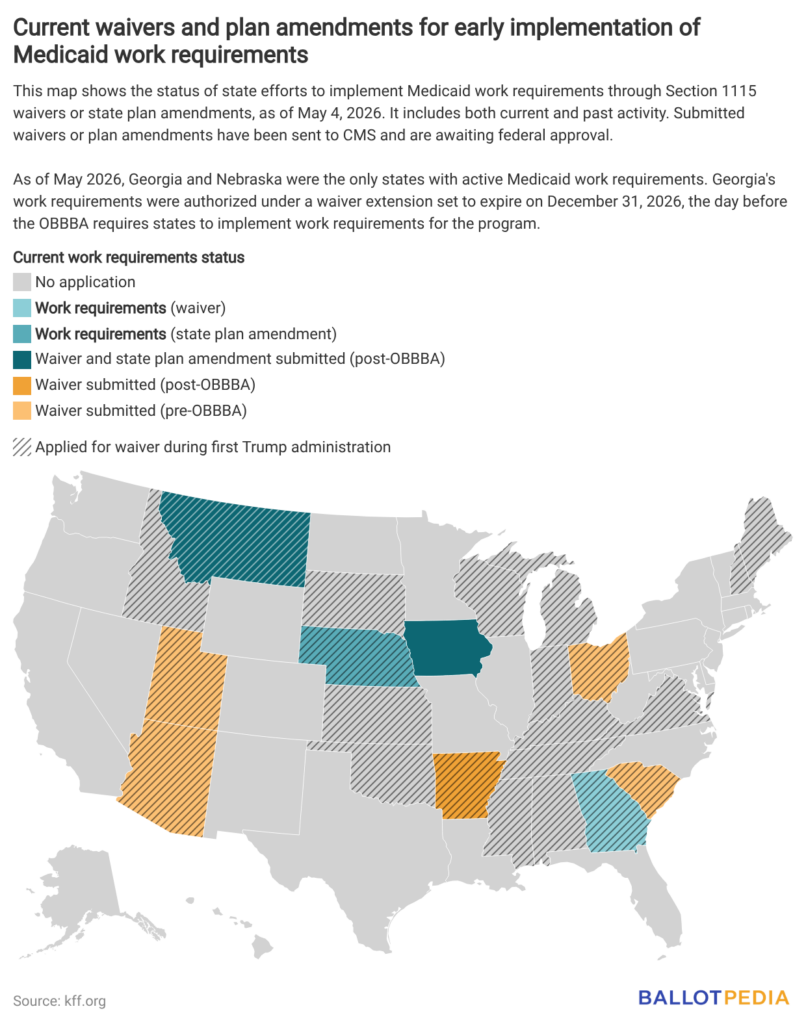
Previously, states could apply for a waiver to implement work requirements, but only two states had ever successfully implemented a Medicaid work requirement. Arkansas briefly implemented work requirements under a waiver that was granted under the first Trump administration before it was revoked under the Biden administration. Georgia was similarly granted a waiver to implement work requirements for the program and implemented them after a court case was ruled in the state's favor. Georgia has been the only state with active work requirements since July 1, 2023.
The OBBBA included a provision that allowed states to speed up implementation, called a sate plan amendment. Nebraska is the fist to use the mechanism, but two other states, Montana and Iowa, plan to use state plan amendments to implement work requirements on July 1 and Dec. 1 respectively.
State plan amendments aren't the only way to implement the work requirements ahead of schedule. States can still apply for Section 1115 waivers, which require approval from the federal Centers for Medicare and Medicaid Services (CMS). Seven states have active applications for Section 1115 waivers that would implement work requirements before the January 1, 2027 deadline to do so. Two of these states, Iowa and Montana, have since adopted state plan amendments. All of the following waiver applications are still pending:
- Arizona applied to CMS for a waiver to require expansion adults ages 19 - 54 to work 80 hours per month before the passage of the OBBBA.
- Arkansas applied to CMS for a waiver to require expansion adults ages 19 - 64 to work 80 hours per month after the passage of the OBBBA. Arkansas’ waiver also requested permission to use certain compliance tracking methods.
- Iowa applied to CMS for a waiver to require expansion adults ages 19 - 64 to work 100 hours per month before the passage of the OBBBA. Iowa’s policy wouldn’t require individuals to comply with work requirements to begin receiving Medicaid benefits, but would enforce work requirements beginning 6 months after certification and every six months thereafter.
- Montana applied to CMS for a waiver to require expansion adults ages 19 - 64 to work 80 hours per month after the passage of the OBBBA. Montana is requesting additional exemptions.
- Ohio applied to CMS for a waiver that conditions Medicaid expansion on meeting work requirements before the passage of the OBBBA.
- South Carolina applied to CMS for a waiver that would expand Medicaid to cover parents and caretakers earning 67% - 100% of the federal poverty level. The waiver would also require parents and caretakers aged 19 to 64 to work 80 hours per month.
- Utah requested a work requirement waiver, but the state has since indicated that it will no longer be moving ahead with the waiver process. The waiver application is still pending at CMS.