


Welcome to the Tuesday, May 5, 2026, Brew.
By: Briana Ryan
Here’s what’s in store for you as you start your day:
- So far this year, fewer incumbent state legislators are retiring, but more are running in contested primary elections
- Texas' May 2 elections resulted in the first partisan change in one of the most populous U.S. cities having mayoral elections this year
- A look at the primary elections happening in Indiana and Ohio today
So far this year, fewer incumbent state legislators are retiring, but more are running in contested primary elections
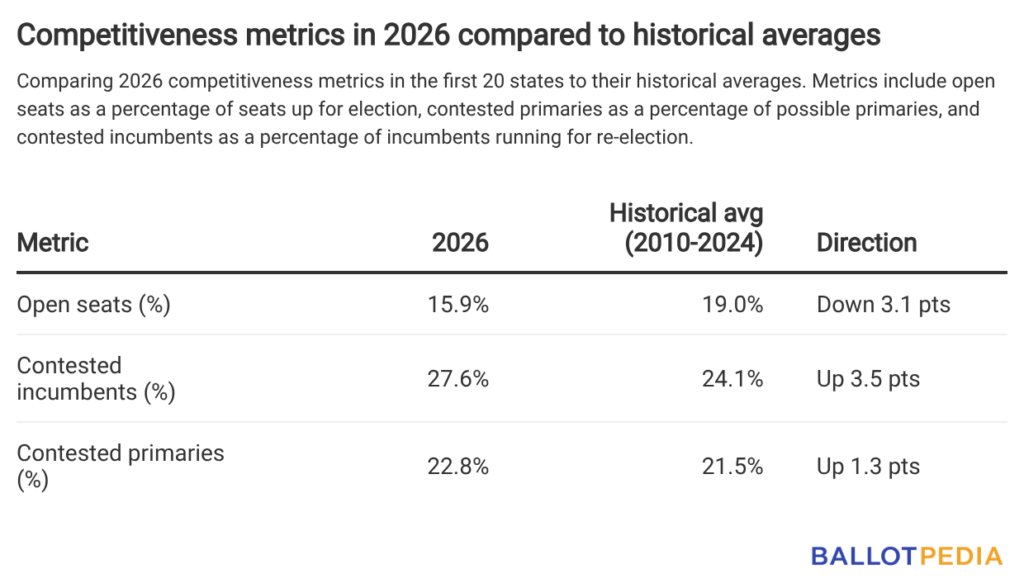
Across 20 states with completed candidate filing data, 28% of incumbent state legislators are running in contested primaries this year — the second-highest share since 2010, trailing only 2022. At the same time, the share of open seats, at 15.9%, is the second-lowest since 2010.
Among the 20 states with completed 2026 candidate-filing data — Alabama, Arkansas, California, Idaho, Illinois, Indiana, Kentucky, Maryland, Maine, Montana, North Carolina, North Dakota, Nevada, Ohio, Oklahoma, Oregon, South Carolina, Tennessee, Texas, and West Virginia — three patterns emerge compared to those states across even-year cycles since 2010:
Here's a closer look at what's driving the data.
Number of incumbents who are not seeking re-election
Across the 20 states, 15.9% of state legislative seats up for election this year have no incumbent running. That's down from the historical average of 19%, and the second-lowest since 2010. Only 2020 was lower, with 14.7%. Sixteen of the 20 states are below their own historical average for open seats.
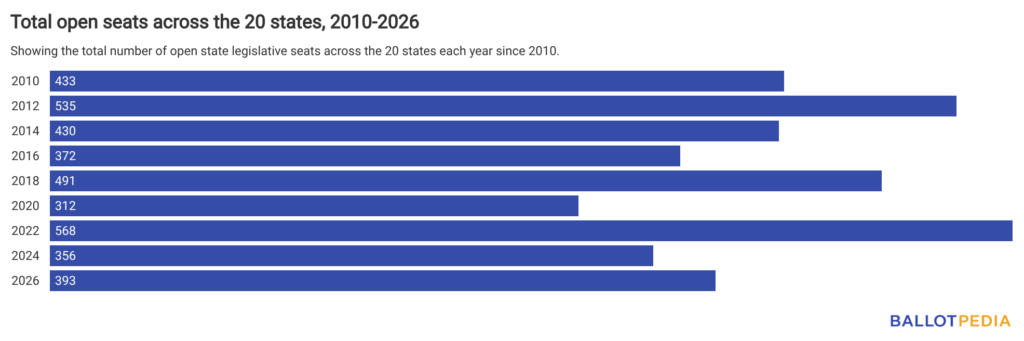
The 20-state set includes 12 Republican trifectas, five Democratic trifectas, and three divided governments — open seats are down across all three categories, with the largest average declines occurring in states with divided governments.
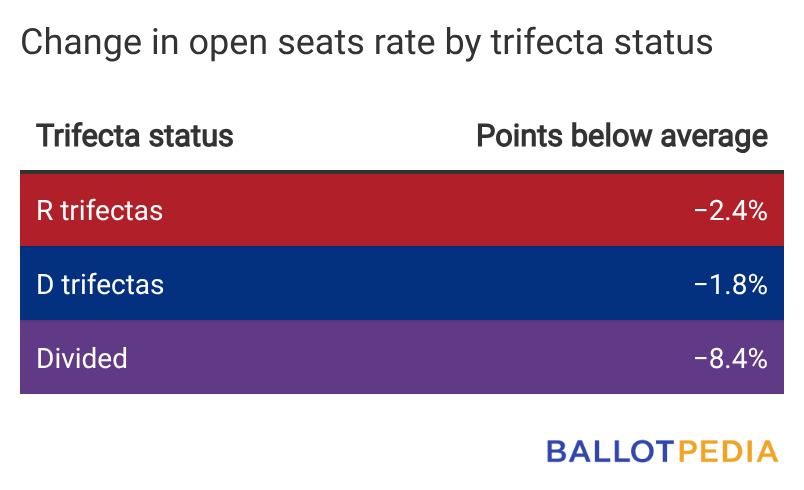
Nevada, which has a divided government, had the largest decline in share of open seats, down 13 percentage points below its historical average. Four states buck the trend and show increases in open seats this year — Maine (+10 points), North Dakota (+7 points), Ohio (+0.5 points), and Texas (+5 points). These trends may change as data from additional Democratic trifectas and divided governments are incorporated compared to the initial large set of Republican trifectas.
Number of incumbents facing primary challengers
Between 2010 and 2024, an average of 24% of incumbents in the 20 states in our analysis had primary challengers. In 2026, 28% of incumbents are running in contested primaries, second only to 2022 at 30%.
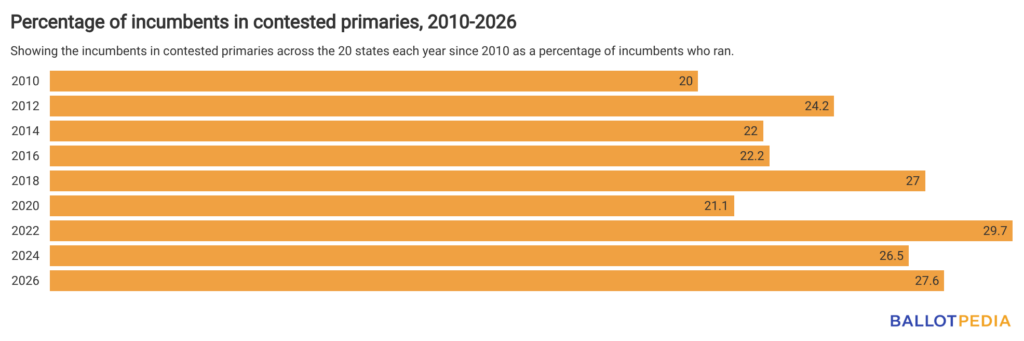
Twelve states are above their own historical averages for contested incumbents this year, with the biggest jumps occurring in North Dakota (+22 points from average), Oklahoma (+14 points from average), Oregon (+13 points from average), Indiana (+10 points from average), and West Virginia (+8 points from average).
The overall increase in the percentage of incumbents facing primary challenges would have been larger, except for a decline in Maryland below its historical average. There, incumbents have historically faced the highest average number of challenges among the 20 states we reviewed at 67%.
Maryland remains the state with the highest number of incumbents facing challengers this year, at 51%, 16 points below its average. Had Maryland matched its historical average for incumbent contests, the average across all states would have been nearly one point higher.
Number of primary elections with more than one candidate
This year, an average of 22.8% of possible primaries are contested across the 20 states, 1.3 percentage points higher than the historical average of 21.5%.
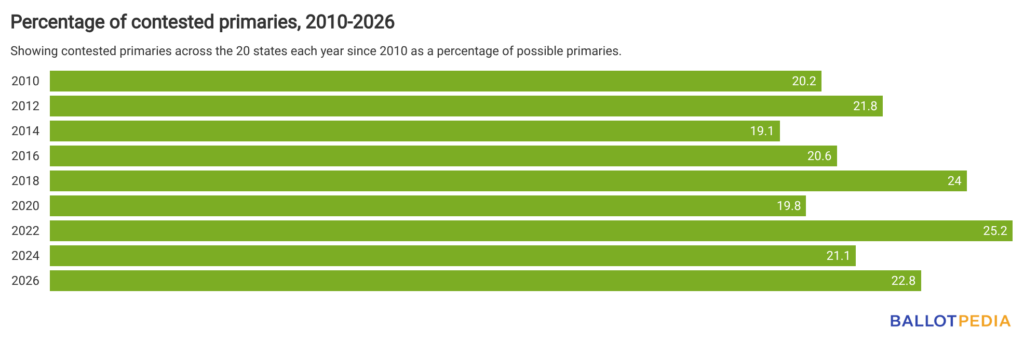
While the states are not far from the average number of contested primaries collectively, there are a handful of noteworthy up- and downswings.
Five states are running more than six points above average: Indiana (+10 points), North Dakota (+9 points), Oregon (+7 points), South Carolina (+7 points), and Texas (+6 points). Three states are running more than six points below average: Alabama (-7 points), Nevada (-6 points), and Maryland (-11 points).
Click here to see our analysis of primary election competitiveness in state and federal government this year.
Texas' May 2 elections resulted in the first partisan change in one of the most populous U.S. cities having mayoral elections this year
On May 2, partisan control of the mayor's office in Irving, Texas — one of the nation's 100 most populous cities — changed from Republican to unaffiliated. This election marks the first time that one of the 100 most populous cities has changed partisan control this election cycle.
Here's a closer look at what happened in that election and the three other mayoral elections this year that did not change partisan control.
Let’s start with the city where partisan control changed. On May 2, Albert Zapanta defeated Olivia Novelo Abreu and Zhanae Jackson in the nonpartisan general election. Zapanta won 67% of the vote to second-place finisher Jackson's 19%. On April 29, a representative for Zapanta told Ballotpedia he was unaffiliated. Incumbent Rick Stopfer, who political blogs identified as a Republican, was term-limited.
Zapanta is the president and CEO of the United States-Mexico Chamber of Commerce. He was previously the CEO of Paz Energy. Zapanta was also a White House Fellow under President Richard Nixon (R) and served on several government commissions and advisory committees under Presidents Gerald Ford (R), Ronald Reagan (R), and George H.W. Bush (R), and George W. Bush (R).
The other mayors’ offices up for election on May 2 not only did not change partisan control, but their incumbent mayors won re-election.
Arlington, Texas: On May 2, incumbent Mayor Jim Ross defeated Steve Cavender, Hunter Crow, and Shaun Mallory in the nonpartisan general election. Ross, who identifies as an independent, won 50% of the vote to second-place finisher Cavender's 39%.
Lubbock, Texas: On May 2, incumbent Mayor Mark McBrayer defeated Peggy Bohmfalk, Stephen Sanders, and G. Todd Winans in the nonpartisan general election. McBrayer, who political blogs identified as a Republican, won 70% of the vote to Sanders' 19%.
Oklahoma City, Oklahoma: On Feb. 10, incumbent Mayor David Holt defeated Matthew Pallares in the nonpartisan general election, 86.5% to 13.5%. Holt identifies as a Republican.
Mayoral partisanship update
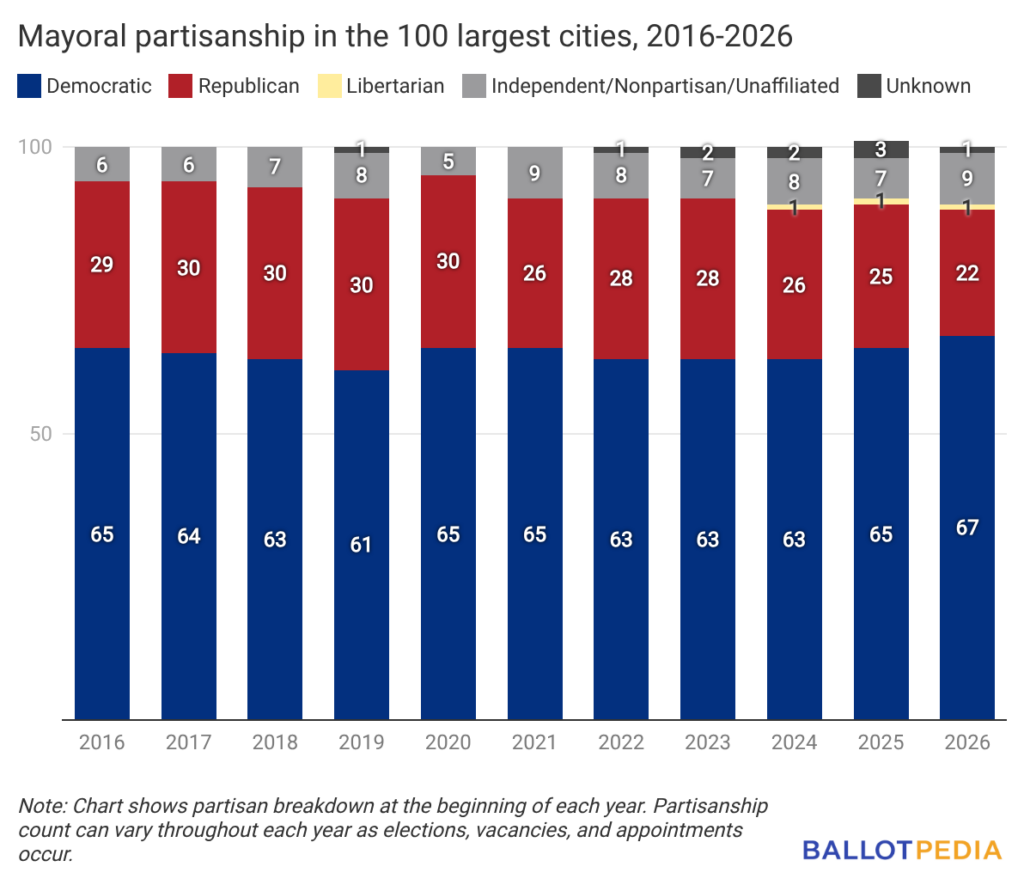
While most mayoral elections in the 100 most populous cities are nonpartisan, Ballotpedia has maintained a list of mayors' partisan affiliations since 2016. Once Zapanta is sworn in as mayor of Irving the number of nonpartisan/unaffiliated mayors will increase from six to seven and the number of Republican mayors will decrease from 22 to 21.
In total, there will be 67 Democratic mayors, 21 Republican mayors, one Libertarian mayor, three independent mayors, and seven nonpartisan/unaffiliated mayors. One mayor's partisan affiliation is unknown. That's the most Democratic mayors since 2016.
Of the 22 most populous cities where mayoral elections are happening this year, 11 had Democratic mayors heading into this election cycle, seven had Republican mayors, one had an independent mayor, and two had nonpartisan mayors. One mayor's partisan affiliation was unknown.
Three mayoral elections in 2025 resulted in a change in partisan control, six did in 2024, five did in 2023, four did in 2022, two did in 2021, seven did in 2020, five did in 2019, two did in 2018, 36 did in 2017, and four did in 2016.
Click here to learn more about mayoral elections this year, and click here to see our analysis of partisanship in this year's municipal elections.
A look at the primary elections happening in Indiana and Ohio today
Voters in Indiana and Ohio are headed to the polls today, May 5. Here's an overview of what voters in each of these states will see on their ballots today.
Indiana
At the state level, there are primaries for 25 state Senate seats and all 100 state House seats. Additionally, Indiana is holding primaries for all nine of its congressional districts.
Among Indiana's 125 state legislative elections, there are 66 contested primaries. These include 23 Democratic primaries and 43 Republican primaries. From 2010 to 2024, there were an average of 42 contested state legislative primaries each cycle.
As we mentioned in the April 7 Daily Brew, 10 of the 21 Republicans in the state Senate who voted against a mid-decade redistricting bill in December 2025 are up for re-election this year. Two of those 10 Republicans are not running for re-election. President Donald Trump (R) endorsed primary challengers against seven of the eight Republicans who voted against the effort and are running for re-election.
There are 16 Republican incumbents in contested state Senate primaries this year. The average number of contested Republican incumbents in the state Senate each year since 2010 was three.
Heading into the primaries, Republicans have a 40-10 majority in the state Senate and a 70-30 majority in the state House.
For the first time since 2014, no congressional districts in Indiana are open this year. That means all nine incumbents — two Democrats and seven Republicans — are running for re-election. Six of those incumbents — two Democrats and four Republicans — are facing primary challengers.
We're following one of those contested primaries with an incumbent running as a battleground. In the Republican primary for Indiana's 4th Congressional District, incumbent Rep. Jim Baird is running against Craig Haggard and John Piper. According to FOX59 News' Hannah Adamson, "The race has revealed somewhat of an internal rift within the MAGA coalition of the Republican Party, with President Trump endorsing Baird and Indiana Attorney General Todd Rokita endorsing Haggard."
Ohio
At the state level, there are primaries for six state executive offices, 17 state Senate seats, and all 99 state House seats. Additionally, Ohio is holding primaries for one U.S. Senate seat and all 15 of its congressional districts.
All the state executive offices up for election this year — governor, lieutenant governor, attorney general, secretary of state, auditor, and treasurer — are open. In Ohio, gubernatorial and lieutenant gubernatorial candidates run together on a single ticket in both the primary and the general elections.
We're following the Republican primary for treasurer between Jay Edwards and Kristina Daley Roegner as a battleground. Like the congressional battleground mentioned above, this primary also shows a divide in terms of endorsements. Vice President J.D. Vance (R) endorsed Edwards. Gubernatorial candidate Vivek Ramaswamy (R), who ran for president in 2024, endorsed Roegner. Politico's Jacob Wendler wrote, "The otherwise sleepy battle … is one of many divides bubbling up in the Republican Party that is tentatively charting a post-Trump future, with both Ramaswamy and Vance jockeying to put their stamp on the GOP."
Among Ohio's 116 state legislative elections, there are 42 contested primaries. These include 23 Democratic primaries and 19 Republican primaries. From 2010 to 2024, there were an average of 48 contested state legislative primaries each cycle.
Heading into the primaries, Republicans have a 24-9 majority in the state Senate and a 65-34 majority in the state House.
Sherrod Brown (D) and Ron Kincaid (D) are running in the special Democratic primary for the U.S. Senate. Incumbent Sen. Jon Husted (R) is running in the special Republican primary unopposed.
The number of candidates running for the U.S. House in Ohio is the second-most since 2014. Seventy-eight candidates — 46 Democrats and 32 Republicans — are running for Ohio's 15 congressional districts. The year with the most candidates was 2018, when 82 candidates ran for Ohio's 16 congressional districts.
These are the first elections since the Ohio Redistricting Commission voted unanimously to approve a new congressional map. Based on the 2024 presidential election results, two Democratic-held districts could be more competitive for Republicans.
Click here to check out more about the elections we're following today, May 5. If you're a voter in one of these states, make sure to check out our Sample Ballot Lookup Tool before you get to the polls.