



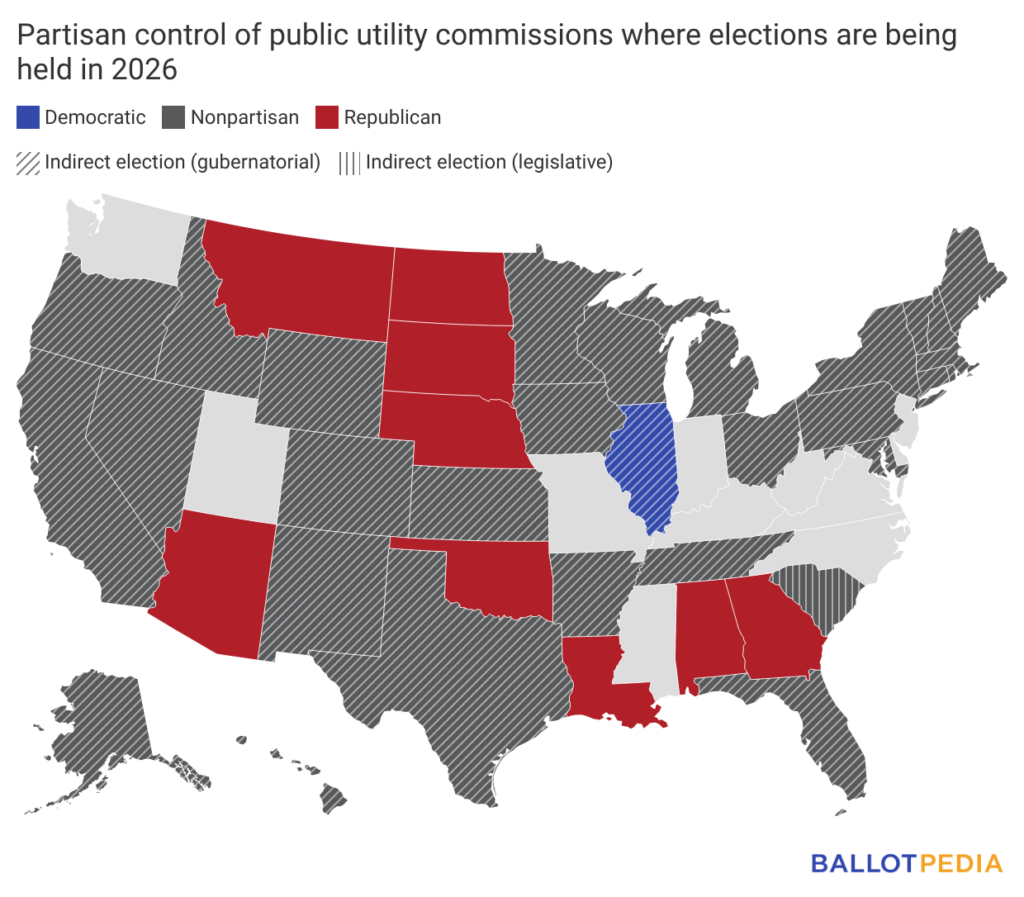
Republicans have majorities on all nine of the public utility commissions directly on the ballot this year. These states are Alabama, Arizona, Georgia, Louisiana, Montana, Nebraska, North Dakota, Oklahoma, and South Dakota. The other state in which public utility commissioners are directly on the ballot is Mississippi, which also has a Republican majority. However, Mississippi is not on the ballot this year.
Of the nine states holding direct elections this year, Georgia and Louisiana are the only ones in which the commission’s partisan control could change. Republicans currently have a 3-2 majority on the Georgia Public Service Commission. Democrats need to retain control of the District 3 seat and gain control of the District 5 seat to win control of the commission. Republicans need to either gain control of the District 3 seat or retain control of the District 5 seat to retain a majority.
Louisiana is the only other of the nine states with a Democrat on its commission. Republicans currently have a 3-2 majority on the Louisiana Public Service Commission. Democrats need to retain control of the District 5 seat and gain control of the District 1 seat to win control of the commission. Republicans need to either gain control of the District 5 seat or retain control of the District 1 seat to retain a majority.
Of the nine commissions, we’re following the elections for three as battlegrounds.
- Arizona: In April, national groups invested in elections for the Salt River Project, a utility regulator in central Arizona. As a result of the election, candidates aligned with the SRP Clean Energy slate won majority control of the board. Two Democrats are campaigning to reduce the state commission’s 5-0 Republican majority to 3-2. Democrats last won a seat on the commission in 2020.
- Georgia: In November 2025, Democrats won two seats on the Georgia Public Service Commission, resulting in the commission’s current 3-2 Republican majority. One of the Democrats elected last year is running again, while another seat is up for election. This election will decide which party controls a majority of the commission.
- Montana: Two seats are up for election. One district is open, while in another, a Republican incumbent faces two primary challengers. A Democrat was last elected to the commission in 2012. The 2026 races also follow a 2025 court ruling that the commission's district boundaries were constitutional. According to Montana Public Radio's Ellis Juhlin the boundaries “divided major cities across the state into different districts, and was found by an expert during trial to have been drawn in a way that favored Republican candidates.”
Although commissioners are elected in 10 states, commissioners in the other 40 states are appointed to their seats. Heading into the 2026 elections, 10 commissions have a majority of members from the Republican Party, one has a majority of members from the Democratic Party, and 39 are officially nonpartisan.
In addition to the nine commissions on the ballot this year, 30 are also up for election because either the appointing person or all or part of the appointing body is up for election.
Twenty-nine states in which the governor appoints commissioners are holding gubernatorial elections this year. Democrats currently control 16 of those offices, and Republicans control 13.
In South Carolina, the Legislature selects the commission's members. Currently, Republicans have a 34-12 majority in the South Carolina Senate and an 88-36 majority in the South Carolina House of Representatives. All 124 seats in the state House are up for election this year.
A total of 23 commissions are in states with a Democratic governor or a Democratic majority in the legislature with appointment power. The other 17 commissions are in states with a Republican governor or a Republican majority in the legislature with appointment power.
As a result, Democrats currently control 16 of the 39 commissioner elections either directly or indirectly on the ballot this year, and Republicans control 23.
To read more about public service commission elections being held this year, click here.