


Welcome to the Monday, May 18, 2026, Brew.
By: Lara Bonatesta
Here’s what’s in store for you as you start your day:
- State and federal courts have overturned 2.3% of state ballot measures since 1995
- Hawaii legislators advance bill to restrict corporate political activity
- Our new episode of On The Ballot examines the history and evolving present of congressional redistricting
State and federal courts have overturned 2.3% of state ballot measures since 1995
Since 1995, federal and state courts have overturned 57 voter-approved state ballot measures. Voters approved 2,409 state ballot measures during this period, meaning courts rendered 2.3% of them unenforceable or void.
One example of this happened earlier this month in Virginia, where, in a 4-3 decision, the state’s supreme court overturned an April 21 redistricting amendment, preserving the state’s 2021 congressional map. This was the fastest that a state or federal court of last resort has overturned a voter-approved measure since 1995.
In light of the news in Virginia, today we’re taking a look at other times federal and state courts have overturned voter-approved ballot measures. Click here to see our full analysis of overturned ballot measures dating back to 1995.
Types of overturned ballot measures
Here is some important information to know about what it means when a court overturns a measure.
The word overturned can describe two different judicial outcomes: one in which a ballot measure becomes unenforceable, and another in which a ballot measure becomes invalid or void.
Courts may rule that a ballot measure is unenforceable because its provisions conflict with superior law, such as the U.S. Constitution. In these cases, the affected ballot measures remain part of a state's constitution or law and could regain legal effect should the controlling precedent change.
Courts may rule that a measure is invalid or void because it was not lawfully enacted due to procedural issues involving the ballot measure process, such as violations of single-subject rules, signature requirements, or constitutional amendment requirements.
Key takeaways from our analysis:
Courts ruled that 43 measures (75.4%) were unenforceable, and that 14 measures (24.6%) were void.
In some cases, courts overturned measures years after voters approved them. 2004 had the highest number and percentage of ballot measures that were ultimately overturned. In 2004, voters approved 13 measures that defined marriage as between one man and one woman, or otherwise prohibited same-sex marriage. The U.S. Supreme Court's 2015 decision in Obergefell v. Hodges rendered all 13 unenforceable. These 13 measures represented 11.1% of the 117 total statewide ballot measures that voters approved in 2004.
Obergefell v. Hodges made more ballot measures unenforceable than any other case, rendering 30 measures unenforceable. Excluding Obergefell, 48.1% were ruled unenforceable, while 51.9% were ruled void.
The case that affected the second most measures was League of Education Voters v. Washington State, which rendered three voter-approved ballot measures unenforceable in Washington. Washington also had the most overturned ballot measures, with 10 overturned in state courts. Eight of these measures addressed tax limits or legislative vote requirements for taxes.
Between 1995 and 2026, the average voter approval for an overturned measure was 63.4%, ranging from 50.7% for Washington Initiative 1240 (2012) to 86.0% for Mississippi Amendment 1 (2004).
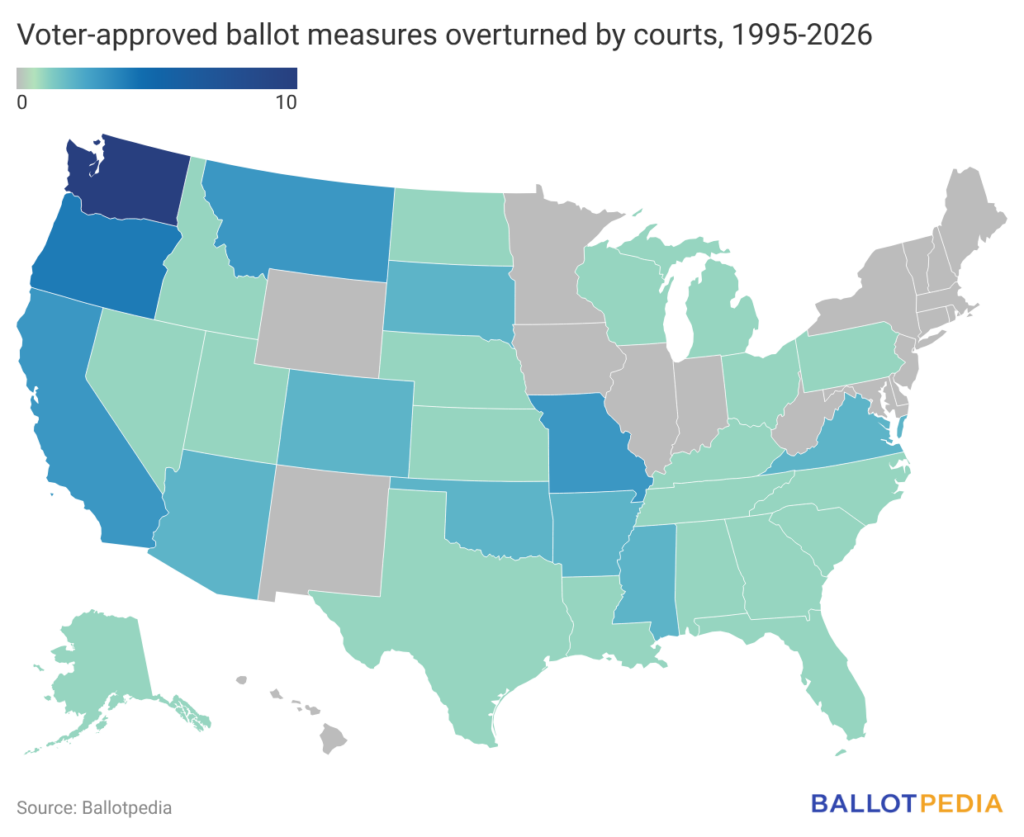
Of the 57 overturned measures, federal courts overturned 35 (61.4%), while state courts overturned 22 (38.6%). Excluding Obergefell, federal courts overturned five measures (18.5%), while state courts overturned 22 (81.5%).
Thirty-four measures of the 57 measures (59.6%) were citizen initiatives. Legislatures put the other 23 (40.4%) on the ballot.
The average length of time between voter approval of a ballot measure and a final court ruling overturning it was 6.2 years. Excluding Obergefell, the average time was 2.2 years. As we mentioned above, the shortest period of time between voter approval and a court overturning a measure was 17 days, for the Virginia Use of Legislative Congressional Redistricting Map Amendment in 2026. The longest period was 16.7 years, for Alaska Measure 2, Definition of Marriage Amendment (1998), which was the first constitutional amendment prohibiting same-sex marriage. The U.S. Supreme Court overturned it in Obergefell v. Hodges on June 26, 2015.
Click here to see our full analysis and list of measures that were overturned between 1995 and 2026.
Hawaii legislators advance bill to restrict corporate political activity
On May 8, Hawaii legislators sent a bill to Gov. Joshua Green (D) that would prohibit corporations from spending money or participating in election or ballot measure activities.
SB 2471 would amend state law to modify the powers given to corporations. The bill establishes that corporations have artificial-person powers, defined as the ability to carry out their business or other affairs, but cannot engage in election or ballot measure activity in Hawaii.
Supporters of the bill say their aim is to limit how the U.S. Supreme Court’s 2010 Citizens United v. Federal Election Commission decision applies to corporate political spending in the state.
In that ruling, the Supreme Court held that the First Amendment protects independent corporate (including nonprofit organizations) and union election spending. The ruling struck down a provision of the 2002 Bipartisan Campaign Reform Act, that banned for-profit and not-for-profit corporations and unions from broadcasting electioneering communications in the 30 days before a presidential primary and in the 60 days before the general elections.
At the time of the Citizens United ruling, 23 states prohibited corporations from spending in state elections. According to a paper that the National Bureau of Economic Research published, “These states now had to comply with the federal ruling, which meant that corporations were free to spend in elections where they had previously been constrained."
Hawaii state Rep. Scot Matayoshi (D) said, “If the states are not brave enough to challenge Citizens United and other court rulings at the highest court in the land, those rulings will stand forever. We need states to step forward in order to challenge these rulings.”
In a March 18 committee hearing, Deputy Attorney General Christopher Han said, “While many Americans strongly disagree with the U.S. Supreme Court’s holding in Citizens United, under our federal system of government, it is our duty to state that this opinion remains the law of the land, irrespective of its merits (or lack thereof).”
SB 2471 passed the House on May 8 with 41 Democrats and nine Republicans voting in favor and one Republican voting in opposition. Also on May 8, it passed the Senate 24-0. Hawaii has a Democratic trifecta.
Legislators in 14 other states have introduced similar bills in 2026, though none have advanced. Six of the bills were introduced in states with Democratic trifectas, four in states with Republican trifectas, and four in states with divided government.
On April 1, the Montana Supreme Court ruled that supporters could continue gathering signatures for a ballot measure that would prohibit corporations from engaging in political or ballot measure activities.
The Montana Court’s unanimous ruling came in response to a lawsuit from a group of businesses and industry groups, including the Montana Chamber of Commerce and the Montana Mining Association, challenging the measure’s constitutionality. The measure could appear on the November ballot.
For more information on campaign finance regulations, click here.
Our new episode of On The Ballot examines the history and evolving present of congressional redistricting
In our new episode of On The Ballot, Ballotpedia’s Nathan Maxwell joins host Norm Leahy to discuss congressional redistricting.
In the episode, Nathan and Norm break down the history of redistricting, the mechanics behind it, and the latest news as multiple states work to change their maps ahead of this year’s midterm elections.
Nathan talks about how redistricting has evolved alongside Congress over the past century — from the Apportionment Act of 1842 to the historical Supreme Court cases and controversies that have shaped the rules for redistricting today.
Shifting to the present, Nathan and Norm also talk about the different roles states, Congress, and the federal courts play in redistricting, as well as the processes and requirements states must follow to determine how their populations are represented. They’ll also discuss the U.S. Supreme Court’s recent decision in Louisiana v. Callais, what it changed, and what else we’re watching for this year.
Click here to listen to the full episode and make sure to subscribe to On The Ballot wherever you listen to your podcasts. Click here to see our full coverage of redistricting ahead of the 2026 midterm elections.
For more on redistricting, you can also check out our latest installment of The Blueprints of Democracy, our project marking America's 250th anniversary.