


In this week’s edition of Economy and Society:
- New York replaces 2030 emissions goal with 2040 target
- Florida AG questions legality of NFL hiring practices
- ESG legislation update
- European Central Bank warns about climate risks
- Germany drops 65% renewable fuel mandate for buildings
- Agriculture secretary criticizes dairy ESG effort
In the states
New York replaces 2030 emissions goal with 2040 target
What’s the story?
New York Governor Kathy Hochul (D) announced a proposed $268 billion budget on May 7, 2026, that would change emissions reduction targets and regulatory deadlines under the state's 2019 Climate Leadership and Community Protection Act (CLCPA). Hochul said “an agreement has been reached with legislative leaders on key priorities.”
Under the proposed budget, lawmakers will set a requirement for 60% emissions reductions by 2040, replacing a 40% target by 2030, compared to 1990 levels. The state's 2050 goal — an 85% reduction in emissions compared to 1990 levels — would remain unchanged.
Hochul and legislative leaders also agreed to push back the deadline for the New York Department of Environmental Conservation to adopt emissions reduction regulations. The 2019 CLCPA required regulations by 2024, a deadline the state missed. In late 2025, the New York Supreme Court, the state’s main trial court rather than its highest court, ordered the department to issue regulations by early 2026 unless the law changed. The new deadline would be 2028.
The proposed agreement would also change how New York measures greenhouse gas emissions, shifting from a 20-year accounting standard to a 100-year standard. Democratic Assembly Speaker Carl Heastie (D) disputed Hochul's characterization of the agreement, telling reporters there is no deal and calling the announcement premature.
The agreement would increase funding for disadvantaged communities, raising their share of climate investment benefits from 35% to 40%.
Why does it matter?
The proposed budget would change how quickly New York moves toward its climate goals. Hochul said, "New York has led and will continue to lead on clean energy and climate, but reality has been harsh. We cannot meet the current timelines without driving energy costs higher. The facts bear that out, and I cannot let that happen. We have to strike the right balance between our clean energy ambitions and the affordability pressures that real New Yorkers are facing right now."
New York Senate Finance Committee Chair Liz Krueger (D) said, "Those of us living in reality know that if we do what the governor is proposing and roll back CLCPA, it will do absolutely nothing to reduce energy costs for New Yorkers," Krueger said in a March statement. "The only problem it would solve is the manufactured political crisis that the governor has created for herself."
New York Senate Minority Leader Rob Ortt (R) said, “The only way to ensure affordable and reliable energy is to repeal the Climate Act and move forward with a new plan that is realistic.”
What’s the background?
The CLCPA set mandatory targets for New York to achieve 85% economy-wide emissions reductions by 2050, with an interim target of 40% by 2030. The law also established goals to meet 70% of the state's electricity needs through renewable energy by 2030 and 100% zero-emissions electricity by 2040.
Twenty-nine Democratic state senators sent a letter to Hochul in March stating they "categorically oppose any effort to roll back New York's nation-leading climate law."
According to the Climate Policy Dashboard, 25 states have adopted statewide greenhouse gas emissions reduction targets.
Florida AG questions legality of NFL hiring practices
What’s the story?
Florida Attorney General James Uthmeier (R) issued a subpoena to the National Football League (NFL) on May 13, 2026, writing in an accompanying letter that the league's Rooney Rule and related hiring policies "continue to raise significant concerns under Florida law."
The Rooney Rule, established in 2003, initially required teams to interview at least one diverse candidate before hiring a head coach. The NFL has since expanded the rule. Teams must now interview at least two external candidates who are women or people of color for head coach, general manager, or coordinator positions, and at least one woman or person of color for quarterback coach or senior executive positions.
Because the Rooney Rule applies diversity-related hiring requirements to privately owned NFL teams, critics have framed the policy as a form of environmental, social, and governance (ESG) or diversity, equity, and inclusion (DEI) regulation affecting private-sector employment practices.
The subpoena followed an initial inquiry Uthmeier sent to NFL Commissioner Roger Goodell on March 25, 2026. In that letter, Uthmeier wrote that the Rooney Rule "brazenly violates Florida law. So, too, do the NFL’s related 'diversity' initiatives." Uthmeier gave the NFL until May 1, 2026, to confirm it would stop enforcing the rule in Florida. Uthmeier's May 13 letter stated that the NFL's response raised new concerns about violations of the Florida Civil Rights Act and the Florida Deceptive and Unfair Trade Practices Act.
Why does it matter?
Uthmeier said the rule violates Florida's Civil Rights Act, which prohibits employers from limiting or classifying applicants based on race or sex in ways that would deprive individuals of employment opportunities.
NFL Executive Vice President and General Counsel Ted Ullyot wrote in the May 1 response, "The Rooney Rule does not impose any hiring quotas or mandates, nor does it even limit who may be interviewed." He continued that the rule "does not license clubs to consider race or sex in making hiring decisions, consistent with NFL policy and applicable law."
Uthmeier wrote in his May 13 letter that the NFL updated its Rooney Rule webpage after Florida's March inquiry, removing language stating the rule "aims to increase the number of minorities hired in head coach, general manager, and executive positions." Uthmeier wrote that if the NFL's previous representations about requiring hiring of diverse candidates "did not 'accurately reflect' the NFL's actual policies, that would violate Florida law."
What’s the background?
The Rooney Rule was named after Dan Rooney, former owner of the Pittsburgh Steelers. The NFL has modified the rule multiple times, including expanding the definition of minority candidate in 2022 to include women.
America First Legal, co-founded by Stephen Miller, who now serves as assistant to the president and deputy chief of staff for policy, filed a federal civil rights complaint against the NFL over its diversity hiring policies in 2024. No public resolution or action by federal civil rights regulators had been announced as of May 2026.
Florida has three NFL teams: the Miami Dolphins, Tampa Bay Buccaneers, and Jacksonville Jaguars.
ESG legislation update
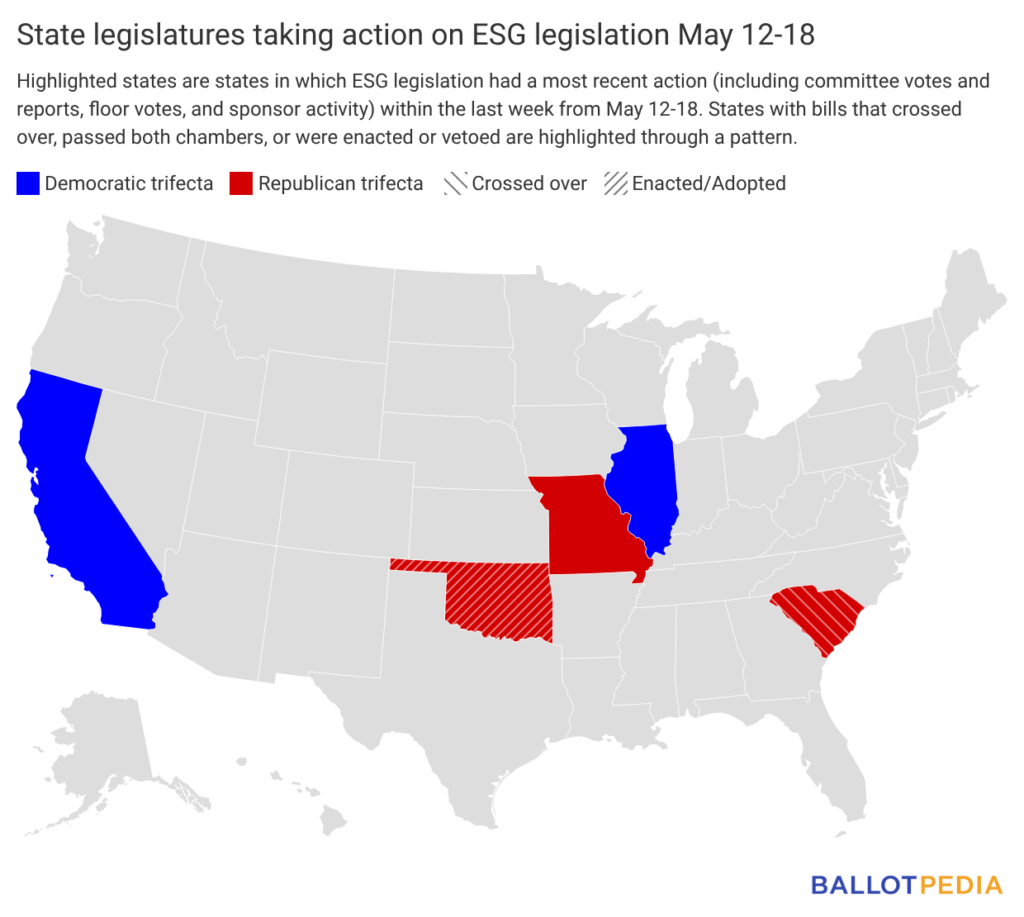
Five states took action on eight ESG-related bills since May 12, 2026. Oklahoma Gov. Kevin Stitt (R) signed HB 4428, which requires public pension boards to base proxy voting and shareholder engagement decisions solely on pecuniary factors and shareholder value, prohibiting the consideration of ESG factors.
States with legislative activity on ESG last week are highlighted in the map below. Click here to see the details of each bill in the legislation tracker.
Around the world
European Central Bank warns about climate risks
What’s the story?
The European Central Bank (ECB) released an updated compendium of good practices for climate and nature-related risk management and stress testing on May 8, 2026. The best practices draw on approaches that more than 60 ECB-supervised institutions use in areas where banks struggle, including:
- quantifying physical risk,
- prudential transition planning,
- scenario analysis, and
- nature-related risks.
ECB Executive Board Member and Supervisory Board Vice-Chair Frank Elderson wrote in a May 8, 2026 blog post that banks' methods for measuring physical and nature-related risks "are still in their infancy with risks very likely being underestimated."
The good practices are examples of risk management approaches that banks can use to strengthen their frameworks, though they do not create new legal requirements. Around one-third of the new practices focus on nature-related risks, such as assessing companies' dependence on ecosystem services, their effect on biodiversity, their geographical distance from protected areas, pollution levels, and water consumption.
The ECB noted that while most banks have performed materiality assessments for nature-related risks, around two-thirds do not systematically link these to risk management actions. The guide includes both advanced practices from large banks and simpler approaches that smaller banks with fewer resources can implement.
Elderson said, "Euro area banks have made significant strides in building up their resilience to [climate and nature-related] risks, but the journey is far from complete. The good practices compendium is an effective toolkit for banks to tackle gaps, navigate a challenging and evolving risk environment — and in turn — capitalise on the opportunities offered by the transition."
Why does it matter?
Elderson wrote that banks face a more disorderly transition scenario with higher uncertainty and must be "resilient and prepared for a range of possible scenarios — including higher and faster-moving transition and physical risks."
The ECB emphasized that banks can remain compliant without implementing the specific examples in the compendium, provided they use other suitable measures for their business model and risk profile.
What’s the background?
The European Banking Authority, the EU regulatory body that sets standards for banks across the bloc, published guidelines on the management of ESG risks in January 2025 and guidelines on environmental scenario analysis in November 2025 that take effect in January 2027.
The ECB announced priority areas earlier in 2026 to advance its work on embedding climate and nature-related risks into its activities, including assessing banks' green economy transition plans and analyzing their capabilities to address risks related to the physical effects of climate change.
Germany drops 65% renewable fuel mandate for buildings
What’s the story?
Germany's cabinet voted on May 13, 2026, to replace the country's 2023 heating law, which required new building heating systems to use at least 65% renewable energy. The cabinet decision came as Chancellor Friedrich Merz's government seeks to revive construction investment and address concerns from households about the cost of replacing gas and oil boilers.
Under the new proposal, new gas and oil heating systems would be required to gradually use climate-neutral fuels starting in 2029. The share would begin at 10% and rise to 60% by 2040. Households would be allowed to keep existing boilers if they do not choose alternatives such as heat pumps, district heating, or biomass systems.
The cabinet also backed measures to create a market for standby power generation, under which operators of power stations or storage facilities would receive payments for keeping capacity available when renewable output drops.
Economy Minister Katherina Reiche told reporters the new approach would reduce uncertainty for companies planning construction and building restoration: "With it, we are creating investment security, we are creating planning security, we are enabling technological openness and flexibility in the choice of heating system."
Why does it matter?
The 2023 heating law became a flashpoint in German politics, with critics arguing it would force households to pay thousands of euros for cleaner heating systems. Germany's BDI industry federation called the change "an important step towards finally getting investment back on track."
Greens parliamentary leader Katherina Droege criticized the cabinet decision as "a complete abandonment of Germany's climate targets." Her party had driven the original heating law under former Chancellor Olaf Scholz.
The European Union's Buildings Directive mandates all new buildings to be zero-emission from 2030.
Germany has maintained its 2045 climate neutrality target despite the policy change.
In the spotlight
Agriculture secretary criticizes dairy ESG effort
What’s the story?
U.S. Secretary of Agriculture Brooke Rollins (R) criticized the dairy sustainability initiative Pathways to Dairy Net Zero in a May 15, 2026, thread on X. Rollins reposted a video from Heartland Impact arguing the initiative would burden dairy farmers with ESG compliance requirements disguised as sustainability standards.
The video featured Samantha Fillmore, senior state government relations manager at The Heartland Institute, who also wrote a separate article criticizing the initiative. Fillmore wrote that Pathways to Dairy Net Zero “functions as yet another sector-specific implementation of global ESG and net-zero governance” and said sustainability guidance can become an obligation for farmers working within larger dairy supply chains. Rollins said the initiative would burden small farms with costly compliance.
Pathways to Dairy Net Zero is a voluntary initiative that said it seeks to “reduce dairy’s greenhouse gas (GHG) emissions over the next 30 years” and to create “methodologies, tools and pathways to transform commitments into positive, practical actions.” The initiative also said it supports emissions measurement, mitigation practices, and climate-related monitoring across the dairy supply chain.
What’s the background?
In April 2025, the U.S. Department of Agriculture canceled the Biden administration’s Partnerships for Climate-Smart Commodities program and replaced it with a new initiative called Advancing Markets for Producers (AMP). USDA said the previous program imposed excessive reporting requirements and directed too much funding toward administrative costs rather than farmers.
In announcing the change, USDA said it would prioritize reducing paperwork burdens and ensuring a larger share of federal funds went directly to producers. Secretary Rollins said the previous program “was largely built to advance the green new scam at the benefit of NGOs, not American farmers.” The administration has also taken broader actions opposing ESG- and climate-related regulations, including an April 2025 executive order directing the Department of Justice to challenge certain state climate and ESG laws.
National Sustainable Agriculture Coalition Policy Director Mike Lavender said that the program's cancellation will "bring unnecessary hardship nationwide to farmer serving organizations and likely farmers as a result of USDA changing program requirements and cancelling projects mid-stream."