


Welcome to Hall Pass, a newsletter written to keep you plugged into the conversations driving school board governance, the politics surrounding it, and education policy.
In today’s edition, you’ll find:
- On the issues: The debate over mandating recess in schools
- School board filing deadlines, election results, and recall certifications
- U.S. Education Department greenlights Louisiana’s request for greater flexibility over some federal education funds
- North Dakota voters to decide amendment requiring schools to provide free meals
- Extracurricular: education news from around the web
- Candidate Connection survey
Reply to this email to share reactions or story ideas!
On the issues: The debate over mandating recess
In this section, we curate reporting, analysis, and commentary on the issues school board members deliberate when they set out to offer the best education possible in their district. Missed an issue? Click here to see the previous education debates we’ve covered.
On April 23, 2026, Oklahoma became the most recent state to mandate recess for public school students in some grade levels when Gov. Kevin Stitt (R) signed SB 1481. The law applies to students in kindergarten through fifth grade, and mandates 40 minutes of recess each school day.
Before Oklahoma, California enacted a law requiring 30 minutes of recess for elementary students in 2024. A 2023 National Association of State Boards of Education (NASBE) analysis found nine states required daily recess.
Should more states mandate recess?
Dale Chu, an education consultant, says that while laws mandating recess may sound desirable, they come with unacknowledged tradeoffs that should give proponents pause. Chu says that, because the school day is fixed, any time schools devote to recess necessarily leaves less time for other objectives, such as classroom instruction. Chu also says that recess can take many forms, some more beneficial for kids than others, and that these laws don’t help school administrators design thoughtful policies.
Kelly McKenna, the CEO of nonprofit organization End Chronic Disease, writes in defense of New York’s SB 6858, which was introduced in 2025 and is currently before the state’s Senate Education Committee. McKenna says research shows recess is good for elementary school students, helping to improve their mental and physical health and academic performance. McKenna says it is no surprise that youth mental health has declined as schools, focused on preparing students for standardized tests, have relegated unstructured playtime to an afterthought.
Everyone loves recess, but should states mandate it? | Dale Chu, Thomas B. Fordham Institute
“Schools already operate under significant time constraints. Districts routinely lament that there is not enough instructional time in the day to adequately cover a full range of content areas. It is difficult to imagine reading or math being cut, especially in the wake of continued concerns about lagging student achievement. That leaves other subjects—namely social studies, science, or the arts—as the more likely sources of adjustment. Alternatively, schools could extend the school day, but that approach would carry fiscal costs and would likely face significant political hurdles. Put simply, it is easy to add requirements to schools, but far harder to account for what must be taken away to accommodate them.”
Recess should be mandatory for all elementary school students | Kelly McKenna, New York Post
“The benefits would extend beyond mental health, too. Childhood obesity and other chronic diseases have reached record highs. Recess helps students be more physically active, improve cardiovascular health, and establish habits that reduce long-term risk of chronic conditions like diabetes and heart disease.
“The bill [SB 6858] would also likely enhance academic performance. Research consistently shows that students concentrate better after physical activity, and active students generally get better grades and perform better on assessments. Movement also strengthens executive functioning, which is essential for learning and academic success.”
School board update: filing deadlines, election results, and recall certifications
In 2026, Ballotpedia will cover elections for more than 30,000 school board seats. We’re expanding our coverage each year with our eye on covering the country’s more than 80,000 school board seats.
Upcoming school board elections
Ballotpedia’s staff is covering school board elections for 107 seats in 72 districts in the next 30 days.
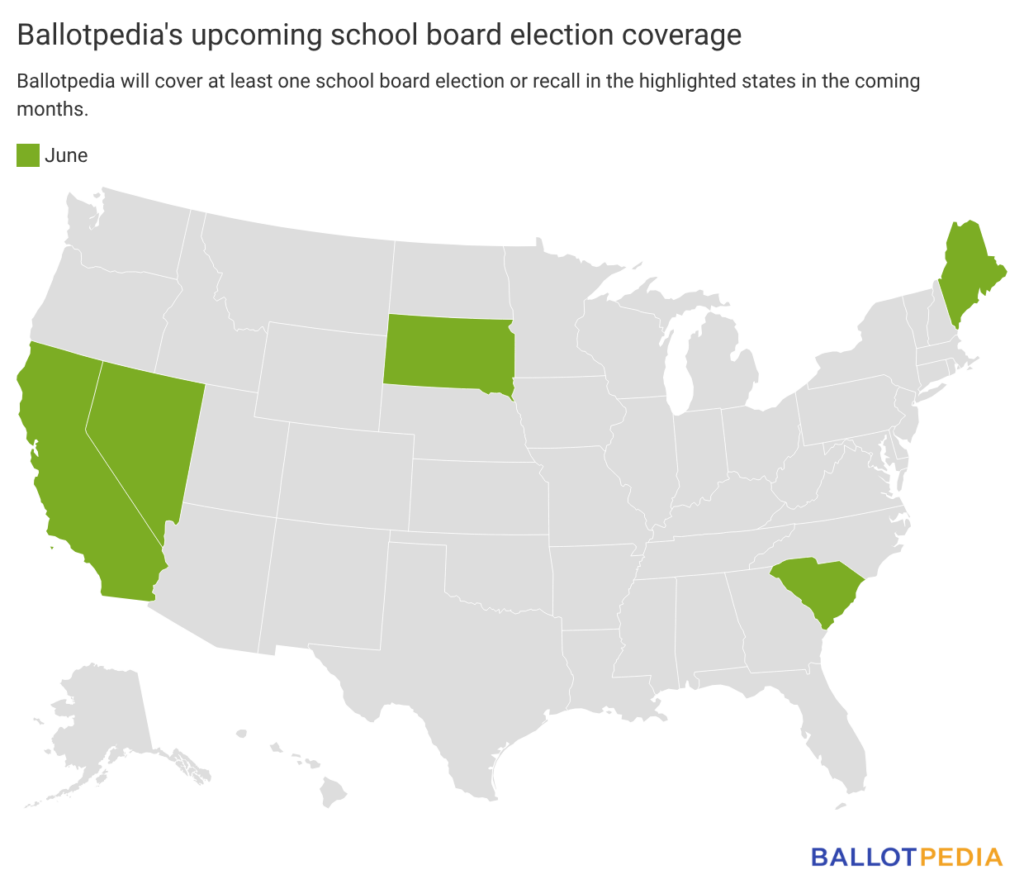
Watch future editions of Hall Pass for the following June primary and general election results:
- California: Primaries in three districts and general elections in five on June 2
- South Dakota: General elections in 25 districts on June 2
- Maine: General elections in 22 districts on June 9
- Nevada: Primaries in 15 districts on June 9
- South Carolina: Primaries in one district and a general election in one district on June 9
U.S. Education Department greenlights Louisiana’s request for greater flexibility over some federal education funds
On May 20, 2026, the U.S. Department of Education, as part of its Returning Education to the States Waiver policy, approved a request from Louisiana to consolidate four federal grants into one, saving some funding that would have gone toward compliance and reporting requirements. According to a release from the U.S. Department of Education, the waiver will release “more than $18 million from bureaucratic red tape to the classroom through 2029.”
Louisiana is the second state to receive a Returning Education to the States Waiver. In February, the U.S. Department of Education approved a similar request from Iowa. Both Iowa and Louisiana have Republican trifectas.
In a July 2025 letter announcing the Returning Education to the States Waiver, Secretary of Education Linda McMahon wrote, “The Trump administration’s goal is to improve academic achievement, particularly by strengthening literacy and numeracy instruction, empowering parental decision-making, and returning education to the States. Encouraging innovation among States is a critical step to achieving those goals.”
The 1965 Elementary and Secondary Education Act (ESEA) permits the creation of waiver programs. The U.S. Department of Education used that authority to establish the Returning Education to the States Waiver policy. The waivers don’t change the amounts allocated to states or districts as part of the grants. State education departments must document how they are using the funds saved on compliance to improve student academic performance.
Both Iowa and Louisiana asked to combine the following grants:
- Supporting Effective Instruction (Title II, Part A of the ESEA)
- English Language Acquisition (Title III, Part A of the ESEA)
- Student Support and Academic Enrichment (Title IV, Part A of the ESEA)
- 21st Century Community Learning Centers (Title IV, Part B of the ESEA)
In its waiver application, Louisiana asked to consolidate several additional grants beyond the ones listed above, but the U.S. Department of Education did not approve those requests. Those grants included funding for schools with a high percentage of low-income students and programs for migrant students.
Louisiana Superintendent of Education Cade Brumley said, “We feel like this flexibility gives us an opportunity to be more efficient in the way in which we serve various student populations in our state.” Brumley said the state could put the money made available by the waiver toward math and literacy instruction and teacher training and retention.
Proponents of the Returning Education to the States Waiver point to the increased flexibility it gives states, which they say are better equipped than officials in Washington D.C. to identify and address barriers to student achievement in their own school systems. But critics say that combining distinct grants, even if only for purposes of reducing compliance costs, risks allowing states to redirect funding from the groups they’re meant to help.
Eric Duncan, P-12 Policy Director at EdTrust, an organization that says it advocates against racial and economic barriers in the school system, said: “This waiver approval is part of a larger federal effort by the Trump administration to abdicate responsibility for education by reducing federal funding and oversight.”
The U.S. Department of Education said it was working with 10 states on Returning Education to the States Waivers. One of those states is Vermont. In April, the Vermont Agency of Education solicited public comment on its waiver request. The request asked the U.S. Department of Education to consolidate three of the four grants mentioned in Iowa’s and Louisiana’s applications. The public comment period ended May 11.
During the Trump administration, states have also attempted to use waivers for other purposes, such as relaxing certain federal testing requirements. As we covered in a previous edition of Hall Pass, Oklahoma’s then-Superintendent of Education Ryan Walters (R) submitted a waiver request to expand “its use of alternative assessments including the Classical Learning Test (CLT), the SAT, and innovative benchmark assessments.” The CLT is an alternative to the SAT and the ACT that emphasizes “thoughtful reading passages drawn from classic literature and historical texts.” Click here to read our look at the debate around the CLT.
The waiver request from Oklahoma has been on hold since Walters stepped down as superintendent in September 2025.
Similarly, Idaho submitted waiver requests that included allowing 11th graders to choose from several state-approved exams, which the state said could include the CLT. That request is pending.
Idaho and Oklahoma have Republican trifectas.
North Dakota voters to decide on an amendment that would require public schools to provide free meals
North Dakota voters will decide on a constitutional amendment that would require public schools to provide free meals to students.
Together for School Meals sponsored the initiative. It would require all public schools to provide one free breakfast and one free lunch to students each school day. Schools that provide these meals would be eligible for reimbursement if they first maximize federal reimbursements. If the Legislative Assembly is unable to identify a source of funds for reimbursement, the funds will be appropriated from the state's Legacy Earnings Fund, which voters created in 2024 for the purpose of investing oil and gas revenue.
The secretary of state’s office verified 49,338 valid signatures out of the 57,229 submitted in April. The campaign needed 31,164 signatures to qualify for the ballot.
According to the North Dakota Department of Public Instruction, an estimated 47,000 children in the state receive free or reduced-cost meals, out of approximately 120,000 K-12 students statewide. Currently, students are eligible for free breakfast and lunch programs if their household income is below 225% of the federal poverty guideline, which is estimated at $74,250 for a family of four.
According to the North Dakota Department of Public Instruction, the proposed meals program would cost an estimated $140 million over two years.
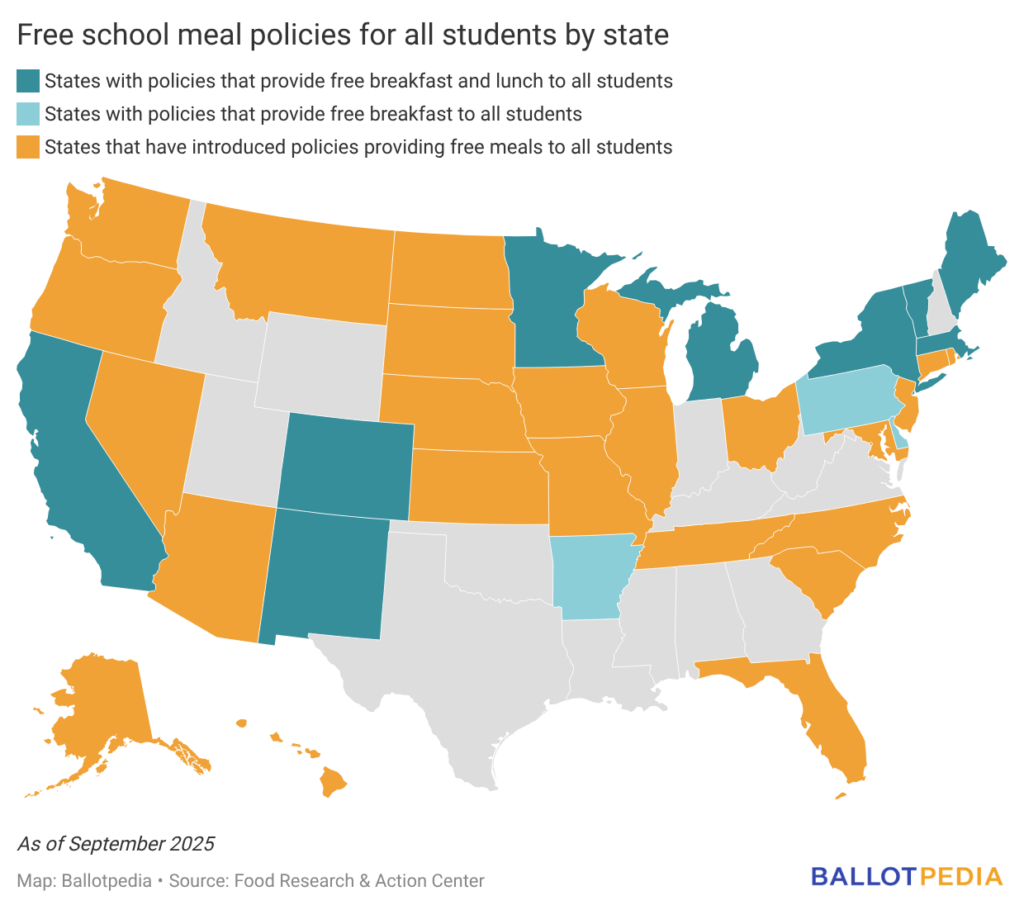
As of September 2025, nine states had policies providing free breakfast and lunch to all students, while three states had policies providing free breakfast to all students. California became the first state to implement the policy (going into effect for the 2022-2023 school year), while New York was the most recent state to implement the policy for the 2025-2026 school year. According to the Food Research and Action Center (FRAC), a nonprofit that advocates for free school meals, 25 states, and Washington, D.C., have introduced legislation providing free meals to all students. In 2022, Colorado voters approved Proposition FF, which created the HSMFA program in the state.
Robin Nelson, chair of Together for School Meals, said, “Providing school meals at no cost is one of the most effective, research-backed ways to strengthen academic performance, reduce stress on families, and give every child a fair shot.”
State Sen. Janne Myrdal (R-19) opposed the measure, saying, “Really know what you’re voting on. You’re voting on burdening yourself with taxes.”
Voters will decide the amendment along with two others on the Nov. 2026 ballot — one amendment that would change legislative term limits, and another that would require a 60% supermajority to approve new constitutional amendments. North Dakota voters will also decide on a constitutional amendment that would create a single-subject requirement for new amendments on June 9, 2026.
Click to read more about this amendment.
Extracurricular: education news from around the web
This section contains links to recent education-related articles from around the internet. If you know of a story we should be reading, reply to this email to share it with us!
- The Voting Rights Act reshaped school boards. What will happen after the Supreme Court weakened it? | Chalkbeat
- AI Raises Equity Stakes in K-12 Education | Let’s Data Science
- America’s schools face a backlash on digital devices as screens saturate classrooms | ABC News
- A Bad Supreme Court Decision Is Hard to Undo | Education Next
- Can Oklahoma make public education ‘normal’ again? | The Hechinger Report
- The Enrollment Cliff Is Here. Which Schools Will Survive It? | The New Yorker
- Overworked and understaffed: Special ed teachers turn to AI for help | NPR
- Report: Nearly One-Third of Teachers Still Use ‘Discredited’ Reading Methods | The 74
- SPLC pushed its way into K-12 schools and is more of a threat than you realize | Fox News
- Fixing what’s *really* wrong with education research | Alexander Russo’s The Grade
Take our Candidate Connection survey to reach voters in your district
Today, we’re featuring responses from the two candidates running in the June 2 primary for San Mateo County Superintendent of Schools.
There are 58 county superintendents in California. According to the California County Superintendents, an organization made up of all 58 offices, “County Superintendents operate intermediate service agencies providing direct and regional support to school districts and serve as the primary implementation arm of the California Department of Education (CDE).”
Chelsea Bonini is an attorney and former elementary school teacher who currently serves as an elected trustee on the San Mateo County Board of Education. The California Teachers Association (CTA), the state’s largest teachers union, endorsed Bonini. Here’s how Bonini answered the question, “What areas of public policy are you personally passionate about?”

“I am an advocate for education, housing, mental health awareness, disability rights and inclusive communities. My public service reflects my commitment to the whole child, having served as a SMCOE Personnel Commissioner, a San Mateo County Behavioral Health Commissioner, a member of the San Mateo County Commission on Disabilities, a San Mateo-Foster City School District Trustee, and currently as a San Mateo County Board of Education Trustee. My comprehensive engagement in mental health, literacy initiatives, and special education services demonstrates the collaborative, student-centered, and systems-level perspectives that guide my work.”
Click here to read the rest of Bonini’s responses.
Hector Camacho Jr. is the executive director of Equity, Social Justice and Inclusion in the San Mateo County Office of Education and a former trustee on the San Mateo County Board of Education. The California Federation of Teachers (CFT), the state’s second largest teachers union, endorsed Camacho. Here’s how Camacho answered the question, “What areas of public policy are you personally passionate about?”

“I am passionate about the role public education plays in shaping the strength and future of our communities. Strong schools are not separate from strong communities, they are foundational to them. How we invest in children reflects our values and determines the kind of society we build. I believe children are our most important responsibility, and every decision we make should be grounded in how it impacts them today and the opportunities they will have tomorrow. We have to ask ourselves, in every policy choice, what kind of world we are leaving behind for the next generation, and whether we are preparing them not just to succeed, but to lead and contribute. This has been my life’s work, and I am ready to lead this work on day one.
Click here to read the rest of Camacho’s responses.
As a reminder, if you're a school board candidate or incumbent planning to run this year, click here to take the survey. If you complete the survey, your answers will appear in your Ballotpedia profile. Your responses will also appear in our sample ballot. If there is an election in your community, share the link with your candidates and urge them to take the survey!