


Welcome to the June 1 edition of Robe & Gavel, Ballotpedia’s newsletter about the Supreme Court of the United States (SCOTUS) and other judicial happenings around the U.S.
“Not everything that is faced can be changed, but nothing can be changed until it is faced.”
- James Baldwin
Where has the time gone, dear reader? We are in the final month of SCOTUS’s 2025-2026 term, and we have a bunch of opinions coming your way. So grab a seat, and let’s gavel in!
Follow Ballotpedia on X and Bluesky or subscribe to the Daily Brew for the latest news and analysis.
We #SCOTUS and you can, too!
Grants
SCOTUS has accepted two new cases to its merits docket since our May 11 issue. To date, the Court has agreed to hear 59 cases for argument for the 2025-2026 term and 11 cases for the 2026-2027 term.
Click the links below to learn more about these cases:
- Crowther v. Board of Regents of the University System of Georgia originated from the U.S. Court of Appeals for the Eleventh Circuit and concerns Title IX and employees of federally funded educational institutions’ right to sue for sex discrimination in employment.
- Maxwell v. Thomas originated from the U.S. Court of Appeals for the Fifth Circuit.
Arguments
The Supreme Court will not hear any arguments this week. Click here to read more about SCOTUS' current term.
In its October 2024 term, SCOTUS heard arguments in 65 cases. Click here to read more about SCOTUS's previous term.
Opinions
SCOTUS has ruled on 11 cases since our May 11 edition. The court has issued rulings in 39 cases so far this term. Twenty-six cases are still under deliberation.
Click the links below to read more about the specific cases SCOTUS ruled on since May 11:
May 14
Jules v. Andre Balazs Properties was argued before the court on March 30. The case concerns arbitration awards.
The outcome: In a unanimous opinion, the Supreme Court affirmed the decision of the U.S. Court of Appeals for the Second Circuit. The Court held that Sections 9 and 10 of the Federal Arbitration Act grant a federal court jurisdiction to confirm or vacate an arbitration award on a pending claim under Section 3 of the same act.
Montgomery v. Caribe Transport II, LLC was argued before the court on March 4. The case concerns § 14501(c).
The outcome: In a 9-0 opinion, the Court reversed and remanded the judgment of the U.S. Court of Appeals for the Seventh Circuit, holding that the Federal Aviation Administration Authorization Act of 1994 did not preempt a negligent-hiring claim against a freight broker because it fell within the statute’s safety exception.
May 21
Havana Docks Corporation v. Royal Caribbean Cruises, Ltd. was argued before the court on Feb. 23. The case concerns Title III of the LIBERTAD Act.
The outcome: In a 8-1 opinion, the Court vacated and remanded the judgment of the U.S Court of Appeals for the Eleventh Circuit, holding that Royal Caribbean
Cruises, Norwegian Cruise Line Holdings, Carnival Corporation, and MSC Cruises’ use of Havana Docks establishes that they used “property which was confiscated by the Cuban Government.” Havana Docks is not required to establish that the cruise lines used their property.
M & K Employee Solutions, LLC v. Trustees of the IAM National Pension Fund
was argued before the court on Jan. 20. The case concerns 29 U.S.C. §1391.
The outcome: The Court affirmed the decision of the U.S. Court of Appeals for the District of Columbia Circuit in a unanimous ruling, holding that the Employee Retirement Income Security Act of 1974 does not require pension plans to assess withdrawal liability based on actuaries’ assumptions that were adopted before the measurement date.
Hamm v. Smith (2025) was argued before the court on Dec. 10, 2025.
The case concerns 28 U.S.C. § 2254 and the cumulative effect of multiple IQ scores in assessing an Atkins claim.
The outcome: In a per curiam opinion, the Supreme Court dismissed the case as improvidently granted.
- When SCOTUS dismisses a case as improvidently granted, it means the justices decided that they should not have agreed to hear the case.
May 26
Margolin v. National Association of Immigration Judges was decided without argument. The case concerned the Executive Office for Immigration Review’s policy regulating immigration judges’ work-related speech.
In a unanimous opinion, SCOTUS reversed and remanded the decision of the U.S. Court of Appeals for the Fourth Circuit.
May 28
Flowers Foods, Inc. v. Brock was argued before the court on March 25. The case concerns exceptions for Transportation Workers under the Federal Arbitration Act.
The outcome: In a 9-0 opinion, the Court affirmed the decision of the U.S. Court of Appeals for the Second Circuit. SCOTUS held that a worker who transports goods on an intrastate leg of an interstate journey can qualify for §1’s exemption without crossing state lines or interacting with vehicles that do.
Pitchford v. Cain was argued before the court on March 31. The case concerns the Antiterrorism and Effective Death Penalty Act of 1996 and 28 U.S.C. § 2254(d).
The outcome: In a 5-4 opinion, SCOTUS reversed and remanded the decision of the U.S. Court of Appeals for the Fifth Circuit. SCOTUS held that the Mississippi Supreme Court unreasonably applied the clearly established Batson precedents and unreasonably determined that Pitchford waived his opportunity to rebut the prosecutor’s race-neutral reasons for the peremptory strikes of four black prospective jurors.
Fernandez v. United States was argued before the court on Nov. 12, 2025. The case concerns discretionary sentence reductions under 18 U.S.C. § 3582(c)(1)(A).
The outcome: In an 8-1 opinion, the Court affirmed the decision of the U.S. Court of Appeals for the Second Circuit. SCOTUS concluded that the compassionate release provision (18 U.S.C. § 3582(c)(1)(A)) cannot be used to attack the validity of a conviction.
Rutherford v. United States was argued before the court on Nov. 12, 2025. The case concerns the First Step Act and 18 U.S.C. § 3582(c)(1)(A)(i).
The outcome: In a 6-3 opinion, the Court affirmed the decision of the U.S. Court of Appeals for the Third Circuit, holding that compassionate release (18 U.S.C. § 3582(c)(1)(A)) is only available when a court finds that “extraordinary and compelling reasons warrant” a sentence reduction. The disparity from Congress’s decision to leave a sentence untouched cannot serve as one of those reasons.
June 1
Whitton v. Dixon was decided without argument.
Federal court action
Nominations
President Donald Trump (R) has announced six new Article III nominees since our May 11 edition.
- Angela Colmenero, to the U.S. District Court for the Southern District of Texas
- Daniel Domenico, to the U.S. Court of Appeals for the Tenth Circuit
- Michael C. Martin, to the U.S. District Court for the Eastern District of Michigan
- Kasdin Mitchell, to the U.S. District Court for the Northern District of Texas
- Antonio Pozos, to the U.S. District Court for the Eastern District of Pennsylvania
- Daniel Traynor, to the U.S. Court of Appeals for the Eighth Circuit
Committee action
The Senate Judiciary Committee has reported four new nominees out of committee since our May 11 edition.
- Justin Smith, to the U.S. Court of Appeals for the Eighth Circuit
- Jeffrey Kuhlman, to the U.S. District Court for the District of Kansas
- Anthony W. Mattivi, to the U.S. District Court for the District of Kansas
- Anthony J. Powell, to the U.S. District Court for the District of Kansas
Confirmations
The Senate has confirmed two nominees since our May 11 issue.
- Evan Rikhye, to the U.S. District Court of the Virgin Islands
- Sheria Clarke, to the U.S. District Court for the District of South Carolina
Vacancies
The federal judiciary currently has 32 vacancies, all of which are for lifetime Article III judgeships. As of publication, there were 18 pending nominations.
According to the Administrative Office of U.S. Courts, there were 14 upcoming vacancies in the federal judiciary, where judges have announced their intention to leave active judicial status.
For more information on judicial vacancies during President Trump’s term, click here.
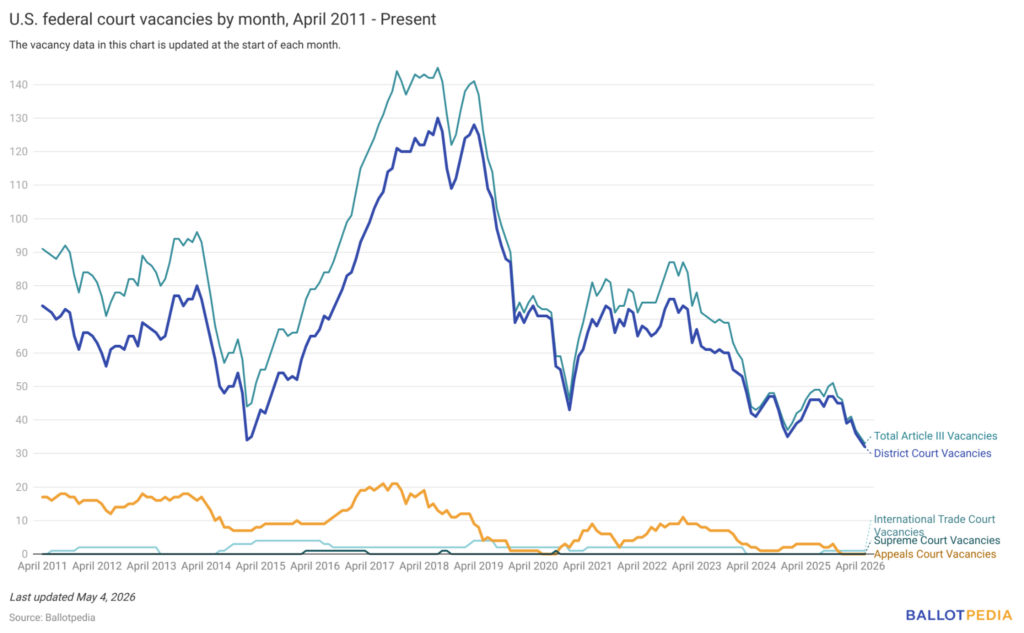
Do you love judicial nomination, confirmation, and vacancy information? We figured you might. Our monthly Federal Vacancy Count monitors all the faces and places moving in, moving out, and moving on in the federal judiciary. Click here for our most current count.
Need a daily fix of judicial nomination, confirmation, and vacancy information? Click here for continuing updates on the status of all federal judicial nominees.
Or, keep an eye on our list for updates on federal judicial nominations.
Looking ahead
We’ll be back on June 8 with a new edition of Robe & Gavel. Until then, gaveling out!
Contributions
Myj Saintyl compiled and edited this newsletter, with contributions from Sam Post, Ellie Mikus, and Spencer Richardson.