


Welcome to Ballot Bulletin: Ballotpedia's Weekly Election Policy Digest. Every Tuesday, we deliver the latest updates on election policy around the country, including nationwide trends and recent legislative activity.
In this week’s edition, we cover 128 bills state legislatures acted on last week and look at a proposed U.S. Postal Service rule concerning absentee/mail-in voting.
The state of election legislation in the U.S.
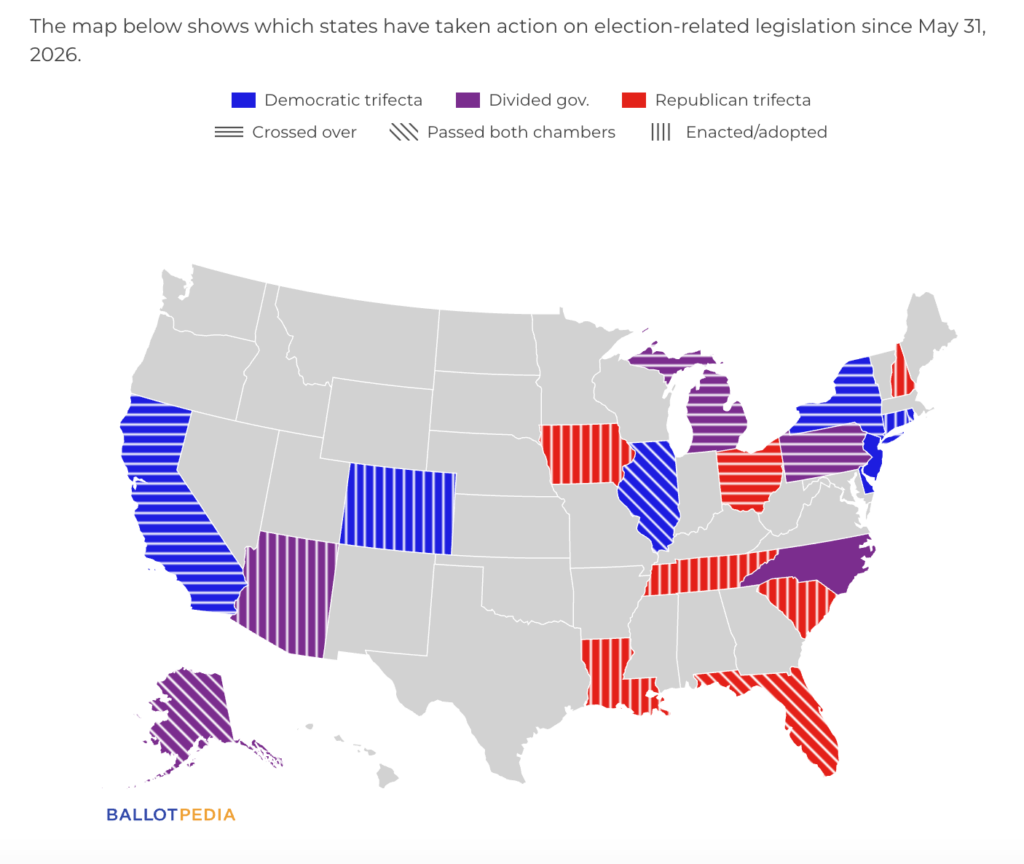
Lawmakers in 19 states acted on 128 election-related bills last week. Thirteen state legislatures are in regular or special sessions. Last week, 11 bills were enacted, seven bills passed both chambers of a state legislature, and no bills were vetoed.
Of the bills acted on last week, 66 (51.6%) are in states with Democratic trifectas, 36 (28.1%) are in states with Republican trifectas, and 26 (20.3%) are in states with divided government. The most active bill categories last week were campaign finance (26), election types and stages (25), voter registration and list maintenance (24), and election dates and deadlines (24).
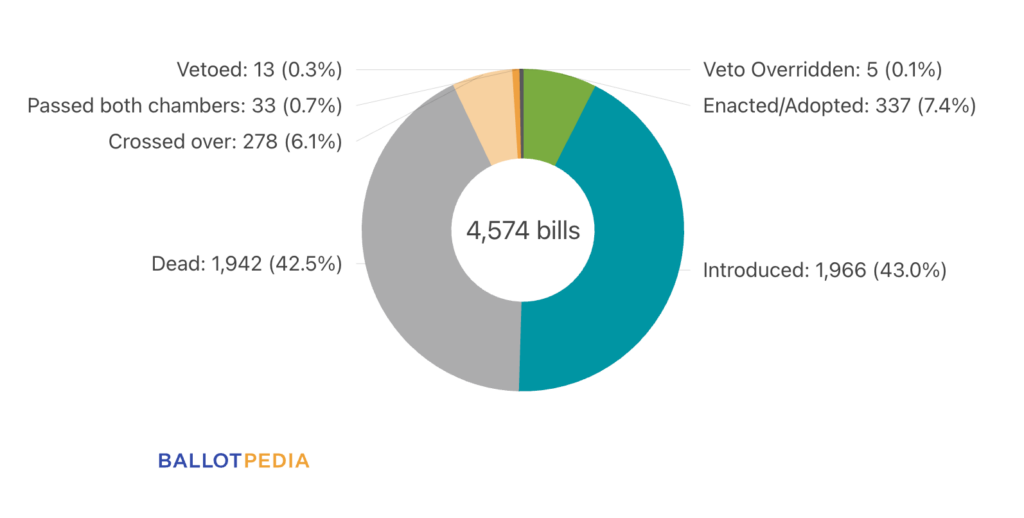
We are currently tracking 4,574 election-related bills across the country. The chart below breaks down the status of those bills by where they stand in the legislative process:
Enacted bills
On June 2, Iowa Gov. Kim Reynolds (R) signed SF 2218 into law. It requires voter registration applications to include an oath that the voter is qualified to vote and a U.S. citizen, and makes it a crime of election misconduct in the first degree for a person to falsely swear an oath on a voter registration application. The bill also requires the state registrar of voters to verify all registered voters’ U.S. citizenship status using the Systematic Alien Verification for Entitlements (SAVE) system administered by the U.S. Citizenship and Immigration Services (USCIS).
Ten other bills were enacted or adopted last week:
- Arizona (Divided government)
- Colorado (Democratic trifecta)
- Connecticut (Democratic trifecta)
- Iowa (Republican trifecta)
- Louisiana (Republican trifecta)
Bills passing both chambers
On May 31, the Louisiana State Senate concurred in House amendments to SB 25, sending the bill to Gov. Jeff Landry (R). Among other provisions related to the annual compensation of certain election officials, the bill establishes new district lines for Louisiana State Senate Districts 33, 34, and 35.
Six other bills passed both chambers last week:
- Florida (Republican trifecta)
- Illinois (Democratic trifecta)
- Louisiana (Republican trifecta)
- Rhode Island (Democratic trifecta)
To see a full list of bills awaiting gubernatorial action, click here.
Vetoed bills
No bills were vetoed this week.
To see a list of all bills vetoed this session, click here.
All bills
The chart below shows all bills Ballotpedia is currently tracking, broken down by partisan sponsor
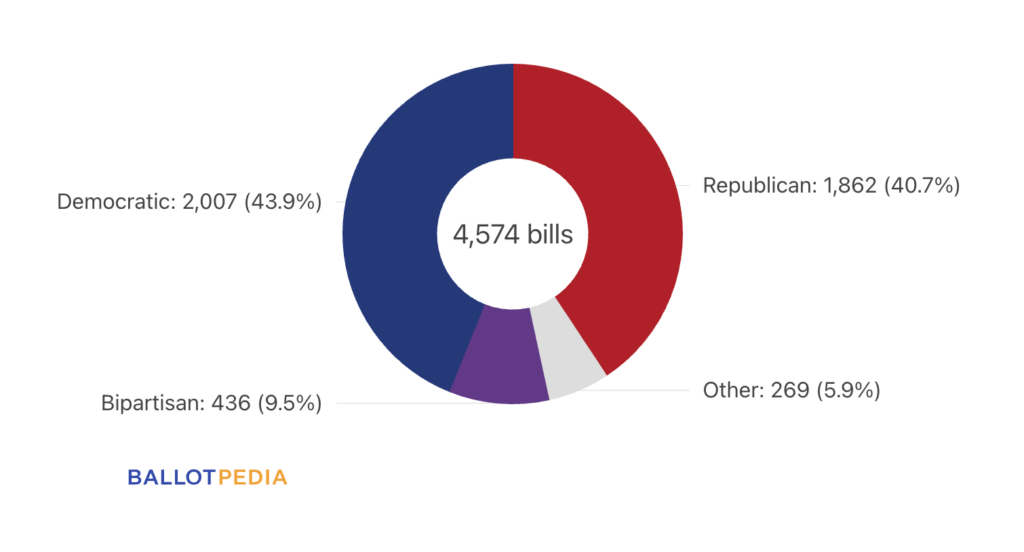
We are currently following 4,574 election-related bills, including bills carried over from the previous year.
- Trifecta status
- Democratic: 1,956 (42.8%)
- Republican: 1,655 (36.2%)
- Divided: 963 (21.1%)
- Partisan sponsorship
- Democratic: 2,007 (43.9%)
- Republican: 1,862 (40.7%)
- Bipartisan: 436 (9.5%)
- Other: 269 (5.9%)
In the news
On June 2, the U.S. Supreme Court granted a stay of the U.S. District Court for the Northern District of Alabama’s ruling in Allen v. Milligan in response to Attorney General of Alabama Steve Marshall’s (R) May 27 emergency appeal. As covered in the June 2 edition of Ballot Bulletin (released before the Supreme Court’s ruling that evening), the district court issued an injunction against the state’s 2023 congressional districts on May 26, saying elections using the maps would be “tainted by intentional race-based discrimination.” The Supreme Court’s decision allows Alabama to use its 2023 maps in the upcoming elections.
In its 6-3 unsigned order, the Supreme Court held that Alabama demonstrated “a strong showing of irreparable harm” if the new maps were overturned and stated that the court has “repeatedly cautioned that lower federal courts should not ‘alter the election rules on the eve of an election,’” a legal concept known as the Purcell Principle. In a dissent to the order, Justice Sonia Sotomayor (joined by Justices Ketanji Brown Jackson and Elena Kagan) wrote that the correct application of the Purcell Principle necessitates a reinstatement of the former maps, as “the path of least change in Alabama is keeping the District Court’s remedial plan in place.”
Here are other news stories from across the country:
- On June 4, the Arizona Supreme Court declined to hear a November 2025 appeal from Arizona Secretary of State Kris Mayes regarding a September 2025 decision from the Arizona Court of Appeals. The appeals court’s decision threw out the indictments of 18 individuals accused of interfering with the results of the 2020 presidential election. Judges previously threw out similar charges in Georgia and Michigan.
- On June 4, the Equal Ground Education Fund filed an emergency petition to the Supreme Court of Florida in a lawsuit contesting the state’s new congressional maps. In the petition, the plaintiffs said that the new districts violate Florida’s Fair Districts Amendment because they were consciously drawn with partisan data. The qualifying period for congressional candidates in Florida began June 8. The Equal Ground Education Fund and a group of Florida voters sued to block the maps in May. As covered in the June 2 edition of Ballot Bulletin, the Circuit Court of the Second Judicial Circuit of Florida issued a ruling declining to strike down the state’s new congressional districts.
- On June 4, Judge Patricia Tolliver Giles of the U.S. District Court for the Eastern District of Virginia signed a consent decree prohibiting election officials from rejecting voter registration applications from students who do not provide “a dormitory name, dorm room, campus mailing address, and/or mail box number.” The Virginia State Board of Elections and NAACP agreed to the consent decree, which emerged in response to an October 2025 NAACP lawsuit. In the order, Judge Giles wrote that the consent degree signifies the “parties’ commitment to ensure that all eligible citizens of the Commonwealth of Virginia, including eligible students attending Virginia colleges and universities, have an equal opportunity to participate in the electoral process.”
Wondering about ballot counting timelines after the California primary? Check out our case study comparing California and Florida on factors affecting the speed of unofficial election results here.
Policy spotlight: U.S. Postal Service proposes absentee/mail-in voting rule
The story below is adapted from a recent Ballotpedia News story by Andrew Bahl.
The United States Postal Service filed a proposed rule on May 29 that would prohibit absentee/mail-in ballots for general elections from being delivered to anyone not on a list provided to USPS by state election officials. The proposed rule was published in the Federal Register on June 2.
According to the proposed rule, states would submit to USPS the names of absentee/mail-in voters, as well as "the unique barcode applied to the outbound and return ballot mail envelope for such individuals." States would be allowed to modify this list up to the final day for sending out absentee/mail-in ballots. The rule would not apply to primary elections or to military or overseas voters.
President Donald Trump (R) issued Executive Order 14399, "Ensuring Citizenship Verification and Integrity in Federal Elections," on March 31, 2026. In supplementary background on the rule, USPS states, "The Executive Order discusses the importance of additional measures concerning the use of the mails to vote in federal elections, in order to facilitate enforcement of federal law, reduce the risk of fraud, and help protect the integrity of federal elections. ... [T]he Postal Service issues this proposed rule regarding the preparation of ballot mail for federal elections to facilitate the enforcement of federal law."
The rule would require USPS to confirm before mailing an absentee/mail-in ballot that the recipient is on the state-provided list. The agency said that it would not change this information and that "states would retain full control over who would (or would not) be able to vote by mail in federal elections within each state."
"This provision will help determine adherence to federal law and facilitate law enforcement efforts," the USPS document stated. "For example, the provided lists will evidence how many ballots have been mailed, and allow law enforcement officials to compare the total number of mailed ballots to the total number of received ballots to detect potential issues meriting further investigation."
The rule would also create a new design for ballot envelopes, including "placement of a uniquely serialized Intelligent Mail barcode (IMb) on each outbound and return ballot envelope."
Stakeholders have until July 2 to submit comments on the proposed rule to USPS.
After USPS's rule filing, White House representative Abigail Jackson said, "The entire Trump Administration will continue lawfully enacting the agenda President Trump was elected to enact – which includes the safety and security of American elections. ... This campaign pledge from the President is why millions of Americans sent him back to the White House."
Washington Secretary of State Steve Hobbs (D) said, "This is an unnecessary rule and does nothing to provide security in our elections. We’ll continue to evaluate and provide feedback to the USPS. Once again, we’re seeing federal overreach that threatens to undermine the rights of eligible voters and override states’ authority over elections. This is clearly another attempt by the Trump administration to exercise authority they don’t have."
On June 3, the NAACP filed a motion in a lawsuit against USPS that was originally brought in 2020 related to ballot delivery in that year's election. The motion alleges that the proposed rule would violate the terms of a settlement reached in 2021 requiring USPS to "prioritiz[e] ... the timely delivery of Election Mail." NAACP Legal Defense Fund associate director-counsel Samuel Spital said, "USPS has committed over and over to playing its part in democracy by prioritizing the timely delivery of mail-in ballots. ... And now for USPS to say we affirmatively will not deliver a ballot at all because it doesn’t meet criteria that we invented out of whole cloth, not only violates the settlement agreement, but also the historical role of the USPS in our democracy." USPS has until June 11 to file a response.
Trump's executive order also requires the U.S. Department of Homeland Security to provide a list of citizens age 18 and older to state election officials at least 60 days before a federal election. The order grants enforcement powers to the U.S. Attorney General and federal agency heads, including withholding funding from noncompliant states.
In April, multiple groups of Democratic state and federal officials and nonprofit organizations filed four lawsuits, alleging that the requirements of the executive order are unconstitutional and seeking a court order blocking them from taking effect.
On May 28, Judge Carl Nichols of the U.S. District Court for the District of Columbia denied a request to block the order. In his ruling, Nichols held that because the order had not yet been implemented, the plaintiffs in the case could not show the harm required to block it from taking effect. A U.S. district court judge in Massachusetts heard oral arguments in a separate case on June 2.
Every state has a method allowing voters to cast ballots without visiting a physical polling place.
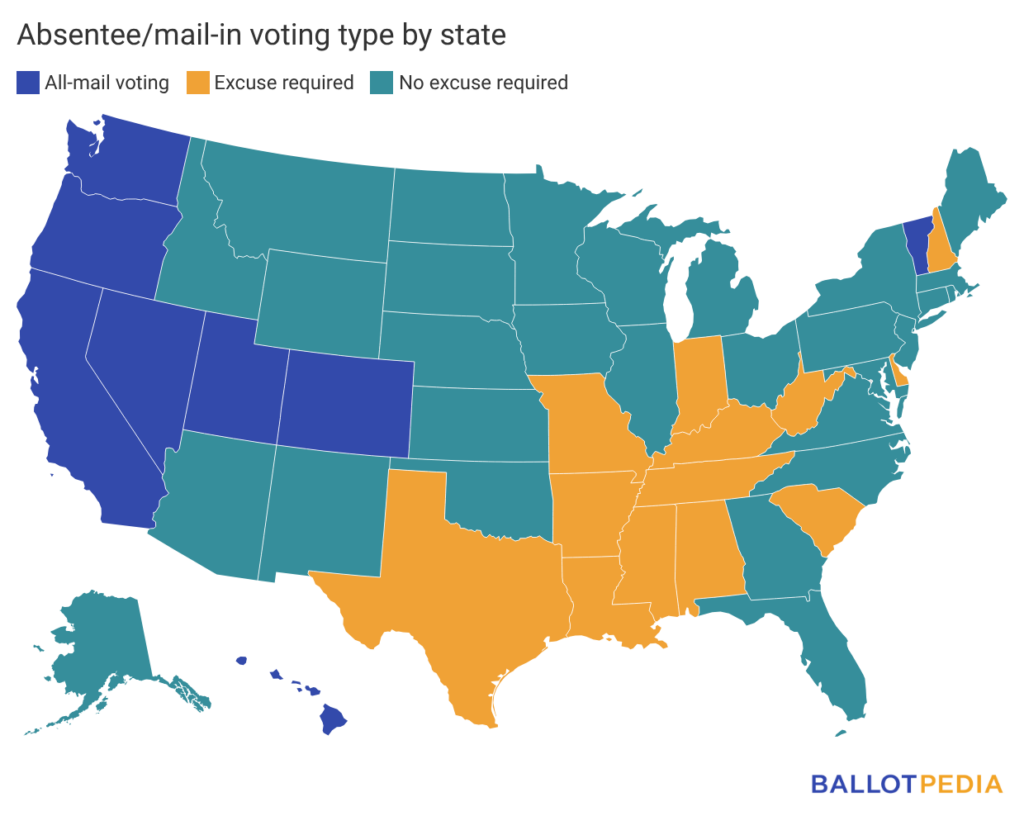
Thirteen states require voters to provide a valid excuse to vote by mail. Twenty-nine states allow any eligible voter to cast an absentee/mail-in ballot. Eight states have all-mail voting systems in which every eligible voter is automatically sent a mail ballot.
For more information on absentee/mail-in voting in the United States, click here.