


In this week’s edition of Economy and Society:
- Global taskforce releases draft framework for social disclosure
- UK regulator plans to streamline climate disclosures
- European investor groups block exemption of ESG reporting for asset managers
- ESG legislation update
- UK pension fund invests £200 million in climate innovation
- Companies shift strategy on shareholder proposals after SEC policy change
Around the world
Global taskforce releases draft framework for social disclosure
What’s the story?
The Taskforce on Inequality and Social-related Financial Disclosures (TISFD) released a draft framework on May 26, 2026, designed to help companies disclose how their business practices affect workers, consumers, and communities. The framework covers governance, strategy, and risk management related to labor practices, wage levels, human rights, and inequality. TISFD is seeking public feedback until July 31, 2026, before publishing subsequent versions.
Twenty organizations, including the California Public Employees' Retirement System, the United Nations Development Programme, and the International Labour Organization, established the Taskforce on Inequality and Social-related Financial Disclosures (TISFD) in September 2024.
The draft framework proposes general requirements for organizations to disclose material people-related impacts and dependencies, with a final version planned for late 2027. The framework asks companies to describe governance of people-related risks, how these issues interact with business strategy and financial performance, processes to identify and manage such risks, and metrics used to track progress.
Why does it matter?
Existing disclosure frameworks focus primarily on environmental risks, while the new framework would create a common approach for reporting workforce, human rights, and inequality-related issues. Similar frameworks already exist:
- Taskforce on Climate-related Financial Disclosures (TCFD) — established in 2015, sets standards for climate risk disclosure. The UK's Financial Conduct Authority and European regulators have made TCFD-aligned reporting mandatory for certain firms.
- Taskforce on Nature-related Financial Disclosures (TNFD) — sets standards for nature and biodiversity risk disclosure. Some jurisdictions including the European Union have incorporated TNFD-aligned requirements into law.
The framework is designed to provide a structure for companies to report on labor practices, wage levels, human rights, and inequality as financial risks. TISFD Co-Chair Arunma Oteh said, "Investors increasingly recognise that inequality and wider people-related issues influence economic stability and long-term returns. TISFD's framework helps provide the structure and information needed to better understand these relationships and integrate them into investment decision-making."
However, disclosure frameworks face criticism. Researchers have cited greenwashing, inconsistent rating methodologies, and superficial compliance as ongoing issues. One analysis noted that "Companies often face significant uncertainty in quantifying and disclosing biodiversity-related risks due to the lack of standardized metrics and methodologies."
UK regulator plans to streamline climate disclosures
What’s the story?
On June 5, 2026, the United Kingdom's Financial Conduct Authority (FCA) proposed eliminating detailed product-level climate reports based on the TCFD framework. The proposal would replace them with simpler, more flexible rules in Consultation Paper CP26/17. The FCA estimates the changes could save firms approximately £20 million ($26 million) annually.
The proposed change would give asset managers more flexibility to provide targeted climate-risk information designed for retail investors rather than detailed product-level disclosures. FCA Director Michelle Beck said the regulator aims to be "a smarter, more proportionate regulator" by "cutting complexity in our rules for asset managers, while keeping the focus on clear, useful information for investors."
The FCA is consulting publicly on the proposals, with the consultation period ending July 10, 2026.
Why does it matter?
For investors, the shift could make climate information easier to compare and understand across funds, potentially improving decision-making about how climate risks—such as floods, storms, and supply-chain disruption—affect portfolio performance.
Simplified rules can be valuable for asset managers operating globally because they currently manage multiple climate disclosure regimes across different jurisdictions. The FCA's approach reflects a broader regulatory shift in the UK toward balancing sustainable finance requirements with competitiveness and lower compliance burden. The proposal does not appear to address explicit benefits to regulators themselves in terms of supervision or enforcement capacity.
What’s the background?
The FCA introduced climate disclosure rules for asset managers in 2021 based on TCFD guidelines. In 2025, the regulator reviewed how the rules were working and found that detailed product-level reports were too complex for retail investors to understand and use, while costing firms significant money to produce. Consumer groups told the FCA that investors found the reports too long and complicated. The FCA concluded that clearer, more focused reporting could better protect investors while reducing administrative burden on firms.
European investor groups block exemption of ESG reporting for asset managers
What’s the story?
On June 2, 2026, two of Europe's leading investor groups — the European Sustainable Investment Forum and the European Federation of Financial Analysts Societies — called for a European Commission proposal to be dropped. A third investor group, the Institutional Investors Group on Climate Change (IIGCC), whose members manage £50 trillion ($67 trillion) in combined assets, asked for greater clarity on the scope of the exemptions. All three groups opposed the Commission proposal to exempt asset managers from reporting environmental, social, and governance (ESG) data on client investments.
The investor organizations said asset managers should continue reporting ESG data on all investments they manage, regardless of ownership structure. The European Sustainable Investment Forum said, "Actual portfolio holdings provide the most objective evidence of how policies translate into practice — rather than merely described in theory."
What’s the background?
On May 7, 2026, the European Commission proposed exempting asset managers from reporting ESG data on investments they manage "without retaining risks or rewards of ownership." The proposal would amend the European Sustainability Reporting Standards, which provide detailed instructions for complying with the Corporate Sustainability Reporting Directive.
Asset manager trade groups and banks supported the exemption, saying it would avoid duplication with existing regulatory requirements for client assets under the Markets in Financial Instruments Directive (MiFID II) and other EU disclosure rules. The Commission's public consultation closed on June 3, 2026.
The proposal is part of the EU's broader effort to simplify reporting requirements. EU Commissioner Maria Luís Albuquerque stated that "simplification is not intended to lower ambition, but to ensure that sustainability reporting remains reliable, comparable, and decision-useful while remaining implementable in practice." The EU rolled back the directive in 2025, removing more than 80% of companies originally required to report. EU member states and lawmakers must still approve this latest proposal.
In the states
ESG legislation update
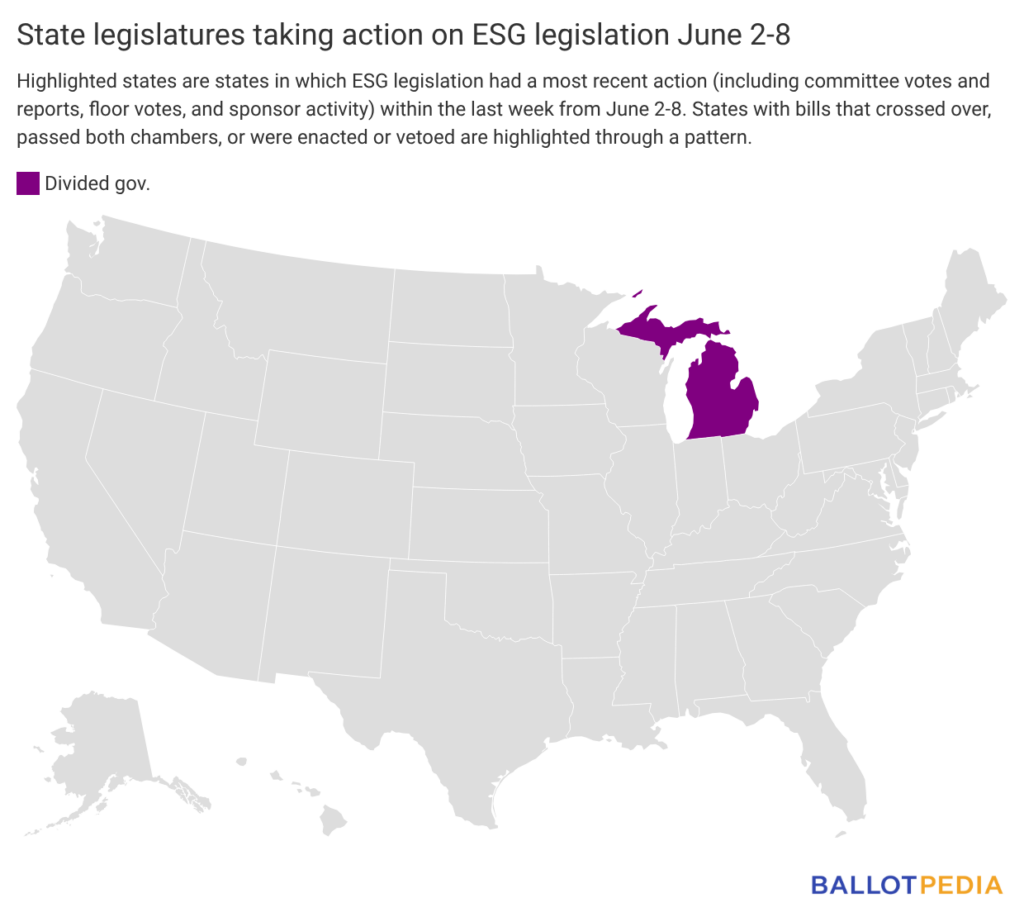
One state took action on one ESG-related bill since June 2, 2026. Michigan SB0807 would create a state-facilitated automatic enrollment IRA program for certain employees, with investments based solely on financial returns and excluding ESG considerations. The bill advanced to third reading.
States with legislative activity on ESG last week are highlighted in the map below. Click here to see the details of each bill in the legislation tracker.
On Wall Street and in the private sector
UK pension fund invests £200 million in climate innovation
What’s the story?
Nest, the United Kingdom's (UK) largest workplace pension scheme by membership, announced on June 5, 2026, plans to invest in companies working on climate and energy solutions. The investment of £200 million ($269 million) will be deployed through investment manager IFM Investors to provide loans to companies in energy, transportation, and industrial sectors. This commitment is part of Nest's broader plan to invest £5 billion through IFM by 2030.
As part of their partnership, IFM will focus on companies that have working technologies and demonstrated commercial traction but are too small or early-stage to obtain loans from traditional banks.
Nest Director Rachel Farrell said "The globally-focussed strategy aims to back companies, asset-backed debt, across power and energy, sustainable transportation, digital circular economy and industrial innovation sectors, backing innovators that deliver measurable, low-carbon outcomes across the real economy."
Why does it matter?
Nest manages retirement savings for more than 13 million UK workers — over a third of the UK workforce. When the largest pension scheme by membership invests in climate and energy companies, that capital helps those companies grow and compete with fossil fuel companies. It signals that large institutional investors believe these sectors will deliver long-term returns. The commitment also reflects Nest's strategy to deepen its allocation to private markets, where it sees climate infrastructure as a key opportunity for member returns.
In the spotlight
Companies shift strategy on shareholder proposals after SEC policy change
What’s the story?
A mid-season analysis by Glass Lewis, a proxy advisory firm, found that companies are excluding significantly fewer shareholder proposals in 2026 following the Securities and Exchange Commission's (SEC) November 2025 decision to stop reviewing most proposal exclusion requests. Through April 30, 2026, companies filed 55% fewer exclusion notices in March and April than during the same period in 2025.
At the same time, the number of shareholder proposals reaching a vote declined only 8%, even though overall proposal filings were down as much as 47%. Glass Lewis said the decline in exclusion requests may reflect a greater willingness to allow proposals to go to a vote, despite the SEC's decision to stop reviewing most exclusion requests and the resulting shift of exclusion disputes to courts and private litigation.
Since the SEC stopped providing most no-action relief on shareholder proposal exclusions, companies appear to be taking different approaches depending on who submitted the proposal. Through April, companies did not exclude any proposals submitted by institutional investors, compared to five during the same period last year. Companies also withdrew all six exclusion requests involving proposals from anti-ESG proponents. Instead, more than 70% of exclusion notices involved proposals submitted by individual shareholders, and more than half involved proposals from John Chevedden, a longtime shareholder activist who frequently submits corporate governance proposals to public companies.
Meanwhile, shareholder litigation has increased. BJ's Wholesale Club, AT&T, PepsiCo, and Axon Enterprises all faced lawsuits challenging proposal exclusions, with several cases resulting in settlements requiring companies to include proposals in proxies. In March 2026, the Interfaith Center for Corporate Responsibility and As You Sow sued the SEC itself, arguing its policy change was an illegal rule change that weakened shareholder rights.
What’s the background?
The SEC announced on Nov. 17, 2025, that it would no longer provide substantive responses to most no-action requests during the 2025–26 proxy season. Companies traditionally requested these letters to confirm the SEC would not enforce if they excluded a proposal. Without this guidance, companies must decide exclusions themselves under Rule 14a-8.
Glass Lewis noted that while the number of shareholder proposals filed declined 47% compared to 2025, the number reaching a vote declined only 8%. The smaller decline in proposals reaching votes reflected companies' reduced reliance on exclusions. Governance proposals now dominate shareholder filings, representing 54% of proposals through April 2026, up from 33% in 2024. Environmental and social proposals declined significantly.