


Welcome to the Monday, June 15, 2026, Brew.
By: Lara Bonatesta
Here’s what’s in store for you as you start your day:
- California initiative to require healthcare union members to approve union political spending qualifies for the November ballot
- So far in 2026, no mayors in the 100 largest cities holding elections are voluntarily retiring
- Two Republican incumbents drawn into the same congressional district to face off in general election for California's 40th
California initiative to require healthcare union members to approve union political spending qualifies for the November ballot
On June 5, a ballot initiative to require healthcare unions to disclose how they spend member dues on state and local ballot measures, and to obtain majority member approval for such spending, qualified for the November ballot in California. The California Hospital Association (CHA), a trade association representing hospitals and health systems across the state, is sponsoring the measure.
The CHA initiative would apply to all healthcare unions in the state with more than 50,000 members. This would include unions such as SEIU Local 2015, California Nurses Association, and SEIU-UHW.
The CHA campaign website says, “Decisions are often made by a small group of union executives, not rank-and-file members. For one large California healthcare union, decisions on where to spend money on politics are made by executives representing one quarter of one percent of their membership. Labor unions have a right to spend money on political issues and measures. But union members also have the right to vote to decide how their dues money is being spent and a right to know exactly where their hard-earned dues money is going, including ballot measure spending.”
In an interview with KFF Health News, Renée Saldaña, a representative of SEIU-UHW, said “we don’t see the legal viability” of the CHA initiative and called it an attempt “to silence the front-line healthcare workers.”
At least one union that this measure would affect - SEIU UHW - is heavily involved in other ballot measures this year. SEIU-UHW represents healthcare workers in the state and proposed two measures on the November ballot. One initiative would establish a compensation limit for CEOs, executives, administrators, and managers of healthcare corporations. Another would prohibit healthcare clinics, specifically federally-qualified health centers and related organizations, from spending less than 90% of their annual revenue on mission-related purposes.
The secretary of state’s office reported that for the CHA initiative, 726,969 of the 931,534 signatures submitted were valid. To qualify an initiated statute for the ballot, petitioners needed to submit at least 546,651 valid signatures, or 5% of the votes cast in the last gubernatorial election.
The campaign sponsoring the initiative, Californians for Health Care Workers' Right to Vote, reported raising $11 million through April 9, all of which came from the California Hospitals Committee on Issues, whose sponsoring organization is the California Association of Hospitals and Health Systems.
The SEIU-UHW also submitted signatures for a combined law and constitutional amendment to levy a one-time 5% wealth tax on the state’s billionaires. The random sample count is due June 18. Between the three ballot initiative campaigns, the SEIU-UHW reported raising more than $9.7 million in cash and in-kind contributions as of March 30.
Five other initiatives and three legislative referrals have qualified for the ballot. The measures address health care executive compensation, housing, health clinic spending, vote requirements on tax measures, voter ID, public financing of election campaigns, conducting recall elections, and vote thresholds for ballot measures.
Signature verification is also pending for nine other ballot initiatives in California. To see the list of measures, click here.
Californians decided on 1,307 ballot measures between 1910 and 2025. They approved 753 measures (57.6%) and rejected 554 (42.4%). A total of 444 of the measures on the California ballot were citizen initiatives. Of those, 159 were approved (35.8%), and 285 (64.2%) were defeated.
Click here to read more about the CHA initiative and here to read more about California’s 2026 ballot measures.
So far in 2026, no mayors in the 100 largest cities holding elections are voluntarily retiring
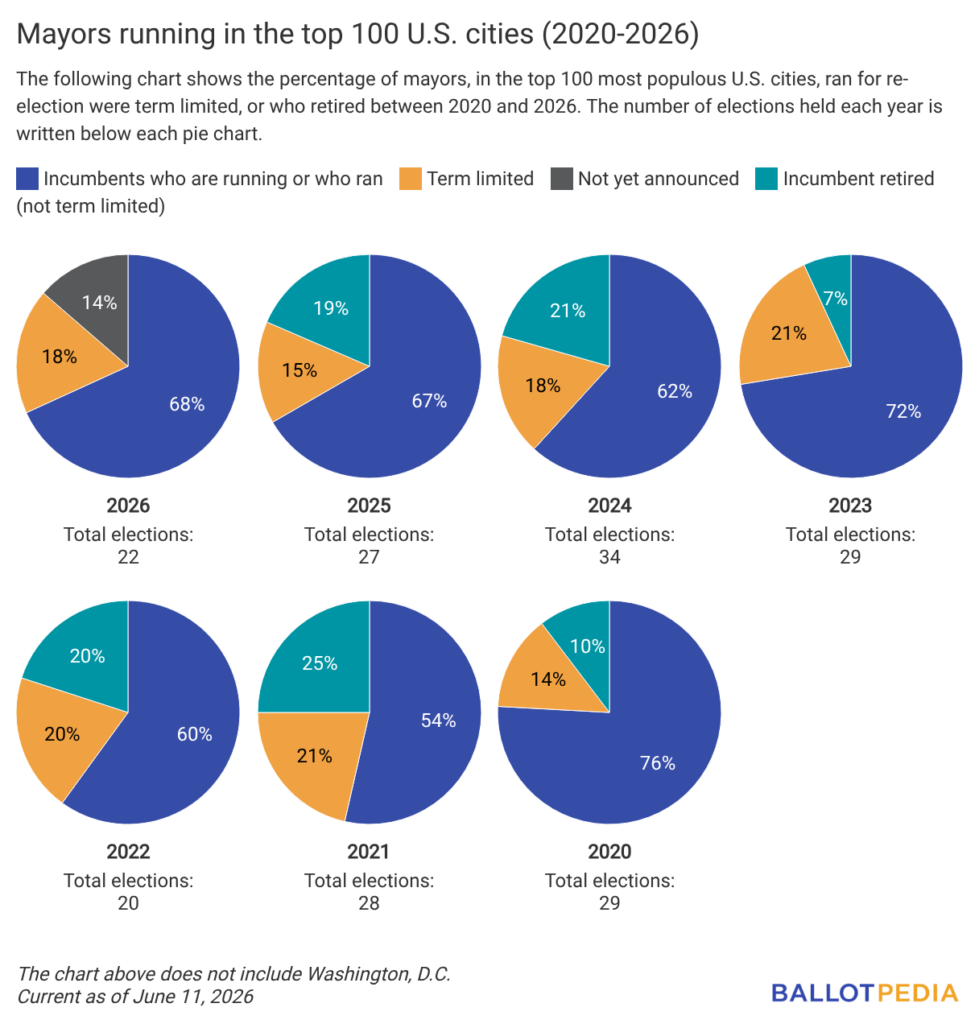
Twenty-two of the nation’s 100 most populous cities are holding mayoral elections this year, and so far, no mayors are voluntarily retiring. (Note: This analysis does not include Washington, D.C.)
An average of 63.4% of mayors ran for re-election between 2020 and 2025, and an average of 16.3% of mayors retired (not including term-limited mayors). An average of 17.5% of mayors were term-limited.
At least one mayor of a city holding elections in 2027 is retiring. Charlotte, North Carolina, Mayor Vi Lyles (D) will resign from office on June 30, 2026.
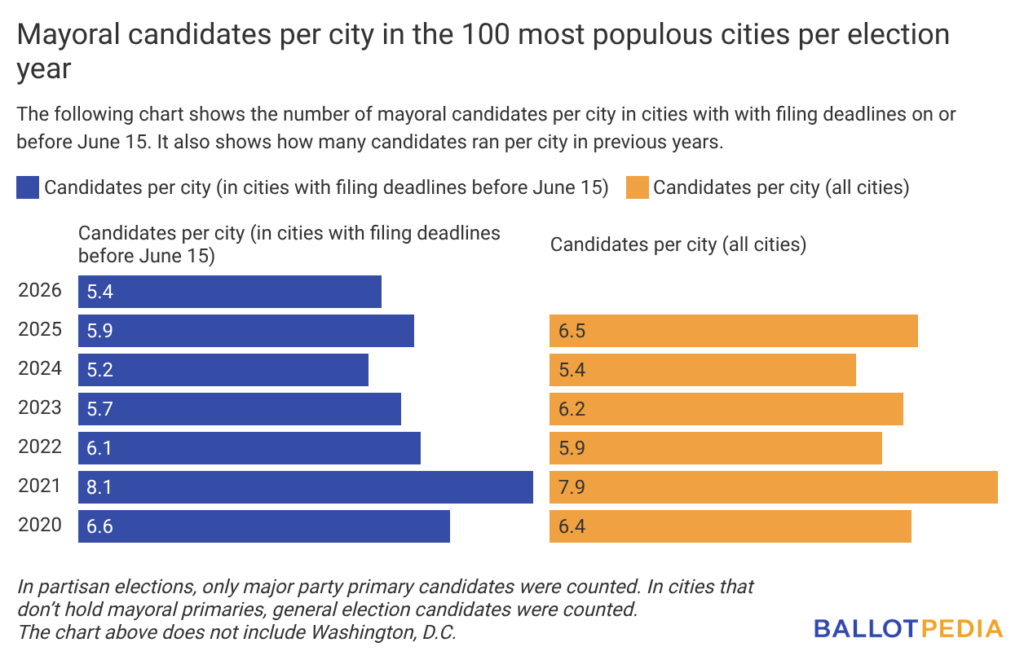
Additionally, every incumbent running for re-election in the 100 largest cities has at least one opponent at the first stage of their re-election bid. There are 5.4 candidates running per city — below the six-year average but comparable to 2024's 5.2 candidates per city at this point in the year.
Thirteen of the 100 largest cities have held some type of mayoral election so far this year. Eight cities have held primaries. Five cities have held general elections. One additional city’s mayoral primary –the one in Raleigh, North Carolina, was canceled after only two candidates filed to run. Here's a look at some recent results.
Three mayoral primaries in the 100 largest cities took place in California on June 2.
In Los Angeles – the second-largest city in the U.S. and the largest city holding a mayoral election this year – incumbent Mayor Karen Bass and City Council member Nithya Raman, both Democrats, advanced to the general election. Bass received 34.3% of the vote to Raman’s 28.5% in the nonpartisan primary. Reality TV star Spencer Pratt, a Republican, received the third most votes at 25.8%.
California Gov. Gavin Newsom (D), both business and labor organizations, and the Los Angeles County Democratic Party endorsed Bass. Abundant Housing LA and the Future Urbanist Club endorsed Raman.
In Long Beach – the 41st-largest city – incumbent Rex Richardson won outright, receiving 57% of the vote in the primary. There were five other candidates who received between 2.8% and 19.7% of the vote each. Richardson is the first mayor to be elected outright in a primary this year.
In Chula Vista – the 77th-largest city – incumbent John McCann and Francisco Tamayo advanced with 56.2% and 39.5%, respectively.
Here are some other noteworthy mayoral elections from across the country since our last update.
- Lexington, Kentucky, held a primary with seven candidates on May 19. Incumbent Linda Gorton (Nonpartisan) and Raquel Carter (Nonpartisan) advanced to the Nov. 3 general election. Gorton received 45.8%, and Carter received 28.3%.
- On May 19, Louisville, Kentucky, held a primary with nine candidates. Incumbent Craig Greenberg and Shameka Parrish-Wright advanced with 52.5% and 26.3%, respectively. The city was required to switch to nonpartisan elections under HB288, which the Kentucky General Assembly passed in 2024. According to the Jefferson County Clerk’s Office, the change from partisan to nonpartisan primaries made about 75,000 independent voters eligible to vote in the primaries for the first time. Governor Andy Beshear (D), U.S. Rep. Morgan McGarvey (D), Lt. Gov. Jacqueline Coleman (D), and eight Democratic members of the Louisville Metro Council endorsed Greenberg. Jefferson County Kentuckians for the Commonwealth, Louisville Showing Up for Racial Justice, Louisville DSA, C-FAIR, and Planned Parenthood endorsed Parrish-Wright.
- Reno, Nevada, held its first open race for mayor since 2014. Incumbent Hillary Schieve was term-limited. Nine candidates ran, including a former lieutenant governor and two city council members. As of this writing, the race was still uncalled.
Currently, there are 67 Democratic mayors, 21 Republican mayors, one Libertarian mayor, three independent mayors, six nonpartisan mayors, and one unaffiliated mayor. One mayor's partisan affiliation is unknown. As we mentioned in our April 9 edition of the Daily Brew, that’s the most Democratic mayors since 2016.
Irving, Texas, is the only city to change mayoral partisanship so far this year — unaffiliated candidate Albert Zapanta won the May 2 general election to replace Republican incumbent Rick Stopfer.
There are no other general elections for mayor in a top-100 city scheduled until Nov. 3. The next top-100 city scheduled to hold a mayoral primary is Chandler, Arizona on July 21.
Click here to see our analysis of competitiveness in mayoral elections this year, and here to see our analysis of partisanship in those elections.
Two Republican incumbents drawn into the same congressional district to face off in general election for California's 40th
Incumbents Ken Calvert (R) and Young Kim (R) advanced the top-two primary for California's 40th Congressional District on June 2, setting up the first incumbent vs. incumbent congressional general election of this cycle. One incumbent so far has lost to another in a primary, specifically in Texas 18th Congressional District where Christian Menefee defeated Al Green in the May 26 Democratic primary runoff.
Calvert represents California's 41st Congressional District, and Kim represents the 40th District. In the top-two primary, Calvert received 35% of the vote and Kim received 21%. The two incumbents were drawn into the same district as a result of Proposition 50, a redistricting amendment voters approved in November 2025. According to ABC7's Josh Haskell, Calvert represents 51% of the new district, and Kim represents 35% of the new district. Based on 2024 presidential results, the new district is 10 percentage points more Republican than the old district.
Calvert was first elected to Congress in 1992. Previously, he was a small business owner in the restaurant and real estate industries.
Kim was first elected to Congress in 2022. Previously, she was a business owner, financial analyst, and staffer for then-U.S. Rep. Ed Royce (R). She represented District 65 in the California Assembly from 2014 to 2016.
There was one U.S. House race featuring two incumbents in 2024. In the March 5, 2024, Republican primary in Alabama’s 1st Congressional district, Barry Moore defeated Jerry Carl 51.7% to 48.3%. In 2022, there were eight incumbent v.s. Incumbent elections.
Click here to read more about the top-two primary in California’s 40th Congressional District.