


Welcome to the Tuesday, June 16, 2026, Brew.
By: Briana Ryan
Here’s what’s in store for you as you start your day:
- Ohio will be one of six states with a voter ID measure on the ballot this year
- It's Election Day in Oklahoma and Washington, D.C.
- President Donald Trump signs the Secure America Act into law
Ohio will be one of six states with a voter ID measure on the ballot this year
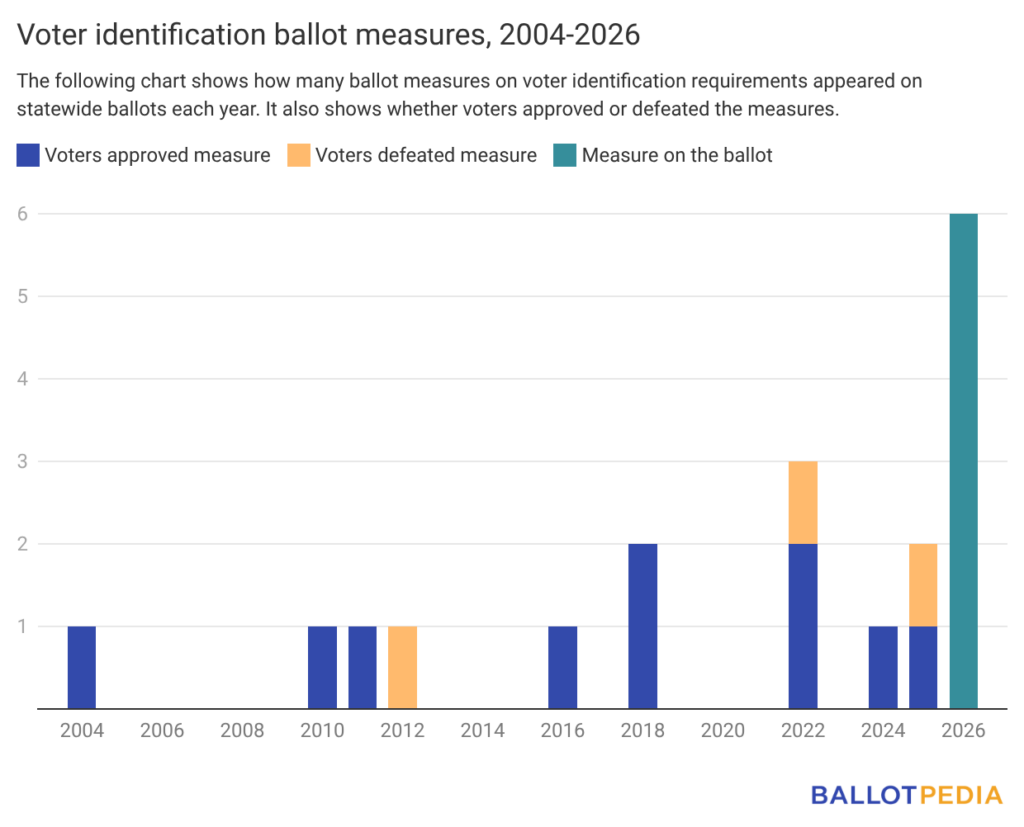
Ohio will be one of six states to decide on a ballot measure on voter identification requirements this year. Other voter ID measures are set to appear on the ballot in Arizona, California, Nevada, North Carolina, and Oklahoma. Two other voter ID measures could also appear on statewide ballots this year.
This year marks the most voter ID measures to appear on statewide ballots in a single year. From 2004 to 2025, 13 voter ID measures appeared on statewide ballots. Voters approved 10 of those measures and defeated three. All 13 measures either established or expanded voter ID requirements. Four measures were state statutes, and nine were constitutional amendments.
The Ohio Require Voter Identification Amendment would amend the state constitution to require voters to present photo identification to vote in person, and to require absentee voters to provide a photo ID, or a signature plus one other unique identifier authorized by law. It would also allow the Legislature to establish an alternative identity-verification process for voters with a sincere religious objection to being photographed.
Current law requires voters to present one of the following unexpired documents in order to vote:
- An Ohio driver’s license, state identification card, or interim identification form.
- A U.S. passport or passport card.
- A U.S. military identification card, an Ohio National Guard identification card, or a U.S. Department of Veterans Affairs identification card.
Individuals who do not have or are unable to provide photo identification are allowed to cast a provisional ballot. For the provisional ballot to count, the voter must go to the board of elections office and present their photo ID within four days after Election Day. If a person has a religious objection to being photographed, they must instead complete an affidavit.
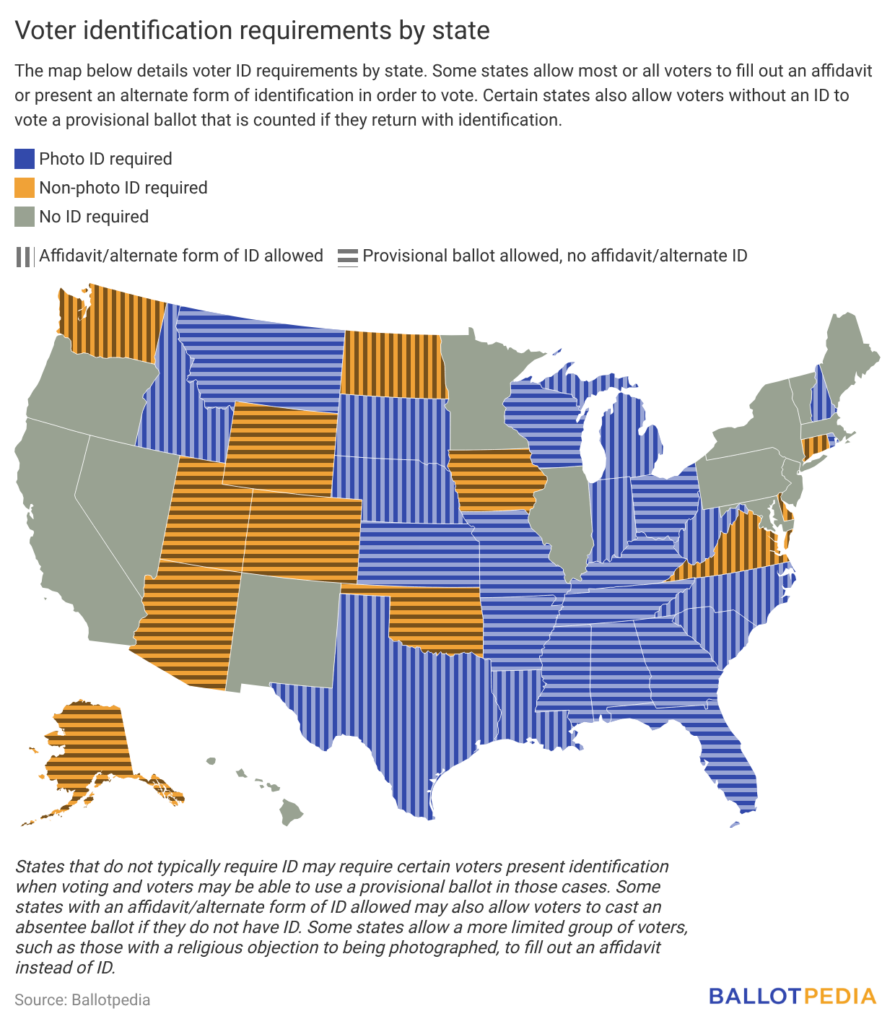
Ohio is one of 40 states that allow voters to cast a provisional ballot if they are unable to provide identification at the polls. It is also one of eight states that specifically allow voters with a religious objection to being photographed to sign an affidavit instead of providing identification, or that exempt them from the ID requirement altogether.
Ohio also requires voters to provide either a copy of their ID or driver's license, or their driver’s license number, ID card number, or the last four digits of their Social Security number when applying for and returning an absentee ballot. Georgia is the only other state to require an ID or ID number when both applying for and returning an absentee ballot.
State Sens. Jane Timken (R-29) and Theresa Gavarone (R-2) introduced the amendment as Senate Joint Resolution 10 (SJR 10). On June 3, the Ohio Senate passed the bill 22-9. Twenty-two Republicans voted for the bill, and eight Democrats and one Republican voted against it. On June 10, the Ohio House of Representatives passed the bill 62-30. Sixty-two Republicans voted for the bill, and30 Democrats voted against it.
Thirty-six states require voters to present identification to vote. Of these states, 24 require voters to present a photo ID, while 12 do not explicitly require it.
Six states — Arkansas, Mississippi, Missouri, Nebraska, North Carolina, and Wisconsin — have voter identification requirements in their state constitutions. Voters approved each of the six amendments with between 55% and 79% of the vote.
So far, this measure is the only one Ohio voters will decide on Nov. 3. However, seven potential amendments could also make the Nov. 3 ballot.
Click here to read more about the Ohio Require Voter Identification Amendment.
It’s Election Day in Oklahoma and Washington, D.C.
Voters in Oklahoma and Washington, D.C., are headed to the polls today, June 16. Here's a look at the four battleground primaries that we're watching closely.
Washington, D.C.
Today's election will be the first in D.C. to use ranked-choice voting (RCV) — a system where voters rank candidates by preference on their ballots. Check out our coverage of D.C.'s use of this system in the June 12 Daily Brew.
Five candidates are running in the open Democratic primary to be D.C.'s non-voting delegate to the U.S. House of Representatives — a race that has broken campaign finance records. In total, the candidates have raised $3.3 million and spent $2.5 million as of May 27. According to NOTUS' Taylor Giorno, this race is the most expensive primary or general election for the seat. Brooke Pinto, Robert White, and Kinney Zalesne lead in fundraising.
Seven candidates are running in the open Democratic primary for mayor of D.C., in which the two noteworthy candidates — Janeese Lewis George and Kenyan McDuffie — are running on competing ideologies. According to The Washington Examiner's Rena Rowe, "Lewis George has embraced a more progressive, left-wing message and drawn comparisons to New York City Mayor Zohran Mamdani, while McDuffie has cast himself as a centrist Democrat closely aligned with [incumbent D.C. Mayor Muriel] Bowser."
Oklahoma
Nine candidates are running in the open Republican primary for governor of Oklahoma, in which President Donald Trump (R) endorsed Mike Mazzei. In addition to Mazzei, Gentner Drummond, Chip Keating, and Charles McCall lead in media attention. Of the 18 gubernatorial candidates that Trump endorsed in primaries, one lost, 10 won, and two advanced to runoffs. Four other candidates are running in primaries that have not occurred yet.
Jon Echols and Jeff Starling are running in the open Republican primary for Attorney General of Oklahoma, where they have campaigned on their different backgrounds. Echols, a business owner, campaigned on his record as a member of the Oklahoma House of Representatives from 2012 to 2024. Starling, Oklahoma's secretary of energy, campaigned on his experience as a lawyer and according to his campaign website, he "isn't a career politician and has never run for office before."
Click here to check out more about the elections we're following today, June 16. If you're an Oklahoma or Washington, D.C. voter, make sure to check out our Sample Ballot Lookup Tool before you get to the polls.
President Donald Trump signs the Secure America Act into law
President Donald Trump (R) signed the Secure America Act — a federal budget reconciliation bill providing $70 billion in funding for border control and immigration enforcement through fiscal year 2029 — into law on June 10. The U.S. Senate passed the bill on June 5, and the U.S. House of Representatives passed it on June 9.
The bill was passed through the budget reconciliation process, which allows certain bills related to spending, revenues, and debt to be brought to a vote in the Senate by a simple majority vote, rather than by a three-fifths supermajority. The last budget reconciliation bill Trump signed was the One Big Beautiful Bill Act (OBBBA) in 2025.
The process began with a budget resolution, or a blueprint for a reconciliation bill, that the Senate adopted on April 23 and the House adopted on April 29. Senate committees then released preliminary bill text on May 4, outlining nearly $72 billion in proposed spending.
On May 16, the Senate parliamentarian ruled that a provision in the bill that would have appropriated $1 billion to the U.S. Secret Service, including funding for security upgrades to the White House ballroom project, violated the Byrd Rule and could not be included in the bill unless a three-fifths vote waived the rule. That provision was removed from the bill to move forward with the reconciliation process.
The final version of the bill included $22.6 billion for Customs and Border Protection (CBP), $3.5 billion for border security technology improvements, $38.5 billion for Immigration and Customs Enforcement (ICE), and $5 billion in additional appropriations to the Department of Homeland Security (DHS).
The Senate passed the Secure America Act on June 5, 52-47, following a vote-a-rama, during which there were 27 roll call votes on amendments to the bill. One Republican, Sen. Lisa Murkowski (R-Alaska), voted against the bill, along with all Democrats and two independent senators who caucus with Democrats.
The House passed the Secure America Act on June 9, 214-212, with Republicans voting in favor of passage and all Democrats and one independent representative who caucuses with Republicans voting against the bill.
The passage of the Secure America Act ends a months-long dispute over funding for DHS. After federal immigration officers shot and killed two U.S. citizens in Minneapolis, Minnesota, in January 2026, Senate Minority Leader Chuck Schumer (D-N.Y.) said that Democrats would not vote to advance a funding package that included a DHS appropriations bill. DHS shut down on Feb. 14 after its funding expired. The department reopened on April 30 after a 76-day shutdown — the longest shutdown of a U.S. government agency in history — with funding from a bipartisan bill that excluded appropriations for certain immigration enforcement functions.
Click here for more information about the Secure America Act.