


Welcome to the June 22 edition of Robe & Gavel, Ballotpedia’s newsletter about the Supreme Court of the United States (SCOTUS) and other judicial happenings around the U.S.
"The cost of liberty is less than the price of repression."
- W. E. B. Du Bois
Follow Ballotpedia on X and Bluesky or subscribe to the Daily Brew for the latest news and analysis.
We #SCOTUS and you can, too!
Grants
SCOTUS has accepted four new cases to its merits docket since our June 8 issue.
Click the links below to learn more about these cases:
- Genalo v. Black originated from the U.S. Court of Appeals for the Second Circuit and concerns whether there is a point at which an alien's detention under 8 U.S. Code § 1226, pending a decision on whether he is to be removed, becomes "unreasonably prolonged." The case originated from the U.S. Court of Appeals for the Second Circuit.
- Kian v. Florida concerns whether Hamed Kian was deprived of his Sixth and Fourteenth Amendments rights to a trial by a 12-member jury. The case originated from the Florida Fourth District Court of Appeal.
- Guerrero v. Johnson originated from the U.S. Court of Appeals for the Fifth Circuit and concerns an inmate’s petition to qualify for a post-conviction relief.
- Nielsen v. Watanabe originated from the U.S. Court of Appeals for the Ninth Circuit and concerns Bivens v. Six Unknown Named Agents of Federal Bureau of Narcotics.
Arguments
The Supreme Court will not hear any arguments this week. Click here to read more about SCOTUS' current term.
In its October 2024 term, SCOTUS heard arguments in 65 cases. Click here to read more about SCOTUS's previous term.
Opinions
SCOTUS has ruled on seven cases since our June 8 edition. The court has issued rulings in 50 cases so far this term. Seventeen cases are still under deliberation.
Click the links below to read more about the specific cases SCOTUS ruled on since June 8:
June 11
Abouammo v. United States was argued before the court on March 30. The case concerns whether federal prosecutors can try a defendant in the judicial district where the crime’s contemplated effects are felt.
The outcome: In a 9-0 opinion, the Court reversed and remanded the decision of the U.S. Court of Appeals for the Ninth Circuit, holding that a defendant charged with violating §1519 must be tried in the district where the falsification occurred. They cannot be tried in a different district where the investigation was located because no “conduct constituting the offense” happened there.
FS Credit Opportunities Corp. v. Saba Capital Master Fund, Ltd. was argued before the court on December 10, 2025. The case concerns sections 18(i) and 47(b) of the Investment Company Act (ICA).
The outcome: The Court reversed and remanded the decision of the U.S. Court of Appeals for the Second Circuit in a 6-3 ruling, holding that Section 47(b) of the Investment Company Act does not imply that companies can sue for rescission of contracts that allegedly violate the act.
Keathley v. Buddy Ayers Construction, Inc. was argued before the court on March 24. The case concerns the doctrine of judicial estoppel.
The outcome: In a 9-0 ruling, the Court vacated and remanded the decision of the U.S. Court of Appeals for the Fifth Circuit, holding that for purposes of judicial estoppel, courts should examine the totality of the circumstances surrounding an omission to determine whether it is inadvertent or mistaken. Additionally, the Court held that the Fifth Court's formulation, which focused on whether the debtor had knowledge of the underlying facts or a potential motive to conceal the claim, was too narrow.
June 18
Hunter v. United States was argued before the court on March 3. The case concerns federal defendants’ waivers of their right to appeal.
The outcome: In an 8-1 decision, SCOTUS vacated and remanded the decision of the U.S. Court of Appeals for the Fifth Circuit. SCOTUS concluded that an agreement not to appeal a sentence is unenforceable when it would result in a miscarriage of justice.
United States v. Hemani was argued before the court on March 2. The case concerns 18 U.S.C. 922(g)(3).
The outcome: In a 9-0 opinion, the Court affirmed the judgment of the U.S. Court of Appeals for the Fifth Circuit, holding that the government cannot use 18 U.S.C. § 922(g)(3) to prohibit unlawful users of a controlled substance from possessing firearms. The Court clarified that its decision was narrow, only applying to unlawful users of controlled substances; the Court did not address whether "addicts" or those "presently intoxicated" may possess firearms.
T. M. v. University of Maryland Medical System Corp. was argued before the court on April 20. The case concerns the Rooker-Feldman doctrine.
The outcome: In a 5-4 opinion, SCOTUS affirmed the decision of the U.S. Court of Appeals for the Fourth Circuit. The Court held that the Rooker-Feldman doctrine bars U.S. district court jurisdiction over cases brought by state-court losers complaining of injuries caused by state-court judgments rendered before the district court proceedings commenced and seeking district court review and rejection of those judgments. The doctrine still applies even if the state-court judgment is under further review in state appellate proceedings.
June 22
McCarthy v. Hernandez was decided without argument in a per curiam ruling. A per curiam ruling is an unsigned opinion of the court as a whole.
Federal court action
Nominations
President Trump has not announced any new Article III nominees since our June 8 edition.
The president has announced 57 Article III judicial nominations since taking office Jan. 20, 2021. For more information on the president’s judicial nominees, click here.
Confirmations
The Senate has confirmed four nominees since June 1.
- Katie Lane, to the U.S. District Court for the District of Montana
- Tony Powell, to the U.S. District Court for the District of Kansas.
- Tony Mattivi, to the U.S. District Court for the District of Kansas.
- Jeffrey Kuhlman, to the U.S. District Court for the District of Kansas.
Vacancies
The federal judiciary currently has 29 vacancies, all of which are for lifetime Article III judgeships. As of publication, there were 14 pending nominations.
According to the Administrative Office of U.S. Courts, there were 13 upcoming vacancies in the federal judiciary, where judges have announced their intention to leave active judicial status.
For more information on judicial vacancies during President Trump’s term, click here.
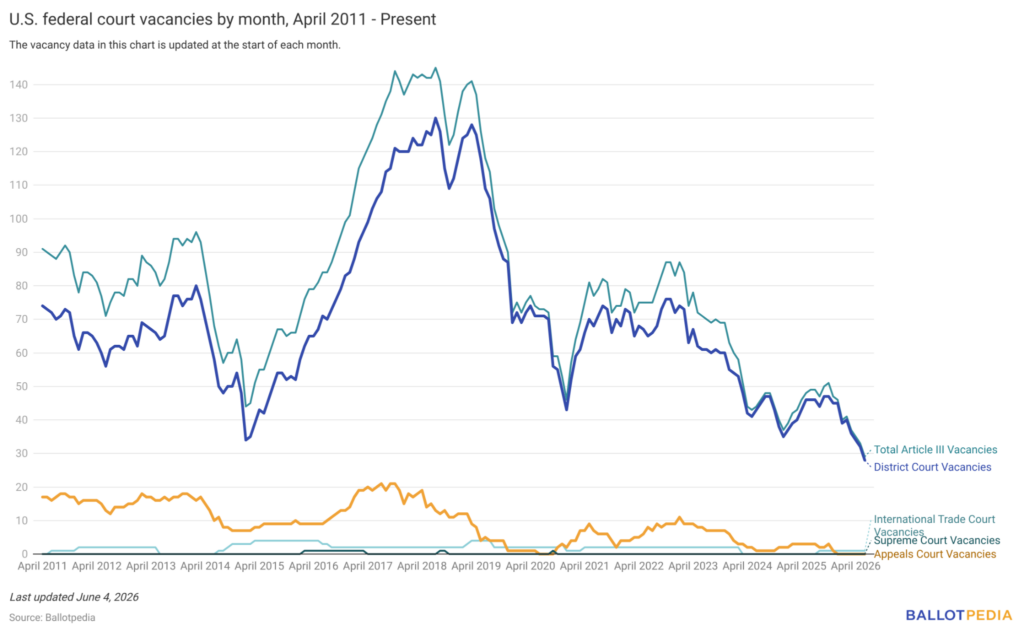
Do you love judicial nomination, confirmation, and vacancy information? We figured you might. Our monthly Federal Vacancy Count monitors all the faces and places moving in, moving out, and moving on in the federal judiciary. Click here for our most current count.
Need a daily fix of judicial nomination, confirmation, and vacancy information? Click here for continuing updates on the status of all federal judicial nominees.
Or, keep an eye on our list for updates on federal judicial nominations.
Looking ahead
We’ll be back on June 29 with a new edition of Robe & Gavel. Until then, gaveling out!
Contributions
Myj Saintyl compiled and edited this newsletter, with contributions from Sam Post, Ellie Mikus, and Spencer Richardson.