


Welcome to the Tuesday, June 30, 2026, Brew.
By: Briana Ryan
Here’s what’s in store for you as you start your day:
- This year’s criminal justice ballot measures continue trend toward increasing criminal penalties and bail restrictions
- It’s Election Day in Colorado
- U.S. district judges in Massachusetts block sections of two Trump executive orders on voting
This year’s criminal justice ballot measures continue trend toward increasing criminal penalties and bail restrictions
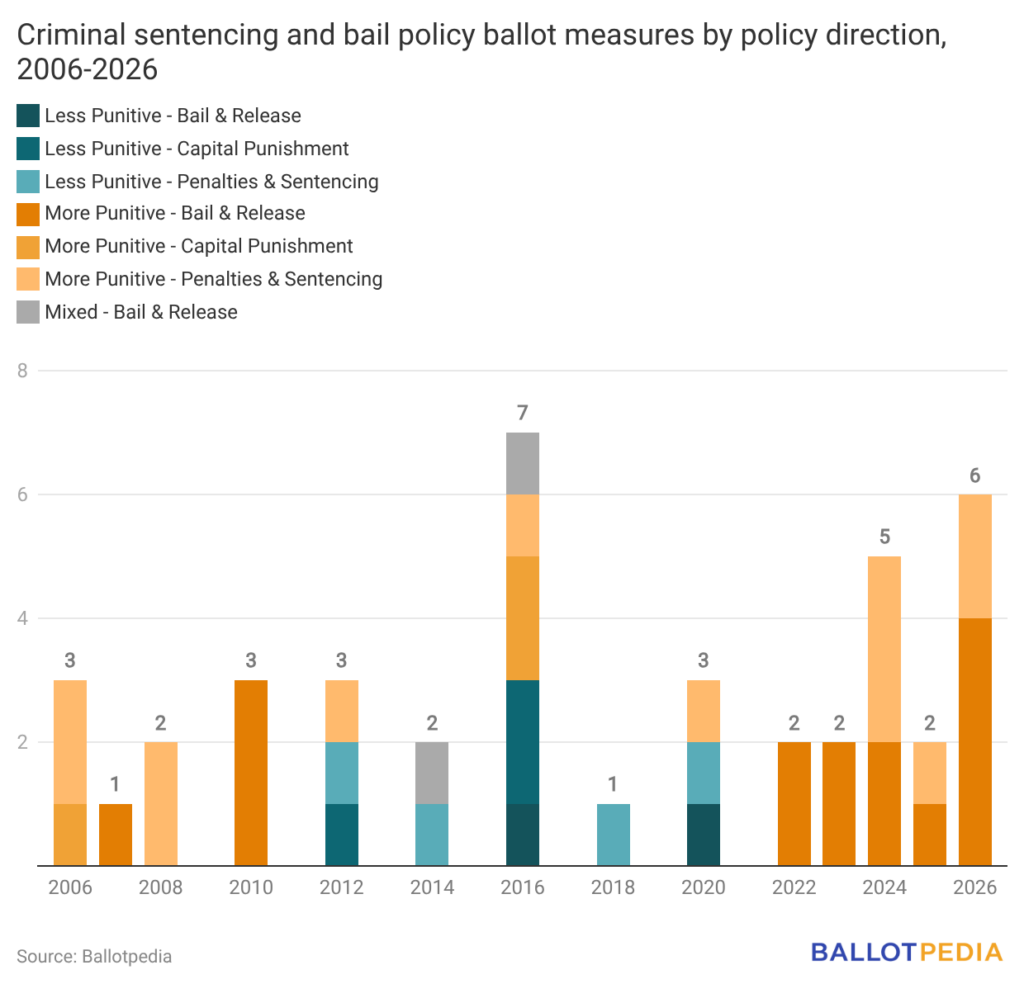
Every criminal justice ballot measure since 2022 has moved towards more punitive policies, including six this year that would increase penalties or expand the circumstances under which courts could deny or restrict bail. This marks a change from the period from 2012 to 2020, when measures proposing less punitive policies outnumbered those proposing more punitive ones.
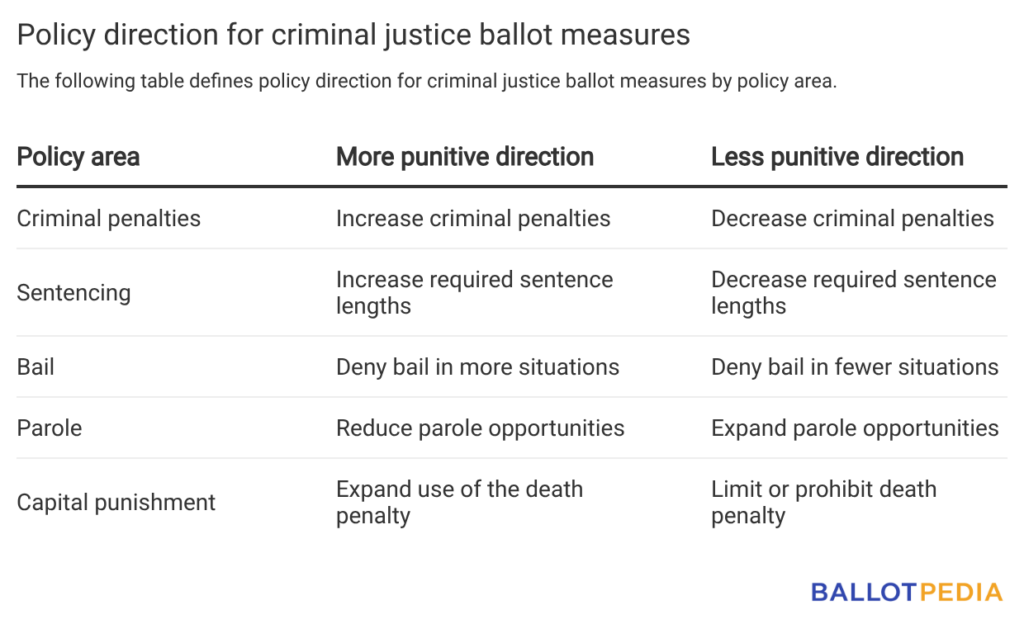
Measures defined as more punitive would increase criminal penalties, expand the circumstances under which bail can be denied, or reduce parole opportunities. Measures defined as less punitive would decrease criminal penalties, limit circumstances under which bail can be denied, or increase parole opportunities. While other terms are often used in political contexts, terminology similar to more punitive or less punitive is often used in criminal justice research and policy analysis to compare sentencing, incarceration, and penalties across time periods, states, and regions. Click here for more on our terminology.
Four of the measures on the ballot this year concern bail policy. On May 19, Alabama voters approved Amendment 1 81.6% to 18.4%. The measure allows a judge to deny bail for defendants charged with certain weapon-discharge offenses or solicitation, attempt, or conspiracy to commit murder. Voters in Indiana, Louisiana, and Tennessee will decide on the three other bail-related measures on Nov. 3:
- Indiana’s measure would allow courts to deny bail for individuals charged with crimes when the proof is evident, or the presumption is strong, and when the accused poses a substantial risk to another person or the community.
- Louisiana’s measure would prohibit post-conviction bail, also known as an appeal bond, for defendants convicted of aggravated offenses against minors.
- Tennessee’s measure would remove the right to bail when the presumption of guilt is great, and the defendant is accused of acts of terrorism, second-degree murder, aggravated rape of a child, grave torture, or any other offense for which a convicted individual would be required to serve at least 85% of their sentence before release.
The other two measures, both in Colorado, would increase criminal penalties. One would increase penalties related to fentanyl offenses. The other would require life in prison without parole or release for persons convicted of human trafficking a child for sexual servitude.
Support and opposition
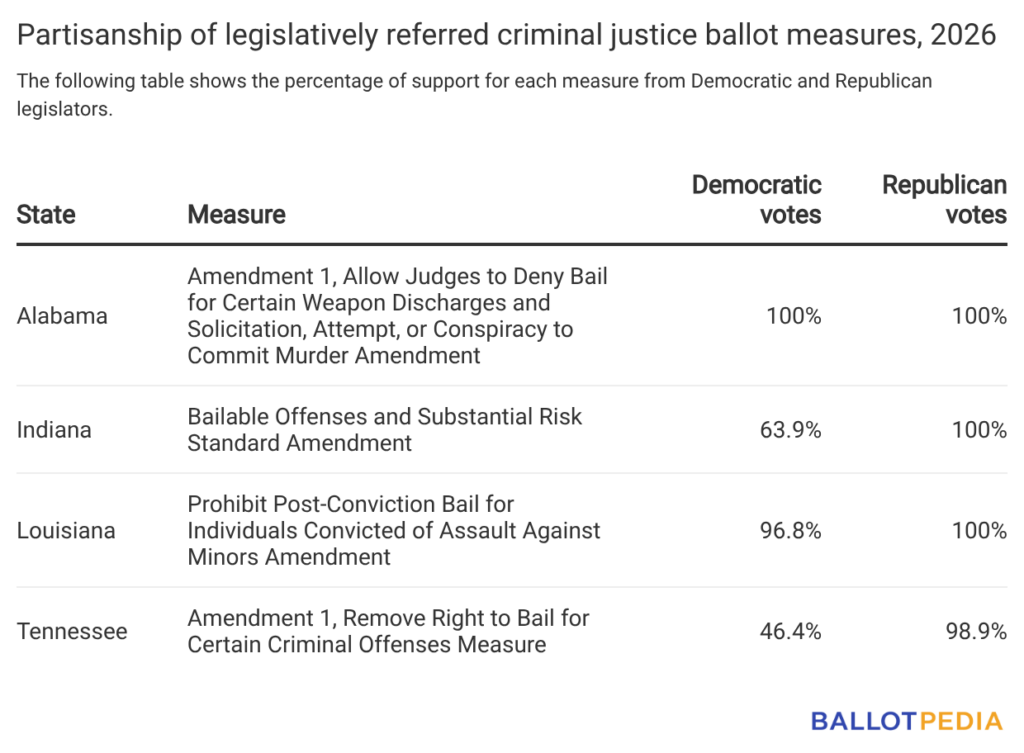
State legislatures put four of this year’s measures on the ballot. Alabama’s measure was the only one to receive unanimous support from both Democratic and Republican state legislators. Support was divided for the other three measures in Louisiana, Tennessee, and Indiana. The table below shows the partisan breakdown among state legislators who voted on these measures.
Colorado’s measures are both citizen initiatives. Advance Colorado is leading the campaign in support of the Penalties for Fentanyl Sale and Possession Initiative. Coloradans for Real Safety Solutions is leading the campaign against the initiative, with funding from the Signal Behavioral Health Network. Protect Kids Colorado is leading the campaign in support of the Require Life in Prison for Human Trafficking of Minors Measure, with funds from the Protect Kids Colorado 501(c)(4). Currently, there is no campaign against the initiative.
Historical context
Between 2006 and 2026, 42 measures concerned criminal sentencing, penalties, and bail and release policies. Thirty-one (74%) measures made policies more punitive, and nine (21%) made policies less punitive. Two (5%) were mixed, with some provisions moving in a more punitive direction and others in a less punitive direction.
The following table defines policy direction for criminal justice ballot measures by policy area.
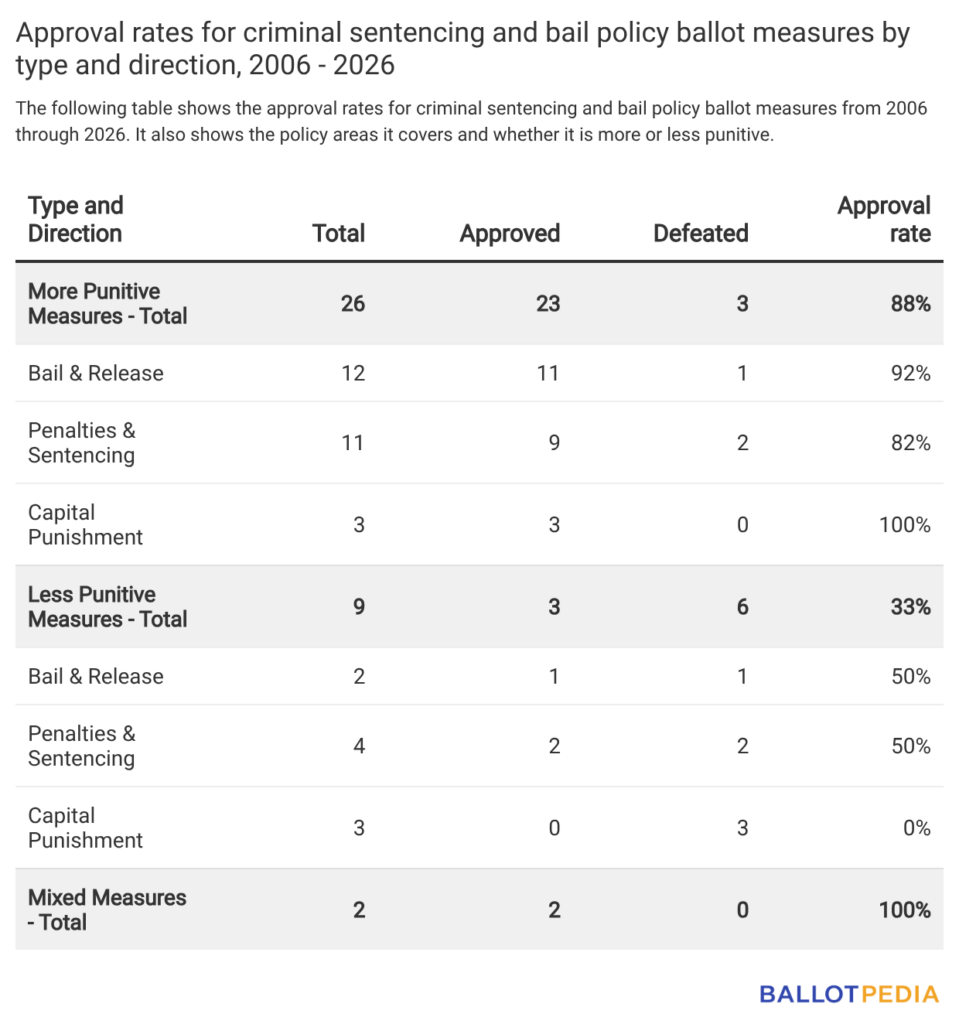
Voters have approved more punitive measures at a higher rate than less punitive ones. Voters approved 23 of 26 (88%) more-punitive measures and three of nine (33%) less-punitive measures. Voters also approved both mixed measures.
Approval rates also varied by policy type. The chart below shows passage rates for various types of criminal justice measures.
Additional measures
These six measures will likely be the only 2026 ballot measures concerning criminal sentencing, penalties, and bail. One initiative was approved for signature gathering in Oregon, but its campaign has reported only 1,351 of the 117,173 required signatures to state election officials. The deadline is July 2, 2026.
Click here for more information about this year’s measures related to criminal sentencing, penalties, and bail.
It’s Election Day in Colorado
Voters in Colorado are headed to the polls today, June 30. Here's a look at the primary elections that we're watching closely.
U.S. Congress
Senator John Hickenlooper and Julie Gonzales are running in the Democratic primary for the U.S. Senate in Colorado — a race in which a candidate is running to the left of a Democratic incumbent. According to Axios' John Frank, the primary "will serve as a test of whether the party still favors Hickenlooper's pragmatic, coalition-building style or wants Gonzales' more ideological and activist-driven vision."
As in the U.S. Senate Democratic primary, there is also an ideological divide among incumbent Rep. Diana DeGette, Wanda James, and Melat Kiros, who are running in the Democratic primary for the 1st Congressional District. James and Kiros are both running to the left of DeGette, who has represented the District since 1997. Additionally, CPR News' Kiara DeMare wrote that "while DeGette said she has the experience and values the district needs, both her challengers argue she hasn't gotten enough done and that the area needs new leadership."
Shannon Bird and Manny Rutinel are running in the Democratic primary for the 8th Congressional District — a race that has focused on what type of candidate would be best suited to run against incumbent Rep. Gabe Evans (R). According to CPR News' Bente Birkeland and Rae Solomon, "Rutinel is running as the more progressive candidate, better able to push back against ICE, while Bird is running as a voice to unite more moderate voters in the district."
State executive offices
Michael Bennet and Phil Weiser are running in the open Democratic primary for governor of Colorado, in which both have campaigned on their current positions as U.S. senator and attorney general of Colorado, respectively. Axios Denver's John Frank wrote that "Bennet is framing Colorado's problems as systemic crises that require bolder action. Weiser is more likely to emphasize his state-level experience and a more pragmatic approach."
Meanwhile, the Republican primary for governor includes three candidates — Scott Bottoms, Barbara Kirkmeyer, and Victor Marx — with opposing ideologies. Axios Denver's John Frank described Kirkmeyer as moderate and said that Bottoms and Marx are running to her right. Kelvin Wimberly is also running as a write-in candidate.
Hetal Doshi, Michael Dougherty, Jena Griswold, and David Seligman are running in the open Democratic primary for attorney general of Colorado. Axios' John Frank said the primary has a "packed field of top-tier candidates and ... unusually high stakes of the race as the Trump administration targets Colorado."
Click here to check out more about the elections we're following today, June 30. If you're a Colorado voter, make sure to check out our Sample Ballot Lookup Tool before you get to the polls.
U.S. district judges in Massachusetts block sections of two Trump executive orders on voting
Judges in the U.S. District Court for the District of Massachusetts have blocked two of President Donald Trump’s (R) executive orders related to elections and voting in the past week.
On June 25, Judge Indira Talwani blocked the federal government from implementing Trump’s March 31 executive order, titled Ensuring Citizenship Verification and Integrity in Federal Elections, in the November general election in 23 states and Washington, D.C.
Democratic officials from those 23 states and D.C. filed a lawsuit in the District of Massachusetts on April 3, challenging Sections 2, 3, and 5 of the executive order.
The challenged sections require the U.S. secretary of Homeland Security to compile and send a list of all U.S. citizens over the age of 18 who are residents of the state to the state’s chief election official, require the U.S. postmaster general to initiate rulemaking to implement certain requirements for the U.S. Postal Service in delivering ballots by mail in federal elections, and require the U.S. attorney general and executive department heads to withhold funds from noncompliant states.
In their complaint, the states alleged that those sections of the executive order “[transgressed the states’] constitutional power to prescribe the time, place, and manner of federal elections,” “[sought to] amend and dictate election law by fiat based on the President’s whims,” and “[harmed their] authority to administer elections and secure the voting rights of their citizens, and particularly the States’ authority to determine which voters are entitled to vote by mail.”
In her June 25 order, Talwani wrote of Section 2 that “the creation of the Confirmed Citizen Lists is ultra vires because the President lacks any authority to compile voter lists for each State,” and of Section 3 that “USPS lacks authority to promulgate regulations on voting and the EO’s directive that USPS do so constitutes ultra vires executive action.” She cited another case to define ultra vires: “To act ultra vires a government official is either acting in a way that is impermissible under the Constitution or acting outside of the confines of his statutory authority.”
Talwani concluded that “Sections 2 and 3 of the EO are legally void as they are ultra vires and unconstitutionally violate the separation of powers, and that Section 5 of the EO is merely precatory.” She blocked the federal government from “implementing or giving effect to Sections 2 and 3 of the EO with respect to the November 3, 2026 or any earlier federal election in the Plaintiff States[.]”
White House representative Abigail Jackson said that the March 2026 executive order “lawfully protects our elections, and we are confident that we will ultimately prevail in its implementation.”
On June 24, the day before Talwani’s ruling, U.S. Sen. Gary Peters (D-Mich.) asked Postmaster General David Steiner at a Senate hearing whether USPS would deliver ballots in a state that did not comply with the executive order. Steiner replied, “Under our proposed regulation, no.”
In a separate lawsuit, U.S. District Judge Denise Casper on June 24 permanently blocked the federal government from enforcing multiple provisions of Trump’s March 25, 2025, executive order, titled Preserving and Protecting the Integrity of American Elections.
The order instructed the U.S. Election Assistance Commission (EAC) to require prospective voters to provide documentary proof of citizenship to register to vote with the national mail voter registration form and required absentee/mail-in ballots to be received by election day, among other requirements.
Democratic attorneys general in 19 states filed a lawsuit in the U.S. District Court for the District of Massachusetts on April 3, 2025, challenging multiple sections of the executive order as violating the separation of powers.
Casper permanently blocked five sections of the executive order, writing that those sections were “unconstitutional and void because they are ultra vires and violate the separation of powers under the United States Constitution.” Those sections included the requirement for documentary proof of citizenship when registering to vote with the national mail voter registration form, as well as the requirement for the U.S. attorney general to enforce Election Day as the deadline for receiving ballots.
Challenges to the March 2025 executive order are pending in multiple federal courts, including the U.S. Court of Appeals for the First Circuit, where the Trump administration is appealing Casper’s previous rulings that temporarily blocked sections of the order. Oral argument in that case is set for Dec. 9. Read more about those lawsuits here.
Click here to read about the March 2026 executive order, and here to read about proposed rulemaking from the USPS. Also, click here to check out other lawsuits challenging this executive order.