


Welcome to Hall Pass, a newsletter written to keep you plugged into the conversations driving school board governance, the politics surrounding it, and education policy.
In today’s edition, you’ll find:
- On the issues: The debate over requiring public school students to read Bible passages
- School board filing deadlines, election results, and recall certifications
- U.S. Supreme Court upholds laws requiring athletes to compete in the sports category that matches their sex
- Extracurricular: education news from around the web
- Candidate Connection survey
On the issues: The debate over requiring public school students to read Bible passages
In this section, we curate reporting, analysis, and commentary on the issues school board members deliberate when they set out to offer the best education possible in their district. Missed an issue? Click here to see the previous education debates we’ve covered.
On June 26, the Texas State Board of Education (SBOE) voted 9-5 (with one absence) to approve a set of required readings for all K-12 public school students, closing the door on a monthslong debate that divided lawmakers, educators, voters, and the SBOE members themselves. The requirement will go into effect in 2030. As of this writing, Texas is now the only state with a list of required literary readings for all public school students on the books.
The readings are the result of HB 1605, which Gov. Greg Abbott (R) signed in 2023, requiring the SBOE to select “at least one literary work to be taught in each grade level.”
In a press release, the SBOE said it took “a classical approach” to curating the list, emphasizing what it considers timeless works. The list comprises more than 200 books, poems, essays, and speeches, though many are single chapters or excerpts.
In earlier grades, students will read works like “Charlotte’s Web,” Robert Frost’s poem “The Road Not Taken,” a children’s adaptation of Charles Dickens' “A Christmas Carol,” and C.S. Lewis’ “The Lion, the Witch, and the Wardrobe.” The selections for middle school and high school include Martin Luther King, Jr.’s “I Have a Dream” speech, George Orwell’s “Animal Farm,” “Beowulf,” and an excerpt from Ayn Rand’s “Capitalism, the Unknown Ideal.”
Readings also include passages from the Bible, which are assigned to students in most grade levels.
The nine SBOE members who voted to approve the list of readings are Republicans, while all five who voted against it are Democrats. SBOE members are elected by district in partisan elections to four-year terms. Eight seats are up for election this year. Texas is one of eight states in which voters will elect new state board of education members in 2026.
The SBOE also voted on June 26 to approve new social studies standards for K-8 students.
Today, we look at contrasting perspectives from two Christians on whether students should have to read the Bible in public schools.
Andrew T. Walker, a professor of Christian ethics and public theology at The Southern Baptist Theological Seminary in Kentucky, says that under the SBOE’s mandatory reading list, schools will teach the Bible as a civics document, not as a source of religious truth. Walker says the Bible occupies a unique place in our country’s founding and throughout its history — a history he says students should be familiar with. Walker says critics misunderstand the Constitution when they claim it prohibits any trace of religion in the public sphere.
Zach W. Lambert, the lead pastor of Restore, a church in Austin, Texas, says that the First Amendment’s Establishment Clause prevents the government from favoring Christianity over other religions, allowing for students of all faiths — or none at all — to feel comfortable in public schools. Lambert says that Christians who support the mandatory literary list would react differently if Muslim officials required that students read passages from the Quran. Lambert says Jesus never called for imposing Christianity through the law and urges Christians instead to live out the Bible’s teachings in their families, churches, and communities.
The Bible and basic civics | Andrew T. Walker, World
“Let’s be clear on what is happening in Texas and what this is not. The Bible is not being taught normatively, that is, as a doctrinal source requiring affirmation of its tenets. Nor is it being taught for proselytizing purposes. No, the Bible is being taught as a civics document alongside classics such as Charlotte’s Web, Eric Carle’s The Very Hungry Caterpillar, and Shakespeare’s Hamlet (among 200 other sources). As I mentioned in the examples above, to know the Bible is to appreciate its role in civic literacy and civic fluency. There is no way to understand America without the role of the Bible in our national experience.
“The Texas move is controversial only because of a malformed understanding of how religion informs our public imagination. Since the 1940s, Americans have been fed a steady diet of strict separationism, owing to a particular strain of jurisprudence that forecloses any religious influence within the government. This argument for a strict separation of church and state usually includes the idea that any whiff of religion in the public domain constitutes an undue influence. Such an approach to law is far afield from America’s founding, a founding that included the government’s publication of Bibles, for example. Seen from this vantage point, the protests against The Texas board’s actions reflect the deracinating efforts of secular ideologues to sanitize the public domain of any hint of religion, let alone Christianity.”
This Lifelong Texan and Christian Pastor Knows that Mandated Bible Study in Public Schools is Wrong | Zach W. Lambert, Public Theology Substack
“Public schools serve children from all kinds of families: Christian families, Jewish families, Muslim families, Hindu families, Buddhist families, atheist families, agnostic families, and families who are still figuring out what they believe. Those children’s religious ideologies do not belong to the state. This should not be a controversial opinion among conservatives. In fact, religious freedom and family autonomy are core tenets of conservatism!
“If you’re a Christian genuinely wondering why it’s bad for the state of Texas to require Bible study in public schools, imagine how you’d feel if your family lived in New York City and Mayor Mamdani required Quran study in public schools. To put it another way, most Christians defending Texas’ actions would immediately understand the problem if the religion being privileged were not their own.
“To be clear: I love the Bible. I read it every day, teach it every week, and wrote an entire book about it. But the Bible should not be weaponized by the state and forced upon anyone, especially children. As Christians, we should be the first to reject this. Not because we are ashamed of our faith, but because we know true faith never uses coercion.”
School board update: filing deadlines, election results, and recall certifications
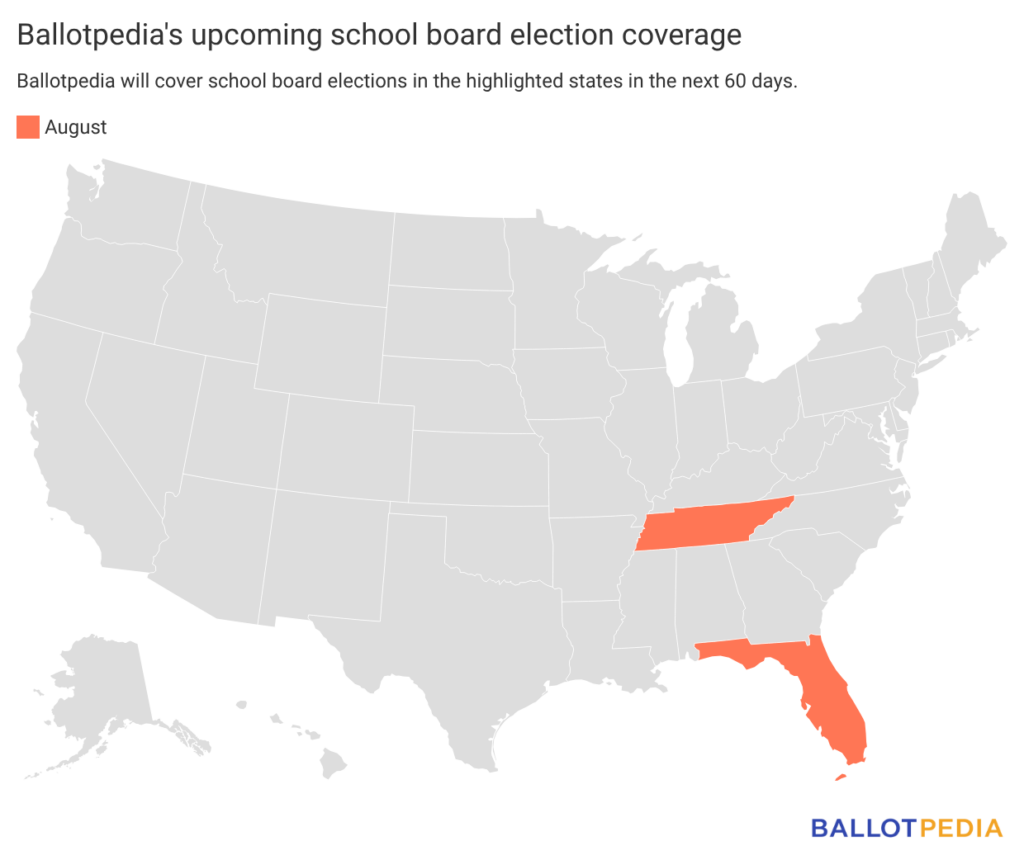
In 2026, Ballotpedia will cover elections for more than 30,000 school board seats. We’re expanding our coverage each year with our eye on covering the country’s more than 80,000 school board seats.
Upcoming school board elections
U.S. Supreme Court upholds laws requiring athletes to compete in the sports category that matches their sex
On June 30, the U.S. Supreme Court (SCOTUS) decided Little v. Hecox and West Virginia v. B.P.J. The two cases dealt with whether, under federal law, states can determine eligibility for women’s and girls’ sports based on sex.
The Court consolidated the two cases and issued one decision.
Here’s what happened
Justice Brett Kavanaugh, writing for a 6-3 majority, ruled that laws requiring athletes to compete in the category that matches their sex are consistent with federal law, including the 14th Amendment and Title IX of the Education Amendments Of 1972.
The 14th Amendment’s Equal Protection Clause states: “[No state shall] deny to any person within its jurisdiction the equal protection of the laws.” Title IX states: “No person in the United States shall, on the basis of sex, be excluded from participation in, be denied the benefits of, or be subjected to discrimination under any education program or activity receiving Federal financial assistance.” Following the enactment of Title IX, the then-Department of Health,
Education, and Welfare (HEW) released regulations that permitted, and often required, schools to provide sex-segregated sports teams.
According to the Movement Advancement Project, a progressive research and communications organization, 27 states have laws that require student athletes to compete in the category that matches their sex. In two additional states, regulation requires student athletes to compete in the category that matches their sex.
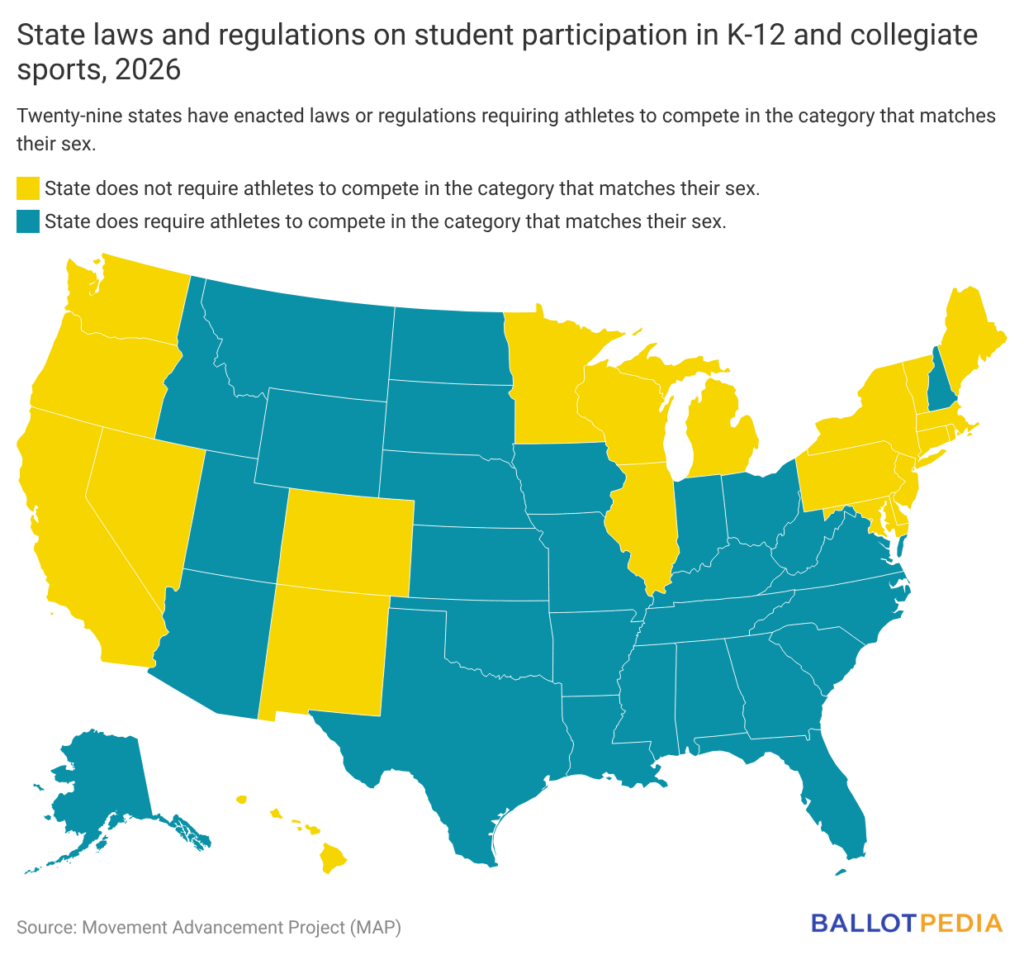
The Court did not rule on whether federal law requires states to either organize sports on the basis of sex or allow transgender students to play on sports teams that align with their gender identity. In other words, the ruling does not affect states with policies allowing transgender girls and women to participate in girls' and women’s sports.
Case background
Little v. Hecox originated in Idaho. In 2020, Gov. Brad Little (R) signed the Fairness In Women’s Sports Act, requiring that K-12 public schools, public colleges and universities, and any schools with sports leagues that compete against public school students maintain separate sports teams for “males, men, or boys,” “females, women, or girls,” or “coed or mixed.” The law states that “Athletic teams or sports designated for females, women, or girls shall not be open to students of the male sex.” Idaho was the first state to enact a law categorically requiring athletes to compete in the category that matches their sex.
That year, Lindsay Hecox, a transgender athlete at Boise State University, sued the state. Hecox argued the law violates the 14th Amendment’s Equal Protection Clause because it makes sex the basis for eligibility in women’s sports but does not set the same standard for men’s sports. In response, a federal district court blocked the Fairness In Women’s Sports Act from taking effect on the grounds that courts were likely to find Hecox’s argument persuasive. The 9th Circuit Court of Appeals upheld the district court’s ruling and sent it back for further litigation. The state of Idaho appealed to SCOTUS, which agreed to hear oral arguments on July 3, 2024.
In 2025, Hecox asked the Court to withdraw her case because she was no longer planning to play sports in Idaho.
West Virginia v. B.P.J. concerns a 2021 West Virginia law, the Save Women’s Sports Act, which is similar in many respects to Idaho’s. B.P.J., a transgender girl in high school who has been taking puberty blockers since the third grade, sued the state, arguing the law violated the 14th Amendment and Title IX. Attorneys for B.P.J. argued that while Title IX permits schools to maintain sex-segregated sports teams, their client B.P.J., because of puberty suppressing drugs and hormones, had not gained a male physical advantage.
A U.S. District judge temporarily blocked the law from taking effect, but later ruled that it violated neither the 14th Amendment nor Title IX. B.P.J. appealed the ruling to the U.S. Court of Appeals for the Fourth Circuit, which reversed the lower court’s decision, finding the Save Women’s Sports Act violated Title IX. The state appealed to SCOTUS, which accepted the case on July 3, 2025.
SCOTUS heard arguments in both cases on Jan. 13, 2026.
What the majority ruled
Justices John Roberts, Clarence Thomas, Samuel Alito, Neil Gorsuch, and Amy Coney Barrett joined Kavanaugh in his majority opinion. Thomas and Gorsuch filed concurring opinions. Justice Sonia Sotomayor concurred with part of the majority opinion, while disagreeing with other parts. Justices Ketanji Brown Jackson and Elena Kagan joined Sotomayor’s opinion. Jackson also filed a separate opinion in which she agreed with some but not all of the majority opinion.
Kavanaugh wrote, “Consistent with Title IX and the Equal Protection Clause, we hold that the [27] States may maintain women’s and girls’ sports for biological females. They may determine eligibility for women’s and girls’ sports based on biological sex. The Constitution and Title IX do not require an overhaul of women’s and girls’ sports throughout America.”
All the justices agreed that neither state violated Title IX. Sotomayor, in her dissent, said she believes B.P.J. 's claim fails to show that West Virginia’s law violated Title IX on “a narrower basis than that on which the majority relies.”
On the Title IX claim, Kavanaugh held that Title IX allows schools to maintain separate sports teams because “as all agree, females and males have inherent physical differences relevant to athletic performance.” According to Kavanaugh, sex in the statute “cannot plausibly be interpreted to refer to anything other than biological sex,” and that it cannot be read to “require schools to allow biological males to participate in women’s and girls’ sports.”
On the Equal Protection Clause claim, Kavanaugh wrote that physical differences between men and women provide reasonable grounds for states to base eligibility for women’s sports on sex while exempting men’s sports from the same requirement. That is, Kavanaugh says that states’ interests in "ensuring safety and competitive fairness amply justify the States in maintaining women’s and girls’ sports for biological females.”
What the dissent said
Sotomayor’s dissenting opinion argues the majority was premature in holding that laws requiring athletes to compete in the sports category that matches their sex don’t violate the Equal Protection Clause. Sotomayor says this is because it is unclear if transgender girls who do not undergo male puberty retain male athletic advantages. She says the Court should have returned the case to a lower court for more factfinding.
Sotomator writes: “According to B. P. J., transgender girls and women who both receive gender-affirming treatment and have never experienced endogenous male puberty neither possess any inherent athletic advantage nor pose any safety risks because of their sex identified at birth.” Sotomator says “this asserted factual difference, which has not been conclusively litigated below, matters to the equal protection analysis.”
Reactions
Kelley Robinson, the president of the Human Rights Campaign, a nonprofit that advocates to make “equality, equity and liberation a reality for all lesbian, gay, bisexual, transgender and queer people,” said: “No kid – not my kid, not your kid, not any kid – deserves to be discriminated against. Yet this ruling is heartbreaking for transgender student athletes who are being forced to sit on the sidelines simply for who they are. When politicians convince the public that any girl could be ‘the wrong kind of girl,’ they invite harassment, intimidation, invasive questioning, or even an inspection of their body by a total stranger.”
Sonja Shaw, a California school board member who is running in the general election for state superintendent of public instruction in November, said, “The U.S. Supreme Court delivered a huge victory for girls and common sense. We’ve been on the front lines fighting this battle in California because our daughters deserve fair competition, privacy, safety, and equal opportunity.”
California allows transgender athletes to play on sports teams that align with their gender identity.
Ballot measures
Voters in several states this year will weigh in on ballot measures addressing transgender student participation in sports.
- Arizona Require Schools and Athletic Associations to Restrict Use of Restrooms, Locker Rooms, and Other Private Spaces Based on Sex Measure
- Colorado Sex Requirement for School and College Sports Initiative
- Washington Sex Verification Requirements for Female School Sports Initiative
Nebraska voters could decide on a measure called Sex Requirement for School and College Sports Amendment. The measure's supporters reported turning in 211,000 signatures for verification. The deadline is July 3.
Extracurricular: education news from around the web
This section contains links to recent education-related articles from around the internet.
- Nevada’s Declining Enrollment Is Reshaping Public Schools | Governing
- Moving Special Ed Programs to HHS Removes Siloes in the Disability System | RealClearEducation
- The real problem with “gifted” education | Slow Boring
- Parents go nuclear on school district for forcing LGBTQ on their kids, seek punitive damages | Just the News
- LAUSD Bans Screen Time in Class for Youngest Students | Government Technology
- Anti-DEI Efforts Reshape How States Serve English Learners | Education Week
- What the International Debate over School Choice Can Teach Us at Home | American Enterprise Institute
- No, Despite what everyone says, American schools aren’t failing | Boston Globe
Take our Candidate Connection survey to reach voters in your district

Today, we’re looking at survey results from Lindsey Denmark and Michelle Petty, the two candidates running in the Aug. 18 primary for Duval County Public Schools Board of Education District 6, in Florida.
Duval County Public Schools is the sixth largest in Florida, with roughly 128,000 students. It encompasses the city of Jacksonville and surrounding areas. Three of the seven seats are up for election this year.
Petty’s career experience includes working as a paralegal. Here’s how Denmark answered the question, “What are the main points you want voters to remember about your goals for your time in office?”

- “Parental Engagement & Transparency
- I believe parents are the primary stakeholders in a child’s education. I support transparency in curriculum, policies, and school decision-making, and ensuring parents have a meaningful voice without being excluded or ignored.
- Student Safety Every student deserves a safe learning environment. I support common-sense safety policies that protect students physically and emotionally, prioritize age-appropriate standards, and ensure schools remain focused on learning—not politics.
- Academic Excellence & Accountability Schools should focus on strong academics that prepare students for college, careers, or skilled trades. I support accountability in curriculum and spending, empowering teachers, and measuring success by real student outcomes.”
Click here to read the rest of Petty’s responses.
Denmark’s career experience includes working in real estate. Here’s how Denmark answered the question, “What areas of public policy are you personally passionate about?”
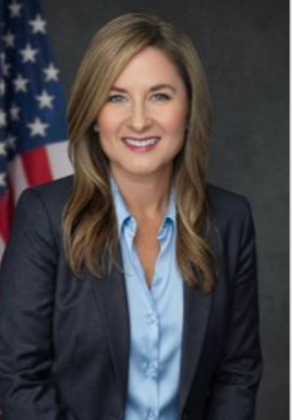
“I am most passionate about policies surrounding curriculum and academic excellence. I believe our schools should focus on teaching America's founding principles, strengthening civics education, and promoting character development through values such as integrity, responsibility, and respect. Education should be about more than teaching to the test. Our goal should be to equip students with the ability to think critically, solve problems, and communicate effectively. Students should also graduate with practical life skills, including financial literacy, budgeting, and career planning. Strong academics, strong character, and real-world preparation will better prepare students for success in college, careers, and life.”
As a reminder, if you're a school board candidate or incumbent planning to run this year, click here to take the survey. If you complete the survey, your answers will appear in your Ballotpedia profile. Your responses will also appear in our sample ballot. If there is an election in your community, share the link with your candidates and urge them to take the survey!