


Welcome to the Wednesday, July 1, 2026, Brew.
By: Lara Bonatesta
Here’s what’s in store for you as you start your day:
- U.S. Supreme Court upholds legality of Mississippi's absentee ballot return law
- Colorado voters to decide initiative requiring vehicle and fuel tax revenue to fund roads
- Alaska Supreme Court rules that man with the same name as U.S. Sen. Dan Sullivan can appear on Aug. 18 primary ballot
U.S. Supreme Court upholds legality of Mississippi's absentee ballot return law
On June 29, the U.S. Supreme Court ruled 5-4 in Watson v. Republican National Committee that federal law does not preempt a Mississippi law allowing absentee ballots to be received up to five days after the election.
Mississippi is one of 14 states that allow all valid absentee/mail-in ballots postmarked by election day to be counted if they arrive within a set period of time after the election. The state passed a law allowing for a five-day grace period in 2020. Thirty states, including Mississippi, allow at least some military or overseas ballots to be counted if they arrive after election day. The ruling means those laws will continue to be in effect.
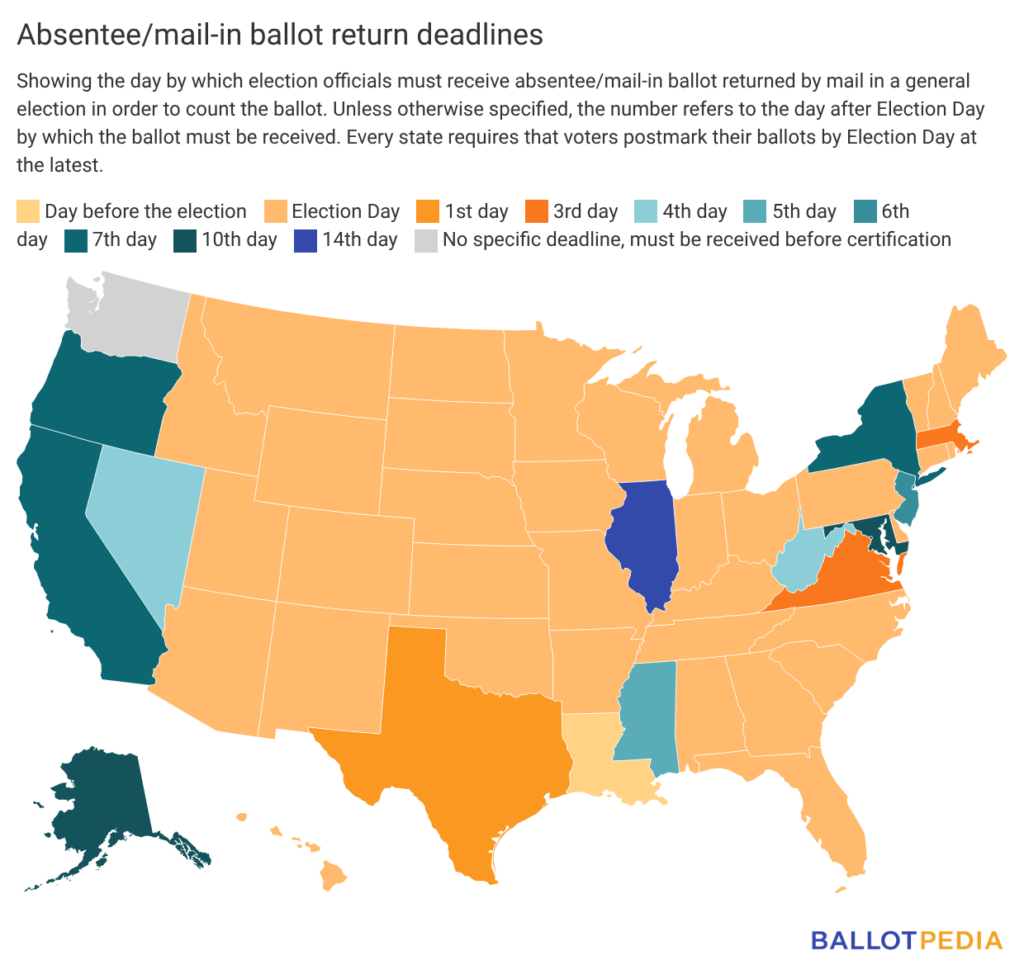
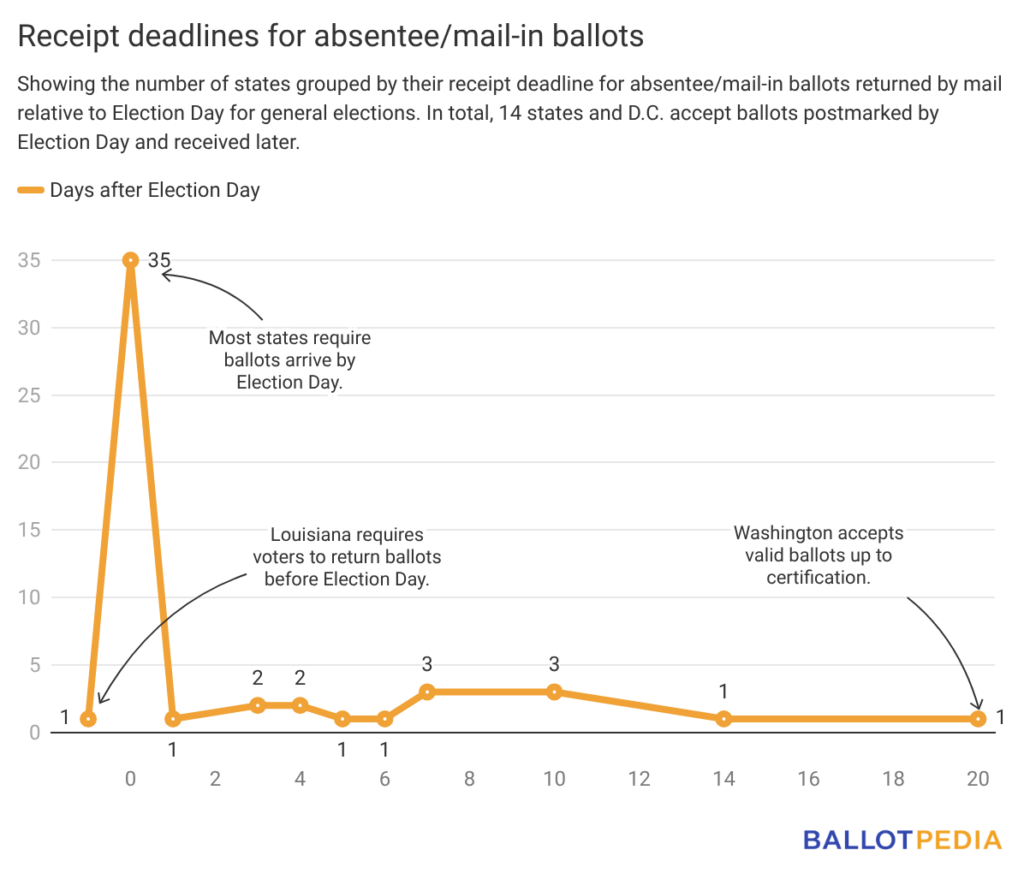
In two 2024 lawsuits, the Republican National Committee (RNC) and the Mississippi Republican and Libertarian parties challenged the law, alleging that because federal law establishes a uniform, national Election Day for congressional and presidential elections, ballots received after that date were invalid.
The U.S. District Court for the Southern District of Mississippi ruled in favor of the state in July 2024. Plaintiffs appealed to the U.S. Court of Appeals for the Fifth Circuit, where a three-judge panel in October 2024 held that Mississippi's statute was unlawful and ordered the case to be sent back to the district court. Mississippi then appealed to the U.S. Supreme Court, which agreed to hear the case last year. Oral arguments took place on March 23.
On March 19, Mississippi Gov. Tate Reeves (R) signed HB 908, a bill that would have required absentee ballots to be received the day before an election if the Supreme Court had overturned Mississippi’s deadline.
In the majority opinion, Justice Amy Coney Barrett wrote that federal law requires voters to cast their ballots by Election Day but does not dictate that the ballots must be received by that date. Chief Justice John Roberts and Justices Elena Kagan, Sonia Sotomayor, and Ketanji Brown Jackson joined the opinion.
"In sum, the election-day statutes require the electorate’s choice to be made on election day. That occurs so long as election day is the deadline for individuals to vote—as it is in Mississippi," Barrett wrote. "But the election-day statutes do not set a deadline for ballot receipt, so they do not prevent Mississippi from counting ballots postmarked before election day yet received afterward." She also wrote, "Carried to its logical conclusion, this theory would call into question the way modern elections work."
Barrett concluded, "The election-day statutes say nothing about ballot receipt, and we cannot add to the words Congress chose."
In the dissenting opinion, Justice Samuel Alito wrote that federal law requires ballots to be collected on the day of the election: "The acceptance of these late-arriving ballots effectively postpones the date on which the electorate’s choice is made, and federal law precludes that postponement." Justices Neil Gorsuch and Clarence Thomas also dissented. Justice Brett Kavanaugh joined part of the dissent.
"Today, not all voting occurs in person on election day. Both voting by mail and early voting have become popular, and respondents do not dispute the lawfulness of these modern practices. Nor do I," Alito wrote. "But acceptance of these practices cannot change the fact that under federal law, the electorate’s collective choice must still be authoritatively expressed on election day."
Watson v. RNC is one of three election law-related cases the court heard during the 2025-2026 term. For more information on Watson v. RNC, click here.
Colorado voters to decide initiative requiring vehicle and fuel tax revenue to fund roads
On Nov. 3, Colorado voters will decide on a ballot measure that would require vehicle-related and fuel tax revenue to be used for road transportation.
Initiative 175 would add a new section to Article X of the Colorado Constitution to require state and local governments to spend any “state revenue collected to support road transportation” on costs related to:
- the construction, maintenance, and operation of public streets, roads, highways, or bridges;
- the development and improvement of safety measures for motor vehicles traveling on public streets, roads, highways, or bridges;
- the design, engineering, and management required for road transportation; and
- the Colorado state patrol.
The initiative defines “state revenue collected to support road transportation” as "all sales and excise taxes on motor vehicles and fuel," as well as "two-thirds of the sales and use taxes on motor vehicle parts, equipment, and accessories that are affixed to a vehicle." The state would then allocate the collected revenue among local governments and the state highway fund.
The Colorado secretary of state's office certified Initiative 175 for the ballot on June 23, announcing that proponents submitted 143,112 valid signatures, surpassing the minimum requirement of 124,238 signatures.
Restore Our Roads, the organization leading the campaign in support of Initiative 175, said, "[Initiative 175] dedicates existing sales taxes generated from motor vehicles and motor vehicle parts and fuel taxes to fixing and maintaining Colorado’s deteriorating roads. For years, transportation revenues have been raided for other priorities while Colorado’s roads and bridges continue to deteriorate. In the meantime, drivers are paying the price in costly vehicle repairs, longer commutes, and lost productivity."
Keep Kids First Colorado, one of two organizations registered to oppose Initiative 175, said, “Initiative 175 is a promise to improve Colorado’s roads without raising taxes. The problem is, the measure takes existing sales tax revenue without adding new dollars to the General Fund, diverting funds from important programs that need continued funding, forcing the general assembly to cut other programs in order to free up additional general fund. Should Initiative 175 pass, balancing the budget without major reductions to Medicaid, K-12 education, and higher education would be impossible."
On May 13, in response to the initiative, Democratic members of the Colorado General Assembly passed a bill that would offset the effects of Initiative 175 through July 1, 2030. House Bill 26-1430 (HB 1430), which is contingent on voter approval of Initiative 175, would temporarily lower fuel taxes, vehicle registration fees, road-safety surcharges, and road-usage fees. HB 1430 would also create a new fund for revenue that Initiative 175 would require to be spent on roads. Some of that money would be used to replace funding that the state already covers through the General Fund. As a result, some of the money directed to roads would replace funding the state already provides, rather than increasing total road funding.
The Colorado Taxpayers' Bill of Rights (TABOR) provision in Colorado’s Constitution limits annual increases in state government spending and tax revenue. Any money collected above this limit is refunded to taxpayers unless the voters allow the state to spend it. Because HB 1430 would reduce transportation taxes and fees, it would leave more room in the general fund for the state to spend money on other things.
Votes in the state legislature were largely along party lines, with Democrats voting for HB 1430 and Republicans voting against it. The Colorado House of Representatives approved the bill 42-22, with 41 Democrats and one Republican voting in favor, and 21 Republicans and one Democrat voting against it. The Colorado Senate approved the bill 22-13, with 22 Democrats voting in favor, and 12 Republicans and one Democrat voting against it.
State Sen. William Lindstedt (D-25), a sponsor of HB 1430, said, "Initiative 175 is a special interest group's irresponsible solution to a legitimate problem. We remain committed to doing more to fix our roads and secure sustainable transportation funding, but not at the expense of hospitals and schools. It's time for the proponents of Initiative 175 to come to the table and work with us to chart a responsible path forward."
Governor Jared Polis (D) also expressed his support for HB 1430, with representative Eric Maruyama saying, "Of course the governor would support a bill to cut taxes and save Coloradans money, and that includes cutting the gas tax while protecting the state budget." Polis signed HB 1430 into law on June 4.
Restore Our Roads said, "The passage of HB 26-1430 unleashed an unprecedented power grab by the governor and Democratic-controlled legislature that strips voters of their right to decide how road dollars are spent with the stroke of a pen."
Colorado last decided on a ballot measure related to funding roads, highways, and bridges in 2018, when voters defeated Proposition 110 59.4% to 40.6%. The measure would have authorized $6 billion in bonds to fund transportation projects, to be repaid through sales taxes, and would have increased the state sales and use tax rate.
Click here to learn more about Initiative 175.
Alaska Supreme Court rules that man with the same name as U.S. Sen. Dan Sullivan can appear on Aug. 18 primary ballot
On Monday, June 29, the Alaska Supreme Court ordered that the Alaska Division of Elections must allow Dan J. Sullivan (R), a retired teacher, to run in the state’s top-four primary for U.S. Senate on Aug. 18. Incumbent U.S. Sen. Dan S. Sullivan (R), who was first elected in 2014, is running for re-election, meaning primary voters will have two Dan Sullivans on their ballot.
The outcome of the general election for U.S. Senate in Alaska will affect the partisan balance of the U.S. Senate in the 120th Congress. Major race forecasters have rated the general election as Lean Republican or Toss-up. Currently, Republicans have a 53-45 majority in the Senate, and two independents caucus with Democrats. Thirty-three seats are up for election, and another two seats are up for special election.
The Alaska Supreme Court order, which upholds Alaska Superior Court Judge Thomas A. Matthews’ June 26 ruling, stated that the Division of Elections may decide how Sullivan's name would appear on the ballot. The Court order did not include an explanation and said a full opinion would be issued at a later date.
Dan J. Sullivan, a retired teacher, filed to run on May 29. On June 1, the National Republican Senatorial Committee (NRSC) sent a letter to Alaska Division of Elections' Director of Elections Carol Beecher and Alaska Lt. Gov. Nancy Dahlstrom (R), who supervises the Alaska Division of Elections, asking them to investigate whether Dan J. Sullivan entered the race to confuse voters and siphon votes from the incumbent to help Democratic candidate Mary Peltola.
On June 8, Dahlstrom sent a letter to Dan J. Sullivan asking him to file an affidavit responding to seven questions on the matter. Dahlstrom also asked Sullivan if he would object to his name appearing as "Sullivan, Daniel James Jr. (non-incumbent)" on the ballot, along with his Republican Party designation being removed. Sullivan did not provide an affidavit.
On June 10, Beecher issued a preliminary decision that Dan J. Sullivan could not appear on the ballot. On June 15, she issued a final decision stating that he was not eligible to run. In a letter announcing her final decision, Beecher wrote, "6 AAC 25.212 forbids me from placing a name on the primary election ballot 'in a manner that is confusing or misleading to voters or compromises the fairness or neutrality of the ballot.'"
Sullivan filed a challenge to the decision on June 22. After Matthews' decision on June 26, the Division of Elections appealed to the Alaska Supreme Court.
Peltola's campaign and Alaska Democratic Party executive director Jenny-Marie Stryker have both denied involvement in Dan J. Sullivan's campaign.
Ballotpedia publishes an annual analysis of elections with candidates that have the same last name. In 2025, 15 states had at least one race between candidates with the same last name. There were 215 such races among the elections that Ballotpedia covered, including 438 candidates who shared last names with one or more of their opponents. Click here to see last year’s full report.
This year’s case in Alaska is not the first time that an instance of two candidates with similar names running against each other has led to litigation.
In 2020, then-incumbent state Sen. Jose Javier Rodriguez (D) and Alex Rodriguez (No Party Affiliation) both ran in the general election for Florida Senate District 37. In that race, Republican Ileana Garcia (R) defeated Jose Javier Rodriguez by 32 votes, while Alex Rodriguez received 6,382 votes. On Aug. 24, 2021, Alex Rodriguez pleaded guilty to two charges of campaign finance crimes and agreed to participate in an investigation against former state Sen. Frank Artiles (R), who prosecutors alleged paid him to run in the state senate race because he had the same last name as the incumbent.
Click here to learn more about the 2026 U.S. Senate election in Alaska.