


Welcome to the Thursday, July 2, 2026, Brew.
By: Briana Ryan
Here’s what’s in store for you as you start your day:
- U.S. Supreme Court rules 6-3 for presidential removal of independent agency commissioner
- Rep. Diana DeGette becomes the seventh U.S. House incumbent to lose a primary this year
- Georgia enacts legislation extending voting machine deadline and establishing automatic hand recounts
U.S. Supreme Court rules 6-3 for presidential removal of independent agency commissioner
On June 29, the U.S. Supreme Court ruled 6–3 in the case of Trump v. Slaughter that the president may remove a leader of a multi-person independent agency for reasons other than those enumerated in statute. The Court upheld President Donald Trump's (R) 2025 dismissal of Federal Trade Commission (FTC) Commissioner Rebecca Slaughter, ruling that the Federal Trade Commission Act of 1914 unconstitutionally restricted presidential power by limiting the reasons for which a commissioner could be dismissed.
The ruling overturned the 1935 precedent of Humphrey's Executor v. United States, which had identified the reasons enumerated in the Act – "inefficiency, neglect of duty, or malfeasance in office" – as the only valid reasons for presidential dismissal of an FTC commissioner. In subsequent jurisprudence, the Humphrey's Executor precedent limited presidential power to remove leaders of multi-member independent agencies to the reasons the U.S. Congress enumerates in statute.
There are approximately 80 federal agencies that demonstrate characteristics of independent federal agencies, which are executive agencies established by statute outside the Executive Office of the President and the 15 executive departments led by cabinet secretaries. Independent agencies have historically defined their independence partly by their protection from presidential removal. A 2012 report from the Administrative Conference of the United States — an independent agency itself — described cause removal protections for agency leaders as meaning "independence from political interference, particularly removal by the President." The Trump v. Slaughter decision rejects this definition.
Chief Justice John Roberts wrote for the majority that "although it is up to the Senate to decide whether to confirm those with whom the President would prefer to work, neither Congress nor the courts may saddle him with those with whom he cannot work. Subordinates who exercise the President's power are subject to removal by him. Then, and only then, can they remain accountable to the President, and the President to the people."
Justices Samuel Alito, Neil Gorsuch, Brett Kavanaugh, Amy Coney Barrett, and (in part) Clarence Thomas joined in Roberts’ opinion. Gorsuch also filed a concurring opinion. Justice Sonia Sotomayor, joined by Justices Elena Kagan and Ketanji Brown Jackson, dissented, writing that “the text of the Constitution, along with its history, the longstanding practices of the political branches, and the precedents of this Court, make clear that Congress may limit the causes for which the heads of Commissions like the FTC can be removed by the President.”
Roberts also wrote that "because the FTC's activities fall well within the heartland of executive power, the Court has no occasion today to define the bounds of what such power entails. Not all offices created by Congress necessarily come with executive power… one example the Court has given of such an entity is the Federal Reserve."
Also on June 29, the Court announced its 5–4 decision in Trump v. Cook. That opinion, which Roberts also authored, upheld a lower-court injunction against Trump's attempted removal of Federal Reserve Governor Lisa Cook in August 2025. Roberts wrote in that case that striking down the injunction (which prevents Trump from removing Cook until litigation in the matter is completed) “would turn for-cause protection into little more than at-will employment…” though “the ultimate question of whether the President can remove Cook for cause will depend in part on the underlying facts.”
What was Trump v. Slaughter about?
Trump dismissed Alvaro Bedoya and Rebecca Slaughter, the two Democratic members of the FTC, on March 18, 2025. The Commission is composed of five members (no more than three from the same political party), nominated by the president and confirmed by the Senate for a seven-year term. Bedoya was appointed to the Commission by President Joe Biden (D) in 2022, while Slaughter was first appointed by Trump in 2018 and re-appointed by Biden for a second term in 2023. The Federal Trade Commission Act identifies "inefficiency, neglect of duty, or malfeasance in office" as reasons for which a president may dismiss a commissioner. However, in an email to Bedoya and Slaughter, Trump did not identify any of these reasons for their dismissal, instead writing that their "continued service on the FTC is inconsistent with my Administration's priorities," and that the dismissal was "pursuant to my authority under Article II of the Constitution."
Bedoya and Slaughter sued to challenge their dismissal. On July 18, 2025, a federal district court judge dismissed Bedoya's case (he had resigned as a commissioner in June), but ruled that Slaughter should be reinstated. The federal government appealed, and the D.C. Circuit Court of Appeals declined to stay the order. The government then filed an emergency stay application with the Supreme Court on Sept. 4. On Sept. 22, the Court granted the stay in a 6–3 decision and heard oral arguments on Dec. 8.
What was the Humphrey's Executor precedent?
Humphrey's Executor v. United States was a 1935 case in which the estate of William E. Humphrey, an FTC commissioner, sued to challenge his 1933 dismissal from the Commission by President Franklin D. Roosevelt (D). The 1935 Supreme Court ruled unanimously in favor of Humphrey's estate that the President could only remove a FTC commissioner for one of the reasons enumerated in the Federal Trade Commission Act ("inefficiency, neglect of duty, or malfeasance in office").
The Supreme Court upheld Humphrey's precedent in subsequent jurisprudence, including the 1958 case of Wiener v. United States. The Court has narrowed the scope of Humphrey's Executor in recent years with the cases of Seila Law v. Consumer Financial Protection Bureau (2020) and Collins v. Yellen (2021). In these cases, the Court found that statutory removal restrictions on presidential removal of Consumer Financial Protection Bureau and Federal Housing Finance Authority officials were unconstitutional violations of the separation of powers principle, without fully striking down Humphrey's precedent.
In Trump v. Slaughter, the majority opinion rejected Humphrey's reasoning, including the 1935 Court's assertion that FTC commissioners exercise "quasi-judicial and quasi-legislative" powers which do not conflict with executive authority. "If anything more is left of Humphrey's, we overrule it," Roberts wrote, continuing that "Humphrey's has for decades been a result in search of a rationale."
Click here for more information about Trump v. Slaughter.
Rep. Diana DeGette becomes the seventh U.S. House incumbent to lose a primary this year
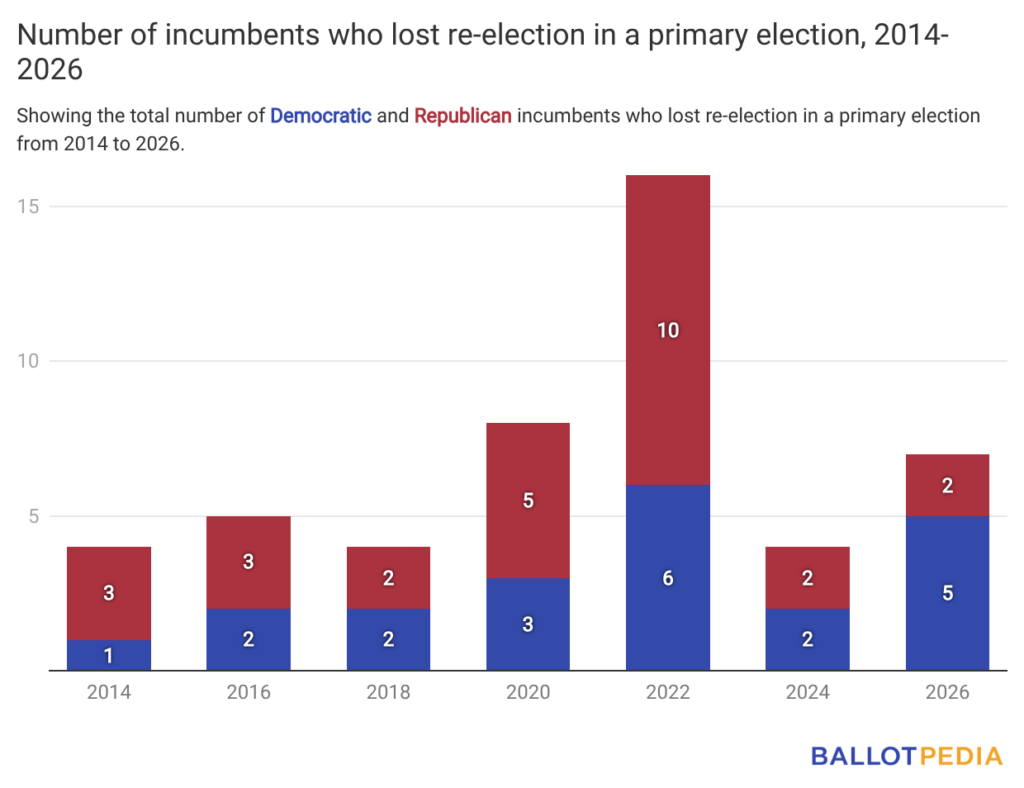
Melat Kiros defeated incumbent Rep. Diana DeGette and Wanda James in the Democratic primary for Colorado's 1st Congressional District in Colorado's statewide primaries on June 30, making DeGette the seventh U.S. House incumbent to lose a primary this year. The number of defeated incumbents so far this year is the third-highest since 2014.
Kiros won 51.3% of the vote to second-place finisher DeGette's 41.7%. James and Kiros both ran to the left of DeGette, who has represented the district since 1997.
Kiros is one of 25 candidates that a local chapter of the Democratic Socialists of America (DSA) endorsed for a U.S. House primary this year. Additionally, the national DSA endorsed three of those 25 candidates, including Kiros.
So far, six DSA-endorsed candidates have won primaries this year, and 10 have lost. Nine DSA-endorsed candidates are running in primaries that have not yet happened.
Two of the six DSA-endorsed candidates defeated incumbents in Democratic primaries, and two won in open districts. A fifth candidate, Mai Vang (D), advanced from the top-two primary to the general election for California’s 7th Congressional District along with incumbent Rep. Doris Matsui (D). Finally, incumbent Rep. Alexandria Ocasio-Cortez (D) won the Democratic primary for New York’s 14th Congressional District.
Bennet becomes the first sitting U.S. senator to lose a gubernatorial primary since 2010.
Colorado Attorney General Phil Weiser defeated U.S. Sen. Michael Bennet in the open Democratic primary for governor 55.8% to 44.2%.
NBC News' Adam Edelman wrote that "While both candidates have long been mainstays in Colorado Democratic politics, Weiser entered the race as the underdog. His victory signals that his antiestablishment message broke through in an environment where Democrats across the country have expressed frustration with the status quo, including in their own party."
Six sitting U.S. senators have run in a gubernatorial primary since 2010. Bennet is the first of those six to lose a primary. The last time this happened was in 2010 when then-Gov. Rick Perry defeated U.S. Sen. Kay Bailey Hutchison in the Republican primary for governor of Texas, 51.1% to 30.3%.
Bennet is one of four sitting U.S. senators who are running for governor this year. Two of those other sitting U.S. senators are running in primaries that have not occurred yet, and a third won his primary.
Here's what happened in the four other primaries that we were watching in Colorado:
- Incumbent Sen. John Hickenlooper defeated Julie Gonzales in the Democratic primary for the U.S. Senate 55% to 45%. Colorado Newsline’s Chase Woodruff described Hickenlooper as a moderate and Gonzales as a progressive.
- Manny Rutinel defeated Shannon Bird in the Democratic primary for the 8th Congressional District 61.7% to 33.6%. Politico’s Andrew Howard described Rutinel as a progressive and Bird as a moderate. Rutinel will now face the district's first-term incumbent, Rep. Gabe Evans (R), in the general election.
- The open Republican primary for governor, which includes Scott Bottoms, Barbara Kirkmeyer, Victor Marx, and Kelvin Wimberly (write-in), has yet to be called. As of July 1 at 3:00 p.m. EST, Kirkmeyer is leading with 39.9% of the vote to second-place finisher Marx's 39.7%.
- Jena Griswold defeated Hetal Doshi, Michael Dougherty, and David Seligman in the open Democratic primary for attorney general, in which her status as the only candidate previously elected statewide set her apart from the other candidates. The Colorado Sun's Jennifer Brown wrote that "Griswold, 41, had the advantage of statewide name recognition. She has served as Colorado secretary of state since 2018, when, at age 36, she was the youngest person ever elected to the office." Griswold won 45.6% of the vote to second-place finisher Dougherty's 19.8%.
Click here to check out all the election results from the June 30 elections in Colorado.
Georgia enacts legislation extending voting machine deadline and establishing automatic hand recounts
On June 25, Georgia Gov. Brian Kemp (R) signed legislation delaying the implementation of a state law banning the use of QR codes and other machine coding in ballot tabulation. Georgia currently uses voting machines that print QR codes on ballots to count votes.
In 2024, lawmakers enacted a bill prohibiting the use of QR codes, bar codes, or other machine coding in ballot tabulation, starting on July 1, 2026. The bill's supporters said the prohibition would improve public confidence in elections and was necessary in order for voters to see that their votes were accurately recorded. Those machines were not replaced before the July deadline.
Kemp called a special session in May to postpone the implementation of the QR code prohibition and consider congressional redistricting. Legislators later said they would not take up redistricting during the session.
The new law, Senate Bill 3EX (SB 3EX), sets a 2028 deadline to eliminate the use of QR codes for ballot tabulation and requires a committee to recommend standards for new election equipment.
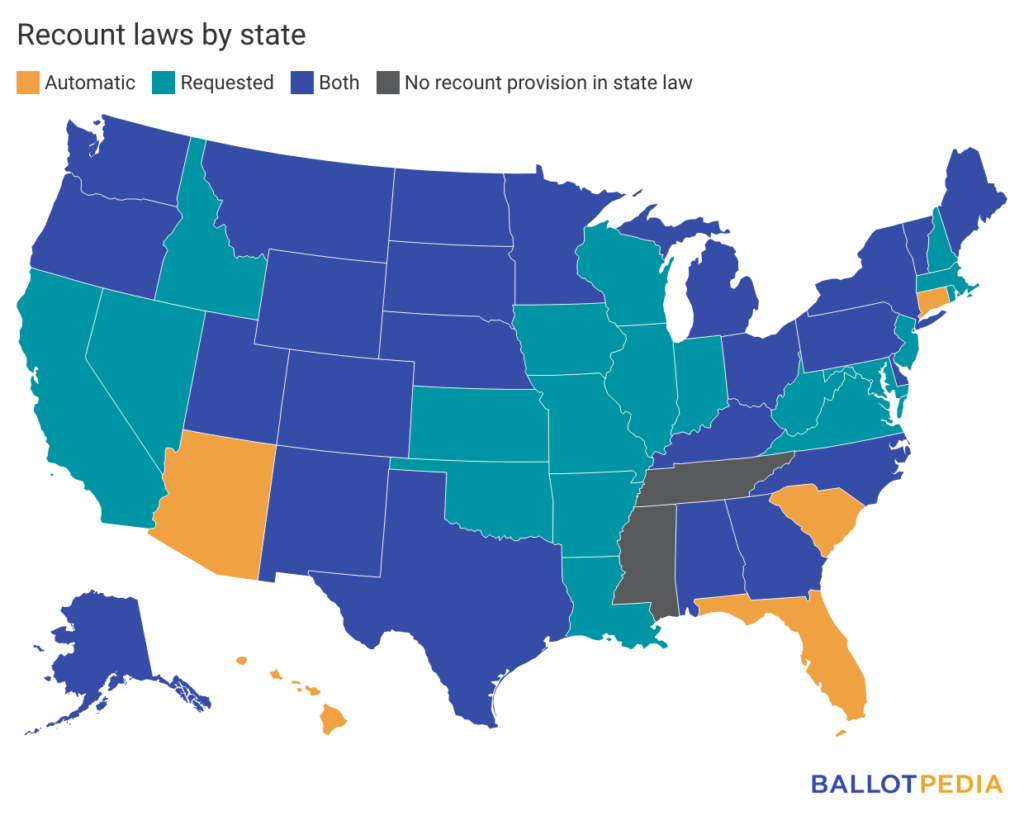
The bill also requires automatic hand recounts in any statewide executive races listed first or second on the ballot that are decided by less than 0.5% of the vote, making Georgia the 29th state to require automatic recounts in at least some races.
On June 23, the Georgia House of Representatives passed the final version of SB 3EX 94-79, with 93 Republicans and one Democrat voting in favor and three Republicans and 76 Democrats voting against. The Georgia Senate agreed to the amended version 36-16, with 32 Republicans and four Democrats voting in favor and 16 Democrats against.
SB 3EX is the ninth election-related bill enacted in Georgia this year and the only elections bill enacted during the special session.
Click here to read more about SB 3EX.