


Welcome to the Tuesday, July 7, 2026, Brew.
By: Lara Bonatesta
Here’s what’s in store for you as you start your day:
- Recalls hit a record high this year, in part due to data center recall efforts
- Second Trump administration has seen historically high ambassador vacancies and political appointments
- Former state legislator, former NFL kicker, and former tech CEO vie for GOP nomination in Arizona’s 1st Congressional District
Recalls hit a record high this year, in part due to data center recall efforts
The number of recall efforts hit a record high in the first half of this year, driven in part by 33 efforts across the country related to data center development.
Through June 30, we've identified 205 recall efforts targeting 329 elected officials in 26 states. This is the most recall efforts through the first half of a year dating back to 2014 — 2024 had the next most recall efforts with 266.
Voters have removed 8% of officials included in recall efforts this year, down from 10% at this point in 2025, and the fifth-lowest percentage of officials removed from office since 2014
Seven officials defeated recall votes to remain in office, while 118 recall attempts did not qualify for the ballot. Eighteen recall elections have been scheduled but not yet held, and 151 officials face active recall campaigns.
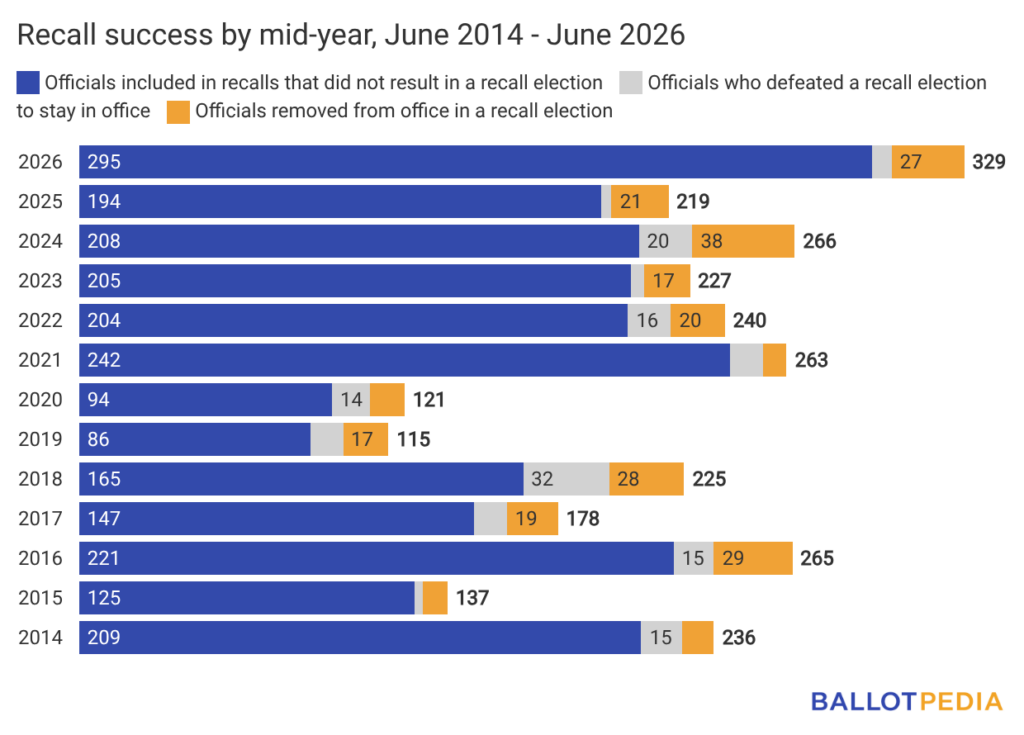
The recall process is a form of direct democracy, and a way for citizens to respond to moments of social and political stress. This year, for the first time, we tracked recall efforts against 58 officials related to data center development in seven states. Click here to learn more about recall efforts related to data centers.
Other examples of topical trends in recall efforts include the period from 2020 to 2023, when citizens initiated 133 recall efforts related to COVID-19 pandemic policies. From 2021 to 2024, 19 recall efforts were started against school board members for disputes over library and classroom materials.
Notable recalls related to data centers this year include:
- Proponents of a proposed data center project organized an effort to recall Imperial County, California Board of Supervisors Chair Peggy Price. The recall focused on Price's vote to approve a property merger that would allow the development to proceed.
- An effort is underway to recall all seven members of the Lyon, Michigan Township Board of Trustees. While recall petitions cite the board's January 2026 vote to approve trustee pay raises as grounds for removal, organizers said the effort was launched in response to a proposed 1.8 million-square-foot data center known as Project Flex. Petitioners must submit 3,000 valid signatures for each official by July 31 to put the recalls on the November ballot.
- An effort to recall the mayor and three city council members of Festus, Missouri, began in April 2026 in response to the officials' support for a proposed $6 billion data center project. Although petitioners submitted enough signatures to meet legal requirements, the city council voted not to place the recalls on the ballot after determining the petitions did not allege that the targeted officials participated in unlawful conduct.
This year, city council members were again the most common targets for recalls, accounting for 151 (46%) of the 329 officials named in recall efforts. In 2025, 186 city council members were targeted, 47% of the 395 officials' names in recall efforts. In 2024, 171 city council members were targeted, 44% of the 387 officials named in recall efforts. Mayors ranked second this year with 52 officials targeted, followed by school board members with 51.
Michigan led the way in officials targeted for recall with 108 in 2026, accounting for almost one-third of all officials tracked. This is the highest number of officials that Ballotpedia has tracked within one state at the midyear point.
California had the second-most officials targeted for recall in the first half of 2026 with 48, and Oregon had the third-most with 33. Michigan also had the most officials targeted for recall in 2018 and 2022 to 2025, while California led from 2016 to 2017 and from 2019 to 2021.
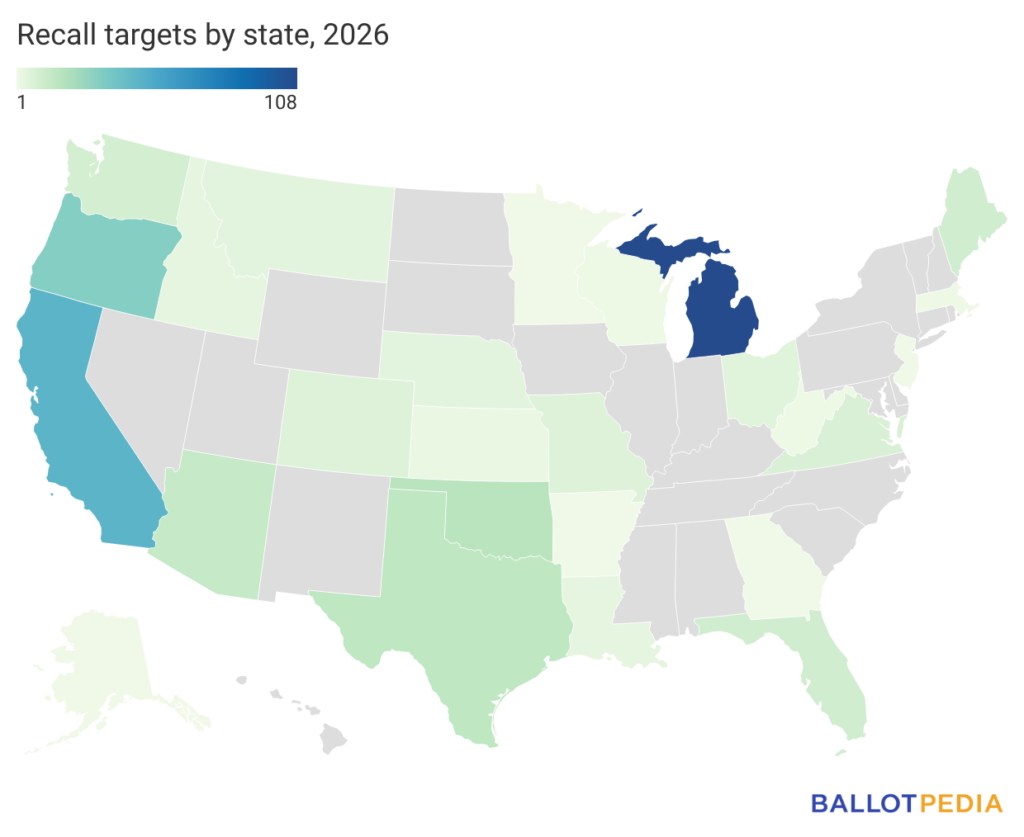
Recall laws vary by state, and not all states allow recalls to take place. Nineteen states allow for the recall of state elected officials, and 39 states allow in some way for the recall of local elected officials. Additionally, the method for choosing a successor after voters recall an elected official varies across the country. These include places where voters elect a successor at a simultaneous election, at a separate special election after the recall, where a successor is appointed, or where the successor is chosen according to a set line of succession.
Ballotpedia launches Recall Roundup newsletter
Recall Roundup is a free, quarterly newsletter covering recall election activity nationwide. Each edition features year-to-date recall statistics, recent and upcoming recall elections, a historical feature spotlighting a notable past recall, and themes in recall activity.
Click here to start your free subscription to Recall Roundup and here to check out Ballotpedia’s 2026 Mid-Year Recall Report.
Second Trump administration has seen historically high ambassador vacancies and political appointments
Seventeen months into President Donald Trump's (R) second administration, a historically high number of ambassador posts remain vacant. According to the American Foreign Service Association (AFSA), an unprecedentedly high percentage of ambassadors appointed during Trump's second term have been political appointees.
Ambassadors are the highest-ranking U.S. representative to their appointed countries or international organizations. Article II, Section 2, Clause 2 of the U.S. Constitution grants the president the authority to appoint ambassadors with the advice and consent of the U.S. Senate.
When an ambassadorial post is vacant, a chargé d’affaires ad interim serves as the senior officer in charge of the mission. According to the Wall Street Journal, these officials do not have the same level of access and influence as an ambassador.
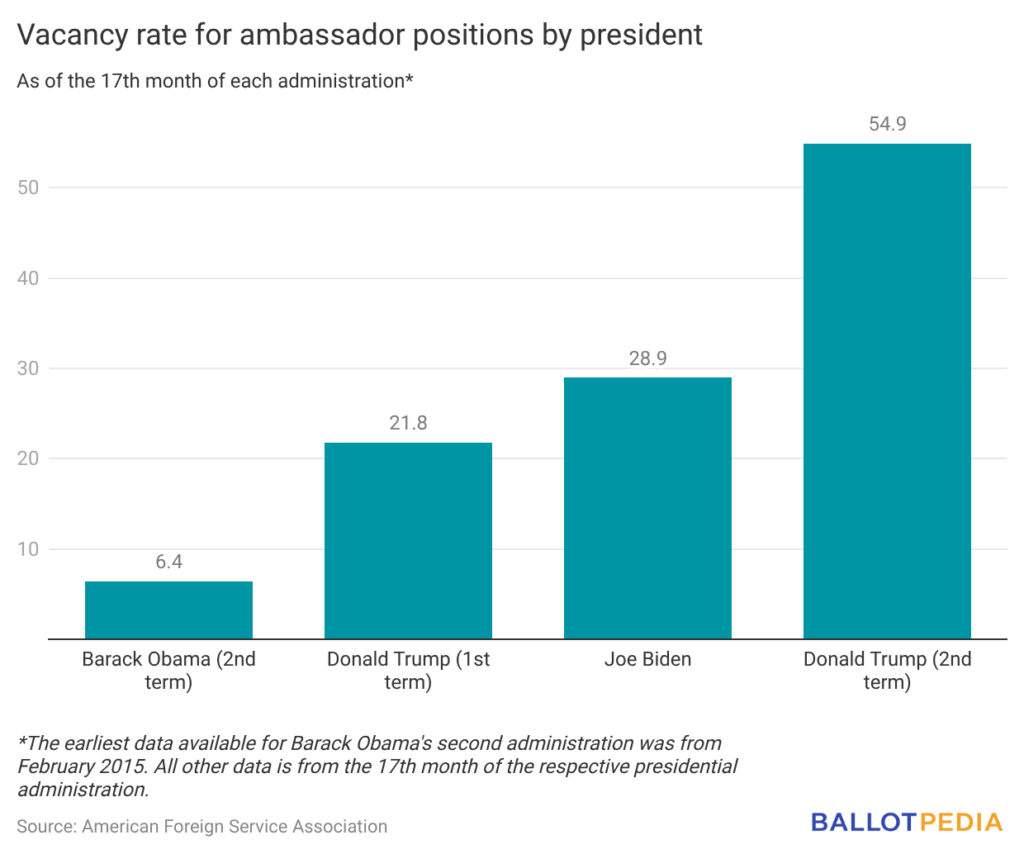
The current vacancy rate for ambassador posts is 54.9%. Out of 195 positions, 107 are vacant. Thirty-four nominees are awaiting Senate confirmation. There are 73 vacant positions for which no one has been nominated. At this point in Trump’s first term, the vacancy rate was 21.8%.
At this point in the Biden administration, the vacancy rate was 28.9%. The earliest available data from the AFSA for the Obama administration shows a vacancy rate of 6.4% in February 2015.
Former diplomatic officials have expressed a variety of views about the vacancies.
Tom Shannon, a former senior career diplomat who served in the Obama and first Trump administrations, said the number of vacancies “really limits an administration’s foreign policy in terms of its ability to respond to crises, to communicate effectively with the highest levels of foreign governments."
Similarly, former Obama administration U.S. ambassador to Israel Dan Shapiro said, "Senate-confirmed ambassadors are the only senior U.S. officials who spend all day, every day in dialogue with foreign leaders. So they simply have greater access to key players in their host governments, knowledge of how they reach decisions, and ability to ensure they hear the views of the United States than do more junior diplomats."
Former Trump administration National Security Council chief of staff Alexander Gray said the number of vacancies "stems from multiple causes, including the arcane Senate confirmation process and the frequent holds placed by senators on ambassadorial nominees over unrelated issues. ... The approval process for all presidential nominees, including ambassadors, needs a major overhaul by congressional leadership. President Trump has been diligent in nominating high-quality, non-career diplomats for critical posts."
Jason Greenblatt, who served as White House Middle East Envoy during the first Trump administration, said of ambassador vacancies in the Middle East, "The leadership and senior diplomats in those countries have strong and trusted relationships with President Trump and with the group doing much of the day-to-day work. ... In this region, those trusted relationships, direct lines of communication and confidence from the president are more valuable than having an ambassador in place."
According to the Foreign Service Act of 1980, “An individual appointed or assigned to be a chief of mission should possess clearly demonstrated competence to perform the duties of a chief of mission, including, to the maximum extent practicable, a useful knowledge of the principal language or dialect of the country in which the individual is to serve, and knowledge and understanding of the history, the culture, the economic and political institutions, and the interests of that country and its people.”
There are generally two types of appointments to ambassadorial positions: career diplomats and political appointees. According to the Columbia Political Review, in most cases, career diplomats from the Foreign Service serve as ambassadors for around three years, while political appointees typically resign at the end of their respective presidential administration.
In his second administration, Trump has appointed 8.9% career Foreign Service officers and 91.1% political appointees.
Prior to the first Trump administration, presidents since Gerald Ford (R) appointed an average of 68.1% career Foreign Service officers to ambassadorial positions and 31.9% political appointees.
In his first administration, Trump appointed 56.5% career Foreign Service officers and 43.5% political appointees, close to 12 percentage points more political appointees than the previous average. Joe Biden (D) appointed 59.2% career Foreign Service officers and 40.8% political appointees.
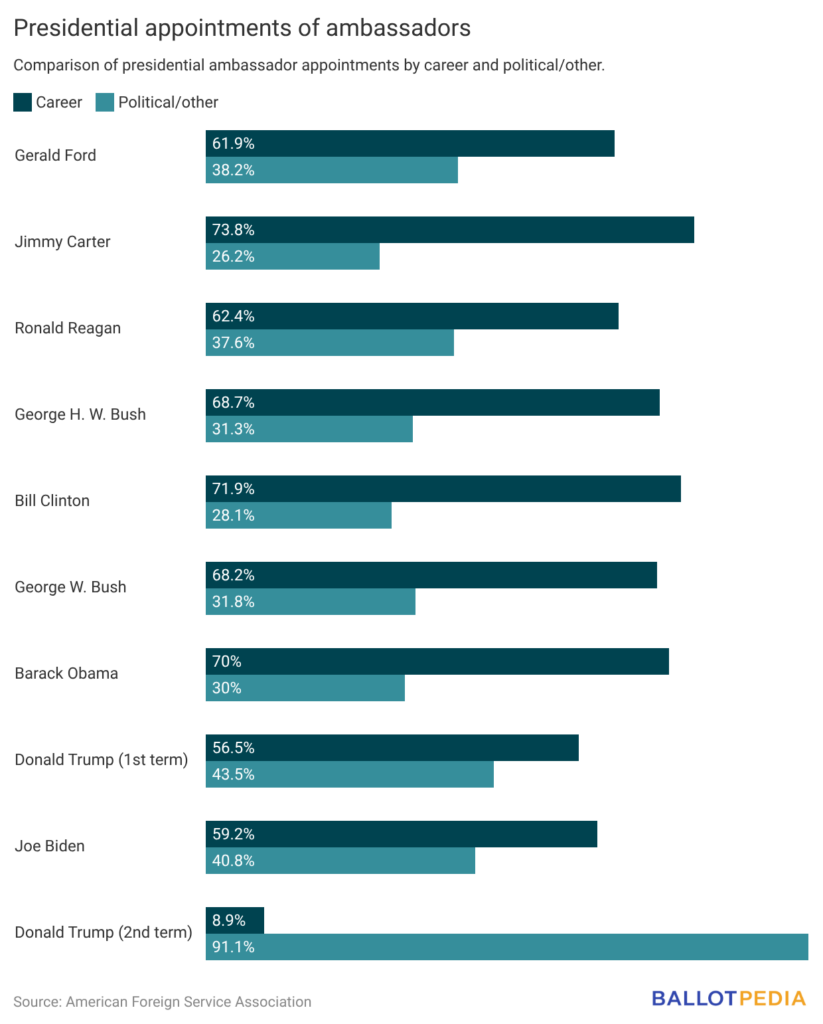
To learn more about Trump’s second-term ambassador appointments, click here.
Former state legislator, former NFL kicker, and former tech CEO vie for GOP nomination in Arizona’s 1st Congressional District
Joseph Chaplik, Jay Feely, and John Trobough are running in the Republican primary for Arizona's 1st Congressional District on July 21. Incumbent David Schweikert (R), who has served in the U.S. House since 2011, is running for governor of Arizona.
The Cook Political Report with Amy Walter, Inside Elections with Nathan L. Gonzales, and Larry J. Sabato's Crystal Ball all rate the general election a toss-up.
12 News' Kevin Reagan writes, "Republicans have a significant advantage over Democrats in the party's number of registered voters in CD1. But the district has over 180,000 non-affiliated voters who could sway the election's outcome." AZ Central's Laura Gersony said that the district "has historically preferred more moderate political figures."
On June 24, Chaplik, Feely, and Trobough participated in the AZ Clean Elections primary debate. According to the Arizona Mirror, the candidates each spoke about their professional backgrounds to differentiate themselves. Chaplik, a former state legislator, said that when he was in the state House, he supported legislation to implement a flat income tax, expand school choice vouchers, and prohibit mask mandates. Feely, who President Donald Trump (R) endorsed on Jan. 6, 2026, spoke about his relationship with the president, saying, “He will take my call and he will listen. I have the ability to get the ear of the president.” Trobough, a former tech CEO, highlighted his career with the Arizona Mirror’s Gloria Rebecca Gomez writing that he “set himself apart from his rivals as someone knowledgeable about economic pressures and the technological landscape” and “especially sought to distinguish himself as better able to handle the regulation of artificial intelligence.”
Chaplik, founder and president of Joseph Bernard Investment Real Estate, represented the 3rd District in the Arizona House of Representatives from 2023 to 2026 and the 23rd District from 2021 to 2023. He resigned in March to focus on his congressional campaign. While in office, Chaplik belonged to the Arizona Freedom Caucus.
Feely is a former NFL kicker and analyst. In March 2026, the National Republican Congressional Committee announced Feely was one of nine candidates who would receive support via its MAGA Majority program.
Trobough is the managing partner at JLA Advisors, a technology consulting firm. Trobough describes himself as a Ronald Reagan conservative. Trobough completed Ballotpedia's Candidate Connection survey. To read his response, click here.
This is one of 58 open U.S. House seats this year– 22 Democrats and 36 Republicans are not running for re-election. In 2024, 45 incumbents — 24 Democrats and 21 Republicans — did not seek re-election.
Click here to see our full coverage of the Republican primary in Arizona’s 1st Congressional District.