


Welcome to the Wednesday, July 8, 2026, Brew.
By: Briana Ryan
Here’s what’s in store for you as you start your day:
- 97% of Trump-endorsed candidates won primaries this election cycle
- Ohio governor vetoes bill requiring photo ID for absentee voting
- Signatures submitted for Washington initiative to repeal legislation establishing an income tax for households earning over $1 million and ban income taxes in general
97% of Trump-endorsed candidates won primaries this election cycle
Candidates who Donald Trump (R) endorsed in 2026 primaries have won 220 of 227 (97%) of their races so far — one percentage point less than the 2020 election cycle, when 98% of Trump-endorsed candidates won their primaries. Those figures include scenarios in which Trump endorsed two candidates in the same race.
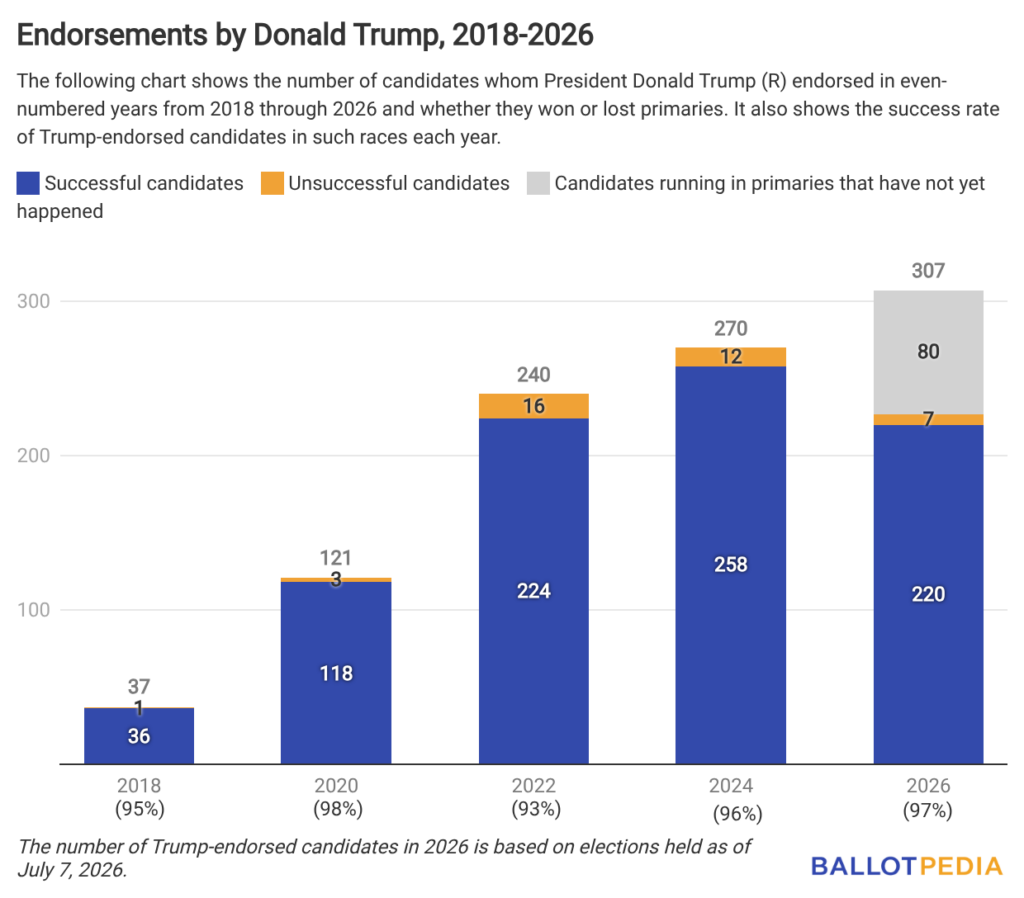
In total, Trump has endorsed 307 primary candidates in the 2026 election cycle — more than in any previous election cycle since 2018. Trump endorsed the second-most candidates in an even-year election in 2024, when he endorsed 270 candidates in primary elections.
One hundred fifty-nine of the 227 candidates whose primaries have already happened were incumbents, 42 ran for open seats, and 26 challenged an incumbent. These figures do not include endorsed candidates who withdrew or for whom the election has not happened yet. This includes congressional, state legislative, and state executive races.
So far, the 2026 primaries are the second-most successful for Trump-endorsed candidates, as 97% have won their primaries. The most successful cycle for Trump-endorsed candidates since 2018 was in 2020. That year, 98% of Trump-endorsed candidates won their primaries. The 2022 primary elections were the least successful for Trump-endorsed candidates in even-numbered years since 2018. That year, 93% of Trump-endorsed candidates won their primaries.
Compared to state-level candidates, Trump-endorsed congressional candidates have been the most successful this year. So far, all 170 of Trump-endorsed congressional candidates have won their primaries.
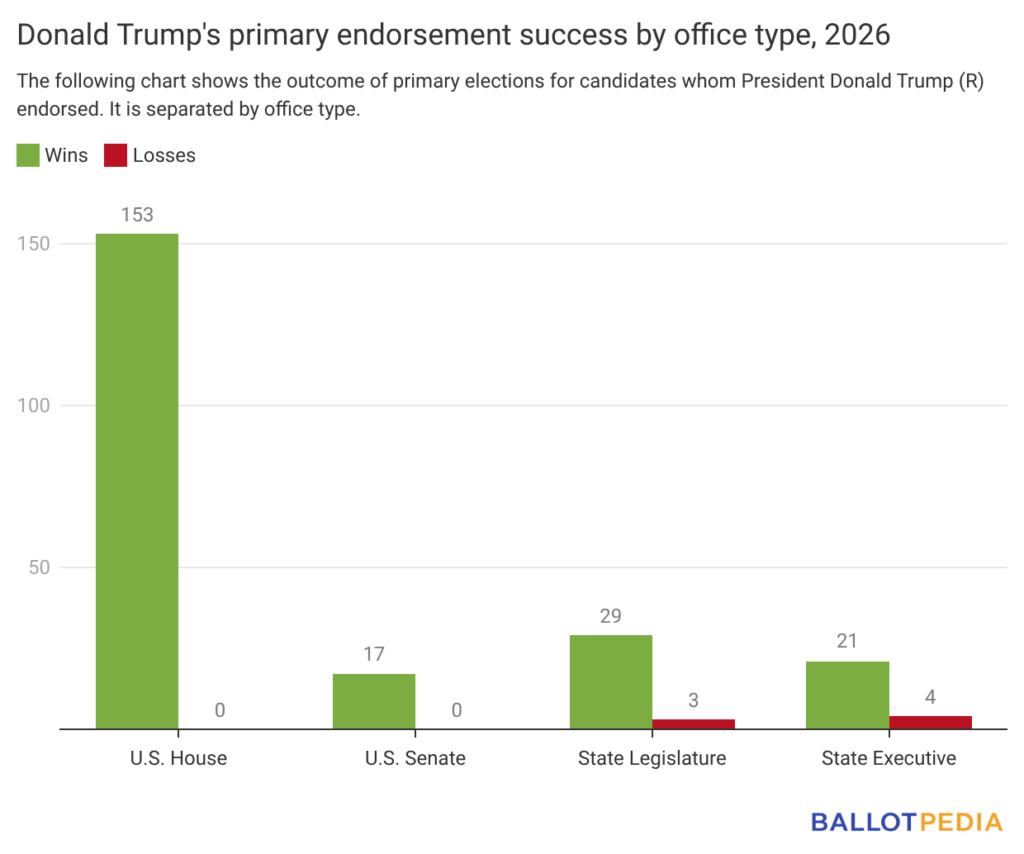
All seven Trump-endorsed candidates who have lost their primaries so far were candidates at the state level.
Two state legislative incumbents lost their primaries — North Carolina Senate President Pro Tempore Phil Berger (R) and Indiana Rep. Bruce Borders (R). One challenger to an incumbent — Brenda Wilson (R) — lost the primary for Indiana Senate 38.
Three candidates — Randy Feenstra (R) of Iowa, Pamela Evette (R) of South Carolina, and Burt Jones (R) of Georgia— lost open gubernatorial primaries or primary runoffs.
The seventh Trump-endorsed candidate to lose a primary was incumbent Sid Miller (R), who is the incumbent Texas Commissioner of Agriculture.
Click here to view a full list of all the endorsements Trump has issued in the 2026 election cycle.
Ohio governor vetoes bill requiring photo ID for absentee voting
On June 24, Ohio Gov. Mike DeWine (R) vetoed legislation that would have required most voters to provide photo identification when either requesting or returning an absentee ballot.
Under current law, Ohio voters casting an absentee ballot can meet the ID requirement by providing a state or federal photo ID or by providing an ID number, such as a driver's license number, state identification card number, or the last four digits of their Social Security number. The ID or ID number must be provided when requesting an absentee ballot and when returning it to election officials.
HB 472 would have required voters to provide a copy of their state or federal photo ID at some point in the absentee voting process. A voter could choose to do this when requesting their ballot by submitting a copy of their ID, by providing a live-capture image of their ID through an online portal, or by showing their ID to election officials when hand-delivering an absentee ballot application.
Alternatively, a voter could provide two of the following three items when requesting a ballot: the last four digits of their Social Security number, their driver's license number or state identification card number, or a signature. They would then be required to provide a copy of their ID when returning their ballot by mail or to present their ID to election officials when returning the ballot in person.
Certain groups of voters would have been exempt from providing a copy of their ID when requesting or returning an absentee ballot. Those groups included overseas and military voters, individuals with a religious objection to being photographed, and individuals who cannot provide an ID due to disability or a medical condition.
Those voters would have been allowed to sign an affirmation and submit their driver's license number, state identification card number, or the last four digits of their Social Security number when returning their ballot.
In his veto message, DeWine said the bill was "all burden for so little benefit" and "would not discourage fraud, would not add any real security, and would create an additional and significant burden for Ohioans who vote by mail."
State Treasurer Robert Sprague (R), who is running for secretary of state, said, "Photo ID is a common sense, commonplace requirement in everyday life and the most trustworthy means of ensuring that a person is who they say they are. The legislation would have served as a significant deterrent to mail-in voter fraud and made Ohio elections more secure, which is the point."
On June 10, the Ohio House of Representatives passed HB 472 60-34, with 60 Republicans voting in favor and 33 Democrats and one Republican voting against. Later that day, the Ohio Senate passed it 23-10, with 23 Republicans voting in favor and nine Democrats and one Republican voting against.
A representative for Ohio House Speaker Matt Huffman (R) said legislators were evaluating their next steps following the veto. Lawmakers would need 60 votes in the state House and 20 votes in the state Senate to override DeWine's veto. The Ohio General Assembly is next scheduled to be in session in September. Republicans have a 24 to 9 majority in the state Senate, and a 65 to 34 majority in the state House.
Ohio currently requires a photo ID for in-person voting. Earlier this year, legislators approved a ballot measure for the Nov. 3 ballot asking voters whether to place Ohio's voter ID requirement in the state constitution.
Ohio is one of two states, along with Georgia, that require voters to provide either a copy of their photo identification or an identification number when requesting and returning an absentee/mail-in ballot.
Twenty-one states require some or all voters to provide an identification number, such as a driver's license or Social Security number, when returning or requesting an absentee ballot.
Seventeen states require some or all voters to provide a copy of their photo identification when casting an absentee/mail-in ballot.
- Alabama, Kentucky, and New Hampshire require voters to provide a copy of their photo identification when requesting an absentee/mail-in ballot.
- Arkansas and North Carolina require voters to submit a copy of their photo identification when returning an absentee/mail-in ballot.
- Eight states require voters to provide a copy of their photo identification when requesting an absentee/mail-in ballot in certain situations.
- Oklahoma and South Carolina require voters to provide a copy of their photo identification when returning an absentee/mail-in ballot in certain situations.
Louisiana and Rhode Island have enacted three bills related to voter ID for absentee/mail-in voting this year. Nationally, 23 states have introduced 57 bills related to voter ID for absentee/mail-in voting this year.
Click here for information about voter identification laws by state.
Signatures submitted for Washington initiative to repeal legislation establishing an income tax for households earning over $1 million and ban income taxes in general
On July 2, sponsors submitted signatures to place an initiative on Washington's November 2026 ballot that would repeal a law imposing a 9.9% tax on household income exceeding $1 million beginning in 2028.
Let's Go Washington, the political action committee (PAC) sponsoring the initiative, submitted 511,408 signatures. The Washington Secretary of State must verify at least 308,911 signatures for the initiative to be eligible for the ballot.
Washington voters have decided on eight measures to create or allow the creation of an income tax, approving one and rejecting seven.
SB 6346
Washington Gov. Bob Ferguson (D) signed SB 6346 into law on March 30. Beginning in 2028, the law would impose a 9.9% tax on the portion of a household’s taxable income exceeding $1 million.
The Washington Senate passed the bill 27-22 on Feb. 16. After the Washington House of Representatives amended and passed it 51-46 on March 9, the state Senate approved the final version 27-21 on March 11. Most (88%) Democrats supported the bill, while Republicans opposed it.
SB 6346 amended the law enacted through Initiative 2111, an indirect initiative that the legislature approved in 2024, prohibiting the state and local governments from imposing taxes on an individual's personal income. Let's Go Washington also sponsored Initiative 2111, which ultimately did not appear on the ballot because the legislature approved it.
SB 6346 added an exception to this law allowing the new state income tax as long as the household standard deduction remains at least $1 million.
Washington does not otherwise impose a general individual income tax on wages, salaries, and other income. The state does impose a separate tax on certain long-term capital gains, which state law classifies as an excise tax.
Let’s Go Washington initially attempted to challenge SB 6346 through a veto referendum. Secretary of State Steve Hobbs (D) declined to process the referendum because the law declared itself necessary for the support of state government, a category of laws exempt from the referendum process under the Washington Constitution. The Washington Supreme Court upheld that decision.
The ruling did not prevent opponents from proposing a separate initiative. Unlike a referendum, an initiative proposes a new law and is not subject to the constitutional exemption for laws supporting state government.
History of income tax measures in Washington
If SB 6346 goes into effect, it would be the first income tax in Washington state history to go into effect. Voters have approved one ballot measure to institute an income tax in state history. Initiative 69, on the ballot in 1932, would have instituted a graduated income tax ranging from 1.0% to 7.0%. Voters approved it 70% to 30%.
However, the Washington Supreme Court ruled in 1933 that Initiative 69 violated the state constitution's clause that "all taxes shall be uniform upon the same class of property..." The Court held that income is property under the state constitution, and because the state constitution requires taxes on the same class of property to be uniform, an income tax could not have graduated rates.
Since then, voters have rejected seven ballot measures that would have allowed or implemented an income tax. The Legislature placed five constitutional amendments on the ballot:
- In 1936, voters rejected SJR 7 78% to 22%. It would have amended the uniform taxation clause to allow for a graduated income tax.
- In 1938, voters rejected SJR 5 67% to 33%. It would have allowed a graduated income tax.
- In 1942, voters rejected HJR 4 66% to 34%. It would have defined income as distinct from property for taxation purposes, empowered the Legislature to enact graduated net income taxes, and provided for income tax deductions, offsets, and exemptions.
- In 1970, voters rejected HJR 42 68% to 32%. It would have reduced the maximum property tax rate to 1% and allowed for a single-rate income tax, also known as a flat income tax.
- In 1973, voters rejected HJR 37 77% to 23%. It would have placed limits on school district taxes and authorized a graduated income tax.
Citizens placed two initiated state statutes on the ballot:
- In 1944, voters rejected Initiative 158 70% to 30%. It would have established a flat 3% income tax to fund monthly payments to the elderly, blind, disabled, and widowed.
- In 2010, voters rejected Initiative 1098 64% to 36%. It would have established a tax on adjusted gross income above $200,000 for individuals and $400,000 for married couples.
Recent measures to tax income of $1 million or more
Since 2000, voters in other states have decided on three measures to enact a tax on income above $1 million.
- In 2004, California voters approved Proposition 63 54% to 46%. It enacted a 1% tax on income above $1 million and dedicated the tax revenue to mental health services and programs.
- In 2022, California voters rejected Proposition 30 58% to 42%. It would have enacted a 1.75% tax on income above $2 million and dedicated tax revenue to zero-emission vehicle subsidies, zero-emission vehicle infrastructure, such as electric vehicle charging stations, and wildfire suppression and prevention programs.
- In 2022, Massachusetts voters approved Question 1 52% to 48%. It levied a 4% tax on income above $1 million and dedicated the revenue to education and transportation.
Elsewhere this year, California voters will decide on an income tax measure. Proposition 3 would amend the California Constitution to indefinitely extend the top marginal tax rates set to expire in 2031 on single filers earning at least $361,000 or joint filers earning at least $721,000, with 89% of revenue allocated to K–12 schools and 11% to community colleges.
Click here for more information on the Washington Repeal Income Tax for Households Earning Over $1 Million Legislation Initiative.