


Welcome to Hall Pass, a newsletter written to keep you plugged into the conversations driving school board governance, the politics surrounding it, and education policy.
In today’s edition, you’ll find:
- On the issues: The debate over Florida’s FACT U.S. history course
- School board filing deadlines, election results, and recall certifications
- School board recalls outpace 2025, but remain below pandemic-era highs
- Extracurricular: education news from around the web
- Candidate Connection survey
On the issues: The debate over Florida’s FACT U.S. history course
In this section, we curate reporting, analysis, and commentary on the issues school board members deliberate when they set out to offer the best education possible in their district. Missed an issue? Click here to see the previous education debates we’ve covered.
On May 4, the Florida Department of Education announced the launch of FACT U.S. History, an advanced course for high school students wishing to earn college credit. FACT is short for “Florida Advanced Courses and Tests.” According to the Florida Department of Education, FACT “courses are designed to provide alternatives to existing options like Advanced Placement that consistently embed Critical Race Theory and DEI into materials.” Most U.S. high schools offer Advanced Placement courses to students, allowing them to obtain college credit with a high enough score on the concluding exams.
The FACT history course will launch as a pilot this fall, and the Department of Education is inviting districts and charter schools to participate.
Gov. Ron DeSantis (R) signed HB 1537 in 2023, directing the Department of Education to create new advanced learning options. In 2025, the Department of Education announced the first FACT course, College Algebra, in 2025.
Below, we present the Florida Department of Education’s rationale for the course, along with a critique of the framework.
The Florida Department of Education says the purpose of studying history is to form citizens who are knowledgeable about and invested in the United States. The department says students should not only learn a set of facts but also a narrative that situates those facts within a compelling story about how the country has changed over time. It also says that students should study the nation’s history, as well as English history and, more broadly, Western Civilization, so that they can learn to apply insights from the past to the challenges of the present and future.
Andrew Kordik, a history teacher, contrasts FACTS U.S. History with the Advanced Placement U.S. History (APUSH) exam, for which he is a writer. Kordik says Florida’s course promotes an overly sunny form of patriotism that encourages obedience and complacency. Kordik says that, in contrast, APUSH encourages students to grapple with a variety of perspectives, including those that look unflinchingly at the country’s flaws and view it as a work in progress. Kordik says APUSH operates within a patriotic tradition embraced by abolitionists, suffragettes, and other movements throughout U.S. history.
Introduction to the U.S. History Framework | Florida Department of Education
“More than that, though, we must teach our young people to become informed, self-aware, and dedicated citizens of the United States of America—of this particular nation. That requires knowledge of the history of American civilization, as well as its deep roots in English and, more broadly, Western civilization. Becoming a good American citizen is about more than just knowing the laws. It means acquiring the knowledge and ability to participate in governance, along with a sense of membership, of belonging—of claiming our civilization’s past as our own. As Martin Luther King so ably demonstrated in Letter from Birmingham Jail, that combination of historical understanding and rightful inheritance can empower citizens to draw from the wellspring of thousands of years of our civilization the concepts and principles needed to address the challenges of the day. The goal, in short, is to help young people become grateful, capable, and responsible members of the society of which they are already a part. To live, as Cicero might put it, as conscientious and knowledgeable American citizens.”
Patriotism Toward What End? The Enduring Debate in U.S. History Education | Andrew Kordik, The Progressive
“But Florida’s FACT U.S. moves in the opposite direction, asking students to love America more while exposing them to less of its story. It treats historical injustices as temporary deviations from American principles. Yet as APUSH students learn with the cases of slavery and the dispossession of Native Americans, these injustices, which indeed were deviations from core national values, were also central to the economic expansion of the United States—a fact that easily segues into relevant discussions about how the crimes of the past might be alive in the outcomes of the present.
“These critical discussions leave AP students with a sense that action is still required, and that the American project remains incomplete and aspirational—something to fight for. This, I suspect, is exactly what FACT U.S. authors hope to prevent. For them, America is a finished project, completed some time ago, and patriots are those who hold fast to that mythical moment when it was perfected. For the rest of us, history studied in earnest still reveals an unfinished America.”
School board update: filing deadlines, election results, and recall certifications
In 2026, Ballotpedia will cover elections for more than 30,000 school board seats. We’re expanding our coverage each year with our eye on covering the country’s more than 80,000 school board seats.
Upcoming school board elections
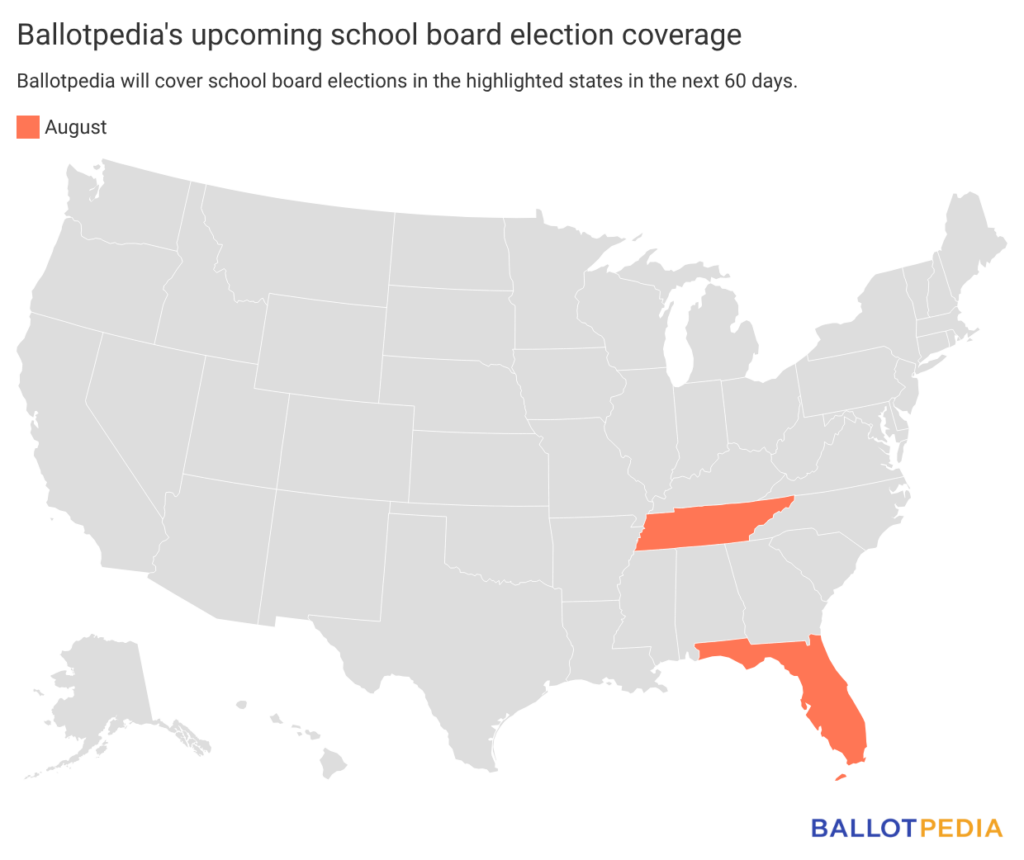
Click here to learn more about this year’s school board elections.
School board recalls outpace 2025, but remain below pandemic-era highs
Ballotpedia’s latest recall report found that 51 school board members were named in 21 recall efforts since the start of 2026, an increase from this time last year. The report covers recall activity against all local and state offices between Jan. 1 and June 30.
We last updated you on school board recalls in January, when we looked back on the recall efforts initiated throughout 2025.
School board recall efforts reached a high-water mark during the COVID-19 pandemic, when campaigns were more likely to try to remove school board members than any other type. Since Ballotpedia began tracking recalls, campaigns have typically targeted city council members more often than other officials.
Here’s what you need to know about our latest recall report.
School board recall efforts in 2026 are running ahead of 2025 at this point in the year
At the midway point in 2025, there had been 17 recall efforts against 34 board members. Recall petitions can be submitted against multiple candidates. At the same point in 2026, that number had grown to 21 efforts against 51 members — a 24% increase in efforts and a 50% increase in officials. On average, campaigns are targeting more school board officials per recall effort than they did at this point in 2025.
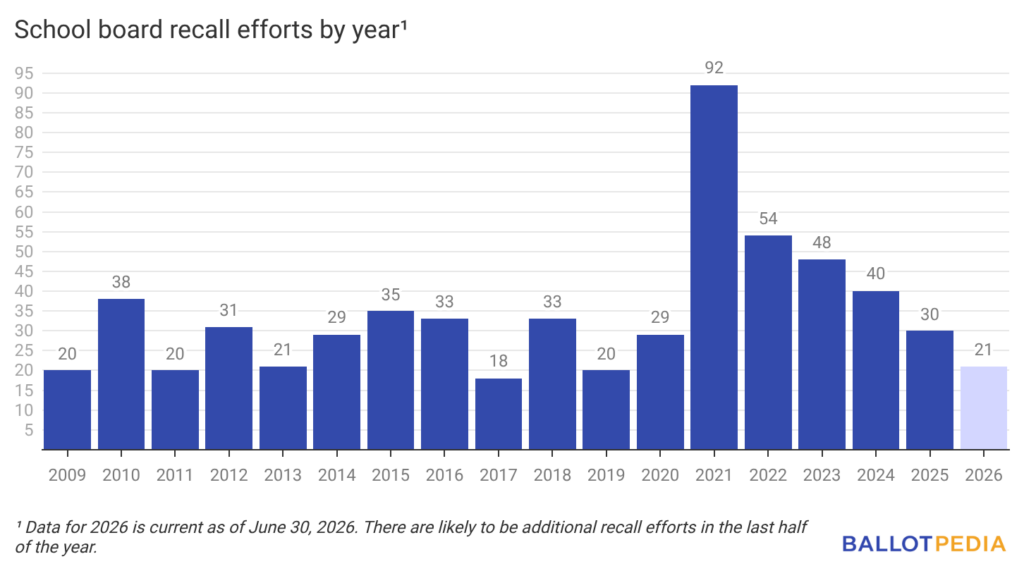
Since 2009, there has been an average of 35 recall efforts against school board members each year. Excluding 2021, when recall efforts spiked, the average is 31.
One school board member has been recalled from office in 2026
On March 3, voters in the Deer-Mount Judea School District, in Arkansas, recalled Kenny King from office, with 84% supporting his removal. The recall petition gave "Loss of Public trust and Unwillingness to listen to the Voters, Parents, and Constituents of the district" as the reason for the effort. Ballotpedia could find no response to the recall petition from King.
This time last year, three school board members had been recalled from office.
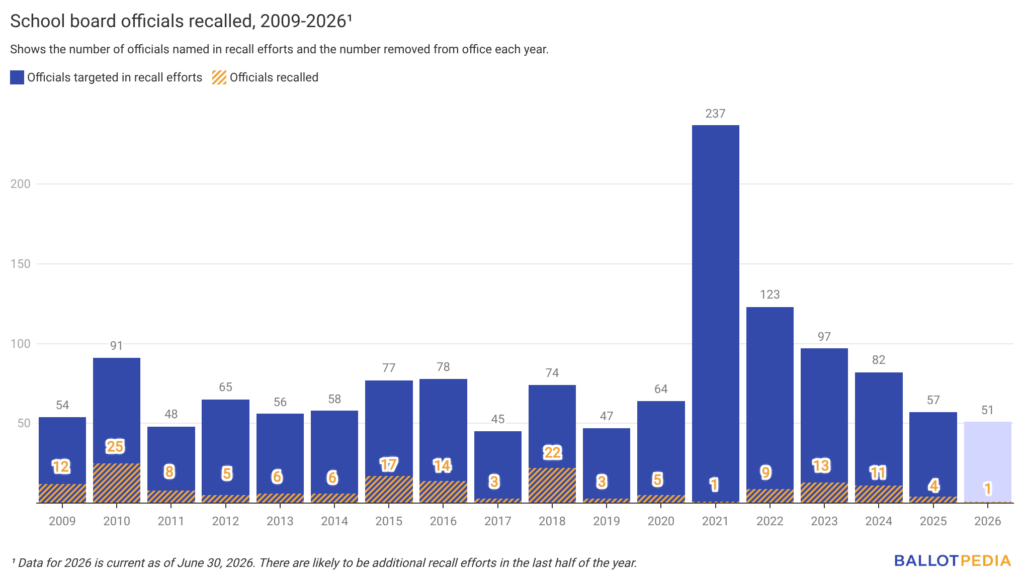
On average, between 2009 and 2025, campaigns have targeted 80 school board members for recall each year. Excluding 2021, that figure is 70.
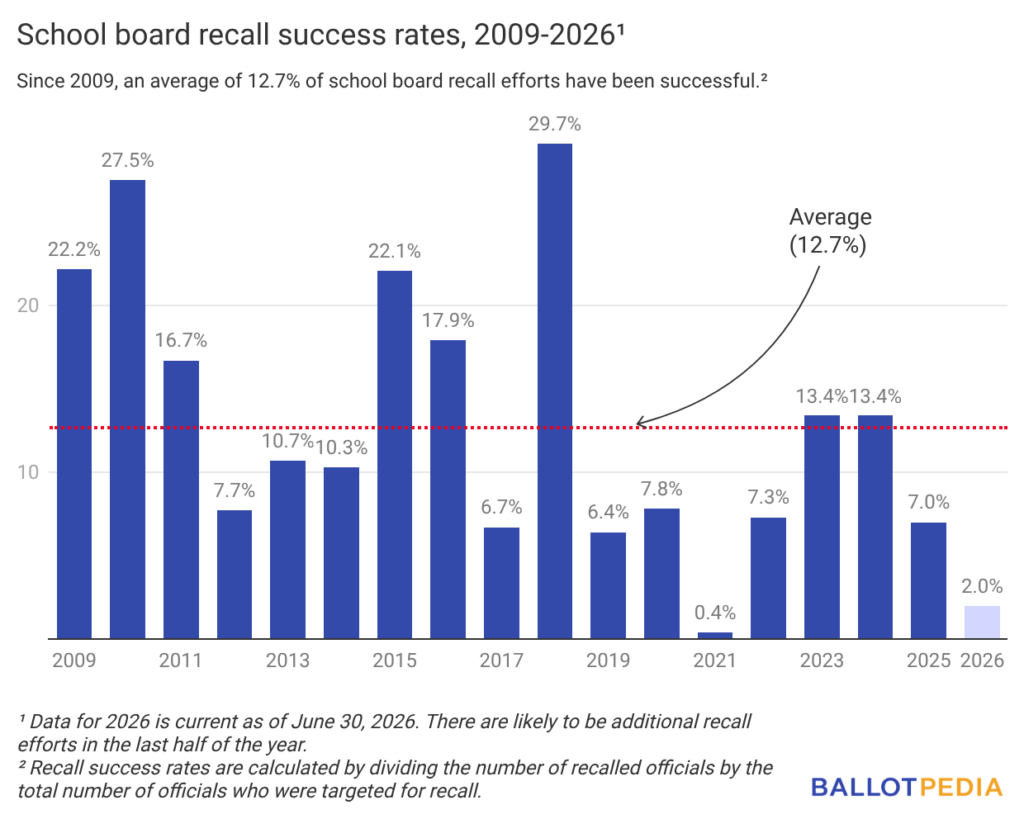
This year’s recall success rate currently sits at 2%, the second lowest since 2009
The one school board member removed from office this year means that voters have removed 2% of the 51 targeted for recall. That’s the second-lowest success rate since 2009. The year with the lowest rate was 2021, when voters targeted 237 members and removed one from office.
As of this writing, 12 of the 21 recall efforts against 12 school board members are currently underway.
This time last year, the recall success rate stood at 9%.
More than half of all school board recall efforts have originated in California and Michigan this year
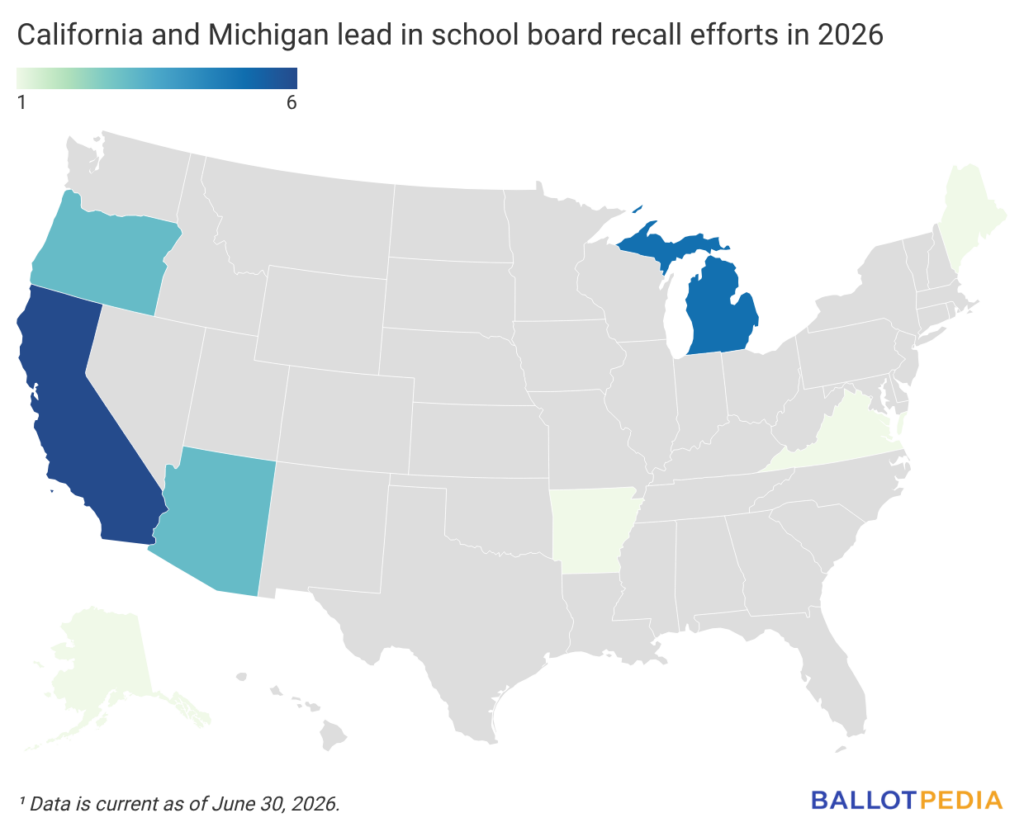
Of the 21 school board recall efforts we’ve tracked so far in 2026, more than half (11) have been initiated in California and Michigan. Six come from California, while five come from Michigan. In 2025, California and Arizona saw the most recall efforts. In 2024, it was California and Michigan.
Campaigns have been more likely this year to target mayors and city council members than school board members
Depending on the year, school board members have tended to be the second- or third-most targeted officials.
That trend has continued through the first half of 2026.
In total, the report found that 151 city council or town board members have been targeted for recall this year, compared to 52 mayors and vice mayors and 51 school board members. At the state level, one state legislator and four state executives faced recall efforts.
During the COVID-19 pandemic, as mask requirements and school re-openings, sex and gender, and critical race theory became topics of national conversation and a focus in school board meetings and campaigns, school board members briefly faced more recall efforts than other elected officials. In 2021, campaigns targeted 237 members for removal — a 276% increase compared to the average from 2009 to 2020.
Although recall efforts against school board members have declined each year since 2021, they remain above the pre-pandemic average. In the four years leading up to 2021, campaigns named an average of 56 school board members in their recall efforts. Between 2022 and 2025, that figure was 90.
Thirty-nine states have provisions allowing for recalls against local officials
Thirty-nine states allow voters to recall elected officials. All 39 allow for the removal of local officials, and 19 allow for the removal of both local and state officials. The U.S. Constitution does not provide a process for recalling any elected federal official.
In some states that allow for recalls, a recall can only occur under certain circumstances. An example of this is Georgia, where an elected official may only be recalled under the circumstances of "an act of malfeasance or misconduct while in office, violation of the oath of office, failure to perform duties prescribed by law, or willfully misusing, converting, or misappropriating, without authority, public property or public funds entrusted to or associated with the elective office to which the official has been elected or appointed."
Recalls hit a record high this year, in part due to data center recall efforts
Recall efforts against all officials, not just school board members, reached a record for the first half of the year since at least 2014. Since January, there have been 205 recall efforts targeting 329 elected officials in 26 states. The year with the most recall efforts was 2024, when 266 officials were targeted.
This year, for the first time, we tracked recall efforts against 58 officials related to data center development in seven states. Click here to learn more about recall efforts related to data centers.
Extracurricular: education news from around the web
This section contains links to recent education-related articles from around the internet.
- A News Site Published a Video of a School Lockdown. Then The Video Was Gone. | The New York Times
- States Scramble to Pass Legislation Targeting Nuanced AI in Education | Duane Morris Government Strategies
- Ten Federal Voucher Myths | Curmudgucation
- What, to the Black Student, is the Fourth of July? | City Journal
- Princess Moss Elected NEA President With Votes From 50% of Assembly Members | The 74
- Congressional Republicans’ Big Beautiful Bill Threatens Access to Free School Meals | Center for American Progress
- How to rethink unions, resource allocation, and school choice in American education | Reason Foundation
Take our Candidate Connection survey to reach voters in your district
Today, we’re looking at survey responses from the two candidates running in a special Democratic primary for Santa Cruz County School Superintendent in Arizona on July 21. The general election is in November.
No Republicans entered the race.
Each of Arizona’s 15 counties elects a county school superintendent. According to the Arizona Department of Education, counties “provide educational services and oversight under the direction of an elected county school superintendent.” Among other duties, county superintendents appoint school board members to fill vacancies, distribute reports and forms from the state, and report to the Superintendent of Public Instruction as directed.
Maya M. Donnelly was appointed to serve as Santa Cruz County School Superintendent in 2025 to fill a vacancy. Her career experience includes working as an educator and administrator. Here’s how Donnelly answered the question, “What are the main points you want voters to remember about your goals for your time in office?”
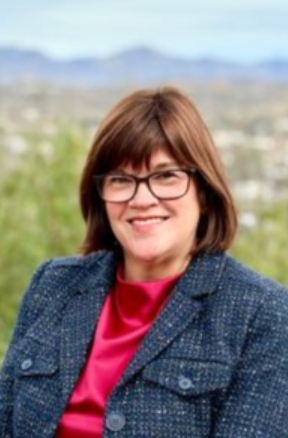
- “I want to assure a seamless transition into the role. This means managing a trained staff, meeting all legal commitments of the office, being an active member of groups like the Arizona Association of County School Superintendents, and providing quality education services to the community. Success will look like a satisfied school district business manager because their payroll and deposits were handled correctly and swiftly. Success will look like a district Superintendent who can confidently call me any time and rely on my astute knowledge and fairness. Success will look like a student and their parents successfully navigating through the overwhelming information surrounding applying for college and earning a degree or certification.
- I want to grow office initiatives with additional grant funding. These include: early childhood, arts, wellness & prevention, college & career readiness, and workforce development. Measures of success will be new grant awards and sustained programs in schools, new partners who support initiatives, and compliant data and budget reports.
- I want to be a convener of education stakeholders and foster community trust and strengthen relationships with school leaders. Achievement of this goal will look like consistent involvement and visibility for the office and teamwork amongst an education consortium that prioritizes student achievement, improved attendance, and teacher retention county-wide.”
Click here to read the rest of Donnelly’s responses.
Sonia Sanchez’s career experience includes working as a public school teacher. Here’s how Sanchez answered the question, “What are the main points you want voters to remember about your goals for your time in office?”
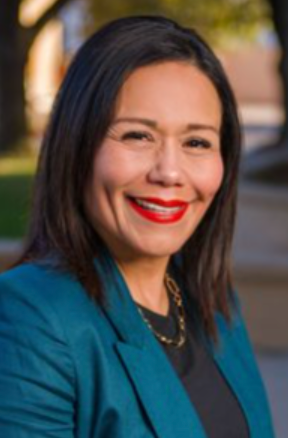
- “Putting Students First: Every decision I make will be guided by what is best for students. I will work to expand educational opportunities through dual enrollment, career and technical education, college readiness, and partnerships that prepare students for success after graduation. Every child deserves access to a high-quality education, regardless of where they attend school.
- Supporting Teachers and Strengthening Schools: Teachers are the foundation of student success. I will advocate for teacher recruitment and retention, meaningful professional development, and collaboration among our school districts. By supporting educators and school staff, we strengthen classrooms, improve learning, and create positive environments where students can thrive.
- Building Strong Community Partnerships: Education is a shared responsibility. I believe schools, families, businesses, higher education, and community organizations all play an important role in helping students succeed. As County Superintendent, I will build partnerships that expand opportunities for students, improve communication, and strengthen trust between schools and the communities they serve.”
Click here to read the rest of Sanchez’s responses.
As a reminder, if you're a school board candidate or incumbent planning to run this year, click here to take the survey. If you complete the survey, your answers will appear in your Ballotpedia profile. Your responses will also appear in our sample ballot. If there is an election in your community, share the link with your candidates and urge them to take the survey!