


Welcome to the July 13 edition of Robe & Gavel, Ballotpedia’s newsletter about the Supreme Court of the United States (SCOTUS) and other judicial happenings around the U.S.
Time flies, dear reader. SCOTUS has released all of the opinions for the argued cases of the 2025-2026 term. We have a ton of updates for you, so grab a seat and let’s gavel in!
Follow Ballotpedia on X and Bluesky or subscribe to the Daily Brew for the latest news and analysis.
We #SCOTUS and you can, too!
Grants
SCOTUS has accepted three new cases to its merits docket since our June 29 issue. The court has accepted 24 cases for the 2026–2027 term.
The court agreed to hear arguments in 59 cases for the 2025–2026 term and dismissed one case after it was accepted.
Click the links below to learn more about the three new cases:
- Viramontes v. Cook County (consolidated with Grant v. Higgins) originated from the U.S. Court of Appeals for the Seventh Circuit and concerns whether the Second and Fourteenth Amendments guarantee the right to possess semiautomatic rifles.
- Grand v. City of University Heights concerns the First Amendment. The case originated from the U.S. Court of Appeals for the Sixth Circuit.
- Apple Inc. v. Epic Games Inc. originated from the U.S. Court of Appeals for the Ninth Circuit and concerns how specific a court order should be before a litigant can be held in civil contempt for violating it.
Opinions
SCOTUS has ruled on three cases since our June 29 edition. The court issued rulings in 68 cases this term.
Click the links below to read more about the specific cases SCOTUS ruled on since June 29:
June 30
West Virginia v. B.P.J. had a combined opinion released with Little v. Hecox. West Virginia v. B.P.J. concerned West Virginia's Save Women’s Sports Act, and Little v. Hecox concerned Idaho's Fairness in Women’s Sports Act.
The outcome: In a 6-3 opinion, SCOTUS held that "[s]chools may determine eligibility for women’s and girls’ sports based on biological sex."
National Republican Senatorial Committee v. Federal Election Commission was argued before the Court on Dec. 9, 2025, and concerned the Federal Election Campaign Act of 1971 (FECA).
The outcome: In a 6-3 opinion, the Court reversed and remanded the judgment of the U.S. Court of Appeals for the Sixth Circuit, holding that the Federal Election Commission's political-party coordinated-expenditure limits violate the First Amendment.
Trump v. Barbara was argued before the Court on April 1, and concerned birthright citizenship in the U.S.
The outcome: In a 6-3 opinion, the Court held that children born in the United States to parents unlawfully or temporarily present are 'subject to the jurisdiction' of the United States and are citizens at birth under the Fourteenth Amendment’s Citizenship Clause.
The Federal Vacancy Count
The Federal Vacancy Count tracks vacancies, nominations, and confirmations to all U.S. Article III federal courts in a one-month period. This month’s edition includes nominations, confirmations, and vacancies from June 2 to July 1.
Highlights
- Vacancies: There were no new judicial vacancies since the June 2026 report. There are 29 vacancies out of 870 active Article III judicial positions on courts covered in this report. Including the U.S. Court of Federal Claims and the U.S. territorial courts, 29 of 890 active federal judicial positions are vacant.
- Nominations: There were two new nominations since the June 2026 report.
- Confirmations: There were four new confirmations since the June 2026 report.
Vacancy count for July 1, 2026
A breakdown of the vacancies at each level can be found in the table below. For a more detailed look at the vacancies in the federal courts, click here.
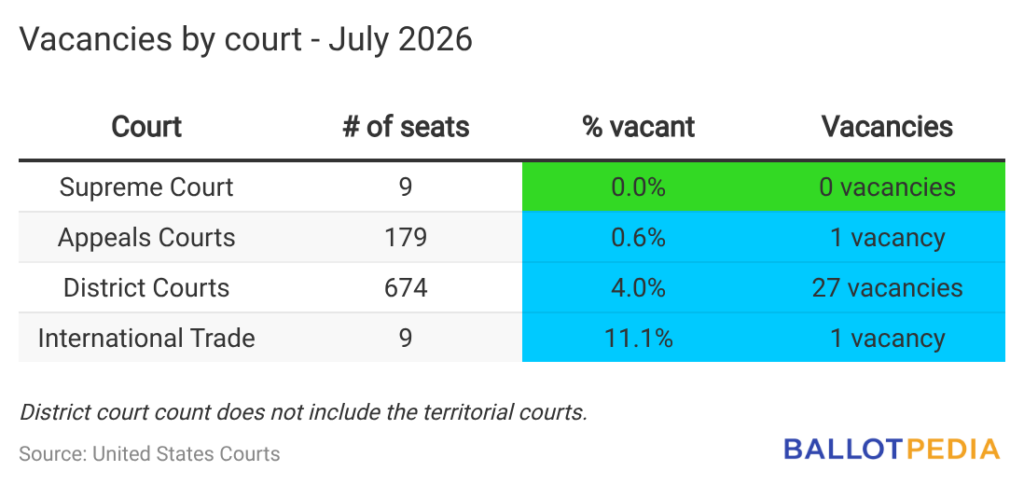
*Though the U.S. territorial courts are named as district courts, they are not Article III courts. They are created in accordance with the power granted under Article IV of the U.S. Constitution. Click here for more information.
New vacancies
No judges left active status since the previous vacancy count. The president nominates individuals to fill Article III judicial vacancies. Nominations are subject to U.S. Senate confirmation.
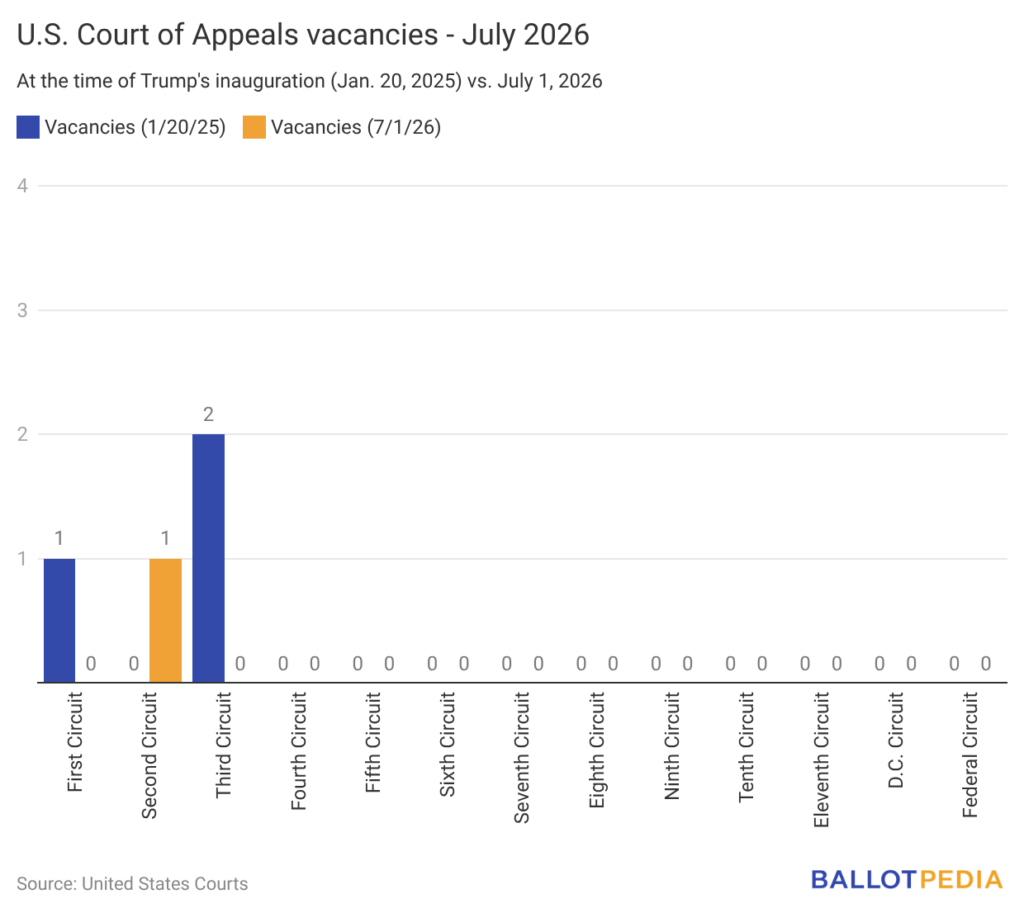
The following chart tracks the number of vacancies in the U.S. Courts of Appeals from President Donald Trump's (R) inauguration to the date indicated on the chart.
U.S. District Court vacancies
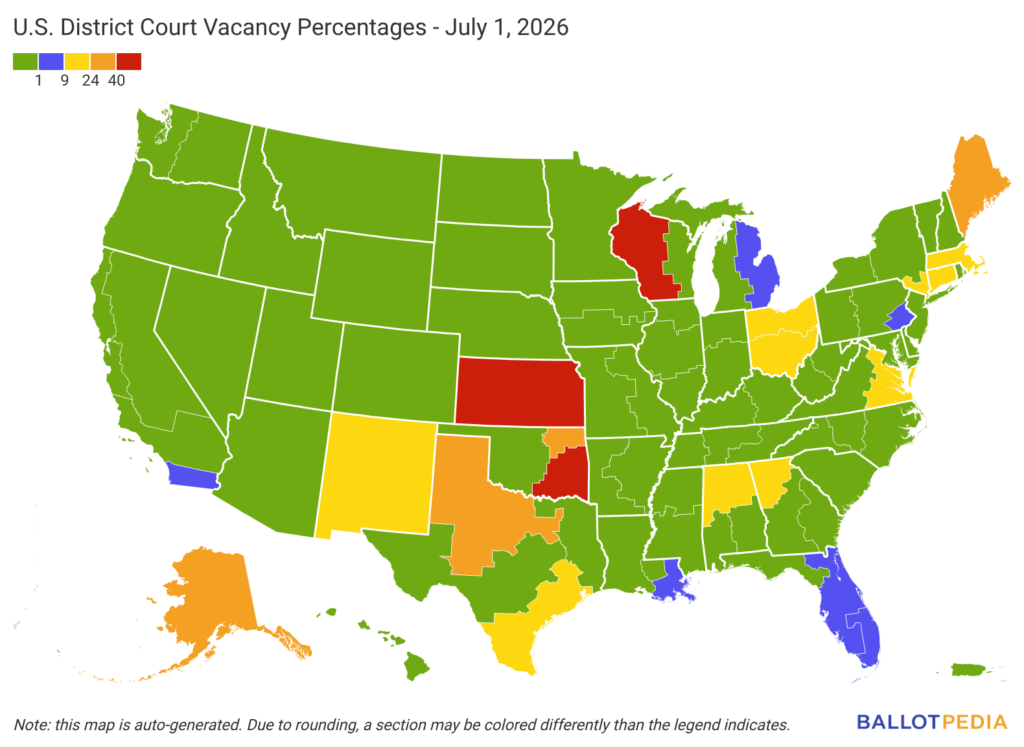
The following map shows the number of vacancies in the U.S. District Courts as of July 1.
New nominations
President Trump announced two new nominations since the June 2026 report:
- Greg Cook, to the U.S. District Court for the Northern District of Alabama.
- Anna St. John, to the U.S. Court of Appeals for the Fifth Circuit.
The president has announced 60 Article III judicial nominations since taking office on Jan. 20, 2025. For more information on the president’s judicial nominees, click here.
New confirmations
As of July 1, the Senate has confirmed 45 of President Trump’s judicial nominees — 38 district court judges and seven appeals court judges — since January 2025.
The Senate has confirmed four Article III judicial nominees since the June 2026 report:
- Tony Powell, to the U.S. District Court for the District of Kansas
- Tony Mattivi, to the U.S. District Court for the District of Kansas
- Jeffrey Kuhlman, to the U.S. District Court for the District of Kansas
- Katie Lane, to the U.S. District Court for the District of Montana
Comparison of Article III judicial appointments over time by president (1981–Present)
- Presidents have made an average of 65 judicial appointments through July 1 of their second year in office. President Barack Obama (D) had the most appointees confirmed with 99, and President Trump had the fewest confirmations with 45.
- President Bill Clinton made the most appointments through four years with 174. President George W. Bush made the fewest through four years with 122.
- President Obama made the most appointments through two years with 134. President George W. Bush made the fewest with 54.
- President Obama made the most appointments through one year in office with 45. President George W. Bush made the fewest with 22.
Need a daily fix of judicial nomination, confirmation, and vacancy information? Click here for continuing updates on the status of all federal judicial nominees.
Or, keep an eye on this list for updates on federal judicial nominations.
Looking ahead
We’ll be back on July 27 with a new edition of Robe & Gavel. Until then, gaveling out!
Contributions
Myj Saintyl compiled and edited this newsletter, with contributions from Sam Post, Ellie Mikus, and Spencer Richardson.