


On June 24, the U.S. Department of Agriculture (USDA) released fiscal year 2025 (FY25) payment error rate data for the Supplemental Nutrition Assistance Program (SNAP). This was the first update of payment error data since the One Big Beautiful Bill Act (OBBBA) established a cost-share system based on this data, and the first year of data that may determine the share of benefit costs that states must pay beginning in 2028.
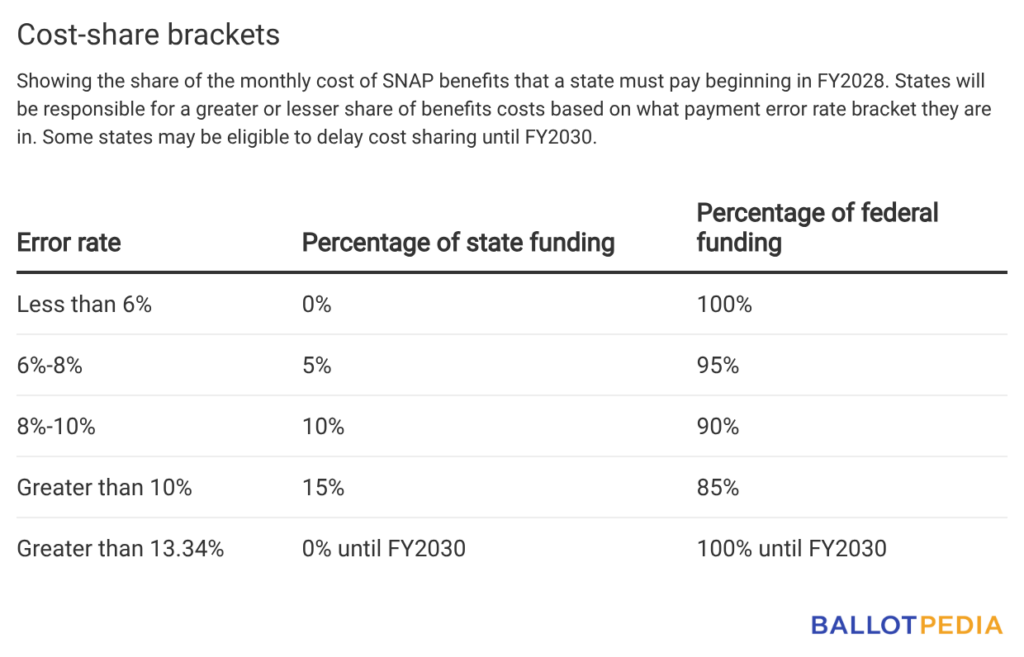
Payment errors occur when SNAP benefits are issued incorrectly, either to an ineligible household, in the wrong amount, or based on misapplied eligibility rules. The OBBBA, which President Donald Trump (R) signed into law in 2025, established a cost-share system for SNAP benefits, under which states must pay a share of benefits based on their payment error rate. Beginning in fiscal year 2028, states will be required to pay a share of SNAP benefit costs if their program error rates exceed 6%. Previously, the federal government has paid for the entirety of SNAP benefit costs.
For FY28, states will be able to choose to use their 2025 or 2026 error rate to determine their cost-share. Starting in FY29, the cost share will be calculated using the rate from three years prior (e.g., error rate from 2026 determines cost-share in 2029). States with error rates from 6%-8% will pay 5% of benefits, states with 8%-10% will pay 10% of benefits, and states with error rates over 10% will pay 15%. For states with error rates under 6%, the federal government will continue to pay all of SNAP benefits. For states with exceptionally high error rates (where the rate × 1.5 exceeds 20%, or 13.34%), implementation of this section can be delayed until FY30.
Error rates are determined through federally required quality control reviews on sampled cases. States submit their rates to the USDA, which verifies the data, and works with states to locate the source of errors or implement corrective action plans.
Biggest increases and decreases in payment error rate
The release of FY25 payment error data marks the first update to states’ rates since federal law created financial penalties for error rates above certain thresholds. Whether or not a state’s rate increased or decreased since this change may provide an indication as to how a state is responding to these penalties.
Between FY24 and FY25, the error rate in 25 states and the District of Columbia increased, and the error rate decreased in the remaining 25 states. Click here to see a visualization that displays the change in each state's error rate from FY24 and FY25.
The five states where the error rate increased the most were:
- Hawaii (+4.24%, Democratic trifecta);
- Delaware (+3.63%, Democratic trifecta);
- Minnesota (+3.6%, divided government);
- Illinois (+3.11%, Democratic trifecta); and
- New Mexico (+2.2%, Democratic trifecta).
The five states where the error rate decreased the most were:
- New Jersey (-7.47%, Democratic trifecta);
- Kentucky (-4.41%, divided government);
- North Carolina (-2.85%, divided government);
- West Virginia (-2.74%, Republican trifecta); and
- Ohio (-2.25%, Republican trifecta).
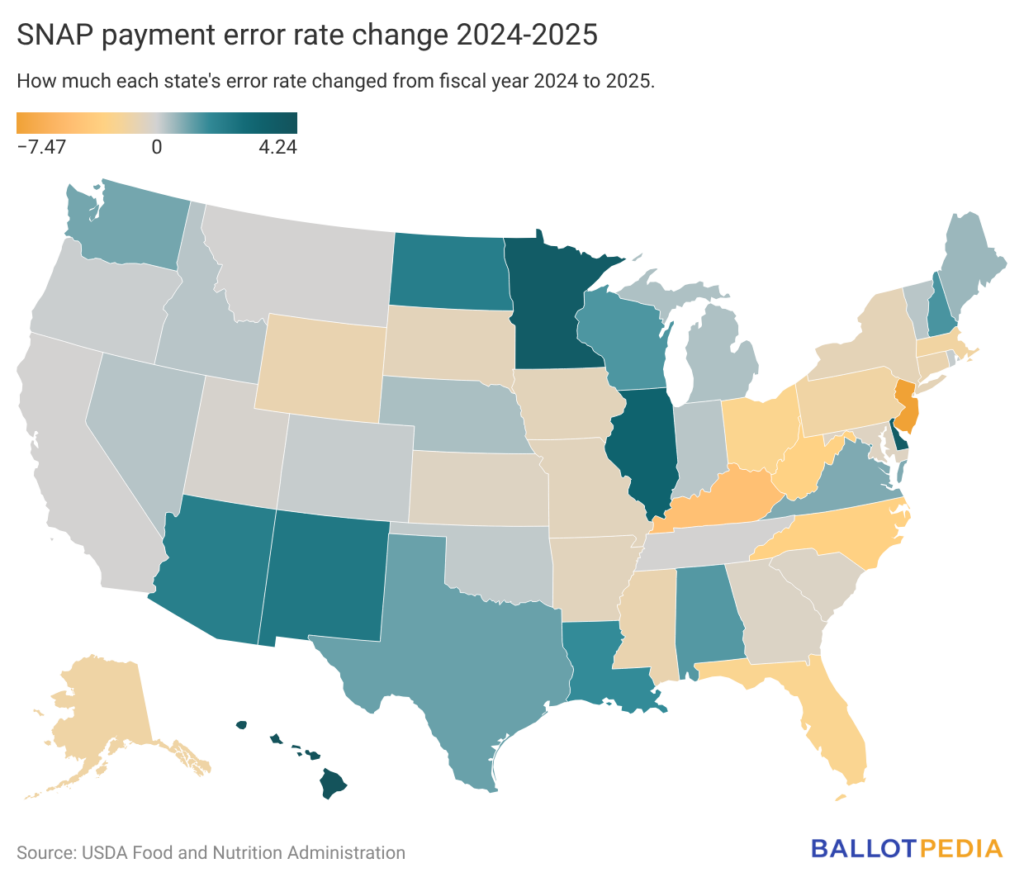
Among the five states where the error rate increased the most, four were Democratic trifectas and one was a divided government. Among the five states where the error rate decreased the most, there was no trend in trifecta status, with the group containing two Republican trifectas, one Democratic trifecta, and two divided governments.
The reason why payment error rates increase or decrease depends on various factors, including whether or not states have pursued policy changes intended to reduce those error rates, and the efficacy of those changes in reducing error rates.
For example, in testimony to the New Jersey Legislature, Stephen Cha, the director of the agency that administers SNAP in the state, said that his department was implementing protocols to reduce payment errors and coordinating closely with county officials that process SNAP applications as part of those efforts.
On the other hand, Niki Kozlowski, director of New Mexico's Income Support Division, said that reducing the payment error rate is her division's top priority, but that the division was taking a strategic approach to the timing of corrective measures. That's because New Mexico currently qualifies to delay the start of cost-sharing until 2030, and reducing the error rate before then may result in increased costs for the state. The department requested an additional $2.9 million in funding to reduce the state's payment errors through technological improvements and additional caseworkers.
Changes in states' cost-share bracket
Overall, 13 states moved down at least one bracket, meaning either they will be expected to pay a smaller percentage of SNAP benefits in 2028 or that they no longer have an error rate high enough to qualify to delay the beginning of the cost-share. Ten states moved up at least one bracket, meaning either they will be expected to pay a greater percentage of SNAP benefits in 2028 or that they now have an error rate high enough to qualify to delay the beginning of the cost-share.
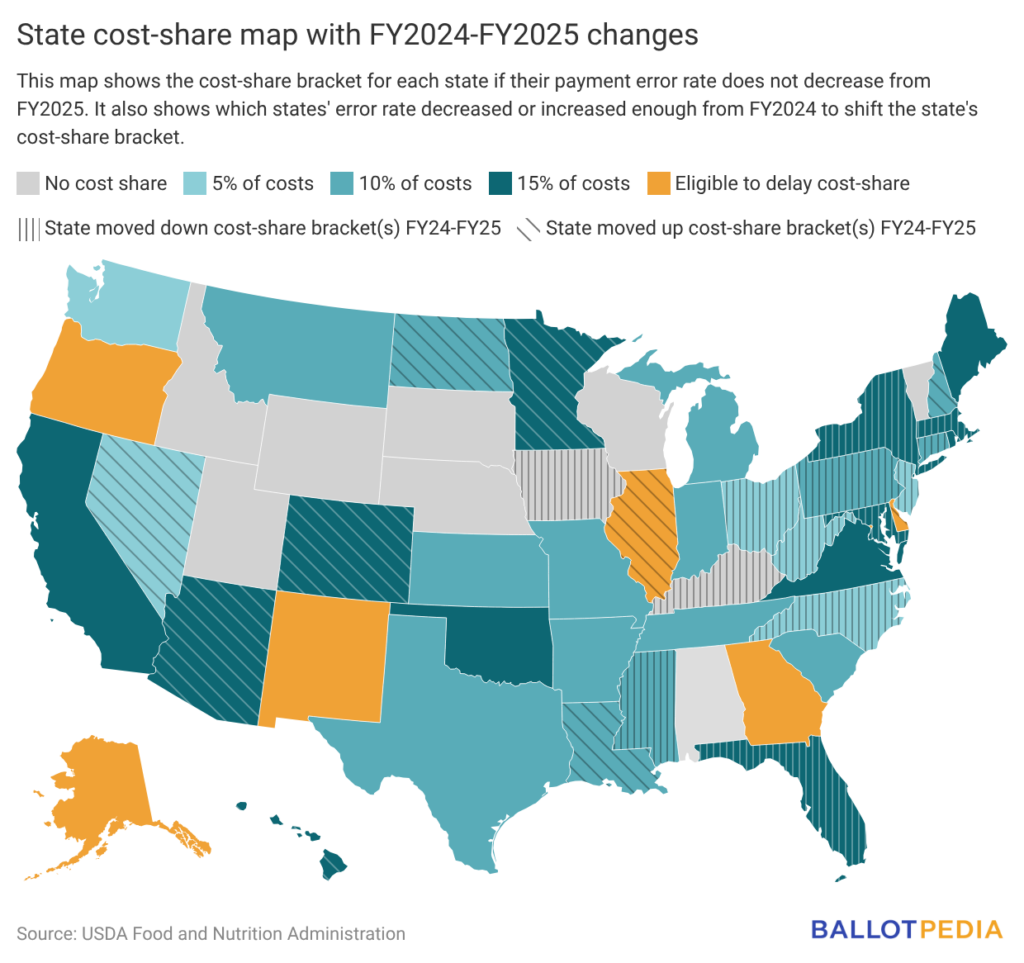
The 13 states that went down at least one bracket include five states with Democratic trifectas, five with a Republican trifecta, and three with divided government. The ten states that went up at least one bracket include four with Democratic trifectas, three with Republican trifectas, and three with divided government.
Florida, Maryland, Massachusetts, New Jersey, and New York lost their eligibility to delay the cost-share. Of these five states, four dropped one bracket, requiring payment of 15% of benefits. New Jersey dropped multiple brackets, to the 5% bracket.
Two states with a Democratic trifecta — Delaware and Illinois — gained eligibility to delay the cost-share. Both of these states were previously in the 15% bracket.
Twenty-seven states and the District of Columbia remained in the same bracket as projected by 2024 error rates. See the maps below for more information.
Click here to read more about the implementation of SNAP provisions from the OBBBA.