



The Idaho secretary of state announced on July 13, 2026, that Idahoans United for Women and Families submitted enough valid signatures to place an initiative on the ballot to create a right to reproductive freedom and privacy in state law.
The initiative would provide that “Every person has the right to reproductive freedom and privacy." It would state that each person has the right to “make personal decisions about reproductive healthcare that directly impacts the person’s own body,” and define personal decisions to include the following:
- abortion;
- childbirth care;
- contraception;
- fertility treatment;
- miscarriage care; and
- prenatal, pregnancy, and postpartum care.
The measure would state that the government could regulate abortion after the point of fetal viability, except in cases of a medical emergency.
Support and opposition to the initiative
Back to Idaho, organized by Idahoans United for Women and Families, is the campaign supporting a ‘yes’ vote on the initiative. A statement on the Back to Idaho website states, “This initiative would restore the personal liberty to make one’s own reproductive healthcare decisions—including birth control, IVF, regulated abortion access, and more—with their doctor WITHOUT undue government overreach. It’s the standard we had in Idaho for nearly 50 years (also known as the 'Roe Standard') and means decriminalized abortion up to fetal viability and past that in cases of medical emergency or fatal fetal diagnosis.”
The Democratic Party of Idaho publicly endorsed the initiative. In a press release from September 2025, Idaho Democratic Party Chair Lauren Necochea said, “Now, Idahoans have the power to act. The Reproductive Freedom and Privacy Act would restore reasonable access to abortion health care, protect access to birth control and fertility treatments like IVF, and ensure that deeply personal medical decisions remain private between women, their families, and their doctors, not dictated by politicians.”
Right to Life Idaho publicly opposes the initiative. Megan Wold, an attorney for Right to Life Idaho, said the initiative “would allow abortion for any reason up until the moment that a baby can survive outside of its mother's womb on its own. That is far more extreme than even Roe vs. Wade allowed. And even after that point, under a broad exception written into the law, abortion would be permitted in many cases, meaning that even if a baby could be safely delivered, abortion would still be allowed. That does not protect women. That guts protections for unborn children."
Additionally, the Idaho Freedom Foundation opposes the initiative. Ron Nate, the president of the foundation, said, “Some Idahoans would be ok with a law only allowing abortion in special circumstances, but this initiative is more extreme than prior law. It would allow abortions to the moment before birth, and for minors without parental consent. This is way too extreme."
Other 2026 ballot measures concerning abortion
In 2026, voters in four states will decide ballot measures related to abortion policy.
Three measures would provide for a state right to abortion: the citizen-initiated statute in Idaho and legislatively referred constitutional amendments in Nevada and Virginia
Voters in one state—Missouri—will decide on a ballot measure to repeal the constitutional right to abortion that voters approved in 2024, prohibit abortion, and prohibit surgical procedures for transgender minors.
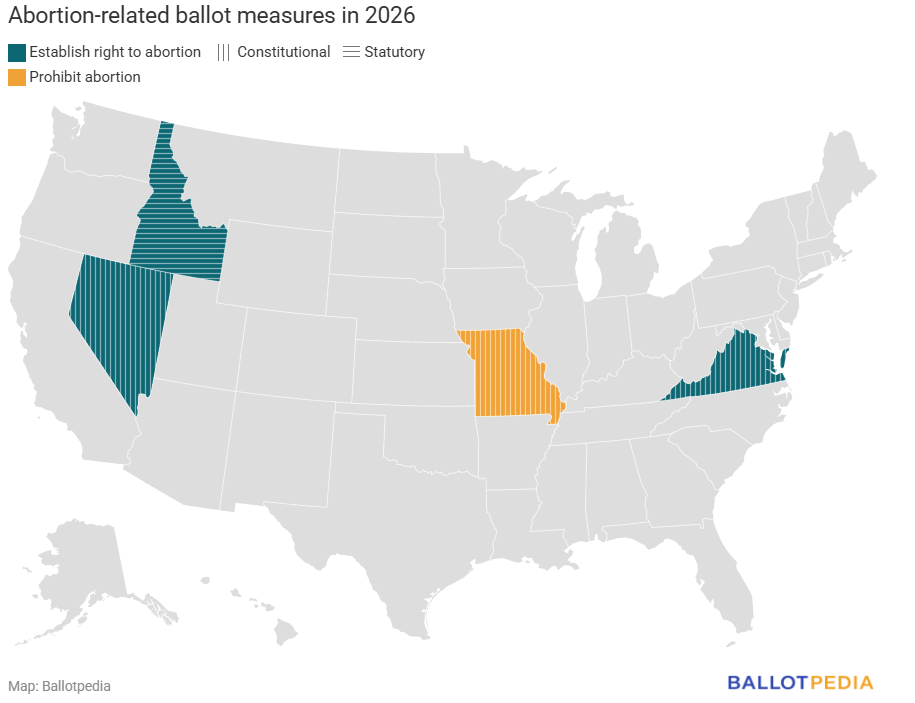
The 2026 measures follow a record year for abortion-related ballot measures in 2024, when voters decided 11 statewide measures—the most in a single year. From 1970 through 2025, voters decided 65 abortion-related ballot measures. Of those, 44 had the support of organizations that described themselves as pro-life, while 21 had the support of organizations that described themselves as pro-choice or pro-reproductive rights.
Medical Marijuana Legalization Initiative
The Right to Reproductive Freedom and Privacy Act Initiative is the only citizen-initiated measure to appear on Idaho's 2026 ballot. The Natural Medicine Alliance of Idaho submitted signatures in support of an initiative that would legalize the use of marijuana for medical purposes. However, the Idaho secretary of state announced that the campaign did not meet the signature requirement to place the measure on the ballot.
Had the initiative qualified for the 2026 ballot, voters would have decided two measures concerning marijuana laws in November. In March 2025, the Idaho State Legislature placed HJR 4 on the 2026 ballot. The constitutional amendment, if approved, would provide that only the Idaho State Legislature shall have the authority to legalize marijuana, narcotics, or other psychoactive substances. The amendment would therefore create a subject restriction on the initiative process by prohibiting citizen-initiated state statutes from legalizing those substances.
Additional reading: