


Welcome to the Wednesday, July 15, 2026, Brew.
By: Lara Bonatesta
Here’s what’s in store for you as you start your day:
- South Carolina and Maine will be the first states to replace a major party U.S. Senate nominee since 2016
- Virginia's 2nd Congressional District Aug. 4 Democratic primary highlights debate over the DCCC’s role in contested primaries
- Trump White House has 411 employees, according to annual report
South Carolina and Maine will be the first states to replace a major party U.S. Senate nominee since 2016
South Carolina joined Maine as the second state where a major party will replace its U.S. Senate nominee this year, following the July 11 death of U.S. Sen. Lindsey Graham (R-S.C.). The last major party candidate to replace another on the ballot for Senate was Evan Bayh (D-Ind.), who replaced Baron Hill (D-Ind.) in 2016. There have not been multiple major party replacement candidates for U.S. Senate on the ballot in one year since 2002.
All states except California and Washington, which both use top-two primaries, allow candidates to be replaced after winning their party’s nomination.
Maine’s Graham Platner (D) and Lindsey Graham are the 12th and 13th major party Senate nominees to leave a race since 1976, either voluntarily or due to death. Ten were Democrats and three were Republicans.
In eight cases, a replacement nominee appeared on the ballot, and two won the general election. In 1978, John Warner (R-Va.) won after nominee Richard Obenshain (R-Va.) died in a plane crash. In 2002, former Senator Frank Lautenberg (D-N.J.) won after Robert Torricelli’s withdrawal.
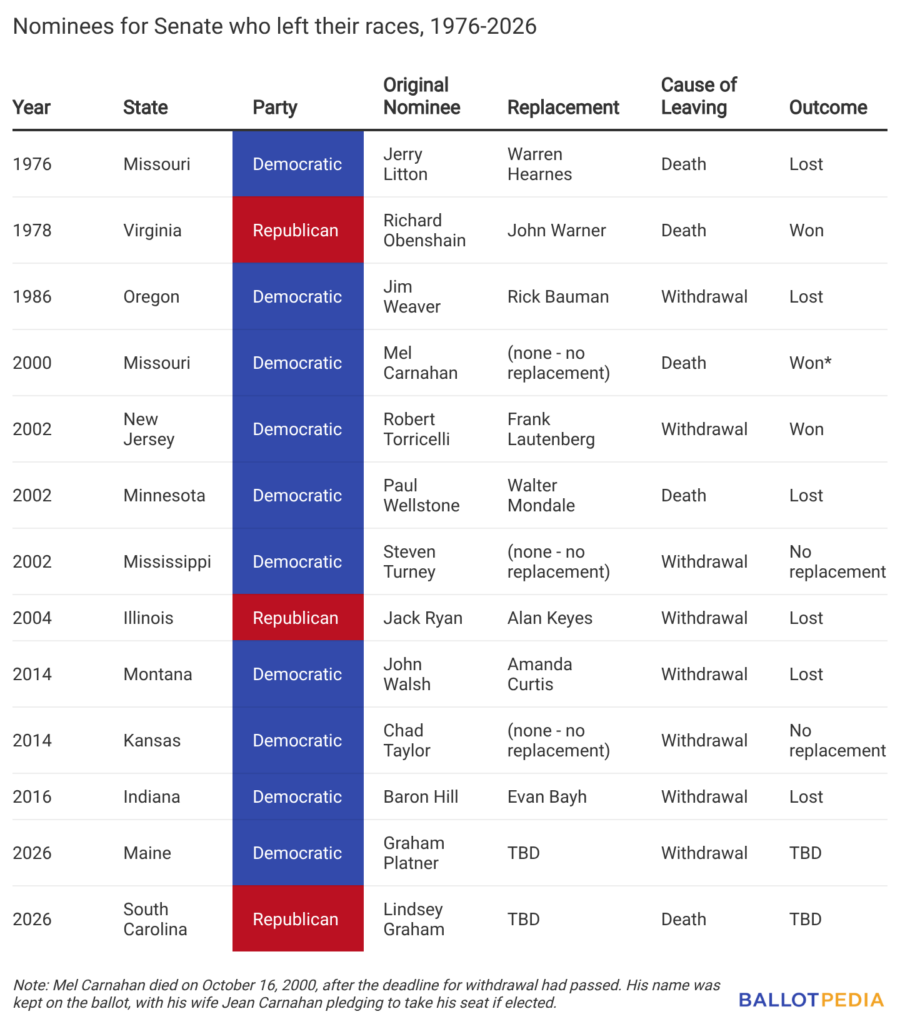
Graham was running for a fifth term and had defeated five opponents for the Republican nomination with 57% of the vote on June 9. Platner won the June 9 Democratic primary for U.S. Senate in Maine with 72.1% of the vote. Platner withdrew from Maine’s Senate election on July 8.
South Carolina requires a special primary election to be held to replace Graham on the ballot. The primary will be held on Aug. 11, with a possible runoff on Aug. 25. If the primary goes to a runoff, it would be the first Republican Senate primary runoff in South Carolina since 2004. Graham’s elected successor will be the third person elected to the seat since 1956. Graham’s predecessor, Strom Thurmond (R-S.C.) served from 1956 to 2003.
In Maine, the Democratic Party has until July 27 to select a replacement nominee.
On July 13, South Carolina Gov. Henry McMaster (R) appointed Darline Graham Nordone, Graham’s sister, to serve the rest of his term until January 2027.
Graham was the first Senator from South Carolina to die in office since Olin D. Johnston (D) died on April 18, 1965. He is the fourth Senator to die in office since 2013:
- Sen. Dianne Feinstein (D-Calif.) died on Sept. 29, 2023, during the 118th Congress. Her seat was vacant for four days.
- Sen. John McCain (R-Ariz.) died on Aug. 25, 2018, during the 115th Congress. His seat was vacant for 11 days.
- Sen. Frank Lautenberg (D-N.J.) died on June 3, 2013, during the 113th Congress. His seat was vacant for seven days.
Graham was the sixth member of the 119th Congress to die in office:
- Rep. David Scott (D-Ga.) died on April 22. As of July 14, Georgia's 13th Congressional District has been vacant for 83 days.
- Rep. Doug LaMalfa (R-Calif.) died on Jan. 5. California's 1st Congressional District was vacant for 156 days.
- Rep. Gerald Connolly (D-Va.) died on May 21, 2025. Virginia's 11th Congressional District was vacant for 112 days.
- Rep. Raúl Grijalva (D-Ariz.) died on March 13, 2025. Arizona's 7th Congressional District was vacant for 244 days.
- Rep. Sylvester Turner (D-Texas) died on March 5, 2025. Texas' 18th Congressional District was vacant for 334 days.
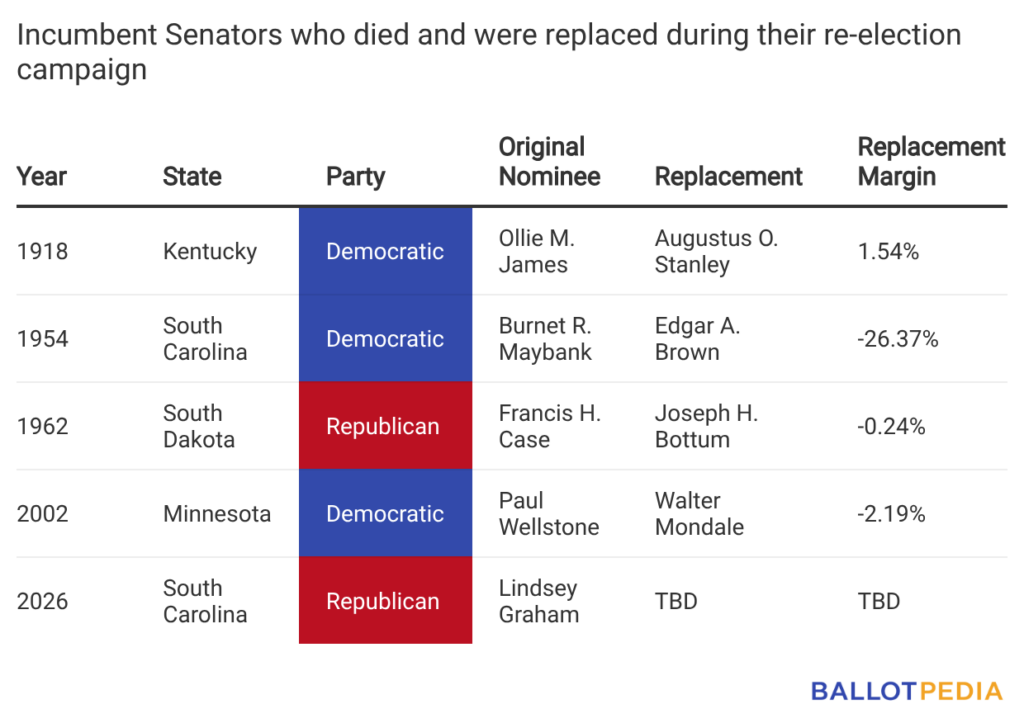
Graham is the first senator to die during a re-election campaign since Paul Wellstone (D-Minn.) died in 2002. The last Republican senator to die during their re-election campaign was Francis Case (R-S.D.) in 1962. Graham is the fifth incumbent senator to die during a re-election campaign since 2018. South Carolina is also the first state where more than one incumbent died during their re-election campaigns and had to be replaced. In 1954, Burnet R. Maybank (D-S.C.) died and was replaced by Edgar A. Brown (D-S.C.). Strom Thurmond (D-S.C.) defeated Brown in a write-in campaign by a 26% margin. Thurmond changed parties from Democratic to Republican in 1964.
Of the four elections in which an incumbent died, their replacement won once. In 1918, Augustus O. Stanley replaced nominee and incumbent U.S. Ollie M. James (D-K.Y.) on the ballot following James’ death Aug. 28, 1918. Stanley won the 1918 general election for U.S. Senate in Kentucky 50.8% to 49.2%.
To read more about Senate elections in 2026, click here.
Virginia's 2nd Congressional District Aug. 4 Democratic primary highlights debate over the DCCC’s role in contested primaries
The Aug. 4 Democratic Party primary in Virginia's 2nd Congressional District is part of a national fight over the Democratic Congressional Campaign Committee's (DCCC) role in supporting candidates in contested primaries.
Four candidates are running. The DCCC is supporting Elaine Luria, who was elected to represent the district in 2018 but ultimately lost re-election to current incumbent Jennifer Kiggans (R) in 2022, as one of 26 Democratic candidates currently in its Red to Blue program. The DCCC added 19 of those 26 candidates to their list before their primaries occurred. Of those 19, 15 ran or are running in contested primaries. (Note: the count of 19 candidates does not include Jasmeet Bains in California’s 22nd Congressional District or Joe Baldacci in Maine’s 2nd Congressional District. Both of whom were added before the contested primaries that they ultimately lost.) If Luria wins the primary, it will set up a rematch between her and Kiggans.
Two of the other three candidates, Nila Devanath, and Patrick Mosolf, joined a statement from 16 other Democratic U.S. House primary candidates opposing the DCCC's involvement. The statement says that DCCC involvement “carries significant influence in the primary process — often shaping fundraising pipelines, access, and perceived viability before voters have had the opportunity to evaluate the full field.” The statement also says that DCCC involvement “risks weakening voter trust and diminishing the role of voters in selecting their own nominees.”
RVA Magazine’s R. Anthony Harris wrote that supporters of DCCC involvement “argue that early consolidation prevents costly internal battles and strengthens nominees heading into competitive general elections.” In an interview on Face the Nation, U.S. Rep. Suzan DelBene (D-Wash.), who is also DCCC chair, said “We only weigh in on primaries when we feel that one candidate stands out as the strongest possible nominee to ensure that we win in the general election. This election is too important to do anything else.”
One other candidate – Bill Fleming – is also running in the Democratic primary. Devanath and Luria lead in fundraising and media attention.
Devanath is a physician and attorney and is currently the regional associate medical director for Sentara Community Care. She earned her bachelor's degree in neuroscience and psychology from the University of Pittsburgh, her law degree from Harvard Law School, and her medical degree from the University of Pittsburgh School of Medicine. Before practicing medicine, she worked as an attorney for victims of domestic violence at a legal aid clinic. On her campaign website, Devanath says she is running "to make healthcare more affordable, bring down everyday costs, and deliver practical leadership rooted in compassion and results."
Luria earned her bachelor's degree in physics from the U.S. Naval Academy and served as a Navy commander for 20 years before retiring. She was first elected to the House in 2018 after defeating Republican incumbent Scott Taylor 51%-49%. She was reelected in 2020, again defeating Taylor in the general election, and lost to Kiggans in 2022. Luria said in a statement, "I cannot sit back and watch as Republicans in Congress create chaos while failing to address the rising cost of living and the issues that matter to Coastal Virginians. Virginians are hungry for change, and I look forward to getting back to work for Hampton Roads."
Click here to learn more about the Democratic primary in Virginia’s 2nd Congressional District.
Trump White House has 411 employees, according to annual report
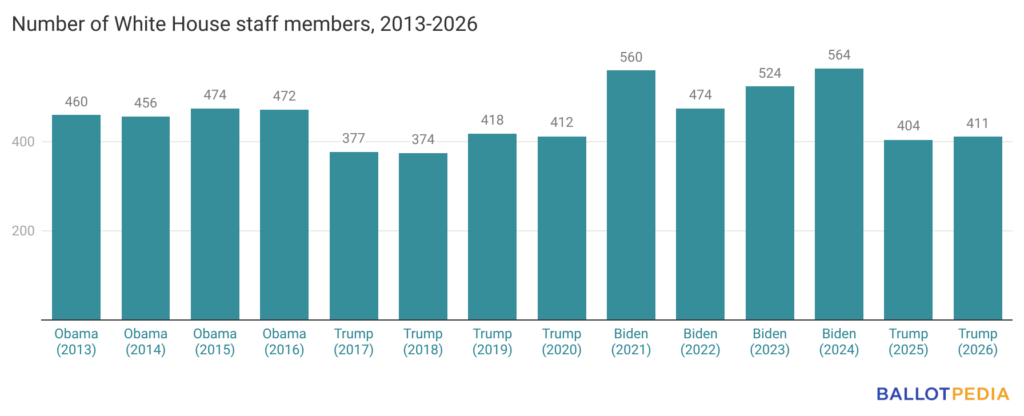
According to the annual White House report to Congress on personnel, the Trump White House includes 411 staff members, more than the average of 395 from Trump’s first term and up from the total of 404 staff members in 2025. The report, which the White House released on July 1, details White House staff members and their salaries.
The Trump White House currently has fewer employees than the Biden White House had at any point during Joe Biden’s (D) administration, according to data from past reports.
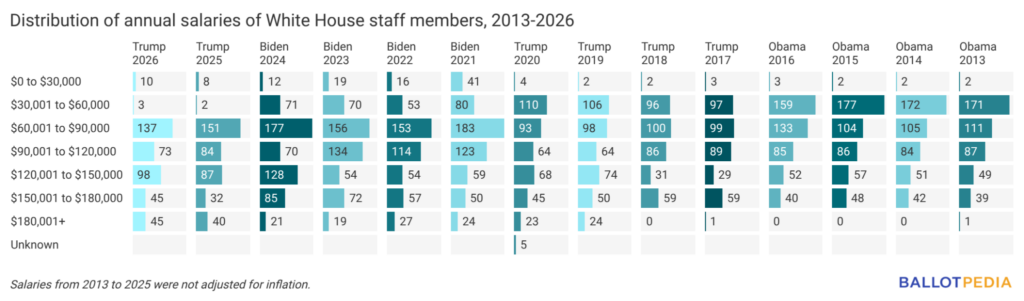
The chart below compares the distribution of salaries from this year’s report to previous years.
Forty-six staff members are detailees — staff temporarily assigned to the White House from another agency or department — including three part-time detailees. The other 365 are employees.
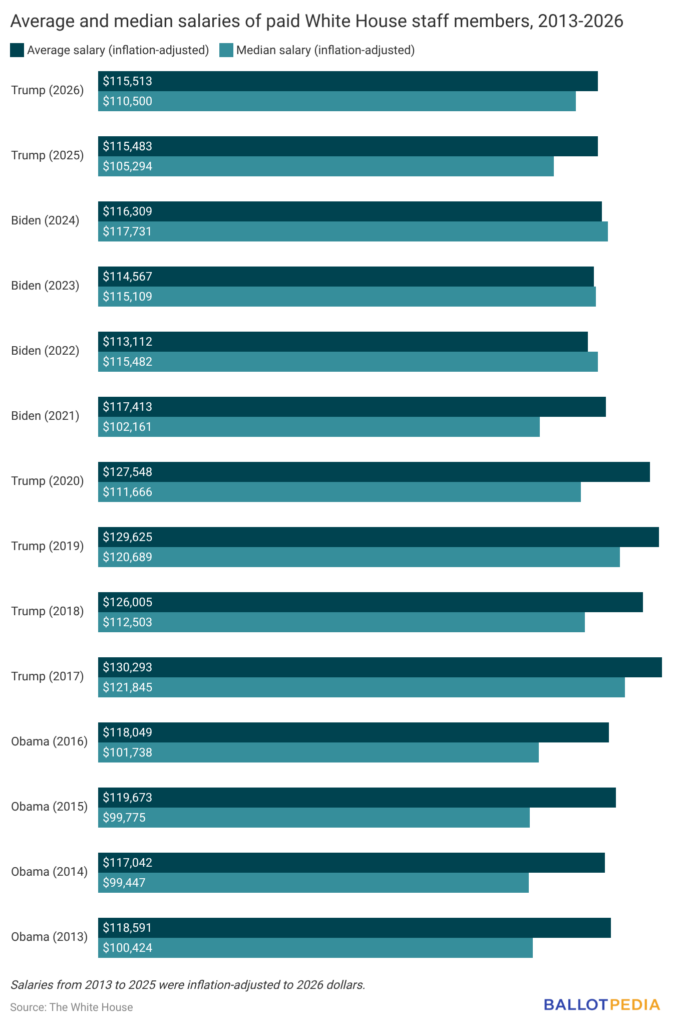
Ten staff members receive no salary, four of whom are advisors. The average salary among paid staff members is $115,513.
Forty-five staff members earn a salary of more than $180,000. The nine highest-paid staff members are detailees who each receive an annual salary of $197,200.
The largest share of staff members, 137, receive salaries between $60,001 and $90,000, and the second-largest share, 98, receive salaries between $120,001 and $150,000.
As of the July 2025 report, the second Trump administration had 404 staff members. Thirty were detailees, and the other 374 were employees. The average salary among paid staff members was $115,483, adjusted for inflation to 2026 dollars.
See the chart below for the average and median salaries of paid White House staff members from 2013 to 2026. Salaries between 2013 and 2025 were inflation-adjusted to 2026 dollars.
Click here to learn more about Trump’s White House staff.