Highlights from this edition of Checks and Balances include a 6-3 Supreme Court ruling for presidential removal of independent agency commissioners, and a South Carolina law with a REINS-style provision, judicial deference prohibition, and sunset review requirement
In Washington
Supreme Court rules 6-3 for presidential removal of independent agency commissioner
On June 29, the U.S. Supreme Court ruled 6–3 in the case of Trump v. Slaughter that the president may remove a leader of a multi-person independent agency for reasons other than those enumerated in statute. The court upheld President Donald Trump's (R) 2025 dismissal of Federal Trade Commission (FTC) Commissioner Rebecca Slaughter, ruling that the Federal Trade Commission Act of 1914 unconstitutionally restricted presidential power by limiting the reasons for which a commissioner could be dismissed.
The ruling overturned the 1935 precedent of Humphrey's Executor v. United States, which had identified the reasons enumerated in the Act – "inefficiency, neglect of duty, or malfeasance in office" – as the only valid reasons for presidential dismissal of an FTC commissioner. In subsequent jurisprudence, the Humphrey's Executor precedent limited presidential power to remove leaders of multi-member independent agencies to the reasons the U.S. Congress enumerates in statute.
There are approximately 80 federal agencies that demonstrate characteristics of independent federal agencies, which are executive agencies established by statute outside the Executive Office of the President and the 15 executive departments led by cabinet secretaries. Independent agencies have historically defined their independence partly by their protection from presidential removal. A 2012 report from the Administrative Conference of the United States — an independent agency itself — described protections for agency leaders that prevent them from being removed without a specific, statute-specified cause as meaning "independence from political interference, particularly removal by the President." The Trump v. Slaughter decision rejects this definition.
Chief Justice John Roberts wrote for the majority that "although it is up to the Senate to decide whether to confirm those with whom the President would prefer to work, neither Congress nor the courts may saddle him with those with whom he cannot work. Subordinates who exercise the President's power are subject to removal by him. Then, and only then, can they remain accountable to the President, and the President to the people."
Justices Samuel Alito, Neil Gorsuch, Brett Kavanaugh, Amy Coney Barrett, and (in part) Clarence Thomas joined in Roberts’ opinion. Gorsuch also filed a concurring opinion, in which he argued that the court’s opinion was an important step in limiting the power of independent agencies but that “it would be a grave mistake to think that step is enough on its own. The fact remains that Congress has endowed formerly independent agencies not just with executive authority, but with enormous legislative and judicial powers as well. And now the President enjoys control over all those powers too. From here, the only sure path is to finish the journey we start today and restore legislative and judicial powers to where they belong: in Congress and the courts.”
Justice Sonia Sotomayor, joined by Justices Elena Kagan and Ketanji Brown Jackson, dissented, writing that “today, this Court undoes centuries of political practice and concludes that all three branches of Government have been acting in open defiance of the Constitution all this time. Its conclusion is wrong. The text of the Constitution, along with its history, the longstanding practices of the political branches, and the precedents of this Court, make clear that Congress may limit the causes for which the heads of Commissions like the FTC can be removed by the President.”
Roberts also wrote in the majority opinion that "because the FTC's activities fall well within the heartland of executive power, the Court has no occasion today to define the bounds of what such power entails. Not all offices created by Congress necessarily come with executive power.”
What was the case about?
Trump dismissed Alvaro Bedoya and Rebecca Slaughter, the two Democratic members of the FTC, on March 18, 2025. The commission is composed of five members (no more than three from the same political party), nominated by the president and confirmed by the Senate for a seven-year term. President Joe Biden (D) appointed Bedoya to the commission in 2022, while Trump appointed Slaughter in 2018 and Biden re-appointed her for a second term in 2023.
Trump wrote in an email to Bedoya and Slaughter that their "continued service on the FTC is inconsistent with my Administration's priorities," and that the dismissal was "pursuant to my authority under Article II of the Constitution." The Federal Trade Commission Act identifies "inefficiency, neglect of duty, or malfeasance in office" as reasons for which a president may dismiss a commissioner. Bedoya and Slaughter sued to challenge their dismissal, citing the fact that Trump did not identify any of these causes. On July 18, 2025, a federal district court judge dismissed Bedoya’s case (he had resigned as a commissioner in June), but ruled that Slaughter should be reinstated. The federal government appealed, and the D.C. Circuit Court of Appeals declined to stay the order. The government then filed an emergency stay application with the Supreme Court on Sept. 4. On Sept. 22, the Court granted the stay in a 6–3 decision and heard oral arguments in the case on Dec. 8.
What was the Humphrey’s Executor precedent?
Humphrey's Executor v. United States was a 1935 case in which the estate of William E. Humphrey, an FTC commissioner, sued to challenge his 1933 dismissal from the Commission by President Franklin D. Roosevelt (D). The 1935 Supreme Court ruled unanimously in favor of Humphrey's estate that the President could only remove a FTC commissioner for one of the reasons enumerated in the Federal Trade Commission Act ("inefficiency, neglect of duty, or malfeasance in office").
The Supreme Court upheld Humphrey's precedent in subsequent jurisprudence, including the 1958 case of Wiener v. United States. The Court has narrowed the scope of Humphrey's Executor in recent years with the cases of Seila Law v. Consumer Financial Protection Bureau (2020) and Collins v. Yellen (2021). In these cases, the Court found that statutory removal restrictions on presidential removal of Consumer Financial Protection Bureau and Federal Housing Finance Agency officials were unconstitutional violations of the separation of powers principle, without fully striking down Humphrey's precedent.
In Trump v. Slaughter, the majority opinion rejected Humphrey's reasoning, including the 1935 Court's assertion that FTC commissioners exercise "quasi-judicial and quasi-legislative" powers which do not conflict with executive authority. "If anything more is left of Humphrey's, we overrule it," Roberts wrote, continuing that "Humphrey's has for decades been a result in search of a rationale."
What about the Federal Reserve?
Roberts’ majority opinion in Trump v. Slaughter said that "because the FTC's activities fall well within the heartland of executive power, the Court has no occasion today to define the bounds of what such power entails. Not all offices created by Congress necessarily come with executive power… one example the Court has given of such an entity is the Federal Reserve."
The Court announced its 5–4 decision in Trump v. Cook the same day as the Slaughter decision, upholding an injunction against Trump’s attempted removal of Federal Reserve Governor Lisa Cook in 2025. A district court judge issued an injunction against the dismissal, which was upheld by the D.C. Circuit Court of Appeals on Sept. 15. The Supreme Court agreed to hear the case Oct. 1 and heard oral arguments on Jan. 21, 2026.
Chief Justice Roberts authored the majority opinion, joined by Justices Sonia Sotomayor, Elena Kagan, Ketanji Brown Jackson, and Brett Kavanaugh. Roberts wrote that striking down the injunction (which prevents Trump from removing Cook until litigation in the matter is completed) “would turn for-cause protection into little more than at-will employment…” though “the ultimate question of whether the President can remove Cook for cause will depend in part on the underlying facts. In this opinion, we have not addressed the facts, as they have yet to be found or analyzed under the relevant legal standards. Rather, we have simply addressed the parties’ arguments about the appropriate legal standards under which the facts must be evaluated.”
Justice Kavanaugh filed a concurring opinion, and Justice Jackson also filed a concurring opinion. Justice Clarence Thomas filed a dissenting opinion. Justice Samuel Alito, joined by Justice Neil Gorsuch filed another dissenting opinion. Justice Amy Coney Barrett also filed a dissenting opinion.
What were the reactions?
In a post on the social media site Truth Social, Trump called the Slaughter case a “BIG WIN… confirming Presidential Power in our Country to remove Executive Branch Officers and Agency Appointees, or Representatives, under Article II…” and a “Historic and Unprecedented Ruling, one of the most important ever given with respect to Presidential Powers.”
Slaughter said that “today’s ruling makes it possible for presidents to fire watchdogs who won’t put politics over principle, and replace them with lap dogs. It’s a recipe for corruption; working families will pay the price.”
In a post on the social media site Bluesky, Georgetown Law professor Stephen Vladeck wrote that Slaughter was “an enormously important ruling (far more important than the other three decisions #SCOTUS handed down today). It's a huge win for Trump/the executive. And it's going to have massive ramifications for the functioning of the government long after Trump is gone.”
Want to learn more?
Pick of the news
OMB director says no plans for a DOGE report. Office of Management and Budget Director Russell Vought told the House Appropriations financial services subcommittee that the Office does not plan to release a final report on the U.S. DOGE service. Under the January 20, 2025 executive order that created DOGE, the service lapsed on July 4. Federal News Network
GAO releases report on CIGIE oversight. The Government Accountability Office released a report on the Council of the Inspectors General on Integrity and Efficiency (CIGIE), a central organization for executive branch inspectors general. The report found various lapses in CIGIE’s procedures for reviewing complaints. Government Executive
State AGs, congresspeople call on EPA to classify mifepristone as water contaminant. The attorneys general of 14 states (Alabama, Alaska, Arkansas, Florida, Idaho, Indiana, Kansas, Kentucky, Missouri, Nebraska, Louisiana, Oklahoma, South Carolina and Texas) and 19 members of Congress (all Republicans) sent letters to Environmental Protection Agency Administrator Lee Zeldin calling for the agency to classify the drug mifepristone as a water contaminant. Mifepristone is prescribed for various uses including medication-induced abortion. Stateline
Proposed rule on federal grants would strengthen White House control. The Office of Management and Budget released a proposed rule on federal grantmaking which would require grants to be approved by politically appointed officials and to “where applicable, demonstrably advance the president’s policy priorities.” New York Times
Supreme Court rules for FCC, SEC. The U.S. Supreme Court ruled 8-1 in favor of the Federal Communications Commission’s system for levying fines in FCC v. AT&T, finding that the Commission’s process did not violate the right to a jury trial. In the separate case of Sripetch v. SEC, the Court ruled 9-0 in favor of the Securities and Exchange Commission’s disgorgement authority, which allows the Commission to recover illegal profits. Reuters
In the states
South Carolina adopts REINS-style state law, prohibits judicial deference, requires sunset review
On June 30, South Carolina Gov. Henry McMaster (R) signed H 3021, titled the Small Business Regulatory Freedom Act, into law.
The bill requires legislative approval for all executive agency regulations with estimated costs exceeding $1 million over five years, which Ballotpedia defines as a REINS-style policy. It also prohibits courts from deferring to agency interpretations of a statute. South Carolina is the third state to enact a REINS-style law in 2026, and the fifth state to limit or prohibit judicial deference.
The bill also:
- Requires agencies to review their regulations every five or eight years (a practice known as sunset review); the Legislative Audit Council must determine the schedule. Agencies must repeal those that are no longer statutorily authorized or obsolete. If agencies do not comply with the review schedule, they are prohibited from promulgating any new regulations unless specifically authorized by the General Assembly.
- Requires agencies to submit all responses received during the public comment period for each proposed regulation to the Small Business Regulatory Review Committee.
- And, requires one member of the Small Business Regulatory Review Committee to be in the agribusiness industry.
The South Carolina House of Representatives passed H 3021 108-0 on March 6, with six Democrats and four Republicans not voting and one Democrat and three Republicans absent. Twenty-seven Democrats joined 81 Republicans in support of the bill.
The South Carolina Senate passed H 3021 40-0 on May 6, with two Democrats and three Republicans absent. Ten Democrats joined 30 Republicans in supporting the bill.
The General Assembly reconciled amendments between the chambers and ratified the bill on June 29, sending it to McMaster for his signature.
National Federation of Independent Business State Director Ben Homeyer said, "small business owners spend too much time and money complying with regulations that are outdated, unnecessary, or more complicated than they need to be. H. 3021 is a big step toward making state government more accountable by reviewing rules and regulations and considering their impact on Main Street businesses."
Arguing against REINS-style laws, Public Citizen said, "agencies already undergo rigorous reviews of their proposed rules and solicit comments from the public, business interests, and other agencies. In addition, many rules are promulgated in response to congressional directives… the REINS Act would inappropriately – but deliberately – inject political considerations into a regulatory process that is supposed to be based on objective agency science and expertise."
REINS-style laws
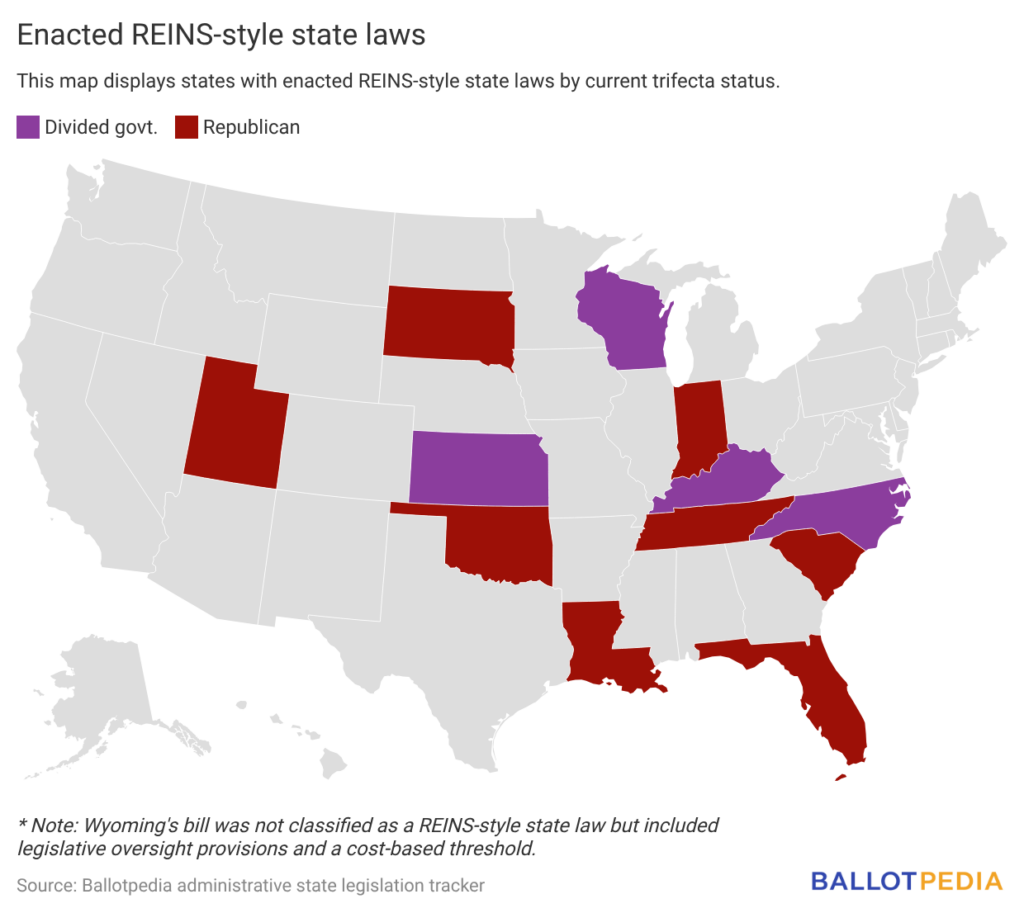
South Carolina is the 12th state to adopt a REINS-style state law since 2010, and the third in 2026 behind South Dakota and Tennessee. Indiana also amended its REINS-style state law in the 2026 legislative session. Five states enacted REINS-style bills in 2025. All of the states that have enacted REINS-style laws since 2010 have had either a Republican trifecta or a divided government at the time of passage.
Ballotpedia defines a REINS-style state law as one that requires legislative approval of a proposed rule exceeding a certain cost threshold before the regulation can take effect. These laws are modeled after a federal legislative proposal called the Regulations from the Executive in Need of Scrutiny Act (REINS Act).
REINS-style state laws are one of several other types of policy proposals designed to increase legislative oversight of agency regulations. REINS-style state laws provide state legislatures with more direct control over major agency regulations with significant economic impacts by granting lawmakers the preemptive authority to review and halt the enactment of certain regulations. They address the separation of powers between state legislatures and state executive branches in administrative rulemaking by undelegating executive branch authority.
Judicial deference
South Carolina is the fifth state to limit or prohibit judicial deference so far in 2026. Georgia, Alabama and Kansas prohibited judicial deference to agencies, and South Dakota limited judicial deference to agencies in determining whether a regulation counts as ‘major’ for the purposes of the state’s REINS law. In 2025, seven states limited or prohibited judicial deference through legislation or court decisions.
In 2024, the U.S. Supreme Court overturned Chevron deference in its Loper Bright Enterprises v. Raimondo decision, and three states ended deference at the state level through legislation.
Judicial deference is an administrative law principle under which courts yield to an executive agency’s interpretation of a statute, regulation, or policy when certain conditions are met. There are different types of judicial deference doctrines at both the federal and state levels. When courts do not apply a deference doctrine, they read the statute, regulation, or policy de novo, deciding the meaning without deferring to any other authority. Judicial deference is central to many debates about the administrative state and the balance of power between executive branch agencies and the courts.
Sunset review
South Carolina is the sixth state to enact laws with sunset review provisions in 2026. Sunset review laws or provisions may require a regular schedule for either agency or legislative review of agency rules. They may also cause a rule to automatically expire at a certain date unless approved by the state legislature to remain in effect.
Want to learn more?
Pick of the news
Florida governor vetoes bill that would have raised damages cap. Florida Gov. Ron DeSantis (R) vetoed HB 145, a bill which would have raised the cap on damages that the state and local governments can be required to pay in residents’ lawsuits. Florida last raised this cap in 2010. Florida Phoenix
Eleven Western governors endorse multistate power transmission task force. The governors of Utah, Colorado, Wyoming, Nevada, Idaho, Oregon, Montana, North Dakota, Arizona, New Mexico and Washington signed a letter endorsing the Western Transmission Expansion Coalition (WestTEC). WestTEC is a multistate task force responsible for studying and developing an action plan to update western power grids. Utah News Dispatch
Washington to join carbon market with California and Quebec. Washington state Department of Ecology Director Casey Sixkiller signed an agreement joining a market for carbon credits with California and the Canadian province of Quebec. California and Quebec must complete additional steps for the market to go into operation. Washington currently auctions carbon credits (which will be traded on this market) every quarter, and requires around 100 companies and other entities in the state to purchase them to offset greenhouse gas emissions. Washington State Standard
Tennessee task force considers changing local power over landfills. Tennessee’s Solid Waste Task Force is considering changes to the Jackson Law, a statute passed in the 1980s which allows local governments that adopt the Law to block new landfills within their jurisdiction. As of January 2026, 54 of Tennessee’s 95 counties, and 18 cities have adopted the Law. Members of the Task Force indicated that they may recommend legislation to reduce this local power to block new landfills. Tennessee also has eight multi-county regional planning boards which are required to develop a long-term plan for waste in their region. Tennessee Lookout
Oklahoma insurance commissioner candidates toughen rhetoric on industry. In the face of rising property insurance rates, the sole Democrat and four Republicans running for Oklahoma insurance commissioner are adopting tough-on-industry rhetoric promising to curb rate increases. Oklahoma is one of 11 states that elect their insurance commissioner. Oklahoma’s insurance commissioner may claim additional regulatory powers if they find the insurance market in the state to be “noncompetitive." Politico E&E News
Featured commentary
How has Loper Bright been applied by lower courts? Center for Progressive Reform researchers Federico Holm and James Goodwin compare lower courts’ use of the 2024 Loper Bright precedent to datasets on courts’ use of the Skidmore and now-defunct Chevron precedents. In 91 lower-court cases decided since Loper, they found an agency win rate comparable to cases involving Skidmore deference, substantially lower than cases decided under the Chevron standard. Click here to read the full article.
In the Media:
- FedWeek, “GAO Report Offers Accounting of Workforce Losses and Reasons for Leaving”
- NOTUS, “The Trump Administration Keeps Ghosting Its Congressional Watchdog”
- Politico, “Tech industry grapples with Trump’s AI about-faces”
- New York Times, “Tensions Are Rising Among States That Rely on the Colorado River”
Regulatory highlight
In this section, we highlight a few of the several regulations reviewed by the Office of Information and Regulatory Affairs (OIRA) each month and discuss an aspect of the federal Congressional Review Act (CRA), an increasingly used mechanism for repealing executive agency regulations. In this edition, we provide an update on how federal legislators have used the Congressional Review Act in the 119th Congress.
Notable regulations
- The Office of Information and Regulatory Affairs (OIRA) completed its review of two U.S. Customs and Border Protection (CBP) final rules that suspend a de minimis administrative exemption for merchandise valued at $800 or less that previously allowed low‑value shipments to enter the U.S. duty‑free. The rulemakings said the regulations aimed to address national emergencies declared by President Trump through a series of 2025 executive orders related to drug trafficking and trade deficits.
Congressional Review Act
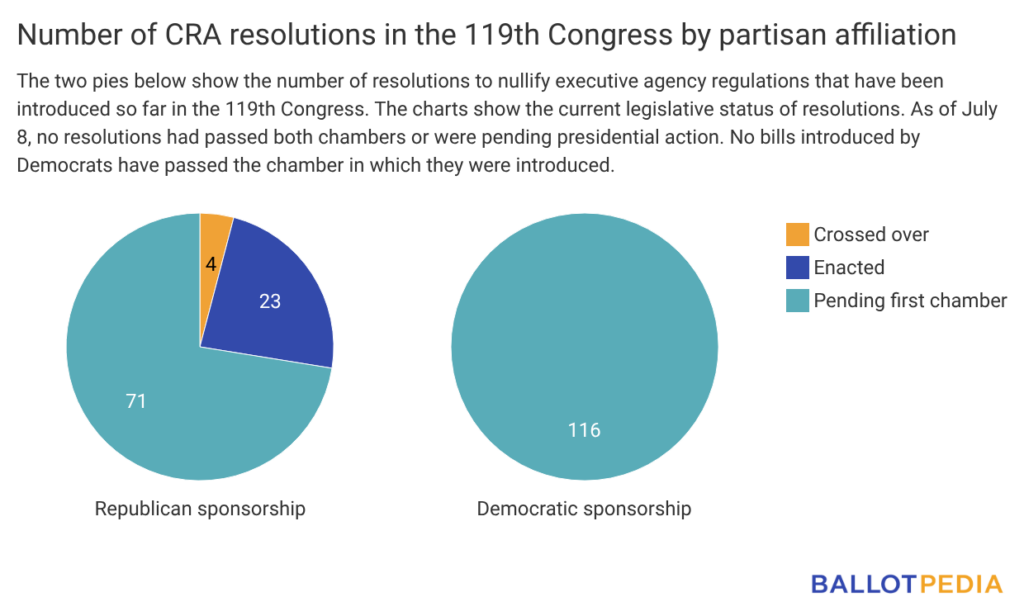
The Congressional Review Act (CRA) allows Congress to repeal executive agency rules with joint resolutions of disapproval. Under the CRA, Congress has 60 working days after a rule has been submitted to Congress to introduce a joint resolution of disapproval.
As of July 8, federal legislators have introduced 214 resolutions of disapproval to nullify agency regulations so far in the 119th Congress. In June, no resolutions saw movement, and the Senate rejected motions to proceed to consideration of three CRA resolutions introduced by Democrats.
- Want to learn more?
Legislative Tracking Update
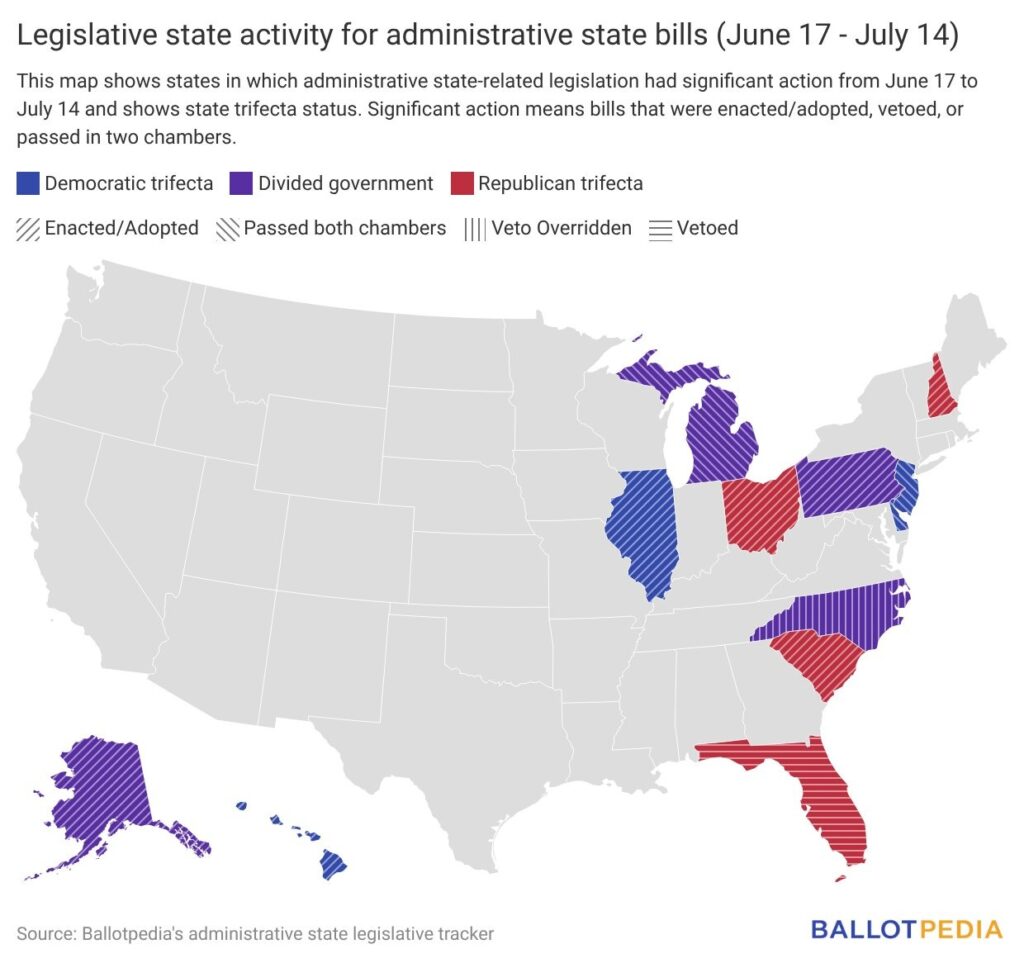
Since our last newsletter edition, Ballotpedia tracked significant legislative action (enactments, vetoes, and passage through both chambers) in 12 states on 16 bills related to the administrative state, as of July 14.
Alaska Gov. Mike Dunleavy (R) signed one bill. The Delaware legislature passed one bill. Florida Gov. Ron DeSantis (R) signed one bill and vetoed one bill. Hawaii Gov. Joshua Green (D) signed one bill. Illinois Gov. J. B. Pritzker (D) signed one bill, and the Illinois legislature passed one bill. The Michigan legislature passed one bill. The North Carolina legislature overrode Gov. Josh Stein’s (D) veto of one bill. New Hampshire Gov. Kelly Ayotte (R) signed one bill, and the New Hampshire legislature passed one bill. New Jersey Gov. Mikie Sherrill (D) signed one bill, and the New Jersey legislature passed one bill. Ohio Gov. Mike DeWine (R) signed one bill. Pennsylvania Gov. Josh Shapiro (D) signed one bill. South Carolina Gov. Henry McMaster (R) signed one bill.
Ballotpedia tracked a total of 1,886 bills related to the administrative state in 2026, as of July 14.