


Welcome to Hall Pass, a newsletter written to keep you plugged into the conversations driving school board governance, the politics surrounding it, and education policy.
In today’s edition, you’ll find:
- On the issues: The debate over Florida's Family Empowerment Scholarship program
- School board filing deadlines, election results, and recall certifications
- 11 states have passed laws related to the Education Freedom Tax Credit this year — here’s how you can follow along
- Rhode Island enacts three-year charter school moratorium
- Extracurricular: education news from around the web
- Candidate Connection survey
On the issues: The debate over Florida's Family Empowerment Scholarship program
In this section, we curate reporting, analysis, and commentary on the issues school board members deliberate when they set out to offer the best education possible in their district. Missed an issue? Click here to see the previous education debates we’ve covered.
On May 5, Florida’s largest public school teachers union, the Florida Education Association (FEA), alleged in a lawsuit that the state’s universal private school choice program violates the Florida Constitution’s requirement for a “uniform, efficient, safe, secure, and high quality system of free public schools.” The policy, officially known as the Family Empowerment Scholarship program, provides enrolled families with government money they can apply toward tutoring, private school tuition, and homeschooling expenses.
The FEA's lawsuit says that “schools receiving taxpayer dollars are no longer held to the same standards, the same oversight, or the same level of accountability. As a result, students are not being served equally.”
In addition to the FEA, other plaintiffs include parents, school board members, and nonprofit organizations.
Florida created the Family Empowerment Scholarship program in 2019. Initially, the program was reserved for students from low-income families. In 2023, Gov. Ron DeSantis (R) signed HB 1, removing the program’s income caps. As of the 2025-26 school year, the Family Empowerment Scholarship program enrolls roughly 521,000 students at a cost of $4.5 billion. Florida spends roughly $31.5 billion on early learning, K-12, and higher education combined.
Florida was the sixth state to expand its private school choice program to cover all or nearly all students, following Arizona (2022), West Virginia (2022), Utah (2023), Iowa (2023) and Arkansas (2023).
Today, 18 states have private school choice programs for which all or nearly all students are eligible. Most of the states with universal private school choice programs, including Florida, have Republican trifectas.
Following the FEA’s lawsuit, supporters and critics of the Family Empowerment Scholarship program took to the pages of Florida’s newspapers to share their perspectives. We feature two such perspectives below.
Sally Butzin, a retired educator and advocate for public schools, says Florida is funding three distinct education systems, ranked from most to least accountable and regulated — traditional public schools, charter schools, and the private schools that accept government funding. Butzin says student achievement in Florida lags most other states in subjects like reading, raising questions about the effectiveness of the private school choice programs. She says that a ruling against the Family Empowerment Scholarship program would lead to more money for public schools and a stronger democracy.
Holly Dunn, a parent who homeschools one child and sends her other to a private school, says Florida’s private school choice program prioritizes students over systems, helping families to access the best learning environments for their children. Dunn says she moved her two children from Indiana to Florida to take advantage of the many options available to families, including funding for tutors and specialists who can supplement her child’s homeschool education. Dunn says she hopes the courts preserve a program that helps kids like hers and others across the state succeed.
Separate and unequal: Understanding school choice in Florida | Sally Butzin, Tallahassee Democrat
“Perhaps the unequal and unaccountable school choice system could be defended if it were working. But Florida’s students remain at the bottom of achievement measures, while Florida continues to have a severe shortage of qualified teachers. A recent report in USA Today (May 21, 2026) cited a study from Harvard and Stanford involving 35 million students in grades 3-8 from 2022-2025. Out of 35 states, Florida ranked last for academic growth in reading, noting that scores have been falling since 2022.
“The school choice debate revolves around one’s understanding of the purpose of public education. Public school proponents view education as a public good, with public funds used to create informed citizens, giving every child the opportunity to reach their full potential. The school choice proponents’ view education as a personal privilege, where parents may use public money to choose what they believe is best for their child.”
I'm a Sarasota mom. Protect school choice for kids like mine | Holly Dunn, Herald-Tribune
“What I appreciate most about Florida’s education system is not that it pushes one model over another. It’s that families are free to pursue the environment that best serves their child – whether that is a district school, charter school, private school, homeschooling, or even a combination of those.
“For us, those options have made all the difference.
“When I learned about the teachers union lawsuit, my first thought was not political.
It was personal.
“I thought about the families whose children are finally thriving after years of struggle, transition or educational setbacks. Why would we want to disrupt environments where children are succeeding?”
School board update: filing deadlines, election results, and recall certifications
In 2026, Ballotpedia will cover elections for more than 30,000 school board seats. We’re expanding our coverage each year with our eye on covering the country’s more than 80,000 school board seats.
Upcoming school board elections
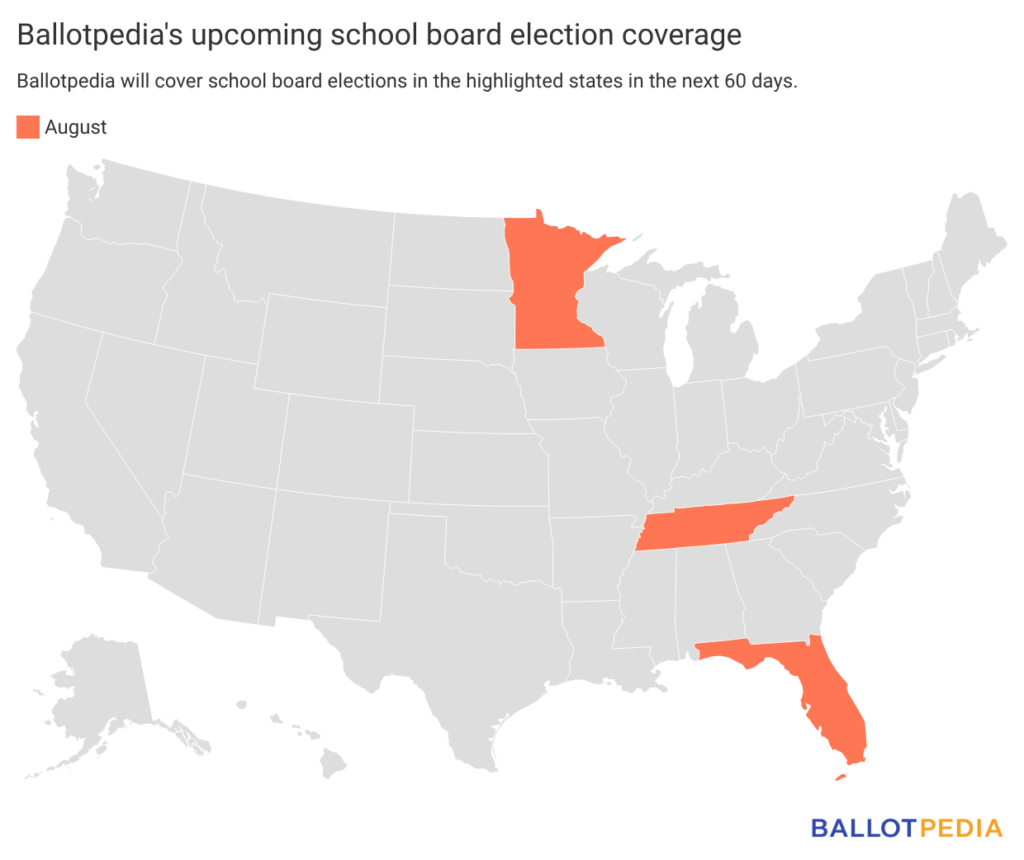
- Tennessee will hold general elections on Aug. 6.
- Minneapolis Public Schools, in Minnesota, will hold a primary on Aug. 11.
- Florida will hold primaries on Aug. 18.
Click here to learn more about this year’s school board elections.
11 states have passed laws related to the Education Freedom Tax Credit this year — here’s how you can follow along
As of July 22, 31 states had indicated that they would participate in the Education Freedom Tax Credit (EFTC), which is set to begin on Jan. 1, 2027.
The EFTC, also known as the Federal Scholarship Tax Credit, is the nation’s first federal K-12 school choice tax credit affecting both taxpayers and eligible students. Taxpayers can make donations to scholarship organizations in exchange for a reduced federal tax liability, while eligible students can use the scholarships for some educational expenses, including private school tuition. For students in a state to receive the scholarship funds, the governor or a designated official must submit a list of scholarship-granting organizations (SGOs) to the U.S. Treasury.
Since the start of the year, 38 states have taken action related to participating in the program. This includes states that have formally opted into the program by submitting IRS Form 15714, and states where the governor or legislature has indicated their state will or will not participate.
Of the 31 states that have signaled participation in the program, state legislatures in eight of them have enacted bills requiring their state to opt in. State legislatures have also adopted language related to the implementation of the program, for example by creating a list of official SGOs or by setting conditions for state participation.
With roughly five months until the EFTC is up and running, we can expect more states to pass laws on different aspects of the program.
To help readers keep track of the quickly shifting landscape, Ballotpedia has launched a new resource with up-to-date information on state laws about the EFTC.
Here’s what we know so far.
As of July 17, 2026, 11 states had passed laws about the EFTC, including ones requiring the state to participate (sometimes requiring permanent participation), ones establishing a state entity responsible for compiling SGO lists, and ones establishing the procedural requirements for state participation.
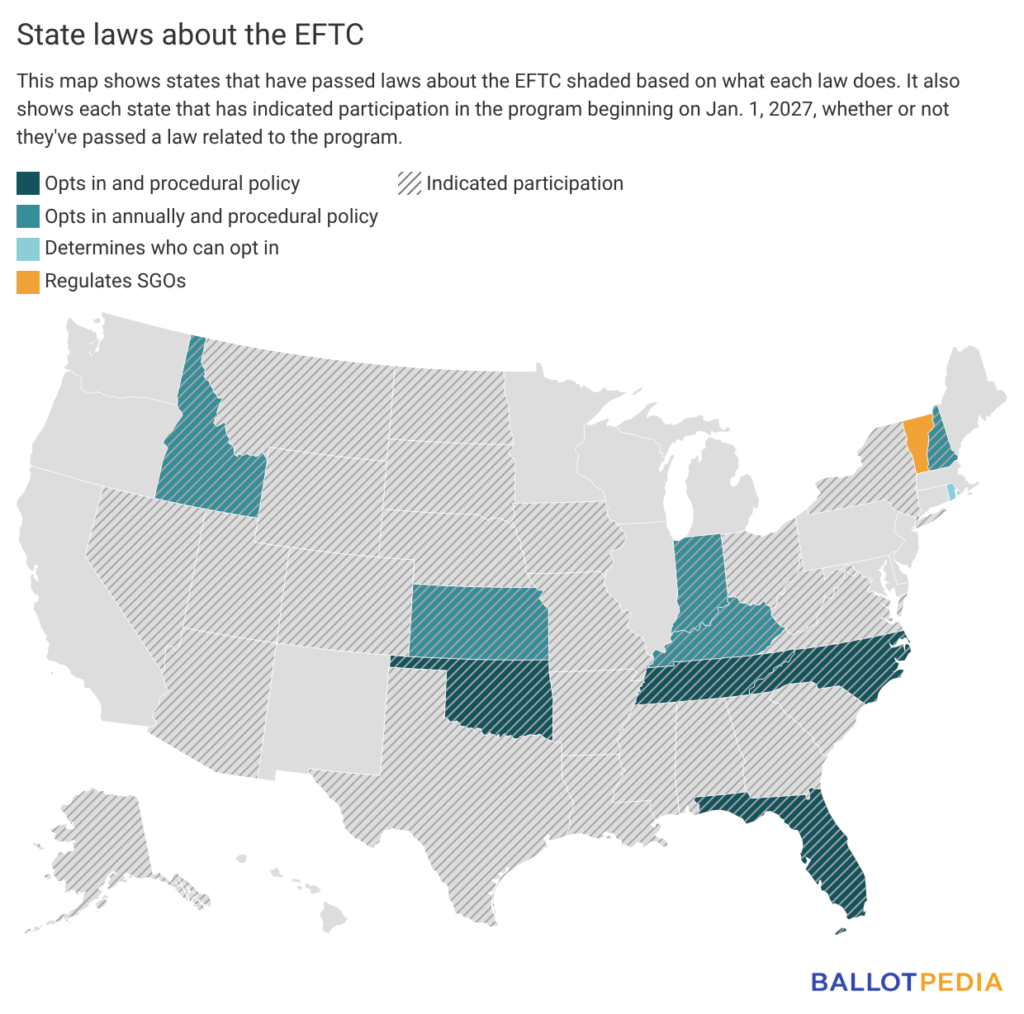
- One state — Vermont — established requirements for scholarship-granting organizations (SGOs) and restrictions on how scholarships could be used. In a June 10, 2026, preview of regulations for the program, the U.S. Treasury said it likely would not allow states to impose more restrictive requirements on SGOs than those enacted in the OBBBA.
- One state — Rhode Island — required both the Legislature and the governor to agree to opt in to the program before the state could participate. It did not indicate whether the state would participate.
- Two states — Oklahoma and Kansas — prohibited the state from establishing rules or regulations that exceed the requirements of the applicable federal law.
- Seven states — Florida, Indiana, Kentucky, North Carolina, Oklahoma, Tennessee, and Vermont — established procedural policy for administering the program in the state.
- Eight states — Idaho, Indiana, Kansas, Kentucky, New Hampshire, North Carolina, Oklahoma, and Tennessee — required the state to opt in, and five explicitly required the state to opt in to the program annually.
- Nine states — Idaho, Indiana, Kansas, Kentucky, New Hampshire, North Carolina, Oklahoma, Tennessee, and Vermont — established a scholarship-granting organization certification authority for the state.
Be sure to bookmark the page and return frequently to it for the latest information.
Background on the ETFC
The EFTC is a dollar-for-dollar nonrefundable tax credit, meaning individuals can lower their federal tax liability by $1 for every $1 donated to accredited SGOs. SGOs distribute the donated scholarship funds to eligible families for a variety of private or public educational expenses, including private school tuition, tutoring services, textbooks, and more. To qualify for scholarships, students had to live in households earning no more than 300% of the area's median gross income and be eligible to enroll in K-12 schools.
The One Big Beautiful Bill Act (OBBBA), which President Donald Trump (R) signed into law in July 2025, provides two mechanisms of state autonomy in the EFTC: the authority to opt in (or not) and the authority to compile a list of SGOs that will participate in the program.
Authority to opt in
The OBBBA does not require states to participate. Under federal law, those who can opt in to the program on behalf of the state are the governor or other individuals, agencies, or entities designated under each state's law to make elections on the state's behalf regarding federal tax benefits. Because the OBBBA says state law may determine the entity that opts in, some states have responded by passing laws to create those designations.
Authority over SGOs
The OBBBA included seven explicit requirements or restrictions for participating SGOs (read them here). The only explicit authority the OBBBA gives states over SGOs is the authority to add them to the list of participating SGOs. The regulations for the program, once issued by the U.S. Treasury, will determine how much control over participating SGOs states may have. In a June 10, 2026, preview of the regulations, the Treasury said it likely would not allow states to impose more restrictive requirements on SGOs than those enacted in the OBBBA.
Rhode Island enacts three-year charter school moratorium
In the June 17 edition of Hall Pass, we looked at the debate over legislation in Rhode Island that would place a moratorium on charter schools and lower the number of charter schools allowed to operate in the state. On June 18, Gov. Daniel McKee (D) signed that legislation.
Here’s an update on Rhode Island’s new law.
Here’s what the law does
S 2787 and H7415 prohibits the Rhode Island’s Council on Elementary and Secondary Education from approving the creation or expansion of any district charter schools through the 2028-2029 school year. The bills also reduced the maximum number of charter schools allowed to operate in the state from 35 to 28, and will prevent some previously approved charter schools from opening.
Rhode Island has three types of charter schools: district charter schools, independent charter schools, and mayoral academies. The moratorium applies to all three.
Debates about the bill
Around 9.5% of Rhode Island's students attend charter schools. When students transfer from traditional public schools to charter schools, their per-pupil local and state funding allocations are also transferred.
State Representative and House Education Committee Chair Joseph McNamara (D) supported the bill, saying that the state's education funding formula was not adequately funding public education, and that charter schools were taking too much money from traditional public schools.
McNamara said, "We desperately need a more equitable formula. This would give us time, because we cannot continue to develop, nor can we afford, to have two parallel school systems in the state…It’s financially impossible.”
Kelsey Bala, Rhode Island KIDS COUNT Senior Policy Associate, opposed the bill. She said that the bill would revoke the recent approval of expanded and newly established charters.
Bala said, "We know that many have concerns about how charter schools are funded, particularly how they receive funding from the state’s funding formula and how local aid is disbursed to charter schools. We agree that this is a critical issue that needs discussion and action; however, we do not agree that students and families that are seeking school options should be denied opportunities to a high-quality public charter school while we work to improve the funding formula and investment strategy."
Rhode Island has 66 school districts, at least 22 of which are charters. In the 2024-2025 school year, 135,978 students attended public (including charter) schools. Rhode Island has a per-pupil expenditure of $23,571. The District of Columbia (D.C.) spent the most per student at $31,629 (FY 2023), and Idaho spent the least at $10,247.
Ballotpedia's local school board authority coverage
Ballotpedia maintains research on school board authority and responsibilities in all 50 states, including on school board authority over charter school establishment. Each article contains an investigation into the authority of and constraints on school board policy-making power concerning curriculum requirements and restrictions, book restrictions, parental notification policies, discipline, charter schools, and more.
Extracurricular: education news from around the web
This section contains links to recent education-related articles from around the internet.
- Innovation, data fixes fuel Native American graduation gains at federally funded schools | Associated Press
- A Test Isn’t Racist. Assumptions About Black Kids Can Be. | New York Times
- What’s Mamdani’s agenda for K-12 education in NYC? 6 months in, it’s hard to say. | Chalkbeat
- Contrary to Common Belief, The Poorest School Districts Outspend The Wealthiest | The 74
- Why K-12 public school enrollments dropped in 40 states | Reason Foundation
- Remembering Lindsey Graham: Lessons for Education Policy and Politics | Charlie Barone’s Substack newsletter
- 3 takeaways from the Supreme Court’s 2025-26 term | K-12 Dive
- A win-win solution: using tax credit scholarships for before and after care | Sara Mead’s Early Developments Substack newsletter
Take our Candidate Connection survey to reach voters in your district
Today, we’re looking at the two candidates running in the Aug. 18 primary to represent District 7 on the Broward County Public Schools school board, in Florida.
Broward County Public Schools is the second largest in Florida, with roughly 251,000 students. Five of the nine school board seats are up for election this year.
Cynthia Alceus Dominique earned an associate degree from Palm Beach State College in 2009, a bachelor's degree from Florida Atlantic University in 2009, and a graduate degree from the University of Miami in 2012. Dominique’s career experience includes working as an adjunct professor. Here’s how Dominique answered the question, “What areas of public policy are you personally passionate about?”
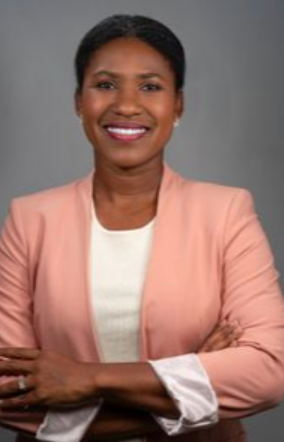
“As a dedicated public school advocate, I am quite passionate about safeguarding funding and access to public education. I am also passionate about increasing access to healthcare to include mental health care, and increasing affordability. Lastly, there needs to be some reforms to factors that increase cost of living in Florida like home insurance and HOA fees.”
Click here to read the rest of Dominique’s responses.
Rochelle Soffer earned a bachelor's degree from Stetson University in 1999 and a graduate degree from the University of Florida in 2004. Soffer's career experience includes working as a speech-language pathologist. Here’s how Soffer answered the question, “What areas of public policy are you personally passionate about?”
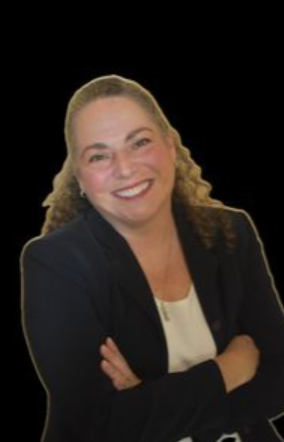
“I am incredibly passionate about ensuring equal access for our English Language learners and students with disabilities with regards to education. These learners both face different hurdles in comparison with our monolingual English non-impaired speakers, so as a board we must ensure adherence to state and federal law. There is also the issue of school choice where I firmly believe parents have the right to choose where their child is educated, but I do not believe in using public school funds for anything other than a public school. Understanding parents have the right to enroll their child in private school or homeschool their child, we should not funnel public school funds outside of their original intended use.”
Click here to read the rest of Soffer’s responses.
As a reminder, if you're a school board candidate or incumbent planning to run this year, click here to take the survey.