



Eleven states have passed laws in 2026 related to the Education Freedom Tax Credit (EFTC), which goes into effect in 2027. These bills take various actions that shape how or if a state will participate in the program.
Of the 31 total states that have indicated they will participate in the EFTC, legislatures in eight of them enacted bills requiring their states to opt in. Other state legislatures have adopted requirements for implementing the program, such as designating a specific state entity to compile a list of official SGOs or setting conditions for state participation.
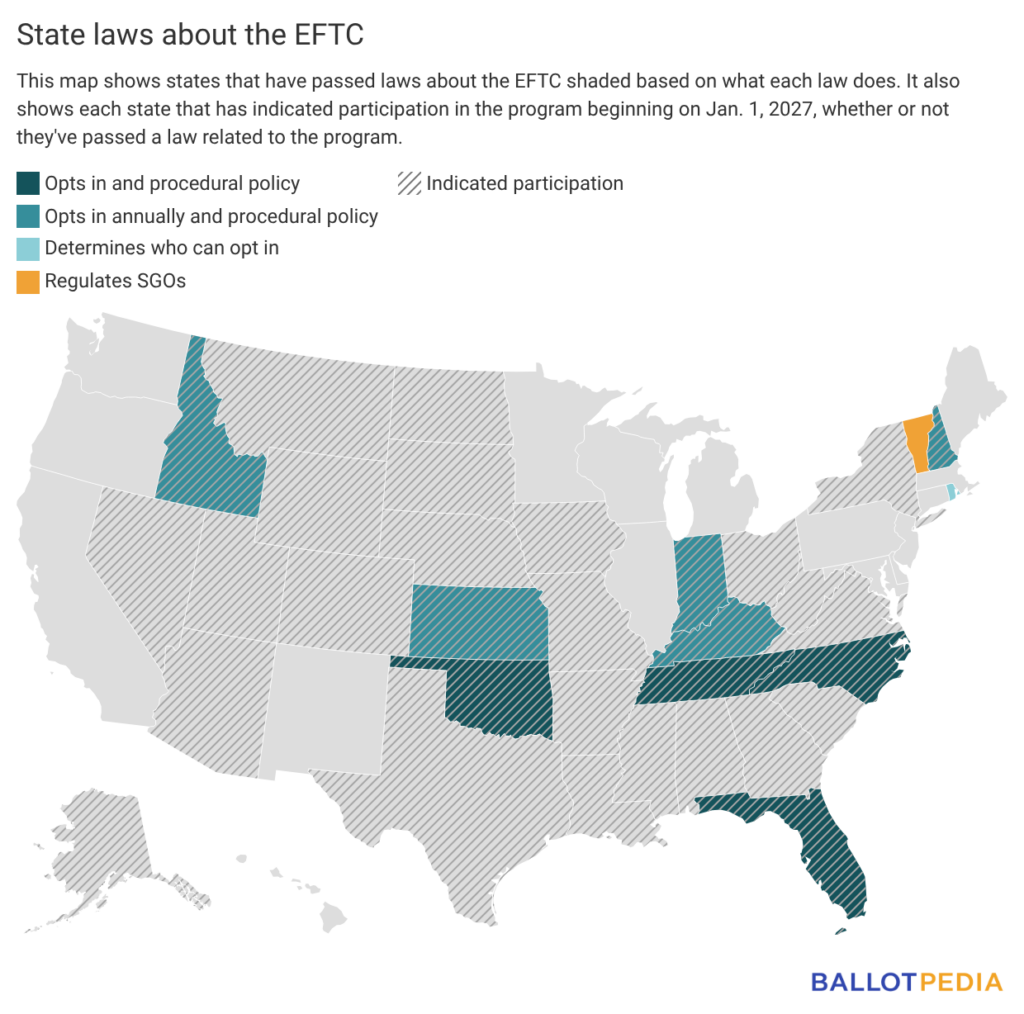
With the program set to begin on Jan. 1, 2027, more states may pass laws on different aspects of the program.
To help readers keep track of the differing state policies about the program, Ballotpedia launched a new resource with up-to-date information on state laws about the EFTC.
Here’s what we know so far:
- One state — Vermont — established requirements for scholarship-granting organizations (SGOs) and restrictions on how scholarships could be used. In a June 10, 2026, preview of regulations for the program, the U.S. Treasury said it likely would not allow states to impose more restrictive requirements on SGOs than those enacted in the OBBBA.
- One state — Rhode Island — required both the Legislature and the governor to agree to opt in to the program before the state could participate. It did not indicate whether the state would participate.
- Two states — Oklahoma and Kansas — prohibited the state from establishing rules or regulations that exceed the requirements of the applicable federal law.
- Seven states — Florida, Indiana, Kentucky, North Carolina, Oklahoma, Tennessee, and Vermont — established procedural policy for administering the program in the state.
- Eight states — Idaho, Indiana, Kansas, Kentucky, New Hampshire, North Carolina, Oklahoma, and Tennessee — required the state to opt in, and five explicitly required the state to opt in to the program annually.
- Nine states — Idaho, Indiana, Kansas, Kentucky, New Hampshire, North Carolina, Oklahoma, Tennessee, and Vermont — established a scholarship-granting organization certification authority for the state.
View the full breakdown of state laws here.
Background on the ETFC
The EFTC is a dollar-for-dollar nonrefundable tax credit, meaning individuals can lower their federal tax liability by $1 for every $1 donated to accredited SGOs. SGOs distribute the donated scholarship funds to eligible families for a variety of private or public educational expenses, including private school tuition, tutoring services, textbooks, and more. To qualify for scholarships, students had to live in households earning no more than 300% of the area's median gross income and be eligible to enroll in K-12 schools.
The One Big Beautiful Bill Act (OBBBA), which President Donald Trump (R) signed into law in July 2025, provides two mechanisms of state autonomy in the EFTC: the authority to opt in (or not) and the authority to compile a list of SGOs that will participate in the program.
Authority to opt in
The OBBBA does not require states to participate. Under federal law, those who can opt in to the program on behalf of the state are the governor or other individuals, agencies, or entities designated under each state's law to make elections on the state's behalf regarding federal tax benefits. Because the OBBBA says state law may determine the entity that opts in, some states have responded by passing laws to create those designations.
Authority over SGOs
The OBBBA included seven explicit requirements or restrictions for participating SGOs (read them here). The only explicit authority the OBBBA gives states over SGOs is the authority to add them to the list of participating SGOs. The regulations for the program, once issued by the U.S. Treasury, will determine how much control over participating SGOs states may have. In a June 10, 2026, preview of the regulations, the Treasury said it likely would not allow states to impose more restrictive requirements on SGOs than those enacted in the OBBBA.
Additional reading: