


Welcome to the Monday, July 27, 2026, Brew.
By: Lara Bonatesta
Here’s what’s in store for you as you start your day:
- Five 2026 ballot measures address sex-based school sports eligibility, certain medical procedures for transgender minors
- Twenty-one states and D.C. place no restrictions on who can obtain their voter files
- South Dakota is holding its first gubernatorial runoff on July 28
Five 2026 ballot measures address sex-based school sports eligibility, certain medical procedures for transgender minors
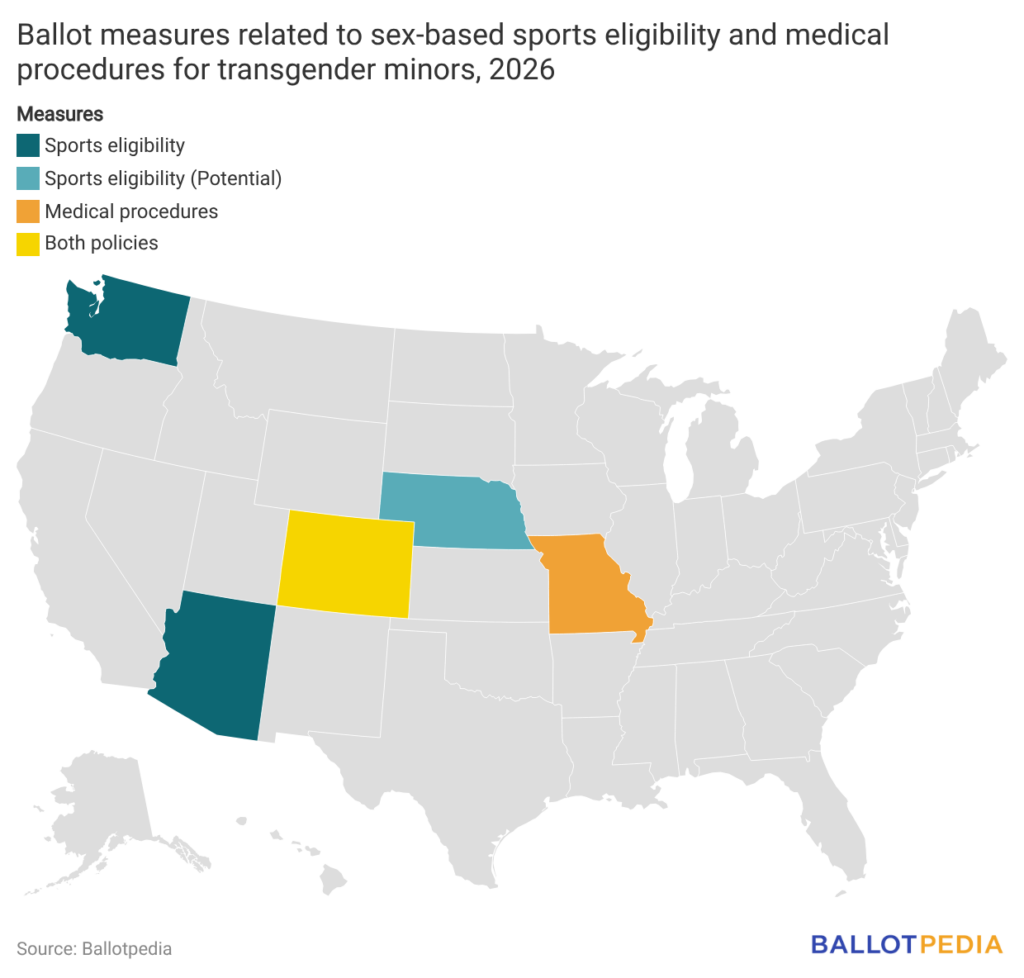
In 2026, voters will decide at least five ballot measures on sex-based requirements for school sports and bans on certain medical procedures for transgender minors. States began passing laws similar to these ballot measures in 2020 and 2021, but this year will be the first time voters have decided on either issue at the ballot box.
Arizona, Colorado, and Washington will decide measures that would establish sex-based requirements for participation on school athletic teams, with varying regulations and methods for determining sex. Colorado and Missouri will decide measures that would prohibit certain medical and surgical procedures for transgender minors when provided to alter sex characteristics. The measure in Missouri, Amendment 3, would also repeal the state's constitutional right to abortion that voters approved in 2024, and prohibit abortion except in cases of "medical emergency, fetal anomaly, rape, or incest." It would permit abortions in cases of rape or incest only through 12 weeks of gestation.
Voters in Nebraska could decide on a citizen-initiated constitutional amendment to prohibit "athletic teams or sports designated for females, women, or girls" from being "open to students of the male sex." On June 30, the campaign behind the initiative filed signatures, which local officials must review within 40 days of receiving them.
Overview of sports participation laws
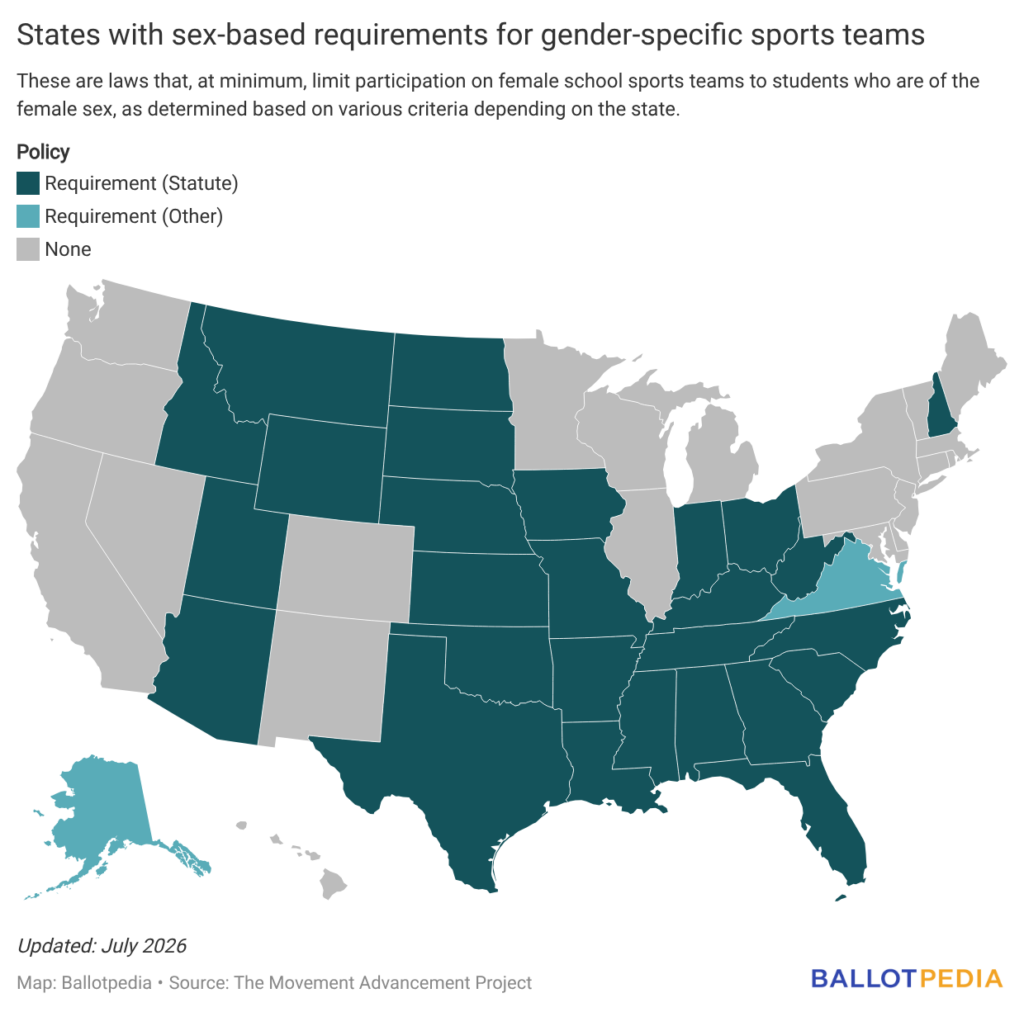
Twenty-seven states have laws that limit participation on female school sports teams to students of the female sex. Alaska’s State Board of Education and the Virginia High School League adopted requirements administratively. Some states also limit participation on male sports teams to students of the male sex.
States that adopted these laws had either Republican trifectas or divided governments where Democratic governors vetoed the legislation and Republican-controlled legislatures overrode the vetoes, with one exception. In Louisiana, Gov. John Bel Edwards (D) allowed a school athletics law to take effect without his signature.
Idaho was the first state to pass a sex-based sports requirement law, doing so in 2020. Eight states adopted requirements in 2021, 10 in 2022, six in 2023, two in 2024, and two in 2025. Republicans had trifectas in 23 of the 27 states when the laws were enacted. Kansas, Kentucky, Louisiana, and North Carolina had divided governments.
Republican governors vetoed bills in Indiana, Ohio, and Utah, where Republican-controlled legislatures overrode the vetoes. Wyoming Gov. Mark Gordon (R) allowed the bill to become law without his signature. Outside the legislative process, Alaska adopted a requirement in 2023, and Virginia adopted one in 2025.
Every Republican trifecta has enacted laws addressing both sex-based eligibility for school sports and medical procedures for transgender minors. No Democratic trifecta has passed such laws.
On June 30, the U.S. Supreme Court ruled 6-3 in West Virginia v. B.P.J. to uphold several state laws requiring "schools [to] determine eligibility for female sports based on biological sex."
States with laws prohibiting surgical procedures for transgender minors
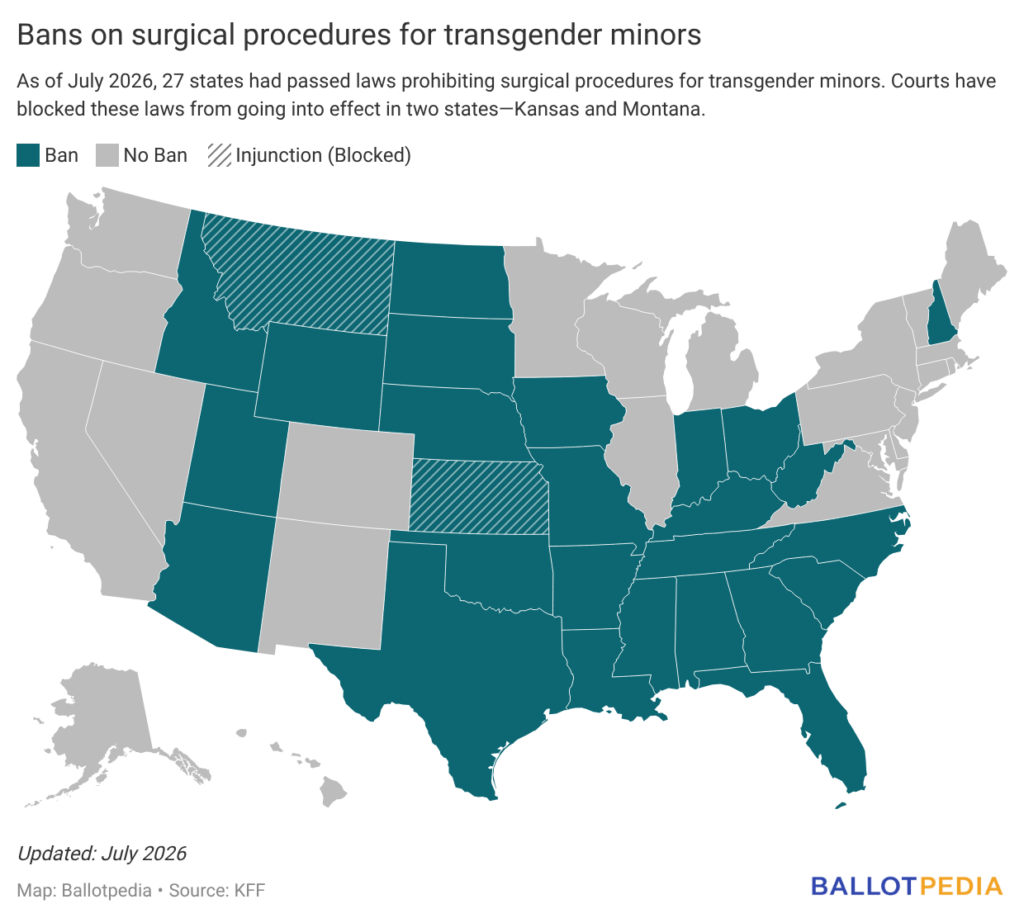
Twenty-seven states have passed laws prohibiting surgical procedures for transgender minors. Some states regulate only surgical procedures, while others also regulate hormone treatments or other medical procedures. No states regulate hormone treatments without also regulating surgical procedures.
Arkansas was the first state to ban surgical procedures, doing so in 2021. Two states approved bans in 2022, 19 states in 2023, four states in 2024, and one state in 2025. Republicans had trifectas in 23 of the 27 states at the time of enactment. Kentucky, Louisiana, North Carolina, and Kansas had divided governments, in which Democratic governors vetoed bills, and Republican-controlled legislatures overrode those vetoes. In Kansas and Montana, state courts have blocked these laws from taking effect.
Click here to learn more about ballot measures on sex-based sports eligibility requirements and medical procedures for transgender minors.
Twenty-one states and D.C. place no restrictions on who can obtain their voter files
President Donald Trump (R) addressed the nation in a speech on July 16, during which he said that China gained illicit access to 220 million U.S. voter files, including names, addresses, phone numbers, and political party preferences. Trump said, “Over a period of years, starting during the 2020 election cycle, the People's Republic of China carried out what is believed to be the largest compromise of election data in history, resulting in China's illicit acquisition of 220 million US voter files.”
Each state is legally required to maintain voter files, or digital databases of information about registered voters, which contain that data or similar details. Every state can sell voter file information to individuals or groups, and each state has its own guidelines for who is eligible to purchase that information and what the voter file can be used for. Eight states give this information to eligible requestors for free.
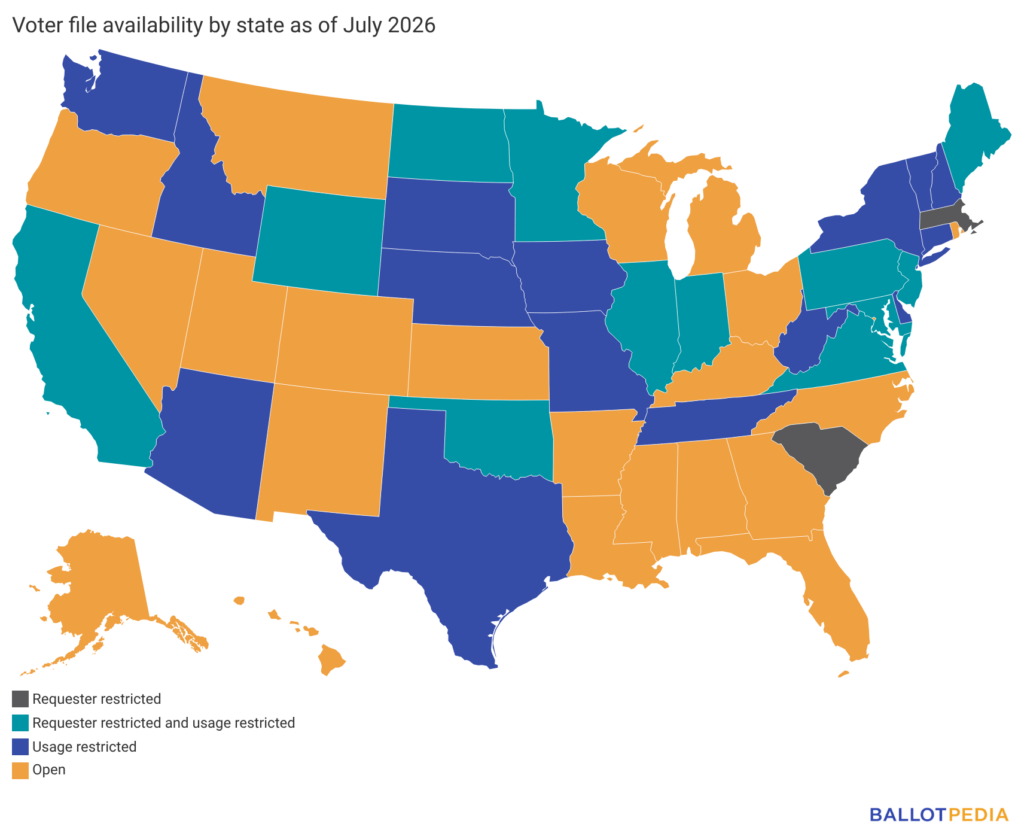
Currently, voter files are openly available in 21 states and Washington, D.C. That means there are effectively no restrictions on who can request or purchase the voter file, and the only restrictions on how the voter file can be used are commercial use restrictions.
Two states have requester-restricted availability, meaning that only certain groups or individuals can request or purchase the voter file. Common examples of requester restrictions include candidates for office, current officeholders, political parties, political action committees, and nonprofits engaged in get-out-the-vote efforts.
Fifteen states have usage-restricted availability, meaning the file can only be used for certain purposes beyond commercial use restrictions. Common examples include prohibiting the use of voter files for advertising, posting voter files on the internet, or requiring voter files to be used only for political or electoral purposes.
Twelve states have both requester- and usage-restricted availability. That means only certain groups or individuals can request or purchase the voter file, and only for certain purposes. Oklahoma and Vermont specifically prohibit their disclosure to foreign entities.
The cost for voter files also varies by state. As we mentioned above, eight states provide voter files for free to qualified requesters. Thirty states and Washington, D.C. charge a maximum cost for voter files between $1 and $1,000. Ten states charge a maximum cost between $1,001 and $10,000. Wisconsin charges a maximum of $12,500. In Michigan, the cost varies based on the time taken to produce the report.
Most states allow voters to request that certain personal identifying information be confidential, but the type of information and who can participate varies by state.
Click here to learn more about the availability of each state’s voter files.
South Dakota is holding its first gubernatorial runoff on July 28
Incumbent Larry Rhoden and Toby Doeden are running in the Republican primary runoff for governor of South Dakota on July 28. The gubernatorial primary runoff is the first runoff of any kind since South Dakota passed a 1985 law requiring a candidate to receive 35% of the vote to avoid a runoff.
According to the University of Minnesota's Eric Ostermeier, none of the 32 congressional or gubernatorial primaries since the law's enactment have resulted in a runoff. Before that law was passed, state party conventions decided the winner if no candidate won more than 35% of the vote.
In the June 2 primary, Doeden received 31% of the vote, Rhoden 25%, Dusty Johnson 23%, and Jon Hansen 21%.
South Dakota journalist Kevin Woster and Searchlight Report podcast host Meghan O’Brien describe Rhoden as a "traditional South Dakota conservative" with governing experience and Doeden as a political outsider with business experience and an anti-establishment message. Affordability and property taxes are central issues in the election. Rhoden advocated for and signed a bill that allows counties to decide on replacing property taxes with a half-cent sales tax increase. Doeden says he will work toward eliminating property taxes.
South Dakota Searchlight's Joshua Haiar and Makenzie Huber reported that Hansen's supporters appear split between Rhoden and Doeden, while Johnson's backers are leaning toward Rhoden. Both Hansen and Doeden oppose the use of eminent domain for carbon pipelines, an issue that Haiar and Huber write has moved some Hansen supporters toward Doeden.
Rhoden was formerly lieutenant governor and replaced former Gov. Kristi Noem (R) on Jan. 25, 2025, when Noem became the Secretary of Homeland Security during the second Trump administration.
Doeden is a car dealership and rental property owner.
In South Dakota, the gubernatorial nominee is selected in the primary. The gubernatorial nominee then chooses a lieutenant gubernatorial running mate, and they run together on a single ticket in the general election.
South Dakota is one of four states with primary runoffs for governor so far this year. The Republican primaries in Georgia, Oklahoma, and South Carolina also advanced to runoffs.
Eleven gubernatorial primaries have advanced to runoffs in seven states since 2018 — two Democratic, eight Republican, and one Libertarian. Nine of those runoffs have already taken place, while runoffs in South Dakota and Oklahoma have yet to occur. In those nine completed runoffs, the candidate who received more votes in the primary won five times. In the other four, the candidate who received fewer votes in the primary won.
Click here to read more about South Dakota’s July 28 Republican gubernatorial primary runoff.