


Welcome to Hall Pass, a newsletter written to keep you plugged into the conversations driving school board governance, the politics surrounding it, and education policy.
In today’s edition, you’ll find:
- On the issues: The debate over Alpha Schools
- School board filing deadlines, election results, and recall certifications
- Four states this year have enacted laws requiring their education departments to develop AI frameworks for school districts
- Extracurricular: education news from around the web
- Candidate Connection survey
On the issues: The debate over Alpha Schools
In this section, we curate reporting, analysis, and commentary on the issues school board members deliberate when they set out to offer the best education possible in their district. Missed an issue? Click here to see the previous education debates we’ve covered.
Alpha School is a network of private K–12 schools that says it uses AI tools to provide students 1:1 personalized education in about two hours of instruction time per day. According to the organization, students use the remaining hours in school on enrichment activities and life skills.
Alpha School was founded in 2014. Twelve locations are currently open across the country, serving various grade levels. Twenty-seven additional schools are set to open in the future and are currently enrolling students.
Today, we look at two perspectives on Alpha Schools.
Alpha School cofounder Mackenzie Price says AI can provide customized learning that meets the needs of all students. Price says that while technology has remade countless aspects of our lives since the Industrial Revolution, schools today look about the same as they always have. Price says Alpha School students use their AI tutors to learn at their own pace, giving them space to demonstrate mastery, while teachers provide emotional support. Price says Alpha Schools work for all students, regardless of family income.
Natalie Wexler, an education writer and author of Beyond the Science of Reading, says Alpha School’s model prioritizes efficiency, but that education is about much more. Wexler says that one of her biggest concerns about Alpha Schools is how students are taught non-STEM (Science, Technology Engineering, and Math) subjects in the humanities and social studies. Wexler says that Alpha School’s model does not provide the appropriate space to learn from teachers and fellow students through discussion and arguments. Wexler says it’s also not clear how much writing Alpha School students are doing.
Redefining School in the 21st Century | Mackenzie Price, Future of Education
“We opened an Alpha School in Brownsville, Texas: the second poorest school district in the country. There, kids often come to us in the bottom 10th percentile. Within two years, they’re performing in the 90th percentile. Some students don’t speak any English — they cross the border every day from Mexico to come to school — but by the end of the school year, they’re 99th percentile in English reading and language. This is the beauty of an AI tutor! It doesn’t care if you’re rich, poor, white, black, brown, 10th percentile or 85th percentile. It is infinitely patient, infinitely equipped to meet each kid where they are. And before you panic and think, “The robots are taking over! What happened to teachers?”, you should know that we value our teachers more than anything. They’re the backbone of our system. Their role has just evolved.
“At Alpha School, our teachers focus on what they’re best at: motivational and emotional support. No more creating lesson plans. No more delivering lectures. No more grading homework. Instead, they prioritize one-on-one time with every single one of their students: developing trust, learning what makes them tick, getting to know their needs, and ultimately, supporting their educational journey. In the classroom, these are gifts.
The Alpha School Debate | Natalie Wexler, Minding the Gap
“Even if Alpha figures out a better way to cover history, literature, and writing through its AI tutors, I would remain skeptical about the model. To be clear, I’m not against AI-assisted learning, period. The evidence indicates it can be highly effective in certain circumstances, including some of the ones in which Alpha uses it. I just don’t think we should hand over academic instruction entirely to bots.
“Why limit human interaction to ‘life skills’ workshops rather than integrating it into academic learning? Yes, using human teachers may be less efficient, but education isn’t solely a matter of efficiency. Some of its most important aspects, like learning to bounce around ideas about academic topics with one’s teacher and fellow students, may require something other than the shortest path to acquiring information.
“Plus, as others have pointed out, Alpha’s model treats the ‘learning’ part of school as something to be gotten through as quickly as possible in order to get to the good stuff. Is that really the message we want to send to kids about the life of the mind? Isn’t there also some good stuff to be found there?”
School board update: filing deadlines, election results, and recall certifications
In 2026, Ballotpedia will cover elections for more than 30,000 school board seats. We’re expanding our coverage each year with our eye on covering the country’s more than 80,000 school board seats.
Upcoming school board elections
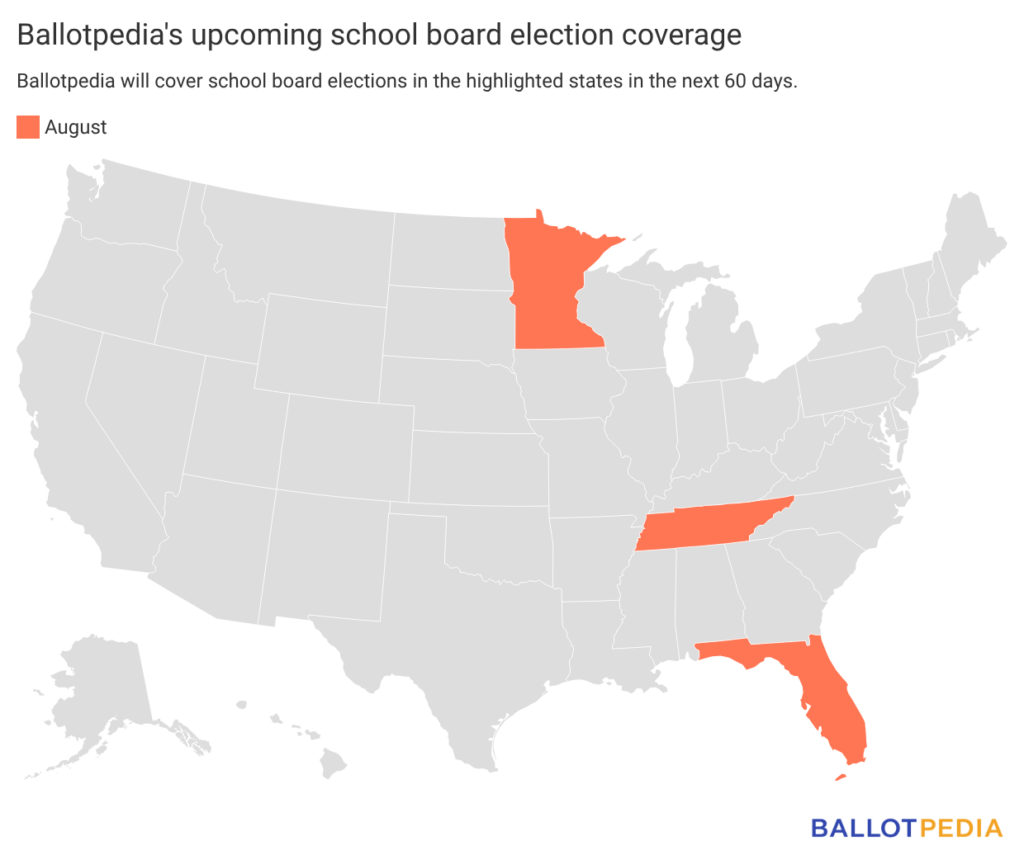
- Tennessee will hold general elections on Aug. 6.
- Minneapolis Public Schools, in Minnesota, will hold a primary on Aug. 11.
- Florida will hold primaries on Aug. 18.
Click here to learn more about this year’s school board elections.
Four states this year have enacted laws requiring their education departments to develop AI frameworks for school districts
A growing number of teachers are using artificial intelligence (AI) for school-related work. But according to a June 2026 NPR/Ipsos poll of teachers, over half of respondents say their districts either haven’t offered guidance on how to use it or they’re not sure what the guidance is. As AI usage becomes more common in K-12 education, lawmakers in some states are mandating that state education officials develop recommendations for how to use the technology — and requiring districts to adopt policies based on that guidance.
In Idaho, Maryland, Oklahoma, and Virginia, new laws enacted in 2026 direct state education departments to release AI guidance that districts must use to inform their own policies.
Those four will join 35 other states that’ve already released AI recommendations for districts.
New laws make demands of both state education departments and districts
State education departments have been releasing AI guidance to help districts become acquainted with and think through some of the challenges posed by generative AI tools like ChatGPT since 2023. In most cases, districts have not been required to comply with the guidance.
The new laws in Idaho, Maryland, Oklahoma, and Virginia are different in that they require districts to adopt AI policies that align with the state guidance.
- Idaho (SB 1227): Gov. Brad Little (R) signed SB 1227 on March 18. It directs the Idaho Department of Education to develop a statewide framework for AI usage in K-12 public schools, prioritizing “human-centered oversight, transparency, safety, and 7 data security” and ensuring “that no generative artificial intelligence replaces or 9 eliminates a human teacher.” The Idaho State Board of Education is required to approve the framework. SB 1227 requires districts and public charter schools to then adopt AI policies that align with the statewide framework. Additionally, SB 1227 requires the Idaho Department of Education to develop AI literacy standards for K-12 students.
- Maryland (SB 720): Gov. Wes Moore (D) signed SB 720 on May 26. The law requires the Maryland State Department of Education to release AI guidance for districts. Districts must adopt AI policies that align with the state guidance within 120 days. The law also requires the Maryland State Department of Education to incorporate AI literacy into K-12 computer science standards, among other provisions. The Maryland State Department of Education released its guidance in June.
- Oklahoma (SB 1734): Gov. Kevin Stitt (R) signed the Oklahoma Responsible Technology in Schools Act on May 13. The law requires the Oklahoma Department of Education to issue AI guidance for school districts. The law also requires districts to adopt AI policies that conform with the Oklahoma Department of Education’s before the beginning of the 2027-28 school year. Among other provisions, the law allows parents to opt their children out of using AI in schools without being academically penalized. The Oklahoma Department of Education had previously released an AI guidance document in 2024.
- Virginia (SB 394): Gov. Abigail Spanberger (D) signed SB 394 on April 13. The law requires the Virginia Department of Education to collect data on student AI usage and, on the basis of that information, release guidance for districts on deploying AI in schools. The law requires school boards to “establish, implement, and enforce policies consistent with the guidance developed by the Department.” In 2024, the Virginia Department of Education released a five-page document titled “Guidelines for AI Integration Throughout Education in the Commonwealth of Virginia.”
These four states are following at least two other states which enacted similar laws in previous years. In 2025, Ohio passed HB 96, directing the Ohio Department of Education and Workforce to issue AI guidance and requiring districts to adopt AI policies by July 1, 2026. HB 96 did not require Ohio districts to align their policies with the state guidance. In Tennessee, SB 1711/HB 1630 required school districts to adopt an AI policy by the start of the 2024-25 school year. Unlike the other laws we’ve looked at, it did not direct the state department of education to promulgate AI guidance.
More than two-thirds of states have released AI guidance for K-12 public schools
Since 2023, state education departments in 35 states have issued documents on the use of AI in K-12 public schools. In most states, districts are not required to follow the guidance.
Click here to see if your state has released guidance for districts.
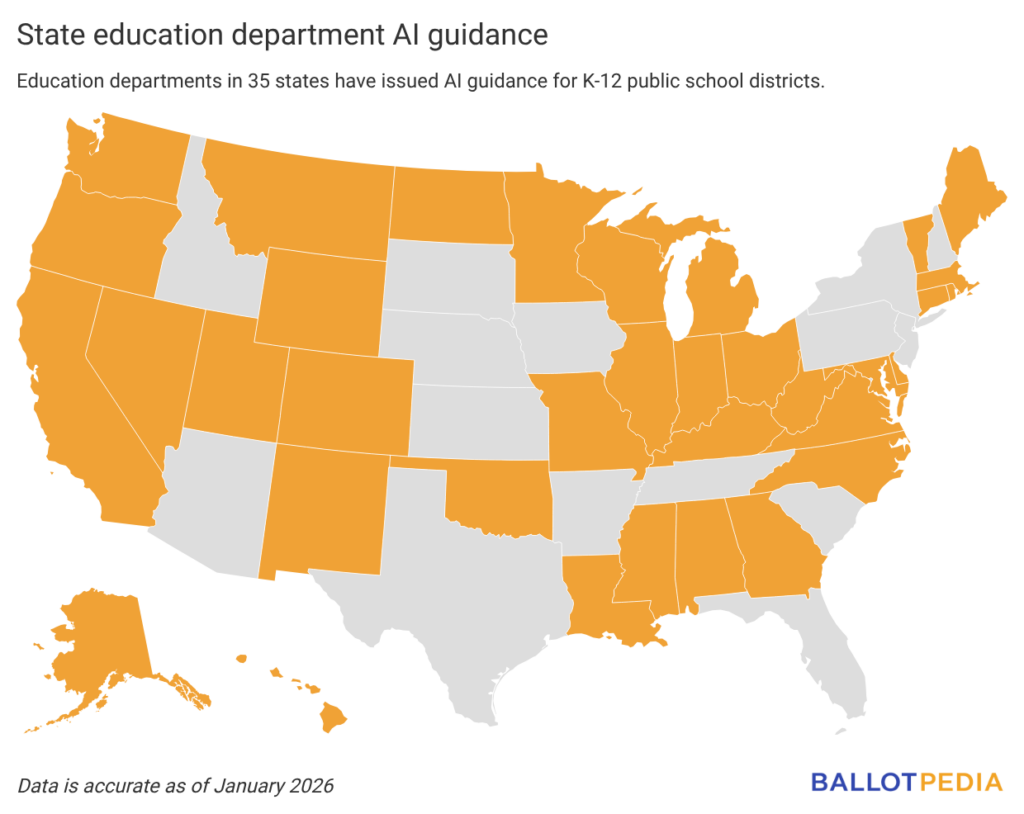
The guidance documents vary in length. Hawaii’s Department of Education released two documents in 2024, one for employees and one for students. Both are two pages. On the other end of the spectrum, Illinois’ AI recommendations, released in June 2026, span more than 400 pages. The next-longest is Ohio’s, at 81 pages.
Most documents address AI literacy, student privacy, equity and bias, academic integrity policies, and the use of AI detection tools. Across all 35 documents, there is a belief that AI should supplement teachers and human judgement, not replace them. The documents assert that AI has both benefits and risks in educational settings.
Below, you’ll find excerpts from several of the guidance documents on different issues in AI.
On the relationship between AI and humans
- California (p. 1): “AI or any other technology cannot replace the value of a student’s relationship with a caring educator who can connect on a human level.”
- Virginia (p. 1): “While AI tools can analyze information and enhance certain aspects of learning with unmatched efficiency, we must remember that education is ultimately a human endeavor. The true art of teaching involves wisdom, judgment and interpersonal skills that machines cannot replicate.”
On AI bans and inaction
- Utah (p. 3): “Providing unrestricted access falls short of providing needed protection. Conversely, an outright ban on AI in schools impedes the development of essential future workforce skills.”
- Wyoming (p. 1): “In order to create the most transparent, efficient, and excellent education in the nation, Wyoming must not only accept, but fully embrace ever changing technology- including Generative Artificial Intelligence. Unless we challenge the status quo of the education system of decades past, we will be less efficient in educating students, and we will be failing to prepare them for a 21st century world.”
- Vermont (p. 7): “Doing nothing also introduces equity and access issues, as some students have access to strong AI models and develop the skills to use them, while others do not.”
On academic integrity
- Utah (p. 11): “Students and staff should not copy from any source, including generative AI, without prior approval and adequate documentation. Students should not submit AI-generated work as their original work. Staff and students will be taught how to properly cite or acknowledge the use of AI where applicable.”
- North Carolina (p. 29): “Because today’s generative AI tools can not actually create content without some level of human participation and guidance, it is generally considered best practice to acknowledge the use or partnership with the AI tool when a formal citation is not required.”
On equity and access
- Oregon (p. 6): “Generative AI can be particularly impactful for students with disabilities and multilingual learners and not using them has the potential to limit students’ access to learning opportunities.”
- Michigan (p. 4): “Districts may assess whether AI tools effectively support diverse learners and provide necessary accommodations to promote equitable access.”
On AI and age-appropriate usage
- Illinois (p. 6): “As uniform approaches that are developmentally agnostic are more likely to lead to unintended consequences when any educational technology is implemented, informed use of AI as a means to inform the planning and delivery of instruction and enrich student experience must be predicated upon developmentally appropriate practice.”
- Wisconsin (p. 13): “It is important that [elementary] students use real-world AI applications during instruction. This practice fosters hands-on experience and critical thinking regarding AI generated content.”
Click here to read the guidance documents.
Extracurricular: education news from around the web
This section contains links to recent education-related articles from around the internet.
- New Report Ties Chronic Absenteeism to Sluggish Academic Outcomes | The 74
- The Bible Belongs in the Classroom | The Atlantic
- The Hidden Factor in Student Success: Family Structure | Wall Street Journal
- Classroom Screen Time Draws Attention of State Lawmakers | Government Technology
Take our Candidate Connection survey to reach voters in your district
Today, we’re looking at responses from two of the four candidates running in the Nov. 3 general election for two seats on the Baltimore City Public Schools Board of Commissioners, in Maryland. Incumbent Ashley Esposito and Domonique Flowers completed the survey.
As of this writing, the other incumbent in the race, Kwame Kenyatta-Bey, and Jamar Day had not completed the survey.
Baltimore County Public Schools is the third largest district in Maryland, with roughly 76,000 students. Two of the nine seats on the school board are up for election this year.
Esposito was first elected in 2022, and her career experience includes working as a database developer, painter, and photographer. Here’s how Esposito answered the question, “What characteristics or principles are most important for an elected official?”

“As an elected official, I believe the most important characteristics are humility, compassion, and the ability to listen deeply. One of my heart and core values is the belief that our neighbors are full of subject matter experts because people know their own lives, challenges, and dreams better than anyone else. My role is to honor that lived experience and make sure those voices guide the decisions that shape our schools and communities.
“I also believe the most vulnerable and valuable people in our communities are our youth and our elders. For both, time is not on their side, but they carry so much wisdom and heart. I love listening to them, and I think as adults we can do a much better job at listening. Youth advocacy and youth voice are especially important to me. When young people speak, they not only share their experiences but also point us toward the future we need to build.
“This work requires tough skin and a willingness to do the thankless tasks. You must be principled when no one is watching and ready to stand and defend the decisions you make. I have learned that when I do the will of the people, you cannot go wrong. Even though I sit in this seat, it is really our seat. I need the community to keep me up to date, and I will continue to reach out so I always have one foot in the neighborhood and one foot in the boardroom. That balance is how I stay accountable and ensure we move forward together.”
Click here to read the rest of Esposito’s responses.

Flowers’ career experience includes working as an attorney with the Social Security Administration and working with Baltimore City Schools students in both in- and after-school programs. Here’s an excerpt from Flowers’ answer to the question, “What are the main points you want voters to remember about your goals for your time in office?”
- “Ensuring in School and Community Stability
Before we can even begin to address the educational needs of our students we need to first focus on the environment that they encounter every day. It is our job to ensure that we address the barriers that prevent our students from attending school and that we provide them with a safe and nurturing environment in which to learn. As your next school board member, I intend to work with you to:
- Ensure in improved school safety measures
-Increase compliance of special education mandates
- Address and decrease tardiness and absenteeism
- Effectively manage the capital and operating budget & increase transparency
- Providing Parent and Educator Support As your next school board member, I want to ensure that our parents and educators (teachers, administrators and staff) are provided with the essential tools and training they need to help rear and educate the next generation of young scholars. To do this I intend to: - Ensure teachers and staff are validated and encouraged through incentives and supportive training -Corroborate with parents who need wrap around services or support for their children -Establish greater transparency for parents concerning the school system in the form of increased community collaborations”
Click here to read the rest of Flowers’ responses.
As a reminder, if you're a school board candidate or incumbent planning to run this year, click here to take the survey. If you complete the survey, your answers will appear in your Ballotpedia profile. Your responses will also appear in our sample ballot. If there is an election in your community, share the link with your candidates and urge them to take the survey!